
In this article
- Key Takeaways (TL;DR)
- What Is Zero Knowledge Crypto?
- What Is a Zero-Knowledge Proof?
- How Does a Zero-Knowledge Proof Work?
- Why Does Zero Knowledge Matter in Crypto?
- What Are ZK-Rollups?
- How Do ZK-Rollups Help Scale Ethereum?
- ZK-SNARK vs ZK-STARK
- What Are ZK-SNARKs?
- What Are ZK-STARKs?
- What Are the Main Benefits of Zero Knowledge Crypto?
- Where Is Zero-Knowledge Technology Used?
- Does Zero Knowledge Make Crypto Anonymous?
- Is Zero Knowledge Crypto Safe?
- What Are the Limitations of Zero-Knowledge Proofs?
- Zero Knowledge Crypto vs Traditional Blockchain Verification
- Is Zero Knowledge the Future of Blockchain?
- How to Evaluate a ZK Crypto Project
- Frequently Asked Questions About Zero Knowledge Crypto
- Final Thoughts
Key Takeaways (TL;DR)
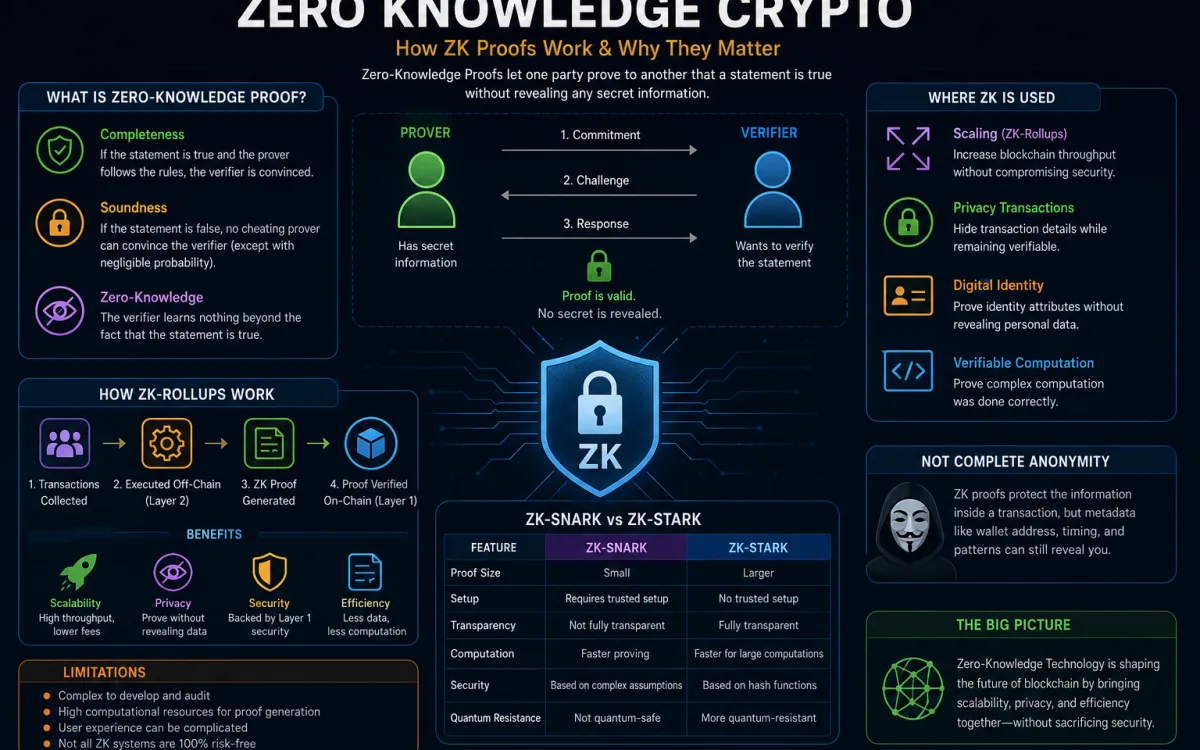
- Zero-knowledge crypto lets users prove that something is true without revealing the underlying secret information.
- ZK proofs use a prover and verifier to confirm claims while limiting unnecessary data disclosure.
- ZK-rollups use validity proofs to process transactions on Layer 2 and help scale blockchain networks.
- ZK-SNARKs and ZK-STARKs are different types of zero-knowledge proof systems with different design and security trade-offs.
- Zero-knowledge technology can improve privacy, but it does not automatically make crypto transactions completely anonymous.
- ZK projects still have risks, including smart-contract bugs, bridge vulnerabilities, upgrade controls, and implementation issues.
- Before using or investing in a ZK crypto project, evaluate its proof system, security model, data availability, documentation, and actual use case.
Blockchain is built around verification. The network needs to know that a transaction or computation follows the rules before it accepts the result. But there is a catch: proving something often means revealing information that you would rather keep private.
Zero knowledge crypto offers a different approach.
With a zero-knowledge proof, one party can prove that a statement is true without revealing the underlying secret information. In blockchain, this idea can support privacy, transaction verification, and Layer 2 scaling.
You do not need to understand advanced mathematics to understand the basic idea. Think of it as proving that you know the answer without showing the answer itself.
This guide explains how zero-knowledge proofs work, why they matter in crypto, how ZK-rollups help scale blockchains, and how ZK-SNARKs differ from ZK-STARKs.
What Is Zero Knowledge Crypto?
Zero knowledge crypto refers to the use of zero-knowledge proof technology in cryptocurrency and blockchain applications.
A zero-knowledge system allows a prover to convince a verifier that a particular statement is true without revealing the secret information behind that statement.
For example, imagine you want to prove that you know the password to an account. Instead of giving the password to another person, you use a method that lets them verify your knowledge without learning the password.
That example captures the basic idea behind zero-knowledge proofs.
In crypto, the technology can become much more sophisticated. A protocol can use a proof to show that a group of transactions was processed according to specific rules without requiring the blockchain to repeat every part of the computation.
This makes zero-knowledge technology useful for two major goals:
- Privacy: prove selected facts without exposing unnecessary information.
- Scalability: verify complex computations more efficiently.
What Is a Zero-Knowledge Proof?
A zero-knowledge proof, or ZK proof, is a cryptographic method that lets someone prove a statement without revealing the secret information used to prove it.
A secure zero-knowledge proof system generally aims to provide three properties.
Completeness
When a statement is true and the prover follows the protocol correctly, the verifier should accept the proof.
Soundness
A prover should not be able to convince the verifier that a false statement is true, except with a negligible probability under the system’s security assumptions.
Zero-Knowledge
The verifier should not learn the secret information itself from the proof.
These properties allow blockchain applications to separate verification from unnecessary disclosure.
That distinction matters because public blockchains normally make transaction data widely available.
How Does a Zero-Knowledge Proof Work?
The exact mathematics behind ZK proofs can become extremely complex, but the basic process is easier to understand.
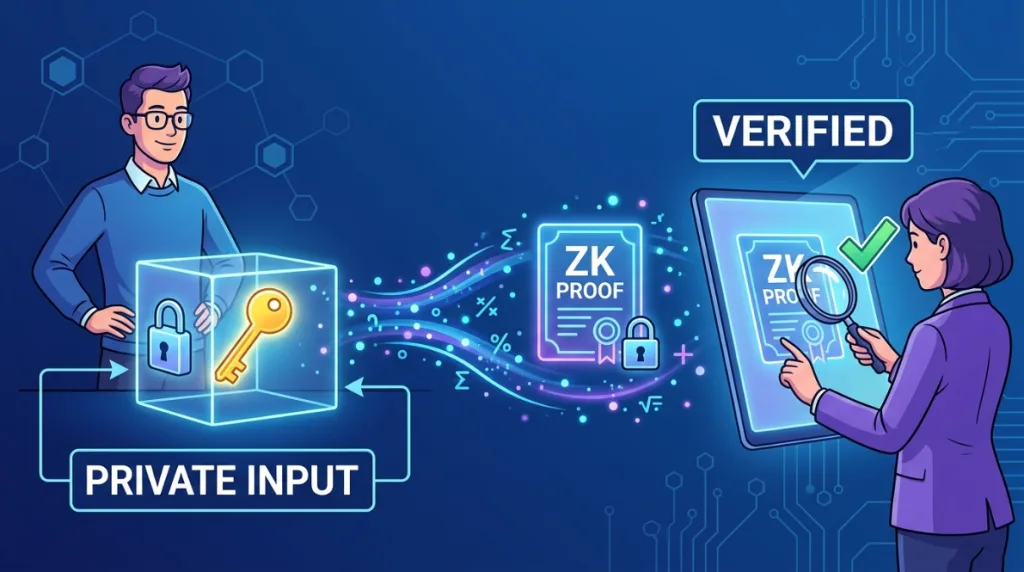
A typical system involves two roles:
Prover: creates evidence that a statement is valid.
Verifier: checks whether the evidence satisfies the required conditions.
The prover starts with information that may contain a secret or private input. The system then generates a cryptographic proof.
The verifier checks the proof using the protocol’s verification rules.
If the proof passes, the verifier accepts the statement without receiving the underlying secret.
A simplified example looks like this:
Private information → Computation → ZK proof → Verification
The important point is that the verifier does not need to receive every piece of information that the prover used.
Modern systems can use this concept to prove that complicated computations followed predefined rules.
Why Does Zero Knowledge Matter in Crypto?
Public blockchains provide transparency, which is one of their biggest strengths. Anyone can inspect much of the activity recorded on a public network.
However, transparency also creates challenges.
Wallet activity can reveal transaction histories, balances, timing patterns, and relationships between addresses. Applications may also need to verify information without exposing everything behind that information.
Zero-knowledge proofs provide another option.
A blockchain application can potentially prove a specific claim while keeping unrelated information hidden.
The technology also has an important role in scaling. Instead of making a base blockchain perform every computation itself, a Layer 2 system can process transactions elsewhere and provide a cryptographic proof that demonstrates the validity of the resulting state.
That is why zero-knowledge technology has become an important part of the broader blockchain scaling conversation.
What Are ZK-Rollups?
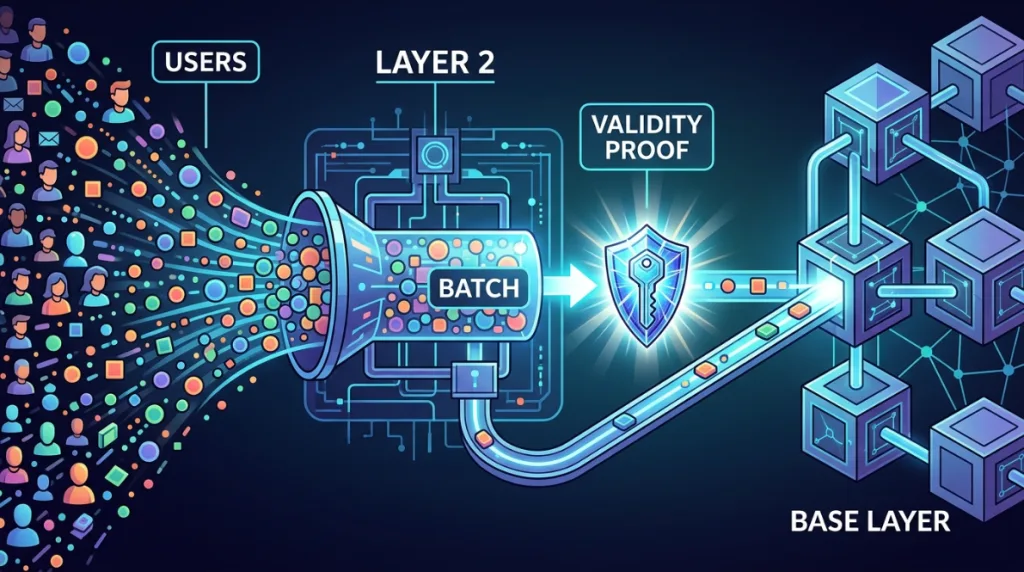
A ZK-rollup is a Layer 2 scaling technology that processes transactions outside the Ethereum mainnet and uses cryptographic validity proofs to demonstrate that the resulting state transition follows the protocol’s rules.
Instead of submitting every execution detail for the base layer to process again, the rollup can batch transactions and generate a proof.
A simplified workflow looks like this:
User transactions → Layer 2 execution → Transaction batch → Validity proof → Ethereum verification
The base blockchain still plays an important role. It verifies the proof according to the rollup’s smart-contract rules.
This design can reduce the amount of computation that the base layer needs to perform directly.
However, ZK-rollups are not magic. They still involve costs, infrastructure requirements, smart contracts, data availability considerations, and other technical trade-offs.
How Do ZK-Rollups Help Scale Ethereum?
Ethereum has limited block space. If too many users compete for that space, transaction costs can increase.
Layer 2 networks try to handle more activity without requiring every transaction to execute directly on Ethereum’s base layer.
A ZK-rollup can execute a batch of transactions on Layer 2 and produce a validity proof for the resulting state.
Ethereum can then verify that proof.
This creates a useful separation:
Layer 2 handles more execution.
The base layer verifies the resulting proof.
The exact performance benefits depend on the specific rollup design, proof system, data availability model, and network conditions.
ZK-SNARK vs ZK-STARK
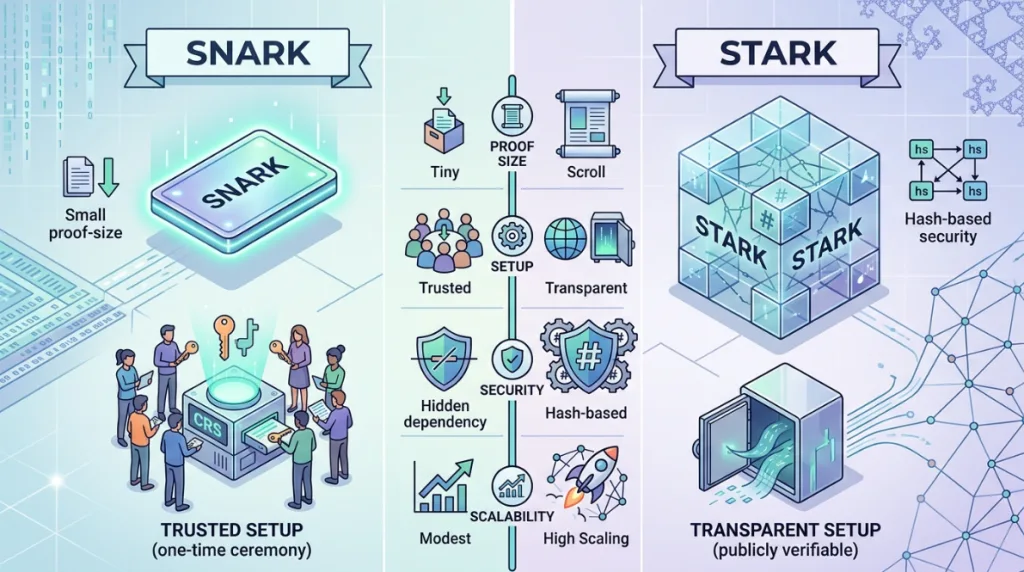
You will often see two terms when researching zero-knowledge crypto: ZK-SNARK and ZK-STARK.
Both describe families of zero-knowledge proof systems, but they use different cryptographic constructions.
| Feature | ZK-SNARK | ZK-STARK |
|---|---|---|
| Proof size | Generally compact | Generally larger |
| Verification | Designed for efficient verification | Designed for efficient verification |
| Trusted setup | Some constructions require one | Does not use a trusted setup in the same way |
| Transparency | Depends on the construction | Strong transparency properties |
| Cryptographic assumptions | Vary by construction | Primarily hash-based assumptions in common constructions |
| Quantum considerations | Depends on the cryptography used | Common constructions use assumptions viewed as more resistant to known quantum attacks |
There is no universal winner.
A developer may prefer one system because of proof size, proving speed, verification cost, setup requirements, hardware needs, or the application’s security model.
So when you compare SNARKs and STARKs, look beyond a simple “which is better?” question.
What Are ZK-SNARKs?
ZK-SNARK stands for Zero-Knowledge Succinct Non-Interactive Argument of Knowledge.
The important idea is that SNARK systems can produce relatively compact proofs that a verifier can check efficiently.
Some SNARK constructions use a trusted setup. In those systems, participants generate public parameters before the protocol becomes operational.
The security implications depend on the specific construction and how the setup works.
Modern SNARK systems use several different cryptographic approaches, so you should not treat every SNARK protocol as identical.
What Are ZK-STARKs?
ZK-STARK stands for Zero-Knowledge Scalable Transparent Argument of Knowledge.
STARK constructions are designed around transparency and generally avoid the trusted setup model used by some SNARK systems.
Many STARK constructions rely heavily on hash-based cryptographic assumptions. This gives them different security and performance characteristics from many SNARK designs.
STARK proofs can be larger than SNARK proofs, but their design can offer advantages for certain large-scale computational workloads.
Again, the best choice depends on the application.
What Are the Main Benefits of Zero Knowledge Crypto?
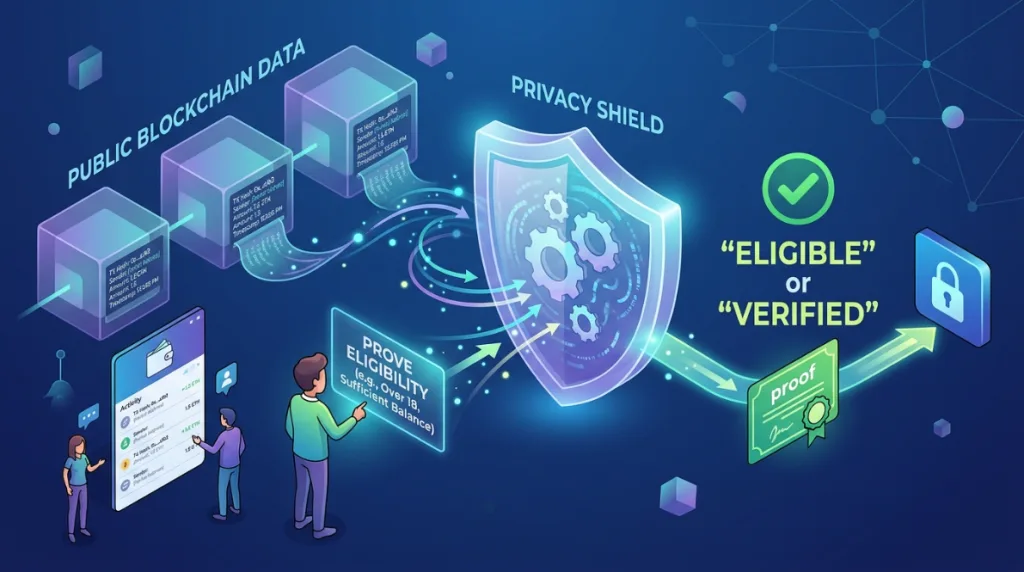
Zero-knowledge technology can provide several important benefits.
Privacy
A system can prove selected facts without exposing the underlying secret data.
For example, an application could potentially verify that a user satisfies a particular condition without revealing every piece of information used to establish that condition.
Scalability
ZK-based Layer 2 systems can execute transactions away from the base layer and use validity proofs to verify the resulting state.
Efficient Verification
Instead of repeating an entire computation, a verifier can check a cryptographic proof that represents the validity of the computation.
Selective Disclosure
Zero-knowledge techniques can help applications reveal only the information necessary for a particular verification task.
Verifiable Computation
A party can perform computation and provide evidence that the result follows the required rules.
These benefits make ZK technology useful beyond cryptocurrency transfers.
Where Is Zero-Knowledge Technology Used?
Zero-knowledge proofs can support several areas of blockchain development.
Layer 2 Networks
ZK-rollups use validity proofs to support Ethereum scaling.
Privacy Applications
Some blockchain systems use zero-knowledge techniques to reduce unnecessary disclosure of transaction information.
Digital Identity
ZK systems can potentially let users prove specific attributes without revealing an entire identity record.
For example, a user might prove that they satisfy an eligibility requirement without sharing unrelated personal information.
Private Credentials
A user could prove possession of a valid credential without exposing the complete credential.
Verifiable Computation
ZK proofs can demonstrate that a computation produced an acceptable result without forcing the verifier to reproduce the entire process.
Decentralized Applications
Developers can integrate ZK technology into applications that need both verification and controlled information disclosure.
The practical privacy and security properties vary significantly between projects.
Does Zero Knowledge Make Crypto Anonymous?
No.
This is an important distinction.
Zero-knowledge technology can improve privacy, but using a ZK proof does not automatically make an entire blockchain transaction anonymous.
Other information can still reveal activity.
For example:
- Wallet addresses may remain public.
- Transaction timing can reveal patterns.
- Smart-contract interactions can remain visible.
- Network metadata can expose information.
- Centralized exchanges may collect identity information.
- Applications can create their own data trails.
Therefore, you should evaluate the complete privacy architecture instead of assuming that a project becomes anonymous simply because it uses ZK technology.
Is Zero Knowledge Crypto Safe?
Zero-knowledge proofs can provide strong cryptographic guarantees when developers use appropriate constructions and implement them correctly.
But ZK does not eliminate every security risk.
A project can still contain vulnerabilities in:
- Smart contracts
- Bridges
- Wallet software
- Proof-generation systems
- Upgrade mechanisms
- Sequencers
- Data availability infrastructure
- Application code
You should also examine the project’s cryptographic assumptions and security model.
An independent audit can provide useful information, but an audit does not guarantee that a protocol will never suffer an exploit.
For users, the safest approach is to evaluate the complete system rather than treating “zero knowledge” as a security certificate.
What Are the Limitations of Zero-Knowledge Proofs?
ZK technology has significant potential, but it also comes with trade-offs.
Complex Development
Zero-knowledge systems require specialized cryptographic and engineering knowledge.
Proof Generation Costs
Generating a proof can require substantial computing resources, particularly for complicated computations.
Development Tooling
ZK development has improved considerably, but building and debugging ZK applications can still be more complicated than building conventional blockchain applications.
Implementation Risks
A strong cryptographic design cannot protect a project from every software bug.
Setup Requirements
Some proof systems require additional setup procedures that developers and users must understand.
User Experience
Bridges, Layer 2 networks, wallets, and unfamiliar transaction flows can make ZK applications confusing for beginners.
These limitations do not make the technology ineffective. They simply show why the underlying implementation matters.
Zero Knowledge Crypto vs Traditional Blockchain Verification
The easiest way to understand the difference is to think about what the verifier needs to check.
With a traditional approach, the blockchain may need to process or verify transaction information directly.
With a ZK-based approach, another system can perform a computation and submit a proof showing that the computation followed the required rules.
| Traditional Approach | ZK-Based Approach |
|---|---|
| More computation may happen directly on the base layer | Some computation can happen outside the base layer |
| Verification may require more transaction-level information | A proof can verify a larger computation |
| Privacy depends on the application’s design | ZK techniques can enable selective disclosure |
| Scaling requires other architectural approaches | ZK-rollups can support Layer 2 scaling |
This comparison does not mean ZK technology replaces traditional verification. Both approaches have different use cases and trade-offs.
Is Zero Knowledge the Future of Blockchain?
Zero-knowledge technology could play a major role in the next stage of blockchain development.
Scaling remains one of the biggest challenges for public blockchain networks. At the same time, users increasingly want better control over personal and financial information.
ZK proofs address both problems from a different angle.
They can help systems verify computation without requiring the verifier to receive every intermediate detail. They can also support applications that need to prove specific facts without revealing unnecessary information.
Future applications could extend beyond transaction scaling into areas such as identity, private credentials, verifiable computation, and cross-system verification.
But adoption will depend on practical factors such as proving costs, hardware requirements, developer tooling, security, interoperability, and user experience.
How to Evaluate a ZK Crypto Project
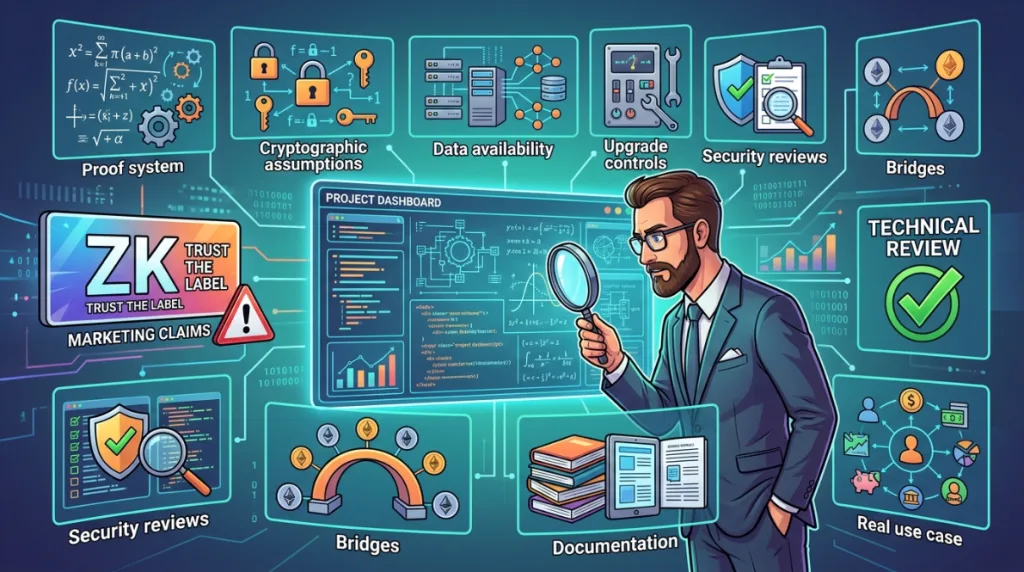
If you are considering a cryptocurrency or blockchain project that uses zero-knowledge technology, do not stop at its marketing claims.
Look at:
- What problem does the ZK technology solve?
- Which proof system does the project use?
- What cryptographic assumptions does it rely on?
- How does the network handle data availability?
- Who controls upgrades and emergency functions?
- Has the code received independent security reviews?
- How does the project handle bridges and external dependencies?
- Can you understand the project’s documentation and trust model?
These questions can help you separate genuine technical use cases from projects that simply use “ZK” as a marketing term.
Frequently Asked Questions About Zero Knowledge Crypto
What does zero knowledge mean in crypto?
Zero knowledge means proving that a statement is true without revealing the underlying secret information used to establish that statement.
What is a zero-knowledge proof in blockchain?
It is a cryptographic proof that allows a blockchain application or network to verify a statement without requiring the prover to reveal the underlying private information.
What is a ZK-rollup?
A ZK-rollup is a Layer 2 system that processes transactions outside the base blockchain and uses validity proofs to demonstrate that the resulting state follows the required rules.
What is the difference between ZK-SNARK and ZK-STARK?
Both are zero-knowledge proof technologies, but they use different cryptographic constructions. SNARKs can offer compact proofs, while STARKs emphasize transparency and avoid trusted setup in the same way as many SNARK constructions.
Does zero knowledge mean complete privacy?
No. A ZK proof can protect specific information, but addresses, transaction patterns, metadata, exchanges, and applications may still expose information.
Are ZK-rollups safe?
ZK-rollups can use strong cryptographic verification, but their overall security depends on their smart contracts, proof system, data availability model, upgrade controls, and implementation.
Why are zero-knowledge proofs important?
They can help blockchain systems verify information while reducing unnecessary disclosure and can support scaling solutions that move computation away from a base blockchain.
Final Thoughts
Zero knowledge crypto is not simply another cryptocurrency trend. It represents a different way of thinking about blockchain verification.
Instead of revealing all the information needed to prove a claim, a zero-knowledge system can provide cryptographic evidence that the claim is valid.
That idea has two particularly important applications: privacy and scalability.
ZK-rollups show how the technology can support Layer 2 networks, while other ZK applications demonstrate how users can prove selected facts without exposing unnecessary information.
The technology remains complex, and no ZK project is automatically secure or private just because it uses zero-knowledge proofs. Understanding the proof system, architecture, security model, and actual use case is essential.
For beginners, the simplest definition to remember is:
Zero-knowledge proofs let you prove something is true without revealing the secret behind the proof.



Leave a Reply