

In this article
- Quick Answer: Schedule C vs. Schedule 1
- Is Crypto Mining Income Taxable?
- When Does Crypto Mining Go on Schedule C?
- When Does Schedule 1 Apply?
- What About Hobby Mining?
- Are Crypto Mining Expenses Deductible?
- Does Schedule C Mean You Pay Self-Employment Tax?
- What Happens When You Sell Mined Crypto?
- What If You Keep the Mined Crypto?
- What Records Should Crypto Miners Keep?
- Common Crypto Mining Tax Mistakes
- Schedule C vs. Schedule 1: Two Simple Examples
- What If You Do Not Receive a 1099?
- Frequently Asked Questions
- Final Takeaway
If you mine cryptocurrency in the United States, you may have to report the value of the digital assets you receive as taxable income. But one important question comes first: Should your crypto mining income be reported on Schedule C or Schedule 1?
The answer depends largely on whether your mining activity is operated as a trade or business or is a non-business activity.
This distinction matters because business income may be reported on Schedule C and may be subject to self-employment tax, while non-business ordinary income from activities such as mining is generally reported on Schedule 1.
Quick Answer: Schedule C vs. Schedule 1
| Mining situation | General federal reporting |
|---|---|
| Mining operated as a trade or business | Schedule C |
| Non-business mining income | Schedule 1 |
| Later sale of mined crypto held as a capital asset | Form 8949 and Schedule D |
| Crypto received as employee wages | Form 1040 wage reporting |
| Crypto received for independent-contractor services | Schedule C |
The correct form depends on the facts of your activity, not simply on how much cryptocurrency you mine.
Is Crypto Mining Income Taxable?
Generally, yes.
When you receive cryptocurrency through mining, the fair market value of the digital asset, measured in U.S. dollars at the relevant time, can be included in your taxable income.

The IRS’s digital-asset guidance specifically identifies mining as an activity that can produce ordinary income. The IRS also says that determining the basis of digital assets requires information such as the type of asset, acquisition date and time, number of units, and fair market value when acquired.
For example, suppose you receive 0.01 BTC from mining when its fair market value is $500.
That $500 may be included in your income for the year, depending on the applicable facts and tax treatment.
If you later sell the Bitcoin for $700, the later sale is a separate tax event. Assuming the Bitcoin is held as a capital asset, the difference between your adjusted basis and the amount realized may result in a capital gain or loss.
When Does Crypto Mining Go on Schedule C?
Schedule C is generally used when you operate a trade or business as a sole proprietor.
The IRS says an activity qualifies as a business when the primary purpose is to earn income or profit and the taxpayer is involved in the activity with continuity and regularity. A sporadic activity, hobby, or activity that is not operated for profit does not qualify as a Schedule C business.
A mining operation may be more likely to qualify as a business when you:
- Mine regularly throughout the year
- Have a genuine profit motive
- Maintain detailed books and records
- Track revenue and expenses
- Invest in and manage mining equipment
- Monitor profitability
- Make ongoing efforts to improve the operation
- Treat the activity in a businesslike manner
No single factor automatically determines business status. Your overall facts and circumstances matter.
Example: Mining as a Business
Suppose Sarah operates several mining machines throughout the year.
She pays electricity bills, maintains equipment, records mining rewards, tracks expenses, monitors profitability, and makes decisions specifically intended to earn a profit.
If the activity qualifies as a trade or business, she may generally report the business income and allowable business expenses on Schedule C.
The net earnings may also be subject to self-employment tax under the applicable rules.
When Does Schedule 1 Apply?
If your mining activity is not a trade or business, the resulting non-business ordinary income is generally reported on Schedule 1.
The IRS currently states that non-business ordinary income from digital assets, including income related to mining, can be reported on Form 1040, Schedule 1.
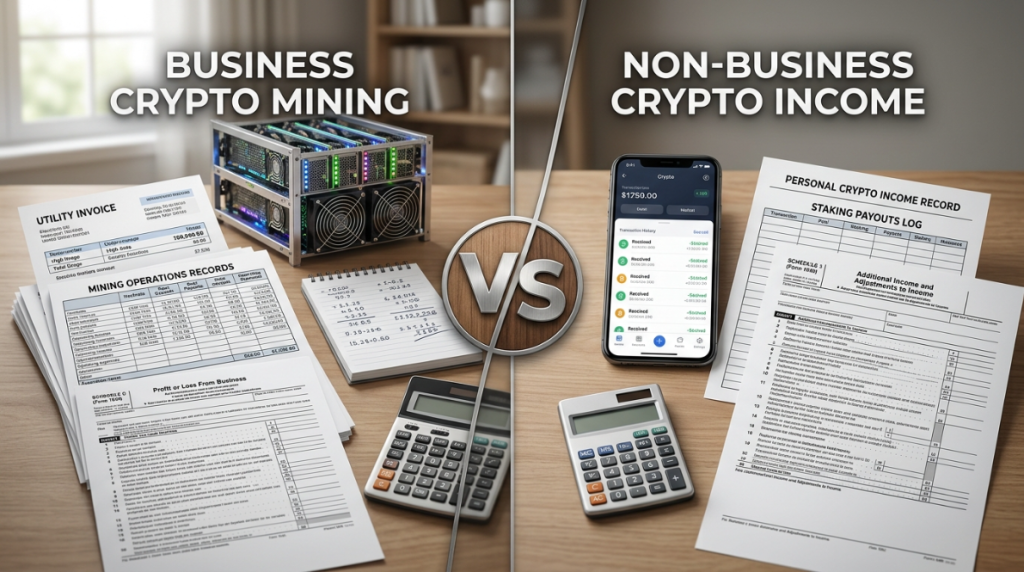
For example, imagine you occasionally participate in mining but do not operate the activity as a profit-oriented business.
If you receive $600 worth of cryptocurrency from that activity, the income may generally be treated as non-business ordinary income and reported on Schedule 1.
Important Point
Do not choose Schedule 1 simply because your mining operation is small.
Likewise, do not choose Schedule C simply because you want to deduct expenses.
The classification should reflect the actual nature of your activity.
What About Hobby Mining?
Calling an activity a “hobby” does not make its income tax-free.
The IRS says income from an activity carried on without a profit motive must still be reported. The Taxpayer Advocate Service explains that hobby income is generally reported on Schedule 1, Form 1040, line 8j.
The difference between a hobby and a business is therefore important.
A business generally has a profit motive and is conducted with continuity and regularity. A hobby is generally pursued for pleasure, recreation, or another non-profit purpose.
Factors that can support business treatment include:
- Operating in a businesslike manner
- Keeping accurate books and records
- Investing significant time and effort
- Having a genuine intention to make a profit
- Depending on the activity’s income
- Having a history of profits
These factors are considered based on the overall circumstances rather than one single test.
Are Crypto Mining Expenses Deductible?
If your mining operation qualifies as a business, certain ordinary and necessary business expenses may be deductible under the applicable tax rules.

Potential examples can include:
- Electricity used for the mining operation
- Repairs and maintenance
- Certain software or monitoring costs
- Business-use portion of internet or networking expenses
- Equipment-related costs
- Other qualifying operating expenses
However, you should not automatically deduct every expense connected with mining.
For example, if a computer is used 70% for mining and 30% for personal activities, the entire cost should not automatically be treated as a business expense.
Equipment may also require depreciation or another applicable tax treatment rather than being deducted entirely as a current expense. The appropriate treatment depends on the asset and the circumstances.
The IRS Schedule C instructions provide rules for reporting business income and expenses and point taxpayers to Form 4562 for depreciation and certain other property-related deductions.
Does Schedule C Mean You Pay Self-Employment Tax?
Potentially.
If your mining activity is a trade or business and produces net earnings from self-employment, self-employment tax may apply.
The IRS says sole proprietors report business income and expenses on Schedule C and use Schedule SE when applicable to calculate self-employment tax. For a sole proprietor, the IRS states that Schedule SE is generally required when total net earnings from self-employment are $400 or more, subject to the applicable rules and exceptions.
Therefore, Schedule C treatment can have consequences beyond ordinary income tax.
It is important not to classify mining as a business solely because the result appears more favorable. The classification should be based on the actual facts.
What Happens When You Sell Mined Crypto?
Mining income and the later sale of mined cryptocurrency are generally separate tax events.

Consider this example:
Value when mined: $1,000
Value when later sold: $1,400
The initial $1,000 may represent ordinary income when the cryptocurrency is received.
If the cryptocurrency is later held as a capital asset and sold for $1,400, the additional $400 may generally be a capital gain.
The holding period can also affect whether the gain is short-term or long-term.
The IRS says individuals generally report applicable capital transactions involving digital assets on Form 8949 and summarize the resulting capital gains or losses on Schedule D.
What If You Keep the Mined Crypto?
You do not necessarily avoid the initial income tax simply by holding the cryptocurrency.
If the mining reward creates taxable income when received, the fact that you continue holding the crypto does not automatically eliminate that income.
For this reason, miners should record the value of the cryptocurrency at the time it is acquired.
That value can also be important later when calculating gain or loss from a sale or other taxable disposition. The IRS recommends keeping acquisition information such as the date, time, quantity and fair market value.
What Records Should Crypto Miners Keep?
Good records are essential because cryptocurrency values can change quickly.
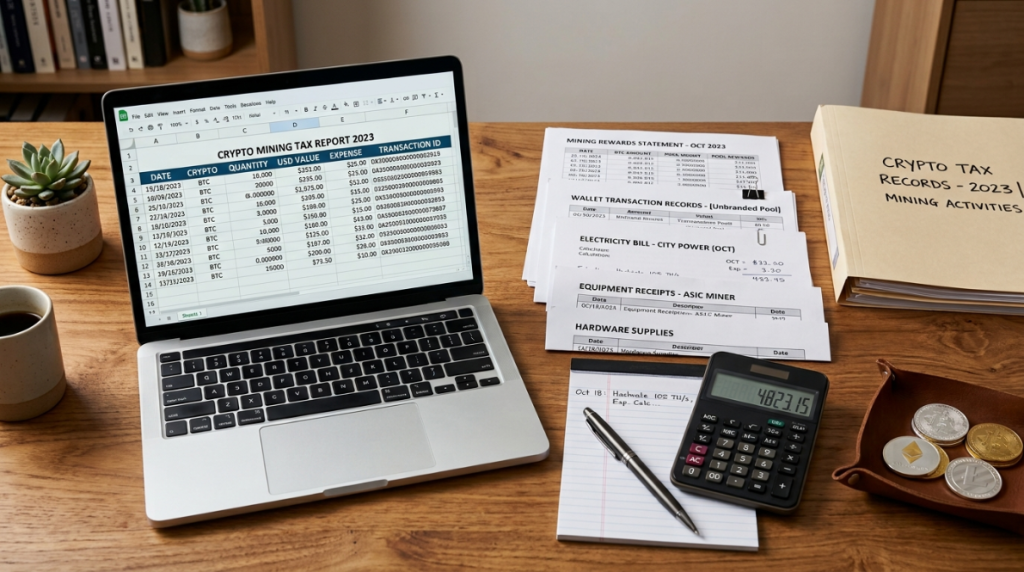
Keep records of:
- Mining rewards — date, time, asset and quantity.
- Fair market value — U.S.-dollar value when acquired.
- Wallet information — relevant transaction IDs and records.
- Mining expenses — electricity, repairs, software and other qualifying costs.
- Equipment — purchase price, purchase date and business-use information.
- Crypto sales — sale date, proceeds and transaction costs.
- Exchange records — statements and transaction histories.
- Business records — if the mining activity is operated as a business.
The IRS specifically identifies the asset type, acquisition date and time, quantity and fair market value as important information for determining digital-asset basis.
Common Crypto Mining Tax Mistakes
Mistake 1: Reporting Income Only When You Sell
Mining can create taxable income before you sell the cryptocurrency.
The later sale can create a separate taxable event.
Mistake 2: Automatically Using Schedule C
Not every mining activity is a trade or business.
Schedule C is generally for a business operated as a sole proprietorship, so the activity must meet the relevant business requirements.
Mistake 3: Automatically Using Schedule 1
The opposite mistake is assuming that every small mining activity belongs on Schedule 1.
A genuine profit-oriented mining business may qualify for Schedule C treatment.
Mistake 4: Ignoring Self-Employment Tax
If your mining activity qualifies as a trade or business and produces net earnings from self-employment, self-employment tax may apply.
Mistake 5: Losing Your Cost Basis Records
Without records showing when and how much crypto you received and its value at acquisition, calculating a later gain or loss can become difficult.
Mistake 6: Deducting Personal Expenses
Mining-related does not automatically mean business-deductible.
Expenses should be evaluated under the applicable tax rules and allocated appropriately when they have both business and personal use.
Schedule C vs. Schedule 1: Two Simple Examples
Example 1: Regular Mining Business
John operates multiple mining machines throughout the year.
He maintains financial records, pays electricity costs, monitors profitability, maintains equipment and actively tries to generate a profit.
If his activity qualifies as a trade or business, he may generally report the business activity on Schedule C.
If the resulting income is subject to self-employment tax, Schedule SE may also be required.
Example 2: Non-Business Mining Activity
Lisa mines cryptocurrency occasionally and does not operate the activity as a profit-oriented business.
If the activity is not a trade or business, the resulting non-business ordinary income generally belongs on Schedule 1.
The important point is that the classification depends on the facts surrounding the activity—not simply the amount of crypto received.
What If You Do Not Receive a 1099?
You still may have a reporting obligation.
The IRS states that taxpayers must report income, gain, or loss from taxable digital-asset transactions regardless of whether they receive a payee statement or information return such as a Form 1099.
Therefore, miners should maintain their own transaction records instead of relying entirely on tax forms issued by exchanges or other platforms.
Frequently Asked Questions
Is crypto mining income reported on Schedule C or Schedule 1?
It depends on the activity. If the mining operation qualifies as a trade or business, Schedule C may apply. If it is non-business ordinary income, Schedule 1 generally applies.
Is crypto mining considered self-employment?
It can be when the mining activity is operated as a trade or business and generates net earnings from self-employment. In that situation, self-employment tax rules may apply.
Is hobby mining taxable?
Yes. Hobby income is generally taxable and is generally reported on Schedule 1.
Do I owe tax if I keep my mined Bitcoin?
Potentially, yes. Mining can create taxable income when the cryptocurrency is received, so holding the asset does not necessarily eliminate the initial tax obligation.
What happens when I later sell mined crypto?
If the cryptocurrency is held as a capital asset, the later sale may produce a capital gain or loss. Applicable transactions are generally reported using Form 8949 and Schedule D.
Can I deduct electricity used for crypto mining?
If the mining activity qualifies as a business, electricity and other qualifying expenses may be deductible under the applicable rules. Personal-use portions and other non-deductible costs should not simply be treated as business expenses.
Final Takeaway
The key question is not simply how much cryptocurrency you mined. The key question is how you operated the mining activity.
If you operate mining as a genuine trade or business with a profit motive and continuity, Schedule C may be the appropriate reporting form, with Schedule SE potentially applying to qualifying net self-employment earnings.
If the mining activity is not a trade or business, the resulting non-business ordinary income generally goes on Schedule 1.
The tax process does not necessarily end when you receive the mining reward. If you later sell, exchange, or otherwise dispose of the cryptocurrency, that transaction may create a separate taxable gain or loss.
For significant mining operations, large equipment purchases, mixed personal/business expenses, or complicated crypto transactions, consulting a qualified U.S. tax professional can help you apply the rules correctly.
Note: This article covers general U.S. federal tax principles and is not individualized tax advice. Tax forms and IRS guidance can change, so verify the rules for the tax year you are filing.


Leave a Reply