

In this article
- What Is a Stablecoin?
- Best Stablecoins in 2026
- 1. USDT – Best for Trading
- 2. USDC – Best for General Use
- 3. DAI – Best for DeFi
- 4. USDS – Best for the Sky Ecosystem
- 5. PYUSD – Best for PayPal Users
- 6. EURC – Best for Euro Exposure
- 7. RLUSD – Best for Payment Use Cases
- 8. USDe – Best for Advanced DeFi Users
- USDT vs USDC: Which Is Better?
- Are Stablecoins Safe?
- How to Choose the Best Stablecoin
- Stablecoins vs Bitcoin
- Are Stablecoins Good for Savings?
- How to Buy Stablecoins
- Common Stablecoin Mistakes
- Frequently Asked Questions
- Final Thoughts
🔑 Key Takeaways
- Stablecoins are crypto assets designed to maintain a relatively stable value, usually around $1.
- USDT is a strong choice for trading because of its high liquidity and broad market adoption.
- USDC is popular for general crypto use, payments, and DeFi, with a strong focus on transparency and compliance.
- DAI and USDS are useful for users interested in decentralized finance.
- PYUSD is connected to the PayPal ecosystem, while EURC is designed for euro-denominated use.
- RLUSD focuses on payment and settlement use cases.
- USDe uses a different synthetic-dollar model and is better suited to experienced DeFi users.
- Stablecoins can still face de-pegging, issuer, reserve, liquidity, regulatory, smart-contract, and network risks.
- The best stablecoin depends on your purpose, risk tolerance, location, liquidity needs, and preferred blockchain network.
- Stable does not mean risk-free, so always research the asset before buying or transferring it.
If you use cryptocurrency, you have probably come across stablecoins.
Unlike Bitcoin and other highly volatile cryptocurrencies, stablecoins are designed to keep their value relatively stable. Most of them aim to stay close to the U.S. dollar.
That makes stablecoins useful for trading, sending money, using DeFi apps, and moving funds between crypto platforms.
But which one should you use?
There is no single answer. The best stablecoins have different strengths. Some are popular because of their liquidity. Others focus on transparency, decentralization, payments, or DeFi.
In this guide, we will compare the leading options and explain what each one is best suited for.
Note: Stablecoins are not risk-free. Their prices can move away from the intended peg, and users can face issuer, reserve, liquidity, regulatory, smart-contract, and network risks.
What Is a Stablecoin?
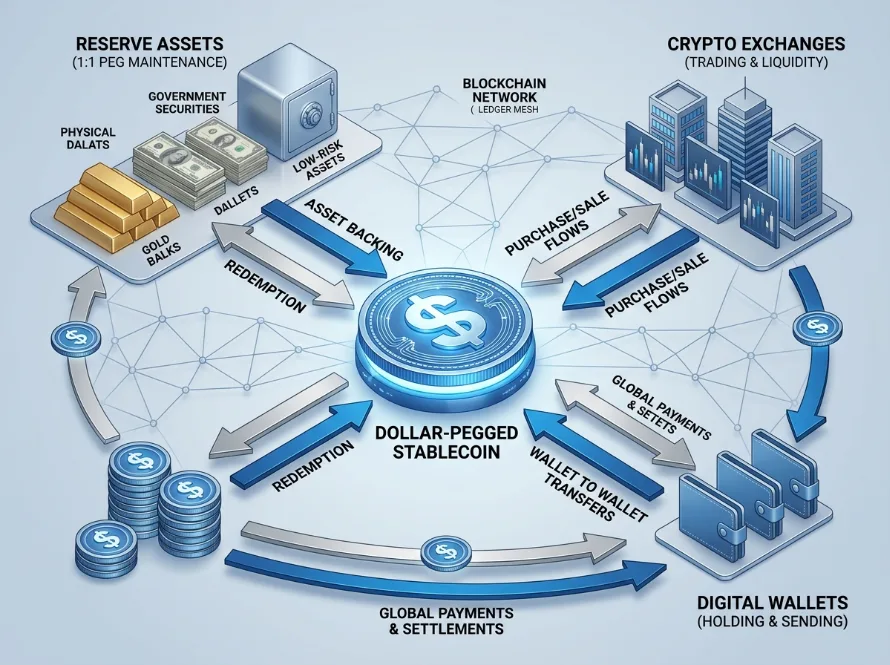
A stablecoin is a cryptocurrency designed to track the value of another asset.
The most common type is a dollar-pegged stablecoin. It aims to stay close to $1.
For example, if you hold 100 USDC, the goal is for those tokens to have a value close to $100.
Stablecoins are popular because they combine some benefits of cryptocurrency with a more stable price.
You can use them to:
- Trade crypto
- Send digital payments
- Transfer funds between exchanges
- Use DeFi applications
- Move money across blockchain networks
- Hold dollar-denominated value within a crypto ecosystem
However, a stablecoin can still move above or below its target price.
Best Stablecoins in 2026

Several stablecoins stand out because of their adoption, liquidity, technology, or specific use cases.
Here is a quick comparison:
| Stablecoin | Best For | Type |
|---|---|---|
| USDT | Trading and liquidity | Reserve-backed |
| USDC | General use and transparency | Reserve-backed |
| DAI | Decentralized finance | Crypto-collateralized |
| USDS | Sky ecosystem | Protocol-based |
| PYUSD | Digital payments | Reserve-backed |
| EURC | Euro transactions | Euro-backed |
| RLUSD | Payments and settlement | Reserve-backed |
| USDe | Advanced DeFi | Synthetic dollar |
Now let’s look at each one more closely.
1. USDT – Best for Trading
USDT, issued by Tether, is one of the most widely used stablecoins in the crypto market.
Its biggest advantage is liquidity.
You can find USDT on many major crypto exchanges and blockchain networks. It is also available in a large number of trading pairs.
For active traders, that can make a big difference.
Why choose USDT?
USDT can be useful if you want to:
- Trade cryptocurrencies
- Move funds between exchanges
- Access many trading pairs
- Transfer dollar-denominated value
- Use certain DeFi platforms
However, USDT is not risk-free.
Before using it, consider Tether’s reserve information, redemption arrangements, regulatory environment, and the risks of the network you use.
Best for: Active traders and users who value deep crypto-market liquidity.
2. USDC – Best for General Use
USDC is a dollar-denominated stablecoin issued by Circle.
It has become widely used across crypto exchanges, wallets, payment services, and DeFi applications.
One reason people choose USDC is its focus on reserve transparency and compliance.
It is also supported across several blockchain networks.
Why choose USDC?
USDC can be a good fit if you want to:
- Hold dollar-denominated crypto
- Use DeFi applications
- Make digital payments
- Transfer funds
- Trade cryptocurrencies
That said, USDC is not the same as a traditional bank deposit.
It still has issuer, reserve, regulatory, custody, and blockchain risks.
Best for: General crypto users, payments, and DeFi.
3. DAI – Best for DeFi
DAI takes a different approach from USDT and USDC.
It is a decentralized, dollar-targeted stablecoin associated with the Maker/Sky ecosystem. Its stability has historically relied on collateral and smart-contract-based mechanisms.
This makes DAI especially important in decentralized finance.
You can find DAI in many DeFi applications for lending, borrowing, liquidity, and collateral.
Why choose DAI?
DAI may appeal to you if you value:
- Decentralized infrastructure
- On-chain collateral
- DeFi applications
- Smart-contract-based systems
However, this model is more complex.
Users should understand smart-contract, collateral, governance, and oracle risks before using DAI in advanced DeFi strategies.
Best for: Experienced DeFi users.
4. USDS – Best for the Sky Ecosystem
USDS is part of the Sky ecosystem, which evolved from the Maker ecosystem.
It is designed for use within Sky’s decentralized finance infrastructure.
If you already use Sky products or understand DeFi protocols, USDS may be worth considering.
However, beginners should first learn how the ecosystem works.
Why consider USDS?
USDS can be useful for:
- DeFi applications
- On-chain transactions
- Sky ecosystem activities
- Decentralized financial strategies
Best for: Users who are familiar with the Sky ecosystem and DeFi.
5. PYUSD – Best for PayPal Users
PYUSD, or PayPal USD, is a dollar-denominated stablecoin associated with PayPal and issued by Paxos.
Its main advantage is its connection to the PayPal ecosystem.
That makes it interesting for people who are already familiar with PayPal and want to explore blockchain-based payments.
What can PYUSD be used for?
Depending on availability, it can support:
- Digital payments
- Crypto transactions
- Transfers
- Blockchain-based payment applications
However, availability can differ by country, platform, and service.
Best for: Users interested in PayPal-related digital payments.
6. EURC – Best for Euro Exposure
Not everyone wants to hold a dollar-based stablecoin.
If you need exposure to the euro, EURC may be a better fit.
EURC is designed to track the value of the euro. It can therefore be useful for euro-denominated transactions and crypto activities.
Why use EURC?
You might consider EURC if you want to:
- Hold euro-denominated digital value
- Make euro-based transfers
- Use euro-focused DeFi applications
- Reduce your dependence on dollar stablecoins
Best for: Users who need euro exposure.
7. RLUSD – Best for Payment Use Cases
RLUSD is a dollar-denominated stablecoin associated with Ripple.
It is designed with payment, settlement, and financial-market applications in mind.
That makes it different from stablecoins that are primarily known for crypto trading.
Potential use cases include:
- Digital payments
- Cross-border settlement
- Institutional transfers
- Liquidity management
- Blockchain-based financial services
Its long-term adoption will depend on market demand, liquidity, integrations, and regulatory developments.
Best for: Payment and settlement-focused use cases.
8. USDe – Best for Advanced DeFi Users
USDe is associated with Ethena.
It is different from traditional reserve-backed stablecoins such as USDC and USDT.
USDe is generally described as a synthetic dollar that uses crypto assets and derivatives-based hedging strategies.
That structure can provide different opportunities, but it also creates additional risks.
What makes USDe different?
USDe involves considerations such as:
- Derivatives
- Funding rates
- Counterparties
- Liquidity
- Market conditions
- Smart contracts
For that reason, it is better suited to experienced crypto users.
Best for: Advanced DeFi users who understand its underlying mechanism and risks.
USDT vs USDC: Which Is Better?
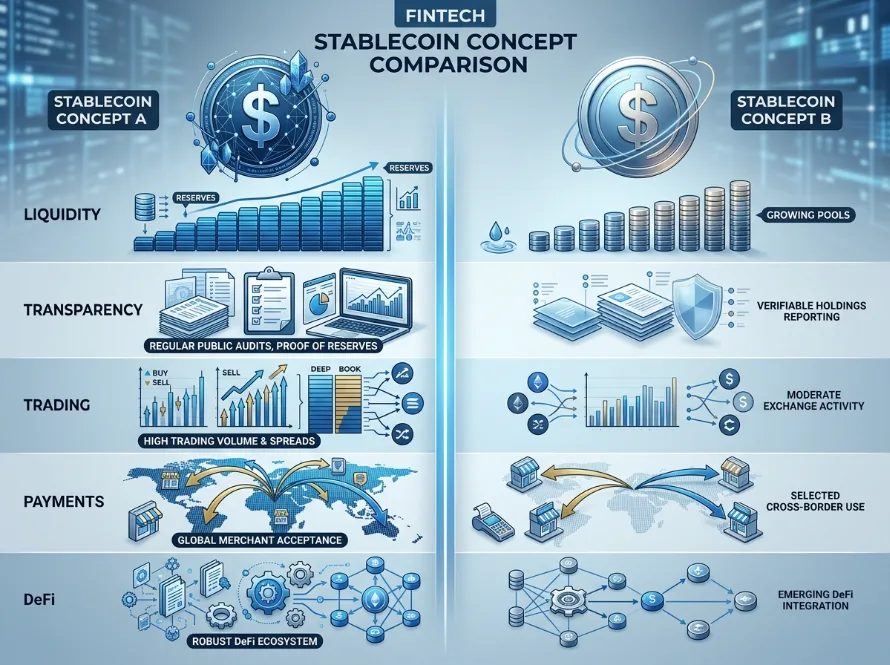
USDT and USDC are often compared because both are major dollar-denominated stablecoins.
However, they are not identical.
USDT is particularly well known for its liquidity and widespread use across crypto markets.
USDC is widely used for payments, DeFi, and institutional applications, with a strong focus on transparency and compliance.
Here’s a simple comparison:
| Feature | USDT | USDC |
|---|---|---|
| Trading liquidity | Very high | Very high |
| Exchange support | Very broad | Very broad |
| DeFi use | Extensive | Extensive |
| Main strength | Market liquidity | Transparency-focused structure |
| Main risks | Issuer, reserve, regulatory | Issuer, reserve, regulatory |
So, which should you choose?
If you mainly trade crypto, USDT may be more convenient because of its extensive liquidity and trading-pair support.
If you care more about a compliance-focused issuer and reserve transparency, USDC may be a better fit.
Neither should be considered completely risk-free.
Are Stablecoins Safe?
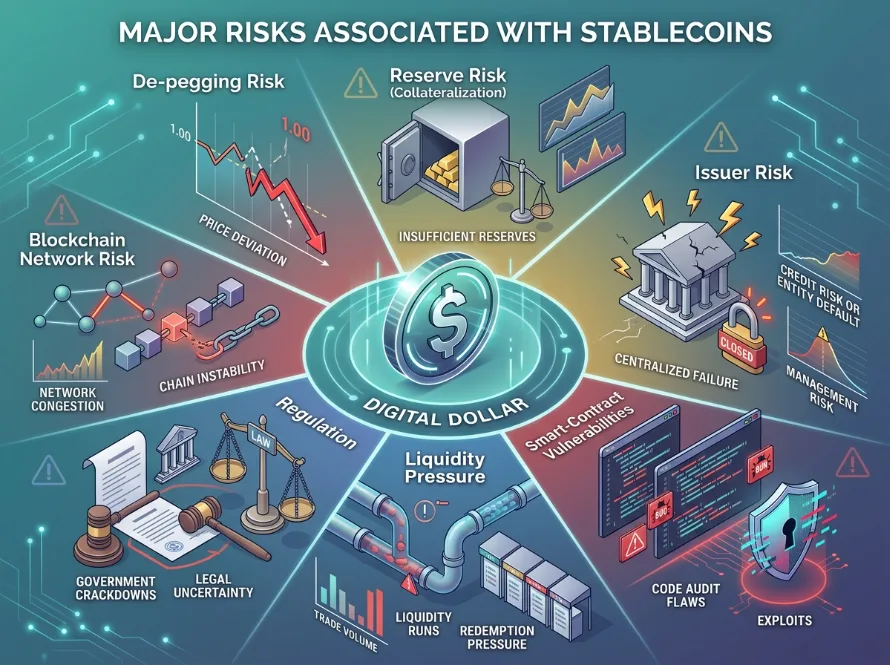
Stablecoins are usually less volatile than Bitcoin or smaller cryptocurrencies.
However, that does not make them completely safe.
There are several risks to understand.
De-Pegging Risk
A stablecoin that targets $1 can sometimes trade above or below $1.
The size and duration of the deviation depend on market conditions and the stablecoin’s design.
Reserve Risk
Reserve-backed stablecoins depend on assets held to support the tokens.
Users should check the issuer’s current reserve disclosures rather than relying on assumptions.
Issuer Risk
Some stablecoins depend on centralized companies.
Problems affecting the issuer, banking partners, custody arrangements, or operations can create risks for users.
Smart-Contract Risk
DeFi-focused stablecoins rely on software.
A smart-contract vulnerability or exploit can cause serious losses.
Regulatory Risk
Governments around the world are developing rules for stablecoins.
These rules can affect how stablecoins are issued, traded, transferred, or redeemed.
Liquidity Risk
A stablecoin may target $1 but still become difficult to trade during severe market stress.
This is why liquidity matters when choosing a stablecoin.
How to Choose the Best Stablecoin

Choosing a stablecoin becomes easier when you know what to look for.
1. Understand How It Works
First, find out what supports the stablecoin.
Is it backed by reserves?
Does it use crypto collateral?
Does it rely on derivatives or another mechanism?
The answer can change the risk profile significantly.
2. Check Liquidity
If you plan to trade frequently, liquidity should be one of your main considerations.
A liquid stablecoin is generally easier to buy and sell.
3. Check Network Support
Always check which blockchain network you are using.
For example, a stablecoin may be available on several networks, but the versions are not necessarily interchangeable.
Before sending funds, confirm:
- The receiving address
- The blockchain network
- The token
- Withdrawal requirements
- Network fees
Sending assets through an unsupported network can result in lost funds.
4. Review Reserve Information
For reserve-backed stablecoins, look at the issuer’s latest reserve information.
Do not rely only on old articles or social-media posts.
5. Consider Regulation
Your location matters.
A stablecoin may be available in one country but restricted or unavailable in another.
Always check the current rules and platform availability where you live.
6. Match It to Your Goal
Think about why you need a stablecoin.
For example:
- Trading: USDT or USDC
- General crypto use: USDC or USDT
- DeFi: DAI or USDS
- PayPal-related use: PYUSD
- Euro exposure: EURC
- Advanced DeFi: USDe
Stablecoins vs Bitcoin
Stablecoins and Bitcoin are designed for different purposes.
Bitcoin’s price is determined by the market. Stablecoins, on the other hand, are designed to maintain a relatively stable value.
| Feature | Stablecoins | Bitcoin |
|---|---|---|
| Main purpose | Price stability | Decentralized digital asset |
| Price | Usually tracks another asset | Market determined |
| Volatility | Generally lower | Higher |
| Supply | Depends on the asset | Maximum of 21 million BTC |
| Common uses | Trading, payments, DeFi | Investment, payments, transfers |
So, a stablecoin is not simply a safer version of Bitcoin.
They solve different problems.
Are Stablecoins Good for Savings?
Stablecoins can be useful for holding dollar- or euro-denominated value within the crypto ecosystem.
However, you should not automatically treat them like a bank savings account.
Depending on the stablecoin and your location, you may not receive the same protections that apply to bank deposits.
Be especially careful with platforms offering very high returns on stablecoins.
High returns can involve lending, liquidity provision, derivatives, or other activities.
These products can carry additional risk.
How to Buy Stablecoins
Buying a stablecoin usually takes only a few steps.
Step 1: Choose a Reputable Platform
Find a crypto exchange or service that is available in your country.
Step 2: Select a Stablecoin
Choose an asset such as USDT, USDC, DAI, or another stablecoin supported by the platform.
Step 3: Check the Network
Before withdrawing, confirm that the receiving wallet supports the same blockchain network.
Step 4: Check the Fees
Review trading and withdrawal fees before completing the transaction.
Step 5: Secure Your Wallet
If you move your stablecoins to a personal wallet, protect your private keys and recovery phrase.
Never share your recovery phrase with anyone.
Common Stablecoin Mistakes
Even experienced crypto users can make mistakes with stablecoins.
Here are some of the most common ones.
Assuming Every Stablecoin Is the Same
USDT, USDC, DAI, USDS, and USDe use different models.
Always understand what you are buying.
Chasing High Yields
A high return does not mean a stablecoin is safer.
In many cases, higher returns come with higher risks.
Ignoring Network Fees
Some blockchain networks can become expensive during periods of high activity.
Check the fee before transferring funds.
Sending Through the Wrong Network
This is one of the most avoidable mistakes.
Always confirm the network on both sides of the transaction.
Relying on Outdated Information
Stablecoin regulations, reserves, liquidity, and supported networks can change.
Check current information before making a large transaction.
Frequently Asked Questions
What are the best stablecoins in 2026?
The best stablecoin depends on your goal. USDT is widely used for trading, while USDC is popular for general crypto use, payments, and DeFi. DAI and USDS are relevant to decentralized finance, while EURC is designed for euro-denominated use.
Is USDC better than USDT?
Neither is universally better. USDT is known for extensive liquidity and trading adoption. USDC is widely used for payments and DeFi and has a strong focus on transparency and compliance.
Can stablecoins lose value?
Yes. A stablecoin can trade above or below its target price. Severe market conditions, liquidity problems, reserve concerns, or technical issues can contribute to a loss of the intended peg.
Is DAI a stablecoin?
Yes. DAI is a decentralized, dollar-targeted stablecoin associated with the Maker/Sky ecosystem. It uses collateral and protocol mechanisms to support its target value.
Is USDe the same as USDC?
No. USDe and USDC use different structures. USDC is a reserve-backed stablecoin, while USDe uses a synthetic-dollar model involving crypto assets and hedging strategies.
Which stablecoin is best for beginners?
USDC or USDT may be easier for beginners because they are widely supported and have simple use cases. However, beginners should still learn about network fees, wallet security, issuer risk, and de-pegging before using them.
Final Thoughts
The best stablecoins are not necessarily the ones with the highest yield or the most attention online.
The right choice depends on what you want to do.
If you trade frequently, USDT can be useful because of its deep liquidity and broad market adoption.
For general crypto use, payments, and DeFi, USDC is a strong option to consider.
If you prefer decentralized finance, DAI and USDS may be more relevant.
Meanwhile, PYUSD focuses on the PayPal ecosystem, EURC provides euro exposure, and RLUSD targets payment and settlement use cases.
For advanced users, USDe offers a different approach, but it also comes with a different set of risks.
Before choosing any stablecoin, check its backing model, liquidity, network support, issuer or protocol, current regulatory status, and risks.
Most importantly, remember one thing:
Stable does not mean risk-free.



Leave a Reply