

In this article
- Ethereum Price Prediction 2026 at a Glance
- What Is Ethereum?
- Why Is Ethereum Price Prediction So Difficult?
- What Could Drive Ethereum Price Higher?
- What Could Push ETH Lower?
- Ethereum Price Prediction: Bearish Scenario
- Ethereum Price Prediction: Base-Case Scenario
- Ethereum Price Prediction: Bullish Scenario
- Can Ethereum Reach a New All-Time High?
- Will Ethereum Go Up in 2026?
- What Should Investors Watch in 2026?
- Is Ethereum a Good Investment in 2026?
- Frequently Asked Questions
- Final Thoughts
Ethereum price prediction remains a popular topic among crypto investors in 2026. ETH has an important position in the digital asset market because Ethereum supports smart contracts, decentralized applications, stablecoins, DeFi, tokenized assets, and Layer 2 networks.
But predicting the exact future price of Ethereum is impossible. ETH can move sharply when market liquidity, Bitcoin sentiment, network activity, regulation, institutional demand, or macroeconomic conditions change.
Instead of promising one exact price target, this guide examines the factors that could influence ETH in 2026 and presents realistic bullish, base, and bearish scenarios.
Ethereum Price Prediction 2026 at a Glance
Ethereum entered 2026 with an expanding scaling roadmap and continued development across its execution and consensus layers. Pectra activated in May 2025, while Fusaka went live in December 2025. Ethereum currently lists Glamsterdam as an upcoming upgrade planned for Q4 2026.
Based on different market conditions, ETH could experience very different outcomes.
| Scenario | Illustrative 2026 Range | What Could Drive It |
|---|---|---|
| Bearish | $1,500–$2,200 | Weak liquidity, risk-off markets, lower demand |
| Base case | $2,200–$3,500 | Moderate adoption and stable market conditions |
| Bullish | $3,500–$5,000+ | Strong liquidity, adoption and positive crypto sentiment |
These ranges are scenario estimates, not guaranteed price targets or financial advice. Crypto markets can move outside any model or forecast.
What Is Ethereum?
Ethereum is a decentralized blockchain designed to support smart contracts and applications without relying on a central authority.
ETH is the native asset of the Ethereum network. Users can use ETH to pay network fees, interact with decentralized applications, and participate in Ethereum’s proof-of-stake system.
Ethereum completed its transition from proof of work to proof of stake through The Merge in September 2022. Since then, developers have continued improving scalability, security, validator operations, and user experience.
The network’s long-term development now places significant emphasis on scaling Ethereum and supporting Layer 2 systems.
Why Is Ethereum Price Prediction So Difficult?
No single indicator can accurately predict the future price of ETH.
Ethereum operates inside a highly volatile crypto market, where several forces can affect price at the same time.
Important factors include:
- Bitcoin’s market direction
- Crypto market liquidity
- Ethereum network activity
- Layer 2 adoption
- DeFi and stablecoin activity
- ETH staking
- Protocol upgrades
- Institutional demand
- Regulation
- Investor sentiment
- Interest rates and macroeconomic conditions
A strong Ethereum ecosystem does not automatically produce a higher ETH price. Market demand must also support that valuation.
What Could Drive Ethereum Price Higher?
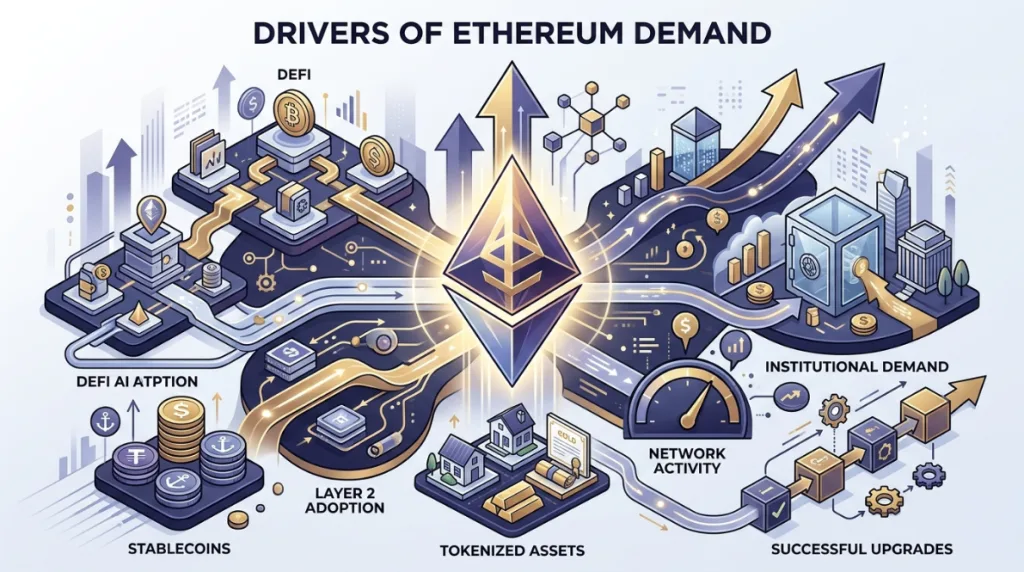
Several developments could create a stronger environment for ETH.
1. Growth in Ethereum Adoption
Ethereum remains a major platform for decentralized applications, smart contracts, DeFi, stablecoins, and tokenized assets.
If developers, businesses, and users continue adopting Ethereum-based infrastructure, demand for the network could increase over time.
However, adoption alone does not guarantee price appreciation. Investors also need to consider how network activity affects demand for ETH.
2. Layer 2 Expansion

Layer 2 networks play an increasingly important role in Ethereum’s scaling strategy.
These networks process transactions away from Ethereum’s main execution layer while relying on Ethereum for security or settlement-related functions.
Ethereum’s roadmap continues to focus on increasing data availability and improving scalability for rollups. Fusaka introduced PeerDAS and additional improvements designed to increase Ethereum’s capacity for rollup data.
If Layer 2 adoption continues growing, Ethereum could strengthen its position as a settlement and infrastructure layer for blockchain applications.
3. Ethereum’s 2026 Upgrade Roadmap
Ethereum’s development remains one of the most important fundamental factors to watch.
Pectra activated on May 7, 2025, bringing changes that included improved account functionality, validator-related improvements, and increased blob throughput.
Fusaka followed on December 3, 2025. It introduced PeerDAS and other changes aimed at increasing data availability and improving Ethereum’s scalability and user experience.

The next major upgrade currently listed by Ethereum is Glamsterdam, which is planned for Q4 2026. Ethereum describes it as a step toward the next generation of scaling, with work focused on how the network processes transactions and manages its growing database.
Successful implementation could strengthen the long-term Ethereum investment case, although an upgrade does not guarantee a higher ETH price.
4. Institutional Demand
Institutional participation can influence cryptocurrency markets by bringing additional capital and liquidity into digital assets.
If institutions increase their exposure to Ethereum-related products or ETH itself, stronger demand could support the price.
However, institutional flows can change quickly. Investors should therefore treat them as one market signal rather than a permanent source of upward pressure.
5. Growth in Stablecoins and Tokenized Assets
Ethereum has become an important infrastructure layer for stablecoins and tokenized financial assets.
If stablecoin usage and tokenization expand across Ethereum and its connected Layer 2 ecosystem, the network could capture additional economic activity.
That growth could strengthen Ethereum’s long-term relevance, although the effect on ETH’s market price depends on several other factors.
What Could Push ETH Lower?

Ethereum also faces significant downside risks.
Crypto Market Corrections
ETH remains a high-volatility asset.
If investors reduce exposure to risky assets, Ethereum can experience sharp declines even when the underlying network continues to develop.
A broad crypto sell-off could therefore overwhelm positive Ethereum-specific news.
Competition From Other Networks
Ethereum competes with other blockchain ecosystems that offer smart contracts, decentralized applications, and alternative scaling solutions.
Some competing networks may attract developers and users through different combinations of transaction costs, speed, liquidity, and application support.
Ethereum needs continued ecosystem growth to maintain its competitive position.
Regulatory Changes
Regulatory decisions can influence exchanges, institutions, DeFi applications, stablecoins, and cryptocurrency investment products.
Clearer regulation could support wider adoption, while restrictive policies could reduce market access or increase compliance costs.
Weak Network Economics
Ethereum’s technical development does not automatically translate into ETH price growth.
Investors should also examine:
- Network usage
- ETH demand
- Transaction fees
- ETH issuance
- ETH burning
- Staking activity
- Layer 2 economics
- Overall market liquidity
These factors can provide a more complete picture than price charts alone.
Ethereum Price Prediction: Bearish Scenario

A bearish scenario could develop if the broader crypto market enters a prolonged risk-off period.
For example, weaker global liquidity, higher interest rates, falling crypto demand, disappointing network activity, or unfavorable regulation could pressure ETH.
Under such conditions, ETH could remain below recent highs and potentially revisit lower price levels.
An illustrative bearish range of $1,500–$2,200 represents a high-risk scenario rather than a prediction that Ethereum will definitely fall into that range.
Ethereum Price Prediction: Base-Case Scenario
The base case assumes Ethereum continues improving while the broader crypto market remains reasonably healthy.
In this scenario:
- Layer 2 adoption continues
- Ethereum upgrades progress successfully
- DeFi and stablecoin activity remain significant
- Institutional interest stays steady
- Crypto liquidity remains supportive
- Competition remains manageable
Under these conditions, an illustrative $2,200–$3,500 range could represent a moderate scenario for ETH.
This range is not a guaranteed forecast. Market conditions can change quickly.
Ethereum Price Prediction: Bullish Scenario
The bullish scenario requires several positive developments to happen together.
Ethereum could benefit from:
- Strong crypto market liquidity
- Rising institutional demand
- Higher network adoption
- Rapid Layer 2 growth
- Increasing stablecoin activity
- Successful Glamsterdam implementation
- Strong investor confidence
- A sustained Bitcoin-led crypto rally
Under an especially strong market cycle, ETH could potentially move toward or above the $3,500–$5,000 zone.
A move above that range would require substantially stronger demand and favorable market conditions. Investors should not treat the scenario as a guaranteed target.
Can Ethereum Reach a New All-Time High?
Ethereum can potentially reach a new all-time high during a strong crypto cycle, but the timing remains impossible to predict with certainty.
A sustained move toward a new record would likely require more than one positive catalyst.
Investors should watch:
- ETH market demand
- Bitcoin’s trend
- ETH/BTC performance
- Institutional flows
- Ethereum network activity
- Layer 2 growth
- Stablecoin adoption
- Market liquidity
- Regulatory developments
If several of these indicators improve simultaneously, the probability of a stronger ETH cycle could increase.
Will Ethereum Go Up in 2026?
Ethereum could rise in 2026, but there is no reliable way to guarantee the direction of its price.
The most important question is not simply whether ETH will go up. Investors should ask why it might rise.
For example, stronger demand from users and institutions could provide a healthier foundation than a short-lived speculative rally.
Likewise, successful Ethereum upgrades could improve the network’s long-term fundamentals, but the market may not immediately reflect those improvements in ETH’s price.
What Should Investors Watch in 2026?
Anyone researching an Ethereum price prediction should track several indicators.
Ethereum Network Activity
Increasing activity can indicate stronger demand for Ethereum-based applications.
Layer 2 Growth
Rising Layer 2 usage can show that Ethereum’s scaling ecosystem continues expanding.
ETH Staking
Staking affects how ETH participates in network security and can influence the amount of ETH immediately available in the market.
ETH Supply Dynamics
Investors should consider issuance and ETH burning rather than looking at circulating supply alone.
Bitcoin Performance
ETH often responds to broader crypto market movements, although Ethereum-specific developments can cause ETH to outperform or underperform Bitcoin.
Ethereum Upgrades
Major upgrades can influence network capacity, costs, security, and investor expectations.
Regulation
Changes in cryptocurrency rules can affect institutional participation and market access.
Is Ethereum a Good Investment in 2026?
Ethereum may appeal to investors who believe blockchain infrastructure will become more important over the long term.
The network has a large developer ecosystem and supports major use cases across DeFi, stablecoins, tokenized assets, and Layer 2 applications.
However, ETH remains a volatile cryptocurrency.
Before investing, consider your risk tolerance, investment horizon, financial situation, and overall portfolio allocation. Avoid buying ETH solely because an online forecast predicts a specific price.
Frequently Asked Questions
What is the Ethereum price prediction for 2026?
Ethereum’s 2026 price could vary significantly depending on market liquidity, adoption, regulation, network activity, and investor sentiment. A scenario-based approach is more realistic than relying on one exact target.
Can Ethereum reach $5,000?
Ethereum could potentially reach $5,000 during a strong market cycle, but there is no reliable way to guarantee that outcome. It would likely require strong demand, favorable liquidity, continued ecosystem growth, and positive market sentiment.
Will Ethereum go up in 2026?
ETH could rise if demand, liquidity, adoption, and broader crypto conditions remain supportive. However, Ethereum can also experience substantial corrections.
What affects Ethereum’s price the most?
Market liquidity, Bitcoin’s direction, Ethereum adoption, network activity, ETH supply dynamics, institutional demand, regulation, and investor sentiment can all influence ETH’s price.
Is Ethereum still worth investing in?
Ethereum remains one of the largest blockchain ecosystems, but whether ETH is suitable for an individual investor depends on risk tolerance, financial goals, and investment horizon.
Final Thoughts
Ethereum price prediction is useful for understanding possible outcomes, but no forecast can remove the uncertainty surrounding cryptocurrency markets.
Ethereum enters the second half of 2026 with a continued focus on scaling and network improvements. Pectra and Fusaka have already been deployed, while Glamsterdam is currently planned for Q4 2026.
The strongest long-term case for ETH would involve continued adoption, growing Layer 2 activity, expanding stablecoin and tokenized-asset use, successful protocol development, and healthy market liquidity.
At the same time, investors should consider competition, regulation, volatility, and changing macroeconomic conditions.
The key takeaway is simple: ETH may have significant upside potential, but every Ethereum price prediction remains an estimate—not a promise.
Disclaimer: This article is for educational and informational purposes only. It is not financial, investment, tax, or trading advice. Cryptocurrency investments carry a high level of risk, and you can lose some or all of your invested capital.



Leave a Reply