
In this article
- What Is the Wash Sale Rule?
- Does the Wash Sale Rule Apply to Crypto in 2026?
- Why Tokenized Securities Matter in 2026
- What Is Form 1099-DA?
- Does Form 1099-DA Make Bitcoin Subject to Wash Sales?
- Can You Sell Crypto at a Loss and Buy It Back?
- What Happens If You Sell a Tokenized Security at a Loss?
- What Is the 30-Day Wash Sale Period?
- What Happens to a Disallowed Loss?
- What If the Sale and Purchase Are in Different Accounts?
- What If You Transfer the Replacement Asset?
- Does a Crypto-to-Crypto Swap Trigger a Taxable Event?
- Crypto Tax Loss vs. Wash Sale Loss
- How to Calculate a Crypto Capital Loss
- What Are Digital Asset Transaction Costs?
- How Form 1099-DA Affects Crypto Tax Reporting
- Do You Have to Report Crypto Losses Without a 1099-DA?
- Common Crypto Wash Sale Mistakes
- Crypto Tax-Loss Harvesting in 2026
- Could Congress Change the Crypto Wash Sale Rule?
- What Crypto Investors Should Do in 2026
- A Simple Example: Ordinary Crypto
- A Simple Example: Tokenized Security
- What Is the Bottom Line for 2026?
- Final Verdict: Is the Crypto Wash Sale Rule Back?
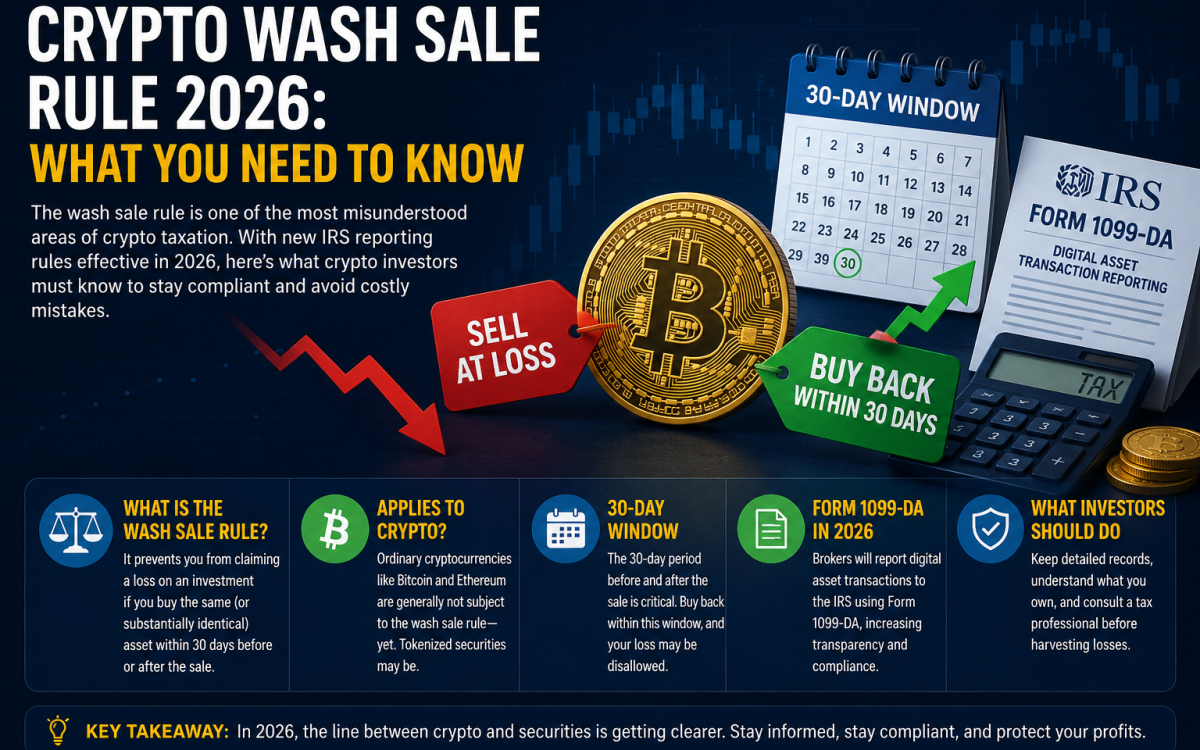
The crypto wash sale rule in 2026 is not as simple as saying that cryptocurrency either has or does not have a wash sale rule.
Under current U.S. federal tax rules, digital assets are generally treated as property. The traditional wash sale rule under Section 1091 applies to losses involving stock or securities. As a result, ordinary cryptocurrency is generally not subject to the traditional wash sale restriction simply because an investor sells it at a loss and buys the same cryptocurrency again.
However, there is an important exception.
The IRS’s 2026 Form 1099-DA instructions specifically address tokenized securities that are treated as stock or securities under Section 1091. Wash-sale losses involving those assets can be reportable, including in Box 1i of Form 1099-DA.
That means the accurate 2026 answer is:
The traditional wash sale rule has not become a blanket rule for ordinary cryptocurrency, but it can apply to certain digital assets that are also stocks or securities.
Understanding that distinction is essential for anyone using crypto tax-loss harvesting strategies.
What Is the Wash Sale Rule?
The wash sale rule is a U.S. federal tax rule that can restrict an investor’s ability to immediately claim a loss after selling stock or securities and acquiring substantially identical stock or securities within the relevant period.
The traditional rule generally covers purchases made during the period beginning 30 days before the loss sale and ending 30 days after the sale.
For example, imagine an investor buys stock for $10,000 and later sells it for $7,000.
The realized loss is:
$10,000 − $7,000 = $3,000
If the investor buys substantially identical stock during the applicable wash-sale period, the $3,000 loss may be disallowed under Section 1091.
The disallowed loss is generally added to the basis of the replacement investment.
The key issue for crypto investors is whether the digital asset is actually covered by Section 1091.
Does the Wash Sale Rule Apply to Crypto in 2026?
For ordinary cryptocurrency, the traditional Section 1091 wash sale rule generally does not apply.

The IRS says digital assets are treated as property for federal income tax purposes. Its current digital asset guidance covers assets such as cryptocurrency, stablecoins, and NFTs.
This is why an investor should be cautious about headlines claiming that the wash sale rule automatically applies to every Bitcoin or crypto transaction.
It does not.
However, the answer changes when the digital asset is also a stock or security for federal tax purposes.
The important distinction
Think about crypto in two broad categories:
| Digital asset situation | Traditional wash sale treatment |
|---|---|
| Ordinary cryptocurrency | Generally not subject to Section 1091 |
| Digital asset that is also a stock/security | Section 1091 may apply |
| Certain tokenized securities | Wash-sale rules can apply |
| Future legislation | Treatment could change if enacted |
So the better question is not simply:
“Does crypto have a wash sale rule?”
The better question is:
“What type of digital asset was sold, and is it treated as stock or a security under Section 1091?”
Why Tokenized Securities Matter in 2026
Tokenized securities are one of the most important developments to understand.
A tokenized security is a digital asset representing an underlying security or another interest that is treated as a security for tax purposes.
The IRS’s 2026 Form 1099-DA instructions specifically state that losses from wash sales of tokenized securities must be reported. For tokenized securities treated as stock or securities under Section 1091, the broker generally reports the disallowed loss in Box 1i when the required conditions are met.

This is why the statement:
“There is no crypto wash sale rule.”
is too broad.
A more accurate statement is:
Ordinary cryptocurrency generally remains outside the traditional Section 1091 wash sale rule, while qualifying tokenized securities can be subject to it.
That distinction makes a major difference when preparing a crypto tax return.
What Is Form 1099-DA?
Form 1099-DA is the IRS information-reporting form for certain digital asset transactions reported by brokers.
For 2026 reporting, the form includes fields for:
- Digital asset identification
- Number of units
- Acquisition date
- Sale or disposition date
- Proceeds
- Cost or other basis
- Wash-sale loss disallowed
- CUSIP information
- Transfer-in information
- Certain other reporting details
The 2026 form specifically includes Box 1i for wash-sale loss disallowed involving digital assets that are also stock or securities for tax purposes.
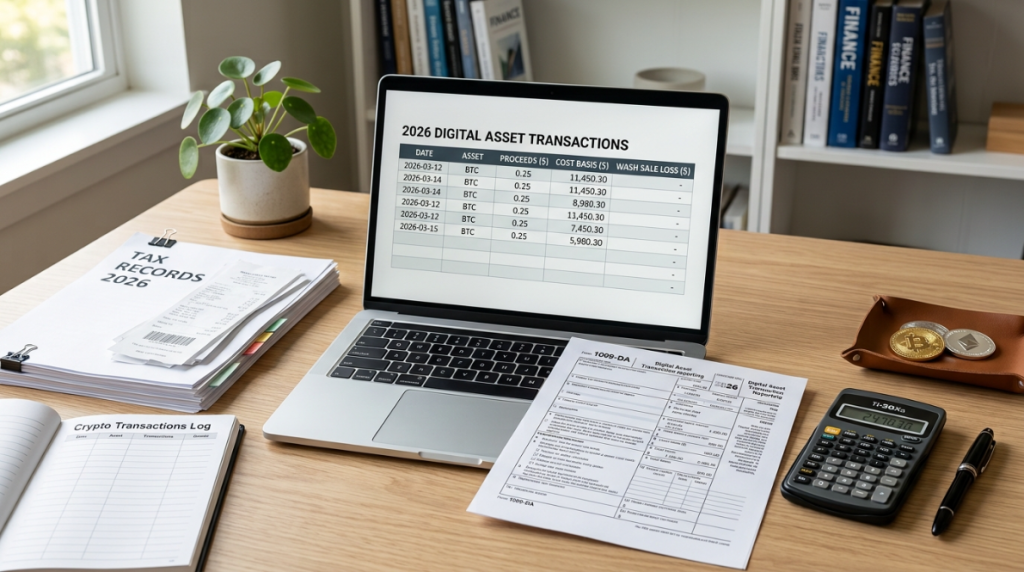
But this does not mean Form 1099-DA created a universal wash sale rule for cryptocurrency.
Instead, the form provides a reporting mechanism for transactions where the applicable tax rules already require a wash-sale adjustment.
Does Form 1099-DA Make Bitcoin Subject to Wash Sales?
No.
The existence of Form 1099-DA does not automatically turn Bitcoin into a security or make every Bitcoin loss subject to Section 1091.
The IRS continues to describe digital assets generally as property for federal income tax purposes.
Form 1099-DA simply provides broker reporting for digital asset transactions.
The wash-sale field is specifically connected to digital assets that are also stock or securities for tax purposes.
Therefore:
Form 1099-DA ≠ universal crypto wash sale rule.
That is one of the most important points investors should understand in 2026.
Can You Sell Crypto at a Loss and Buy It Back?
For ordinary cryptocurrency, the traditional Section 1091 wash-sale restriction generally does not prevent an investor from selling the asset at a loss and buying it back.
For example:
You buy Bitcoin for $40,000.
Bitcoin falls to $30,000.
You sell your Bitcoin for $30,000.
Your realized loss is:
$40,000 − $30,000 = $10,000
If you later purchase Bitcoin again, Section 1091 does not generally disallow the loss merely because you repurchased the same ordinary cryptocurrency.
However, this does not mean the transaction is tax-free.
The sale itself can create a taxable capital loss, and the investor must report the transaction according to the applicable rules.
The IRS states that selling digital assets for U.S. dollars can result in a recognized capital gain or loss, subject to applicable limitations.
What Happens If You Sell a Tokenized Security at a Loss?
The result can be different.
Suppose an investor owns a tokenized security treated as stock or securities under Section 1091.
The investor buys:
100 units for $1,000
Later sells all 100 units for:
$600
The realized loss is:
$1,000 − $600 = $400
Within 30 days, the investor buys:
75 replacement units
The IRS’s 2026 Form 1099-DA instructions provide essentially this type of example. Because 75 of the original 100 units were replaced within the relevant period, the disallowed loss in the example is:
75 ÷ 100 × $400 = $300
The broker reports the $300 wash-sale loss disallowed in Box 1i, and the disallowed amount increases the adjusted basis of the acquired digital asset.
This is a real 2026 reporting rule for the applicable tokenized-security situation.
What Is the 30-Day Wash Sale Period?
The traditional wash sale framework uses a 30-day period before and after the loss sale.
That means the relevant window can span 61 days in total:
- 30 days before the sale
- The sale date
- 30 days after the sale
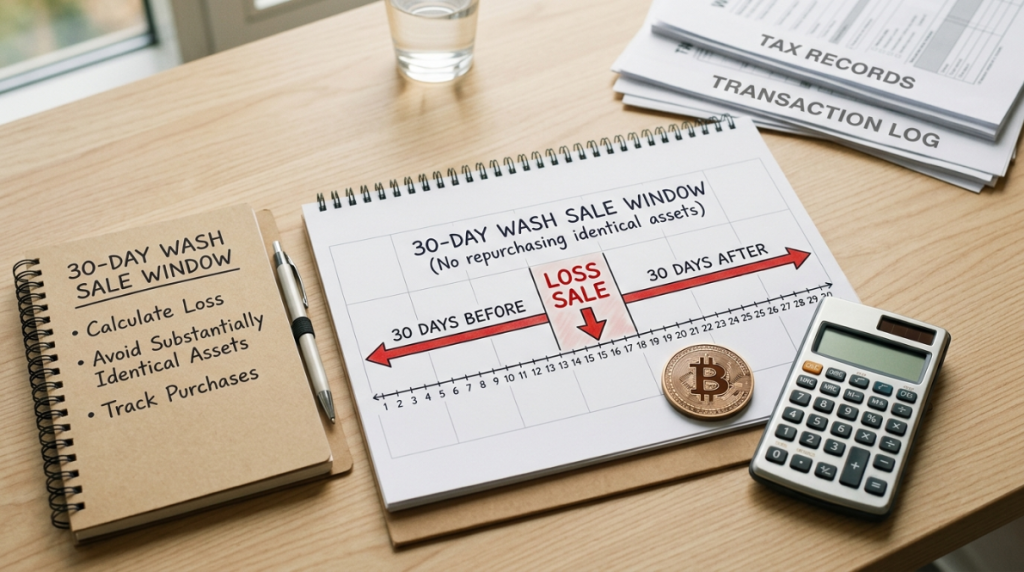
If the applicable replacement security is acquired during that period, the wash-sale rule can restrict the loss.
For ordinary cryptocurrency, this stock-and-security rule generally does not apply merely because the investor buys the same crypto again.
For tokenized securities covered by Section 1091, however, the wash-sale rules can apply.
The IRS’s 2026 instructions specifically use a 30-day replacement period in its tokenized-security example.
What Happens to a Disallowed Loss?
A wash-sale loss is generally not simply erased forever.
Instead, when Section 1091 applies, the disallowed loss is generally incorporated into the basis of the replacement property.
For example:
- Original cost: $10,000
- Sale proceeds: $7,000
- Realized loss: $3,000
- Disallowed loss: $3,000
The replacement property’s adjusted basis can generally be increased by the disallowed amount.
This means the tax benefit may be deferred until a later disposition of the replacement asset.
For tokenized securities, the IRS’s Form 1099-DA instructions specifically state that the adjusted basis of the acquired digital asset is increased by the wash-sale loss reported in Box 1i.
What If the Sale and Purchase Are in Different Accounts?
This is another area where crypto investors need to be careful.
The 2026 Form 1099-DA instructions contain specific rules for tokenized securities.
If the sale and purchase of the tokenized security occur in the same account and involve the same CUSIP number, the broker must report the applicable disallowed loss in Box 1i.
The instructions also say a broker may report other Section 1091 disallowed losses even when the sale and repurchase occur in different accounts.
Therefore, moving assets between accounts does not automatically mean the underlying tax issue disappears.
Investors should keep their own complete records rather than relying entirely on broker reporting.
What If You Transfer the Replacement Asset?
The IRS’s 2026 Form 1099-DA instructions identify certain situations where the broker does not have to apply the wash-sale rules for the reporting transaction.
These include specific transfers between accounts and circumstances involving separate accounts.
That does not mean investors should intentionally move assets between wallets or accounts simply to manufacture a tax result.
Broker reporting rules and taxpayer-level tax obligations are not always identical.
The safest approach is to maintain records of:
- The original purchase
- The sale
- The replacement purchase
- Account or wallet
- Date and time
- Quantity
- Cost basis
- Transaction costs
Does a Crypto-to-Crypto Swap Trigger a Taxable Event?
A crypto-to-crypto exchange can have tax consequences.
The IRS explains that digital asset transactions can include exchanges of one digital asset for another. It also provides rules for calculating gain or loss when digital assets differing materially in kind or extent are exchanged.
For example, suppose you acquired ETH for $3,000 and later exchange it for BTC when the ETH is worth $4,000.
The transaction can require a gain calculation on the ETH you disposed of.
The fact that no U.S. dollars changed hands does not automatically make the transaction tax-free.
This is separate from the wash-sale question.
Crypto Tax Loss vs. Wash Sale Loss
These two concepts should not be confused.
Crypto tax loss
This is the loss realized when a taxable disposition occurs for less than the asset’s adjusted basis.
Wash-sale loss
This is a loss that would otherwise be recognized but is disallowed under Section 1091 because the applicable replacement-property conditions are met.
An ordinary crypto sale can therefore produce a capital loss without creating a wash-sale adjustment.
A tokenized security transaction can potentially produce a loss that is restricted by Section 1091.
How to Calculate a Crypto Capital Loss
For an investment-held digital asset, a simplified calculation is:
Capital Gain or Loss = Amount Realized − Adjusted Basis
For example:
Adjusted basis: $12,000
Sale proceeds: $8,500
Capital loss: $8,500 − $12,000 = −$3,500
The IRS states that gain or loss on a digital asset sale is generally determined by comparing adjusted basis with the amount realized. Transaction costs that qualify under the applicable rules also affect the calculation.
Your actual tax treatment can depend on how you acquired and held the asset.
What Are Digital Asset Transaction Costs?
Crypto investors should not overlook transaction costs.
The IRS describes digital asset transaction costs as amounts paid for services provided by another party to effect the purchase, sale, or disposition of a digital asset.
Examples can include:
- Trading fees
- Gas fees
- Commissions
- Certain transfer taxes
However, costs associated only with transferring assets between your own wallets or accounts are treated differently.
Accurate fee records can therefore make a difference when calculating basis and realized gains or losses.
How Form 1099-DA Affects Crypto Tax Reporting
The arrival of Form 1099-DA makes recordkeeping more important for crypto investors.
The form can report proceeds and, where applicable, cost basis.
The IRS’s 2026 form includes:
Box 1f: Proceeds
Box 1g: Cost or other basis
Box 1i: Wash-sale loss disallowed
For certain noncovered digital assets, Box 1g can be blank, meaning the taxpayer may need to determine the basis from personal records.
This is an important reason not to rely exclusively on a broker’s tax form.
Your own transaction history still matters.
Do You Have to Report Crypto Losses Without a 1099-DA?
Yes.
A taxpayer’s reporting obligation does not disappear simply because a broker does not provide an information return.
The IRS says taxable digital asset transactions must be reported even when the taxpayer does not receive a Form 1099 or similar information return.
For capital transactions, taxpayers generally use Form 8949 and Schedule D when required by the applicable filing rules.
This is particularly important for investors using:
- Multiple exchanges
- Self-custody wallets
- DeFi platforms
- Hardware wallets
- Multiple brokerage accounts
Common Crypto Wash Sale Mistakes
Mistake 1: Saying All Crypto Is Exempt
This is too broad.
Ordinary digital assets are generally treated as property, but qualifying tokenized securities can be subject to Section 1091.
Mistake 2: Saying All Crypto Has a Wash Sale
This is also incorrect.
The traditional wash sale rule is not automatically applied to every cryptocurrency transaction.
Mistake 3: Treating Form 1099-DA as a New Wash Sale Law
Form 1099-DA is an information-reporting form. Its Box 1i addresses applicable wash-sale losses involving digital assets that are also stock or securities.
Mistake 4: Ignoring Tokenized Securities
A tokenized security can have a very different tax treatment from ordinary cryptocurrency.
Mistake 5: Assuming a Repurchase Makes the Entire Loss Disallowed
For an applicable wash sale, the amount disallowed can depend on the amount of replacement property acquired.
The IRS’s 2026 tokenized-security example demonstrates a partial disallowance.
Mistake 6: Relying Only on Exchange Records
Your exchange may not have the complete history of transactions from other platforms or self-custody wallets.
Keep your own records.
Crypto Tax-Loss Harvesting in 2026
Tax-loss harvesting involves realizing losses to offset eligible gains or otherwise manage taxable income under the applicable tax rules.
For ordinary cryptocurrency, the lack of a traditional Section 1091 restriction can provide more flexibility than investors have with stocks and securities.

For example:
- You bought BTC for $50,000.
- Its value falls to $42,000.
- You sell and realize an $8,000 loss.
- You later repurchase BTC.
Under the current traditional Section 1091 framework, the ordinary cryptocurrency loss is not automatically disallowed merely because you repurchased the same asset.
But investors should still consider:
- Trading costs
- Market volatility
- Holding period
- Capital-loss limitations
- Asset classification
- Recordkeeping
- Any future law changes
Tax strategy should never be based solely on whether a wash-sale restriction exists.
Could Congress Change the Crypto Wash Sale Rule?
Potential legislative changes are one reason this topic continues to attract attention.
If Congress enacts legislation expanding Section 1091 to cover additional digital assets, the current tax-loss harvesting strategy for ordinary cryptocurrency could change.
A future law could potentially restrict investors from selling digital assets at a loss and immediately acquiring substantially identical assets.
But there is an important rule for publishing accurate tax content:
A proposed bill is not the same as enacted law.
Therefore, an article should not tell readers that a proposed crypto wash-sale expansion is already effective unless Congress has actually enacted it and the effective-date rules make it applicable.
For investors, this distinction is essential.
What Crypto Investors Should Do in 2026
A practical approach is to maintain a complete transaction log.
Track:
- Asset name
- Asset type
- Date acquired
- Quantity acquired
- Original cost
- Transaction fees
- Date sold
- Quantity sold
- Sale proceeds
- Gain or loss
- Replacement purchases
- Exchange or wallet
- Tokenized-security identifiers where applicable
- Form 1099-DA information
If you hold tokenized securities, pay particular attention to CUSIP numbers and any wash-sale adjustment reported by your broker.
If your broker reports a Box 1i amount on Form 1099-DA, review the transaction history before simply entering the number into your tax software.
A Simple Example: Ordinary Crypto
Suppose you buy 1 BTC for:
$60,000
Later, you sell it for:
$48,000
Your realized loss is:
$12,000
You then purchase 1 BTC again.
For ordinary cryptocurrency, the traditional Section 1091 wash-sale rule generally does not automatically disallow that $12,000 loss.
The sale still needs to be reported under the applicable digital asset tax rules.
The repurchase is also a separate acquisition that creates a new basis.
A Simple Example: Tokenized Security
Now consider a tokenized security treated as stock or securities.
You buy:
100 units for $10,000
You sell them for:
$8,000
Your loss is:
$2,000
Within the applicable 30-day period, you purchase:
50 substantially identical units
If the Section 1091 requirements are met, the loss may be partially disallowed.
The general calculation would be based on the replacement units, and the disallowed amount would generally be added to the replacement property’s basis.
The IRS’s 2026 Form 1099-DA instructions provide a specific example showing this proportional approach for tokenized securities.
What Is the Bottom Line for 2026?
The phrase “crypto wash sale rule 2026” can be misleading if it suggests that every cryptocurrency is now subject to the stock wash-sale rule.
The current picture is more precise:
Ordinary cryptocurrency: generally treated as property and not automatically subject to the traditional Section 1091 wash-sale rule.
Tokenized securities: can be subject to Section 1091 when they are treated as stock or securities.
Form 1099-DA: provides digital asset transaction reporting and includes Box 1i for applicable wash-sale losses.
Tax-loss harvesting: remains possible for ordinary crypto under the current traditional wash-sale framework, but investors still need to report taxable dispositions correctly.
Future legislation: could change these rules, so investors should monitor enacted changes rather than relying on headlines about proposed laws.
Final Verdict: Is the Crypto Wash Sale Rule Back?
Not as a blanket rule for ordinary cryptocurrency in 2026.
The IRS continues to treat digital assets generally as property for federal income tax purposes.
At the same time, the IRS’s 2026 Form 1099-DA instructions make clear that wash-sale losses involving tokenized securities treated as stock or securities under Section 1091 must be reported in the applicable circumstances.
So the most accurate conclusion is:
The crypto wash sale rule is not universally “back” for Bitcoin, Ethereum, and ordinary cryptocurrency. But wash-sale rules can already apply to qualifying tokenized securities, and 2026 reporting makes this distinction more important than ever.
For crypto investors, the best approach is to identify the asset correctly, maintain detailed records, reconcile Form 1099-DA with your own transaction history, and separate current tax law from proposed changes.
This article is for educational purposes only and is not individualized tax, legal, or financial advice. U.S. federal tax treatment can depend on the asset, transaction structure, taxpayer circumstances, and future changes in law or IRS guidance.


Leave a Reply