
In this article
- What Is Investing?
- Why Should You Start Investing?
- 1. Decide What You Want to Invest For
- 2. Review Your Financial Foundation
- 3. Understand Your Risk Tolerance
- 4. Determine Your Investment Time Horizon
- 5. Choose the Right Investment Account
- 6. Decide How Much You Can Invest
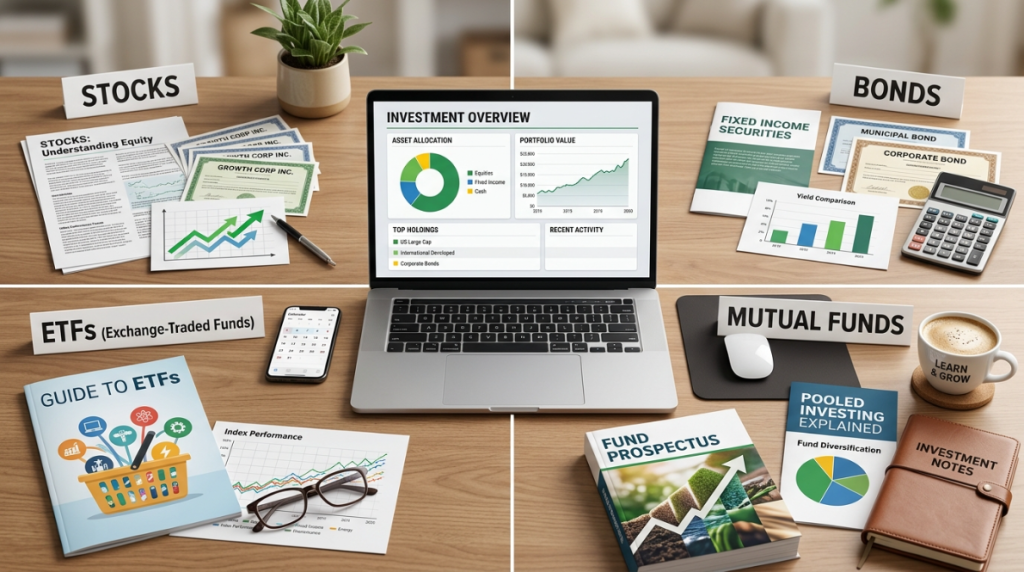
- 7. Learn the Main Types of Investments
- 8. Focus on Diversification
- 9. Understand Asset Allocation
- 10. Make Your First Investment
- 11. Consider Investing Regularly
- 12. Pay Attention to Investment Fees
- 13. Review Your Portfolio Periodically
- Common Investing Mistakes Beginners Should Avoid
- How Much Money Do You Need to Start Investing?
- A Simple Investing Strategy for Beginners
- Beginner Investing Checklist
- Final Thoughts
Investing can look complicated when you are just getting started. You may see stock charts, financial terms, market news, and thousands of investment choices. It can make you wonder where to begin.
The good news is that you don’t need to know everything before you invest.
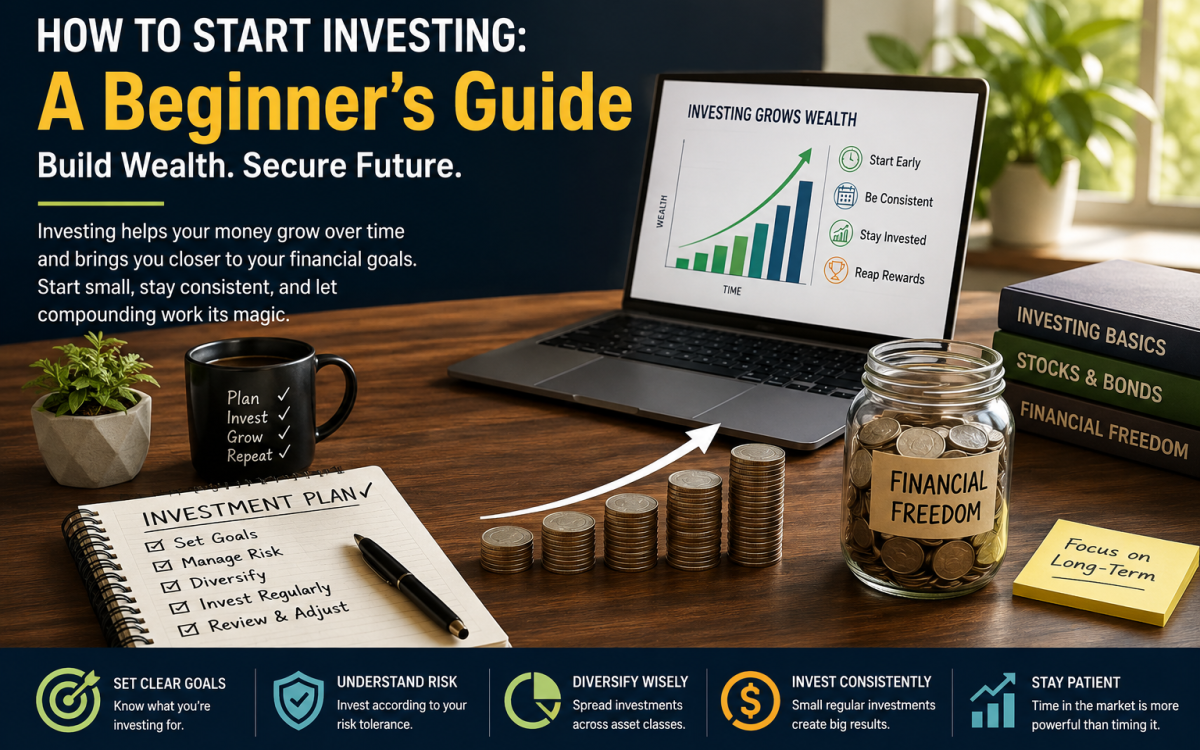
A better approach starts with a simple plan. First, decide what you want your money to achieve. Then, review your financial situation, choose an appropriate account, understand your risk level, select suitable investments, and keep contributing over time.
This guide explains how to start investing in a simple, practical way so you can make more informed decisions without chasing unrealistic returns.
Important: Investing involves risk. The value of your investments can rise or fall, and you can lose some or all of the money you invest. This article provides general educational information, not personalized financial advice.
What Is Investing?
Investing means putting money into assets with the goal of earning a return over time.
Common investments include:
- Stocks
- Bonds
- Exchange-traded funds (ETFs)
- Mutual funds
- Index funds
- Real estate
- Other financial assets
You may earn a return when an investment increases in value. Some investments can also generate income through dividends or interest. However, no investment can guarantee a positive return. Every investment carries some level of risk.
Investing differs from saving because you accept more uncertainty in exchange for the potential to grow your money over a longer period.
For short-term needs and emergency savings, cash or savings products may make more sense. For long-term goals, investing may give your money greater growth potential.
Why Should You Start Investing?
People invest for different reasons.
You might invest to:
- Build long-term wealth
- Prepare for retirement
- Save for a major future goal
- Create potential investment income
- Grow money that you won’t need immediately
One major advantage of starting early is compound growth.
Compound growth happens when your investment earns a return and you keep that money invested. Future returns can then build on both your original investment and earlier gains.
For example, suppose you invest $100 and earn a return. If you leave the money invested, future growth can occur on the original $100 plus the returns that remain invested.
Compounding does not guarantee wealth or a specific return. But giving your investments more time can increase the opportunity for growth.
1. Decide What You Want to Invest For

Before asking, “What stock should I buy?” ask a more important question:
“Why am I investing?”
Your goal can influence almost every other investment decision.
For example, your goal might be:
- Retirement
- Buying a home
- Building long-term wealth
- Funding education
- Creating a future financial cushion
Next, decide when you expect to need the money.
Someone investing for retirement several decades away has a very different timeline from someone saving for a home purchase in two years.
Your goal and timeline help you determine how much risk you may be able to accept.
2. Review Your Financial Foundation
Investing should work alongside your broader financial plan.
Before investing a large amount of money, look at your emergency savings, debt, monthly expenses, and income.
An emergency fund can provide cash for unexpected expenses without forcing you to sell investments during a market decline.
You should also consider expensive debt. If you carry high-interest debt, paying it down may deserve priority before putting significant amounts into risky investments.
You don’t need perfect finances before you start investing. However, a stronger financial foundation can make it easier to stay invested when the market becomes volatile.
3. Understand Your Risk Tolerance
Risk tolerance describes how much investment uncertainty and potential loss you can realistically handle.
Imagine investing $1,000 and watching its market value fall to $800.
Would you remain calm and follow your plan, or would you immediately sell?
Your answer matters.

If a large decline would cause you to panic, you may need a more conservative investment strategy. If you have a long time horizon and can tolerate substantial fluctuations, you may feel more comfortable taking more investment risk.
Remember that higher potential returns generally come with greater risk. You should never choose an investment simply because someone promises that it will make you rich.
4. Determine Your Investment Time Horizon
Your time horizon tells you how long you expect to keep your money invested before you need it.
Consider these examples:
Short-term goal:
You may need the money within a few years.
Medium-term goal:
You may need the money several years from now.
Long-term goal:
You may not need the money for decades, such as retirement savings.
A longer time horizon can give you more opportunity to recover from temporary market declines. A short time horizon gives you less room for a major investment loss.
That’s why your investment strategy should match the purpose of the money.
The SEC also emphasizes that asset allocation should reflect factors such as your time horizon and tolerance for risk.
5. Choose the Right Investment Account
After defining your goal, decide where you will hold your investments.
The available accounts depend on your country. For readers in the United States, common options include retirement accounts and taxable brokerage accounts.
401(k)
A 401(k) is an employer-sponsored retirement plan.
Some employers offer matching contributions, which can increase the value of participating in the plan. Your employer determines the investment options available through its plan.
For 2026, the employee contribution limit for most 401(k), 403(b), and governmental 457 plans is $24,500. Certain older workers may qualify for additional catch-up contributions under current rules.
Always check your specific plan before deciding how much to contribute.
Traditional IRA
A Traditional IRA provides another way to save for retirement.
Contributions, deductions, income limits, and withdrawals follow specific tax rules. Your eligibility for a deduction can depend on factors such as income and whether you have access to a workplace retirement plan.
Roth IRA
A Roth IRA uses after-tax contributions and can provide tax-free qualified withdrawals under applicable rules.
However, Roth IRA eligibility and contribution rules can depend on your income and tax situation.
For 2026, the IRA contribution limit is $7,500, with an additional catch-up contribution amount available to eligible individuals age 50 and older.
Taxable Brokerage Account
A brokerage account can provide more flexibility because it doesn’t have the same contribution structure as a retirement account.
However, taxable investment accounts can create tax consequences when you realize gains or receive taxable investment income.
Note: Retirement account rules and tax treatment can change. Check current IRS guidance or speak with a qualified tax professional before making tax-related decisions.
6. Decide How Much You Can Invest
You don’t need a huge amount of money to start investing.
The right amount depends on your income, expenses, savings, debt, financial goals, and investment account.
Instead of asking:
“What’s the minimum amount I need?”
Ask:
“How much can I invest consistently without damaging my budget?”
You might start with $25, $50, $100, or another amount that fits your situation.
As your income increases, you can gradually increase your contributions.
The important part is to avoid investing money that you need for essential expenses or an upcoming financial obligation.
7. Learn the Main Types of Investments
You don’t need to understand every financial product before you begin. Start by learning the basics.
Stocks
A stock represents ownership in a company.
If the company performs well and investors value its shares more highly, the stock price may rise. Some companies also pay dividends.
However, individual stocks can experience significant price changes. A company’s business performance, economic conditions, market sentiment, and many other factors can affect its share price.
Bonds
A bond represents a debt investment.
When you buy certain bonds, you effectively lend money to a government, municipality, or company. The issuer generally agrees to pay interest according to the bond’s terms and return principal according to those terms.
Bonds carry risks too, including interest-rate and credit risk.
ETFs
An exchange-traded fund, or ETF, holds a collection of investments and trades on an exchange.
Many ETFs track an index, while others focus on specific sectors, markets, or strategies.
A diversified ETF can give beginners exposure to many securities through a single investment.
Mutual Funds
Mutual funds pool money from multiple investors and use that money to buy a portfolio of securities.
Some mutual funds actively select investments, while index mutual funds aim to track a specific index.
Index Funds
An index fund attempts to follow the performance of a particular market index.
Instead of trying to identify individual winning stocks, an index fund can give investors exposure to a broad group of securities.
Stocks, bonds, mutual funds, and ETFs all have different characteristics, risks, and costs. You should understand an investment before buying it.
8. Focus on Diversification
Diversification means spreading your money across different investments instead of depending on one asset.
Imagine investing your entire portfolio in one company. If that company experiences serious problems, your portfolio could suffer heavily.

A diversified portfolio can spread exposure across:
- Multiple companies
- Different industries
- Different countries or regions
- Stocks and bonds
- Different investment funds
You can also diversify within an asset class.
For example, owning one technology stock doesn’t provide the same diversification as owning a broad fund containing hundreds of companies.
Diversification cannot guarantee that you won’t lose money. However, spreading investments can reduce the impact that one poorly performing investment has on your overall portfolio.
9. Understand Asset Allocation
Diversification and asset allocation work together, but they aren’t exactly the same.
Asset allocation means deciding how much of your portfolio goes into different asset classes, such as stocks, bonds, and cash.
For example, an investor might decide to hold a combination of stocks and bonds instead of putting everything into stocks.
Your ideal mix depends on your:
- Investment goal
- Time horizon
- Risk tolerance
- Financial situation
Someone with a long-term goal may be able to accept more market volatility. Someone who needs the money soon may prefer less exposure to volatile investments.
There is no single asset allocation that works for every investor.
10. Make Your First Investment
Once you choose an account and investment strategy, you can make your first purchase.
If you use an online brokerage account, the process generally looks like this:
- Open an investment account.
- Deposit money into the account.
- Research the investment you want to buy.
- Check its fees and risks.
- Decide how much you want to invest.
- Review your order carefully.
- Place the order.
- Keep records of your investment.
Don’t rush this step because you feel pressured to “get into the market.”
Before buying anything, understand what you are purchasing and why it belongs in your portfolio.
Online investing makes transactions quick, but fast execution doesn’t replace research.
11. Consider Investing Regularly

You don’t have to invest everything at once.
Many investors contribute a fixed amount at regular intervals. This approach can help create a disciplined investing habit.
For example, you might invest $100 every month.
When prices rise, your money buys fewer shares. When prices fall, the same amount buys more shares.
This approach is commonly called dollar-cost averaging.
Dollar-cost averaging does not guarantee a profit or protect you from losses. It also doesn’t mean that investing gradually will always produce better returns than investing a lump sum immediately.
Its main advantage for many beginners is consistency. A regular contribution schedule can reduce the temptation to constantly guess the perfect time to enter the market.
12. Pay Attention to Investment Fees
Fees can quietly reduce your investment returns.
Before choosing an investment or financial service, look at costs such as:
- Fund expense ratios
- Account fees
- Advisory fees
- Trading costs
- Transaction fees
- Other ongoing expenses
A small annual fee may seem unimportant when you first invest. But fees can compound over many years because the money you spend on fees no longer remains invested.
The SEC warns that investment fees and expenses can have a significant impact on portfolio value over time.
Don’t choose an investment based only on its fee. Compare its costs with its investment strategy, diversification, services, and overall suitability.
13. Review Your Portfolio Periodically
Investing doesn’t end after you make your first purchase.
Your circumstances can change. Your income may increase, your financial goals may change, or you may move closer to retirement.
Your portfolio can also change naturally because different investments grow at different rates.
For example, suppose you originally planned to keep 70% of your portfolio in stocks and 30% in bonds. If stocks perform strongly, your portfolio might gradually move to a higher stock percentage.
Rebalancing can help bring your portfolio closer to your intended allocation.
You don’t need to make constant changes. Instead, review your strategy periodically and make adjustments when your goals or circumstances justify them.
Common Investing Mistakes Beginners Should Avoid
Chasing Quick Profits
Investing isn’t a guaranteed shortcut to wealth.
If someone promises extremely high returns with little or no risk, treat the claim as a warning sign.
Higher potential returns usually come with higher risk.
Trying to Time the Market
Many investors try to predict when prices will fall so they can buy and when prices will rise so they can sell.
The problem is that consistently predicting short-term market movements is extremely difficult.
A long-term strategy can help you avoid making emotional decisions every time the market moves.
Putting Everything Into One Stock
One successful stock can produce impressive gains, but one failed company can also cause serious losses.
Concentrating your entire portfolio in one company or sector creates unnecessary dependence on a single source of risk.
Investing Money You Need Soon
Don’t treat your emergency savings or money needed for an immediate financial obligation like long-term investment capital.
Market values can fall at inconvenient times.
Keep short-term money in appropriate savings or cash-based products and invest long-term money according to your goals and risk tolerance.
Following Social Media Hype
An investment can become popular online without becoming a good investment for you.
Don’t buy an asset simply because influencers or online communities claim that its price will rise.
Research the investment, understand the risks, and decide whether it fits your own plan.
Ignoring Fees
Two investments can have similar objectives but different costs.
Always understand what you will pay before investing.
Checking Your Portfolio Too Often
Watching every daily price movement can make normal market volatility feel like a crisis.
Long-term investors should focus on whether their overall strategy still matches their goals rather than reacting to every short-term price change.
How Much Money Do You Need to Start Investing?
There isn’t one universal amount that every beginner needs.
Some platforms and investments allow relatively small starting amounts, while others require more money.
Your personal starting amount should depend on your budget and financial priorities.
For example, investing $50 every month may be more sustainable for you than investing $1,000 once and then stopping because you can’t afford future contributions.
Start with an amount you can realistically maintain.
Then, as your financial situation improves, consider increasing your contributions.
A Simple Investing Strategy for Beginners
If the process still feels overwhelming, simplify it.
Use this basic framework:
Set a goal → Build financial stability → Understand your risk → Choose an account → Decide how much to invest → Select suitable investments → Diversify → Invest consistently → Review periodically
This approach keeps the focus on your financial plan instead of the latest market trend.
You don’t need to find the next big stock.
You need a strategy that you can understand and follow.
Beginner Investing Checklist
Before you invest, ask yourself:
- Do I know what I’m investing for?
- Do I know when I’ll need the money?
- Do I have enough emergency savings?
- Have I considered high-interest debt?
- Do I understand my risk tolerance?
- Do I understand the investment I’m buying?
- Have I checked the fees?
- Is my portfolio reasonably diversified?
- Can I continue investing regularly?
- Am I prepared for temporary losses?
- Have I avoided making the decision based solely on social media hype?
If you can answer these questions confidently, you have a much stronger starting point.
Final Thoughts
Learning how to start investing doesn’t mean you need to predict the next market winner.
Successful investing starts with a clear purpose and a realistic plan.
Know what you’re investing for. Understand your time horizon and risk tolerance. Choose an appropriate account, invest an amount that fits your budget, and select investments that match your strategy.
Diversification can help reduce concentration risk, while regular contributions can help you stay disciplined. At the same time, keep an eye on fees and avoid emotional decisions during periods of market volatility.
Most importantly, remember that investing always involves risk. You can lose money, and no investment strategy can guarantee a profit.
Start with what you understand, keep learning, and give your long-term plan enough time to work.
The goal isn’t to become a perfect investor. The goal is to become a consistent and informed one.


Leave a Reply