
In this article
- TL;DR: The Quick Answer
- What Exactly Is SaaS?
- SaaS vs On-Premise vs IaaS vs PaaS
- How Big Is the SaaS Market in 2026?
- How SaaS Companies Make Money
- Key SaaS Metrics Every Investor Should Know
- Pros and Cons of SaaS (For Users and Buyers)
- Investing in SaaS: Valuations and Risks in 2026
- How AI Is Changing SaaS Right Now
- Frequently Asked Questions
- Final Verdict
TL;DR: The Quick Answer
SaaS (Software as a Service) is cloud-hosted software that you pay for on a subscription — monthly or yearly — instead of buying a license and installing it on your own computers. The vendor runs everything: servers, updates, security, and maintenance. You just log in through a browser. The global SaaS market is worth roughly $375–490 billion in 2026 and growing double digits. For investors, the key numbers are ARR (annual recurring revenue), churn rate, LTV:CAC ratio, and net revenue retention — and the median public SaaS stock trades at about 4.6x annual recurring revenue as of late 2026. SaaS is one of the most profitable and scalable business models ever invented, which is exactly why it deserves a spot in any finance reader’s playbook.
What Exactly Is SaaS?
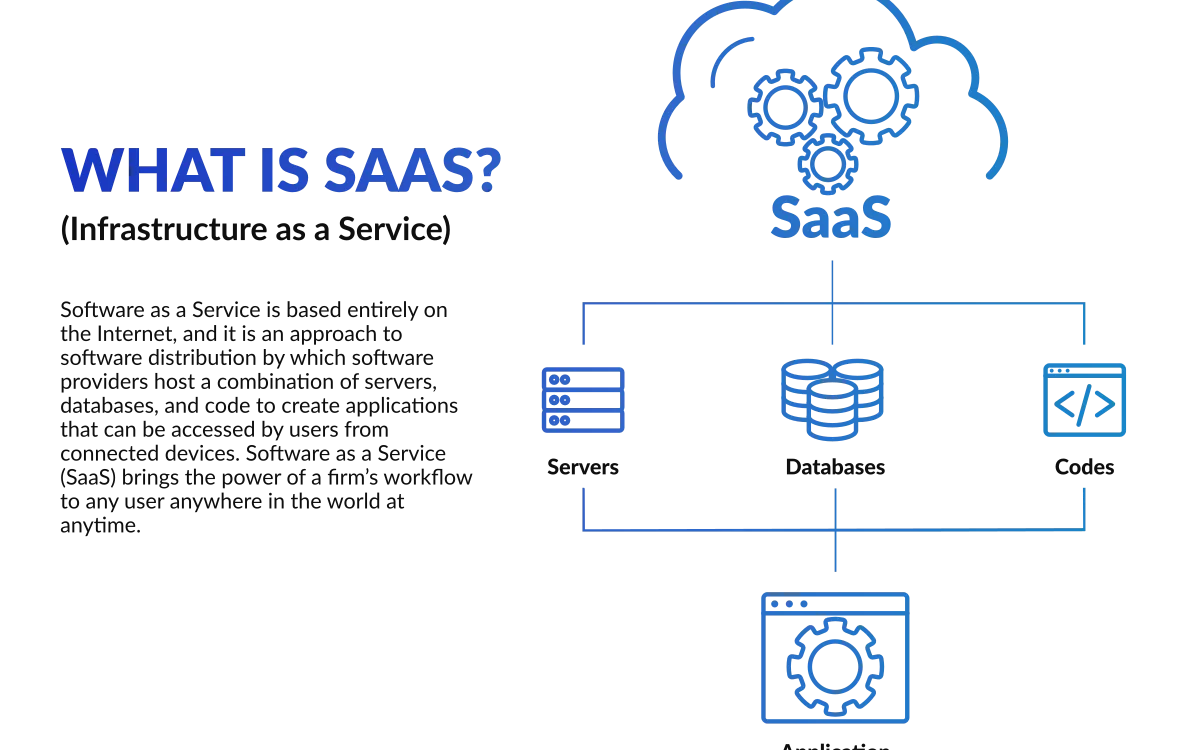
Software as a Service is a software delivery model where a third-party provider hosts an application in the cloud and makes it available to customers over the internet, usually for a recurring subscription fee. Investopedia’s definition of SaaS notes that it eliminates the need for organizations to host and run applications on their own servers or install them on individual devices. You have almost certainly used SaaS today: Gmail, Microsoft 365, Google Workspace, Salesforce, Slack, Zoom, Dropbox, Netflix, and Spotify all run on the SaaS model.
The magic of SaaS is that the marginal cost of serving one more customer is nearly zero. Once a company builds the software and runs it on cloud infrastructure, adding another user costs almost nothing — the same code serves everyone. That is why SaaS companies can grow revenue at 20–40% a year while keeping gross margins above 75%, numbers that traditional software companies could only dream of. It is also why every industry, from banking to healthcare to agriculture, has been quietly turning into a SaaS business over the last decade.

SaaS vs On-Premise vs IaaS vs PaaS
SaaS sits at the top of the cloud stack. Red Hat’s guide to IaaS vs PaaS vs SaaS breaks down who manages what in each model:
| Model | What You Manage | What the Vendor Manages | Examples |
|---|---|---|---|
| On-premise | Everything (hardware, OS, apps, data) | Nothing | Old corporate ERP installed in your office |
| IaaS | OS, apps, data, runtime | Servers, storage, networking | AWS, Microsoft Azure, Google Cloud |
| PaaS | Apps and data | Everything below the app | Heroku, Google App Engine |
| SaaS | Just your data and how you use it | Everything — app, runtime, OS, servers | Salesforce, Slack, Zoom, Gmail |
In plain English: on-premise is like owning a car and doing all the maintenance yourself. IaaS is leasing the car. PaaS is leasing the car plus getting a mechanic on call. SaaS is just calling an Uber — you do not think about the vehicle at all, you just pay for the ride. That simplicity is why SaaS won, and why the old model of buying a software CD and installing it is now a relic.
How Big Is the SaaS Market in 2026?
Estimates vary by how strictly you define SaaS, but every major forecaster agrees on the trajectory. Gartner pegs the worldwide SaaS segment at roughly $300 billion in 2025 and growing, while broader market trackers like Statista put worldwide SaaS revenue at about $489 billion for 2026. BetterCloud’s 2026 SaaS statistics roundup cites similar figures and projects the market to reach roughly $850 billion by 2031. Fortune Business Insights forecasts an even steeper climb to nearly $1.5 trillion by 2034.
The average company now uses hundreds of SaaS applications — sales, marketing, HR, finance, customer support, and collaboration all run on separate subscriptions. That sprawl created a whole secondary industry of SaaS management tools, and it means recurring software revenue is now one of the most predictable income streams in the global economy. For investors, that predictability is the whole point: a SaaS company’s revenue next year is roughly this year’s revenue plus growth minus churn, which makes forecasting far easier than it is for most businesses.
How SaaS Companies Make Money
Almost every SaaS company uses one of five pricing models, and Stripe’s guide to SaaS subscription models walks through how each works:
- Per-user (per-seat) pricing: You pay for each person who logs in. Slack and Microsoft 365 use this. Revenue grows as the customer’s team grows.
- Tiered pricing: Plans like Basic, Pro, and Enterprise unlock more features at higher prices. HubSpot and most marketing tools work this way.
- Flat-rate pricing: One product, one price. Basecamp popularized this — simple but hard to scale.
- Usage-based pricing: You pay for what you consume — API calls, gigabytes stored, messages sent. Twilio and Snowflake use this; revenue scales with customer activity.
- Hybrid pricing: A base subscription plus usage overages, the fastest-growing model because it balances predictability with upside.
The genius of the model is that keeping an existing customer costs almost nothing compared with acquiring a new one. So the best SaaS companies grow not just by signing new logos but by getting existing customers to spend more over time — through more seats, more features, or more usage. When expansion revenue exceeds churned revenue, a company achieves “negative net revenue churn,” and its revenue compounds even if it never signs another new customer. That is the holy grail of SaaS.
Key SaaS Metrics Every Investor Should Know
If you want to understand or invest in SaaS, learn these six numbers. Each one tells you something the income statement alone cannot.
| Metric | What It Means | Healthy Benchmark |
|---|---|---|
| ARR / MRR | Annual / Monthly Recurring Revenue — the run-rate of subscription income | Growth rate matters more than size |
| Churn rate | % of customers or revenue lost each month/year | Enterprise <1% monthly; SMB 3–7% monthly |
| LTV:CAC | Lifetime value of a customer ÷ cost to acquire them | 3:1 or higher |
| CAC payback | Months to recoup acquisition cost | Under 12 months |
| Net Revenue Retention (NRR) | Revenue from existing customers year over year, including expansion | >100%; best-in-class >120% |
| Gross margin | Revenue minus cost of revenue | Above 75% |
There is also the Rule of 40: a SaaS company’s revenue growth rate plus its profit margin should add up to at least 40%. Companies that clear the Rule of 40 trade at premium valuations; companies below it get punished. In 2026, only about 17% of public SaaS companies clear a Rule of 40 score above 40, which tells you how rare truly high-quality SaaS businesses are.

Pros and Cons of SaaS (For Users and Buyers)
SaaS dominates because the benefits usually outweigh the drawbacks, but the tradeoffs are real:
| Pros | Cons |
|---|---|
| No installation or hardware to buy | Your data lives on someone else’s servers |
| Automatic updates and security patches | Limited customization vs on-premise |
| Pay-as-you-go, lower upfront cost | Ongoing subscription cost can add up |
| Scales up or down instantly | Vendor lock-in — migrating is painful |
| Accessible from any device, anywhere | Needs internet; outages take you down |
| Predictable budgeting (OpEx, not CapEx) | Price increases at renewal are common |
For businesses, the biggest hidden cost is SaaS sprawl — paying for dozens of subscriptions nobody uses. For consumers, the lesson is the same: every $10 monthly subscription feels trivial until you add up 20 of them and realize you are spending $2,400 a year on software you barely touch.
Investing in SaaS: Valuations and Risks in 2026
SaaS stocks have been on a wild ride. In late 2021, the median public SaaS company traded above 15x annual revenue. By 2024, rising interest rates crushed that to about 5x. In early 2026, fears that AI would replace traditional software triggered another de-rating — the SaaS stock index fell about 24% in one quarter — before recovering. As of August 2026, the median public SaaS company trades at roughly 4.6x ARR, with top-quartile companies at 7–9x, according to the SaaS Capital Index. Private SaaS companies sell for roughly 2–7x ARR depending on growth and retention.
If you want exposure to SaaS, you can buy individual stocks — Microsoft, Salesforce, ServiceNow, Adobe, and Intuit are the blue chips — or you can use a low-cost index or robo-advisor approach. Our guide to the best AI investing apps compares platforms that make building a diversified tech portfolio straightforward. Before you buy anything, weigh the three big risks:
- Interest rate sensitivity: SaaS profits lie far in the future, so high discount rates compress valuations hard.
- AI disruption: Generative AI could let new entrants build competing products in weeks instead of years, and it could also make existing SaaS tools far more valuable. Both are happening at once.
- Churn and competition: Switching costs are falling, and customers are cutting unused subscriptions aggressively.
A financial advisor can help you decide how much of your portfolio belongs in growth-sensitive tech like SaaS. As a rule of thumb, SaaS belongs in the growth sleeve of a balanced portfolio, not as a substitute for bonds or cash.

How AI Is Changing SaaS Right Now
AI is both the biggest threat and the biggest opportunity for SaaS. On one hand, AI-native startups can now ship products that would have needed a 50-person engineering team five years ago, which intensifies competition. On the other hand, every existing SaaS company is bolting AI features onto its product and charging more for them — Microsoft Copilot, Salesforce Einstein, and Intuit Assist are all examples. Venture capital data from 2026 shows AI-native companies command valuation premiums of 2–3x over legacy SaaS, which tells you where the market thinks the future is. For investors, the safe bet is not “AI vs SaaS” — it is SaaS companies that successfully integrate AI and raise their net revenue retention as a result.
Frequently Asked Questions
What does SaaS stand for?
SaaS stands for Software as a Service — software hosted in the cloud and accessed over the internet on a subscription basis, rather than installed locally on your own devices.
Is Netflix a SaaS company?
Yes — Netflix delivers video software over the internet for a monthly subscription, which fits the SaaS model. Consumer SaaS also includes Spotify, Dropbox, and Adobe Creative Cloud.
What is the difference between SaaS and the cloud?
The cloud is the underlying infrastructure (servers, storage, networking). SaaS is one of three service layers that run on the cloud — alongside IaaS (infrastructure) and PaaS (platforms). SaaS is the finished application layer.
How do SaaS companies make money?
Most charge recurring subscription fees — monthly or yearly — often per user or per feature tier. Some use usage-based pricing (pay for what you consume) or a hybrid of subscription plus usage.
What is a good churn rate for SaaS?
For enterprise SaaS, monthly churn below 1% is healthy. For small-business SaaS, monthly churn of 3–7% is typical. In annual terms, most profitable SaaS companies aim for annual customer churn below 5–7%.
What is the Rule of 40 in SaaS?
The Rule of 40 says a SaaS company’s revenue growth rate plus its profit margin (or free cash flow margin) should add up to at least 40%. Companies above 40% are considered high-quality and trade at premium valuations.
Is SaaS a good investment in 2026?
SaaS can be a strong growth investment, but valuations are sensitive to interest rates and AI disruption. The median public SaaS stock trades at about 4.6x annual recurring revenue as of late 2026, well below the 2021 peak. Quality matters more than ever — focus on companies with NRR above 110% and gross margins above 75%.
What is the difference between SaaS and a license?
A traditional software license is a one-time purchase you install yourself, with optional maintenance fees. SaaS is a recurring subscription where the vendor hosts and maintains everything. Over the last decade, almost every major software company has converted from licenses to SaaS.
Final Verdict
SaaS is not just another tech buzzword — it is the dominant business model of the software industry, and it quietly powers a huge slice of the global economy. For users, it means lower upfront costs and automatic updates. For investors, it means predictable recurring revenue, high gross margins, and some of the best growth stocks in the market — as long as you buy at sensible valuations and watch the metrics that actually matter: churn, net revenue retention, and the Rule of 40. Understand those, and you understand SaaS.
Leave a Reply