

In this article
- Key Takeaways
- What Is Crypto Tax Filing?
- Does the IRS Tax Cryptocurrency?
- Which Crypto Transactions Can Be Taxable?
- What Is Crypto Cost Basis?
- Why Crypto Cost Basis Can Be Difficult
- Short-Term and Long-Term Crypto Gains
- How to Report Crypto on Form 8949
- How Schedule D Fits Into Crypto Tax Filing
- What Is Form 1099-DA?
- Does Form 1099-DA Include Every Crypto Transaction?
- What If You Do Not Receive Form 1099-DA?
- How to Answer the Digital Asset Question
- Do You Pay Taxes When You Buy Crypto?
- Are Transfers Between Your Own Wallets Taxable?
- How to Track Crypto Transactions
- How to Prepare for Crypto Tax Filing
- Common Crypto Tax Filing Mistakes
- Crypto Tax Filing Checklist
- Frequently Asked Questions
- Final Thoughts
Cryptocurrency has become a common investment and payment method for millions of people. However, filing taxes on crypto can be confusing when you have transactions across exchanges, wallets, and different blockchain platforms.
For U.S. taxpayers, the IRS generally treats cryptocurrency and other digital assets as property for federal income tax purposes. As a result, selling, exchanging, or otherwise disposing of crypto can create a capital gain or loss. Certain activities, including staking, mining, and receiving crypto as payment, can create income that must also be reported.
Understanding crypto tax filing can help you organize your records, calculate your gains and losses, and use the correct tax forms.
Key Takeaways
- Crypto is generally treated as property for U.S. federal tax purposes.
- Selling crypto for dollars can create a capital gain or loss.
- Swapping one digital asset for another can also be a taxable disposal.
- Spending crypto on goods or services can create a taxable gain or loss.
- Staking, mining, rewards, and crypto received for services may create taxable income.
- Capital transactions generally involve Form 8949 and Schedule D when applicable.
- Form 1099-DA is being used for broker reporting of digital asset proceeds for sales after 2025.
- Receiving no Form 1099-DA does not eliminate your obligation to report taxable transactions.
- Buying crypto with dollars and simply holding it generally does not by itself trigger a taxable disposal.
What Is Crypto Tax Filing?
Crypto tax filing means reporting your taxable cryptocurrency and digital asset activities on your U.S. federal tax return.
Your activity might include buying and selling crypto, exchanging one token for another, using crypto to buy products, receiving staking rewards, mining digital assets, or receiving cryptocurrency as payment.
The correct tax treatment depends on what happened in each transaction.
For example, buying Bitcoin with U.S. dollars and holding it is different from selling Bitcoin for a profit. Similarly, moving crypto between two wallets you own is generally different from selling that crypto or exchanging it for another asset.
Does the IRS Tax Cryptocurrency?
Yes. The IRS generally applies federal tax rules to cryptocurrency as a form of digital asset or property.
That means a taxable result can occur when you dispose of crypto rather than simply because its market price changes.
For example, suppose you purchase Bitcoin for $20,000 and later sell it for $28,000. Before considering applicable transaction costs and adjustments, the difference is an $8,000 capital gain.
The IRS also treats exchanges of digital assets and disposals involving goods or services as transactions that may need to be reported.
Which Crypto Transactions Can Be Taxable?

Knowing which transactions matter is one of the most important parts of crypto tax filing.
Selling Crypto for Dollars
Selling cryptocurrency for U.S. dollars is one of the clearest examples of a taxable disposal.
Suppose you buy Ethereum for $3,000 and later sell it for $4,500.
Your simplified gain would be:
$4,500 − $3,000 = $1,500 gain
Your actual tax calculation can depend on your basis, transaction costs, holding period, and other facts.
Swapping One Cryptocurrency for Another
A common mistake is assuming that only cashing out to dollars creates taxes.
A crypto-to-crypto swap can also involve a taxable disposal.
For example, if you bought Bitcoin for $15,000 and later exchanged it for Ethereum when the Bitcoin was worth $22,000, the exchange can create a $7,000 gain before applicable adjustments.
The IRS specifically includes exchanging a digital asset for another digital asset among reportable transactions.
Spending Crypto
Using cryptocurrency to purchase goods or services can also create a taxable event.
Imagine that you bought Bitcoin for $4,000 and later used it to buy a product when the Bitcoin was worth $5,500.
The increase in value can result in a $1,500 capital gain before applicable adjustments.
The IRS lists digital asset payments for goods or services among transactions taxpayers may need to report.
Receiving Crypto as Payment
Cryptocurrency received for services can have income-tax consequences.
For example, an employee who receives digital assets as wages generally reports the value as compensation. An independent contractor receiving crypto for services generally reports the income through the rules applicable to self-employment or business income.
The value and timing of the income can be important when you later calculate gain or loss from disposing of the asset.
Staking Rewards
Staking is another area that requires careful recordkeeping.
The IRS includes staking among activities that can generate digital asset income. The value of the rewards and the relevant timing should be tracked carefully so you can report the income correctly.
Do not assume that your Form 1099-DA will contain your staking activity.
The 2026 Form 1099-DA instructions specifically state that rewards and staking payments are not reported on that form.
Mining Income
Mining cryptocurrency can also create tax-reporting obligations.
The tax treatment can depend on how the mining activity is conducted and whether it is treated as a trade or business.
Because business activity can involve additional reporting and expense rules, miners should maintain complete records of income, expenses, dates, and asset values.
Airdrops and Hard Forks
Certain airdrops and hard-fork situations can have tax consequences.
The IRS includes certain digital assets received through an airdrop following a hard fork among transactions that taxpayers may need to consider.
The exact tax result depends on the facts, so investors should document when they received control of an asset and its relevant value.
What Is Crypto Cost Basis?
Cost basis is essential for accurate crypto tax filing.
Your basis is generally used to determine the gain or loss when you dispose of a digital asset.
A simplified calculation is:
Gain or Loss = Amount Realized − Adjusted Cost Basis
For example, suppose you purchased 1 ETH for $2,500.
Later, you sell it for $3,600.
Your simplified gain would be:
$3,600 − $2,500 = $1,100
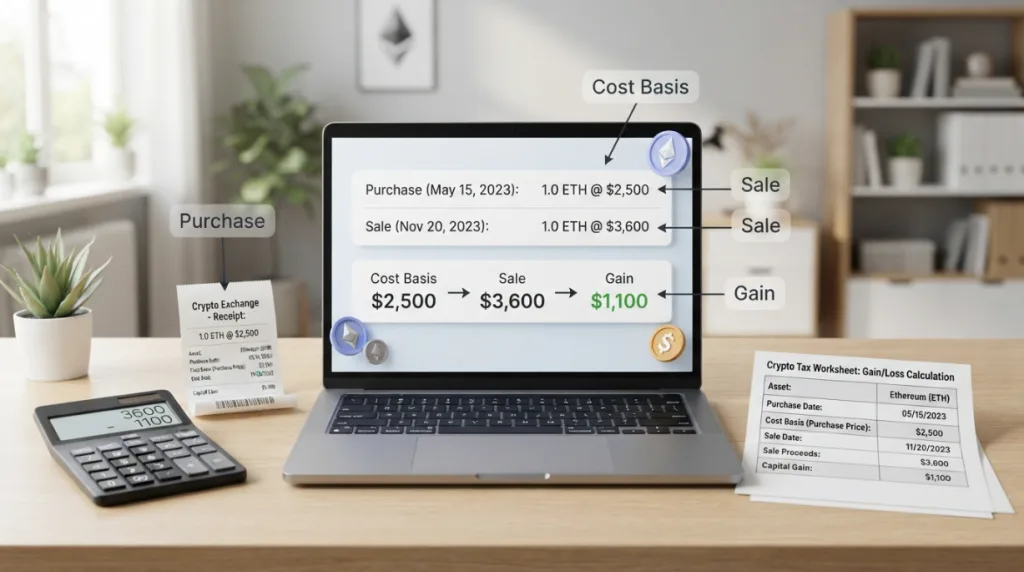
The calculation can be more complicated when you make multiple purchases, receive crypto as income, pay transaction fees, or dispose of portions of a larger holding.
The IRS says taxpayers may need information such as the asset type, acquisition date and time, number of units acquired, and fair market value when determining basis.
Why Crypto Cost Basis Can Be Difficult
Crypto investors often purchase the same asset at different times and prices.
For example:
| Purchase | Amount | Cost |
|---|---|---|
| January | 0.20 BTC | $7,000 |
| April | 0.20 BTC | $10,000 |
| August | 0.20 BTC | $13,000 |
If you later dispose of 0.20 BTC, you need to determine which units were disposed of under the applicable identification rules.
For digital assets held with a broker, the IRS has detailed rules concerning adequate identification. When the required identification is not made, FIFO can apply under the applicable rules.
This is why keeping accurate lot-level records can make tax preparation much easier.
Short-Term and Long-Term Crypto Gains
The holding period can affect the federal tax treatment of a capital gain or loss.
Generally, property held for one year or less is treated as short-term, while property held for more than one year may qualify for long-term capital gain treatment.
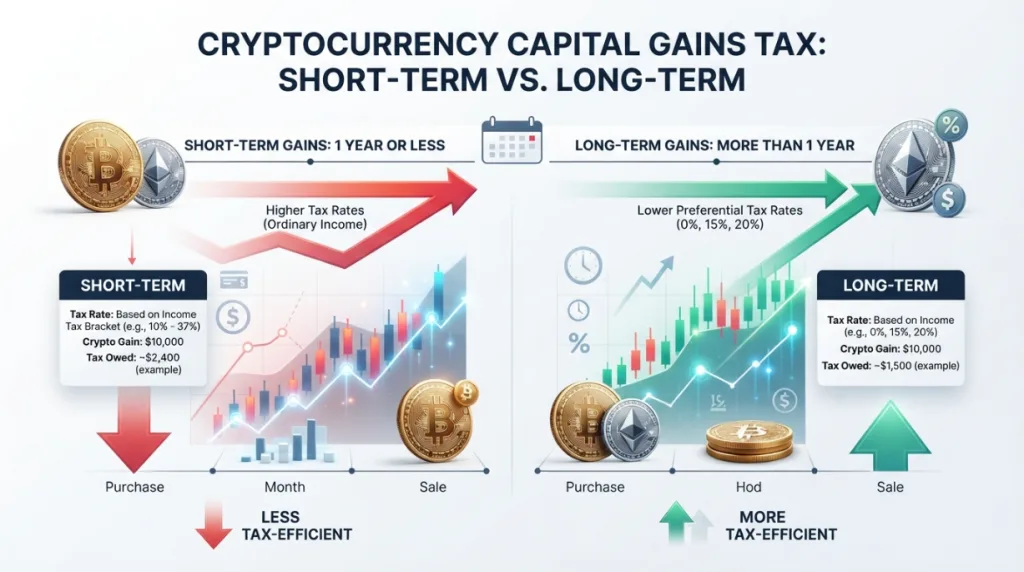
Your actual tax rate depends on your overall tax situation rather than one universal crypto tax percentage.
This means you should not assume every crypto profit is taxed at the same rate.
How to Report Crypto on Form 8949
Form 8949 is an important form for many taxpayers who dispose of crypto held as capital assets.
The IRS explains that individuals generally use Form 8949 to report applicable sales and other capital transactions involving digital assets and then summarize the resulting capital gains and losses on Schedule D.
The current Form 8949 instructions also include digital-asset-specific reporting boxes.
For short-term digital asset transactions, boxes G, H, and I are used as applicable. For long-term digital asset transactions, boxes J, K, and L are used as applicable.
This is an important correction from older crypto-tax articles that still tell readers to use the older generic Form 8949 boxes for digital assets.
How Schedule D Fits Into Crypto Tax Filing
Schedule D is used to summarize capital gains and losses.
When applicable, detailed transactions can be reported on Form 8949 and then carried into Schedule D.
The IRS states that individuals should calculate capital gain or loss from digital asset transactions under the applicable forms and instructions and summarize capital gains and deductible capital losses on Schedule D.
However, the exact reporting workflow can depend on whether you received Form 1099-DA and whether the form includes basis information.
What Is Form 1099-DA?
Form 1099-DA is used to report digital asset proceeds from broker transactions.
For sales effected after 2025, the IRS requires brokers to report gross proceeds for digital asset sales, while basis reporting applies to covered digital assets under the applicable rules. Basis reporting for noncovered digital assets can be voluntary under the 2026 instructions.
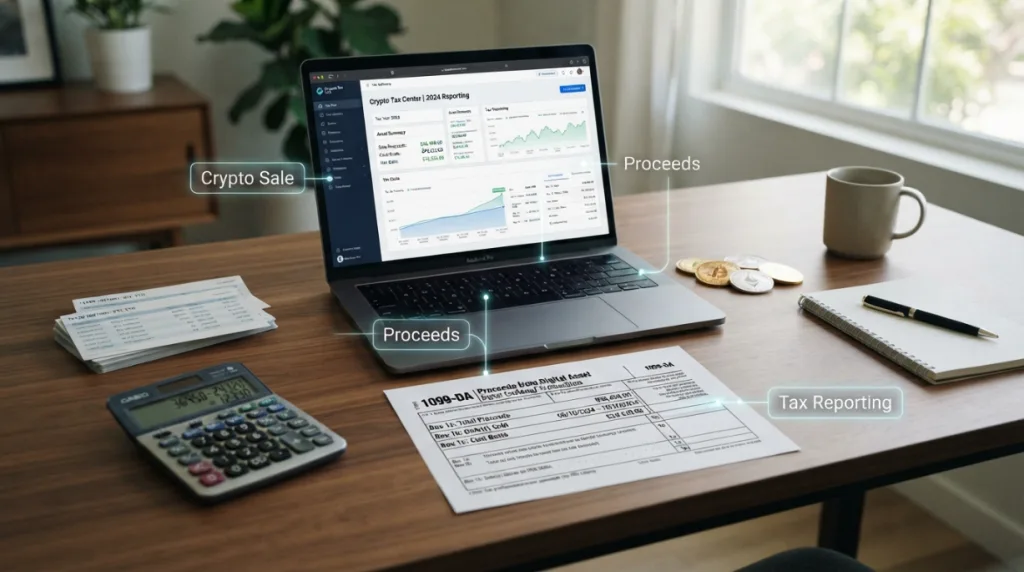
The form can contain information such as the digital asset, units sold, acquisition date where applicable, sale date, proceeds, and basis information when required.
This makes Form 1099-DA an important document for 2026 tax filing.
Does Form 1099-DA Include Every Crypto Transaction?
No.
This is one of the most important points investors should understand.
The 2026 Form 1099-DA instructions describe broker reporting requirements, but certain activities are not reported through the form. For example, staking payments and rewards are not reported on Form 1099-DA.
Therefore, you should keep your own records even when an exchange or broker provides a 1099-DA.
What If You Do Not Receive Form 1099-DA?
Not receiving Form 1099-DA does not mean you can ignore a taxable transaction.
The IRS states that taxpayers must report income, gains, and losses from taxable digital asset transactions even when they do not receive a payee statement or information return.
Your activity may involve self-custody wallets, decentralized applications, multiple exchanges, or other platforms.
In those situations, your own transaction history may be more complete than any single tax form.
How to Answer the Digital Asset Question
U.S. federal tax returns include a digital asset question that taxpayers must answer.
The question asks whether, during the tax year, you received digital assets as a reward, award, or payment for property or services, or sold, exchanged, or otherwise disposed of a digital asset or financial interest in one.
The IRS provides a questionnaire to help taxpayers determine whether they should answer Yes or No.
Importantly, simply owning digital assets, purchasing them with real currency and not selling them, or moving assets between wallets you own can fall into situations where the IRS says you may answer No, subject to the specific facts. Paying a transaction fee with digital assets is one exception to the wallet-transfer example.
Do You Pay Taxes When You Buy Crypto?
Buying cryptocurrency with U.S. dollars and holding it does not generally constitute a taxable disposal.
For example, if you purchase $5,000 of Bitcoin and simply hold it, the market price could rise or fall without creating a realized capital gain merely from that price change.
However, keep your purchase records because the information can become important when you later sell or otherwise dispose of the asset.
Are Transfers Between Your Own Wallets Taxable?
Moving crypto from one wallet or account you control to another generally is not the same as selling or exchanging the asset.
The IRS specifically says that transferring digital assets between wallets or accounts you own or control can fall under the No answer to the digital asset question, provided it is simply your own transfer and you did not pay the transfer fee with digital assets.
Still, you should keep transfer records.
Without them, tax software may misunderstand a wallet-to-wallet movement as a sale or a missing transaction.
How to Track Crypto Transactions
Good recordkeeping can make crypto tax filing much easier.
Create a complete record for every platform you use.
Your records may include:
- Exchange transaction history
- Wallet addresses
- Transaction hashes
- Purchase dates
- Sale dates
- Token quantities
- U.S. dollar values
- Fees
- Staking rewards
- Mining activity
- Airdrops
- DeFi transactions
- NFT transactions
- Transfers between your own wallets
The IRS says taxpayers need information such as the asset type, acquisition date and time, number of units, and fair market value when determining basis.
How to Prepare for Crypto Tax Filing
1. List Every Platform
Start by identifying every exchange, broker, wallet, DeFi application, and marketplace you used during the tax year.
This prevents you from overlooking activity that happened outside your primary exchange.
2. Download Your Records
Export transaction histories from each relevant platform.
Do not rely only on an annual summary if detailed transaction data is available.
3. Separate Transfers From Sales
Mark transfers between wallets you control separately from taxable disposals.
This makes your transaction history easier to reconcile.
4. Calculate Cost Basis
Match each disposal with the appropriate acquisition information.
Pay close attention to multiple purchases of the same asset and the identification rules that apply.
5. Separate Income From Capital Transactions
Not every crypto transaction belongs in the same tax category.
A sale of an investment asset can produce a capital gain or loss, while compensation, certain staking rewards, mining income, or other activities may produce ordinary or business income depending on the circumstances.
6. Review Form 1099-DA
If you receive Form 1099-DA, compare it with your own transaction records.
Check the asset, units, sale date, proceeds, acquisition information, and basis where applicable.
7. Complete the Applicable Tax Forms
Capital transactions may involve Form 8949 and Schedule D.
Other digital asset income may require Form 1040, Schedule 1, Schedule C, or another applicable form depending on the type of income and your circumstances.
8. Keep Your Supporting Records
Save your calculations and supporting transaction records.
Organized records can make future tax filing much easier.
Common Crypto Tax Filing Mistakes
Reporting Only Cash Sales
Some investors report only the crypto they converted into U.S. dollars.
That can overlook taxable swaps and other disposals.
Ignoring Crypto Payments
Using crypto to purchase goods or services can create a taxable disposal.
The IRS specifically includes these transactions among digital asset activities that can require reporting.
Forgetting Staking Rewards
Investors sometimes track trading activity but forget rewards.
Staking income should be reviewed separately because it is not simply another Form 1099-DA transaction.
Using the Wrong Cost Basis
An incorrect purchase price can produce an incorrect gain or loss.
Keep original acquisition records whenever possible.
Assuming 1099-DA Is a Complete Tax Return
Form 1099-DA provides broker-reported information.
It does not necessarily represent every digital asset activity you had during the year.
Using Outdated Form 8949 Instructions
Older articles may not reflect the digital-asset-specific Form 8949 boxes.
The current instructions use G, H, and I for applicable short-term digital asset transactions and J, K, and L for applicable long-term transactions.
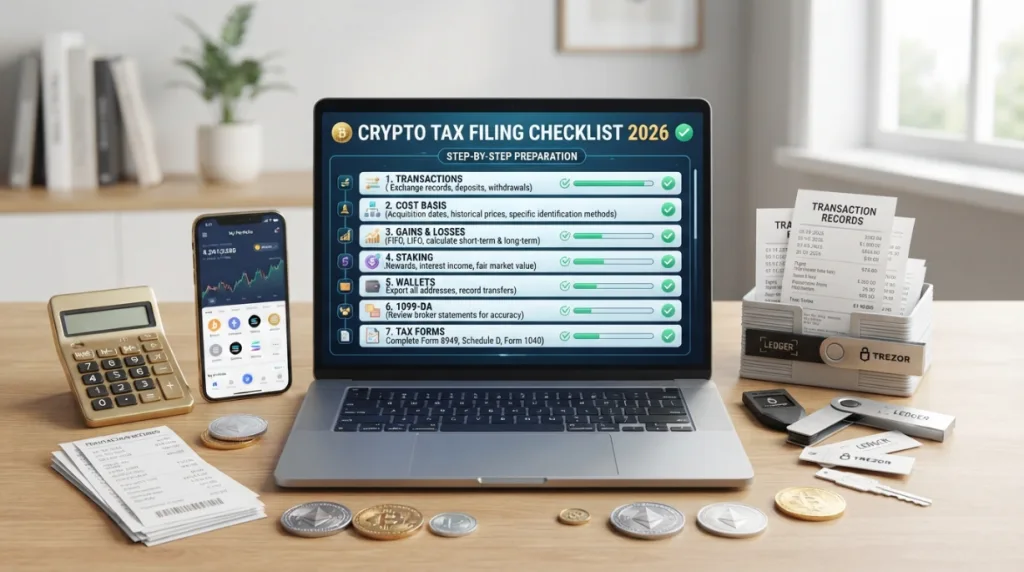
Crypto Tax Filing Checklist
Before filing, review your crypto activity using this checklist:
| Item | What to Review |
|---|---|
| Exchanges | All purchases, sales, and swaps |
| Wallets | Transfers and self-custody activity |
| Cost basis | Acquisition price and date |
| Proceeds | Value received when disposing of crypto |
| Staking | Rewards and related records |
| Mining | Income and expenses where applicable |
| Airdrops | Receipt and valuation records |
| DeFi | Swaps, rewards, fees, and other activity |
| NFTs | Purchases and sales |
| Form 1099-DA | Broker-reported proceeds and applicable basis |
| Form 8949 | Capital transactions |
| Schedule D | Capital gain and loss summary |
| Other income | Appropriate tax forms or schedules |
Frequently Asked Questions
Is crypto taxable in the U.S.?
Yes. Cryptocurrency and other digital assets can create federal tax obligations when you sell, exchange, spend, or receive them in taxable circumstances.
Do I have to report crypto if I did not receive Form 1099-DA?
Yes. The IRS says taxable digital asset income, gains, and losses must be reported whether or not you receive an information return.
Is swapping Bitcoin for Ethereum taxable?
Generally, exchanging one digital asset for another can be a taxable disposal of the asset you gave up.
Do I pay tax when I only buy Bitcoin?
Simply purchasing digital assets with U.S. dollars and holding them generally does not itself create a taxable disposal.
Which forms are used for crypto gains?
For applicable capital transactions, taxpayers generally use Form 8949 and summarize capital gains and losses on Schedule D.
What is Form 1099-DA?
Form 1099-DA is used for broker reporting of digital asset proceeds. For sales after 2025, the 2026 rules include mandatory gross-proceeds reporting and basis reporting for covered digital assets, subject to the applicable requirements.
Are staking rewards reported on Form 1099-DA?
No. The 2026 Form 1099-DA instructions state that rewards and staking payments are not reported on Form 1099-DA.
Final Thoughts
Crypto tax filing becomes much easier when you keep accurate records throughout the year.
Do not wait until tax season to reconstruct your entire crypto history. Track purchases, sales, swaps, rewards, payments, and wallet transfers as they happen.
For 2026, Form 1099-DA is an important development for digital asset reporting. Brokers generally report gross proceeds for sales after 2025, while basis reporting applies to covered digital assets under the applicable rules.
At the same time, Form 1099-DA does not replace your own records. The IRS makes clear that taxpayers remain responsible for reporting taxable digital asset transactions even when they do not receive an information return.
Before submitting a return, review your transaction history, verify your cost basis, check your tax forms, and make sure each taxable activity is reported on the appropriate form.
Because individual tax situations can differ, taxpayers with complex trading, DeFi, mining, staking, business, or international activity may benefit from advice from a qualified tax professional familiar with digital assets.



Leave a Reply