

In this article
- TL;DR: Our Quick Picks
- How We Evaluated These Finance Chatbots
- What Is a Finance AI Chatbot, and How Does It Work?
- The Big News: ChatGPT Finances
- Bank Chatbots: Free, but Limited to Your Bank
- The Best Standalone Finance AI Chatbots, Compared
- How These Apps Make Money (and Why It Matters)
- Honorable Mentions
- What a Finance Chatbot Can — and Can't — Do
- How to Choose the Right Finance Chatbot for You
- Stay Safe: Privacy, Read-Only Access, and When to Call a Human
- Frequently Asked Questions
- Final Verdict
TL;DR: Our Quick Picks
- Best overall chat experience: ChatGPT Finances — the biggest name in AI finally connects to your bank (Plus/Pro, US only).
- Best for people who avoid their finances: Cleo — a sassy chatbot that makes budgeting feel like texting a friend.
- Best all-accounts AI assistant: Monarch Money — one chat coach across every account, great for couples.
- Best for transaction accuracy: Copilot Money — the smartest auto-categorization, iOS only.
- Best for canceling subscriptions: Rocket Money — AI finds and cancels bills you forgot about.
- Best hybrid AI + human: Albert Genius — text a money question; AI drafts, a human reviews.
- Best free bank chatbot: Erica (Bank of America) — 24.6 million users, no extra app needed.
A finance chatbot — also called an AI-powered personal finance assistant or finance AI chatbot — is a conversational tool that connects to your bank and credit-card accounts, reads your transactions, and answers money questions in plain English: “How much did I spend on groceries last month?” or “Can I afford this trip?” The category exploded in May 2026 when OpenAI launched ChatGPT Finances, letting the world’s most popular chatbot connect to 12,000+ financial institutions through Plaid. CNBC’s roundup of top AI-powered apps to manage money confirms the shift from spreadsheets to conversations. This guide ranks the seven strongest options, from ChatGPT itself to bank bots like Erica and standalone apps like Cleo and Monarch, with verified pricing, honest pros and cons, and the safety rules you need before you link your accounts. If you also want a tool that builds and enforces a budget, our companion guide to AI budgeting pairs well with this one.
How We Evaluated These Finance Chatbots
We scored every tool on five criteria: genuine conversational AI depth (not just a marketing label), account-connection breadth and accuracy, pricing transparency, privacy and data-use model, and real-world usefulness. We cross-checked pricing directly on company websites as of September 2026 — several apps restructured their tiers this year, so older review prices are often wrong. Prices below are typical current ranges; always confirm at signup.
What Is a Finance AI Chatbot, and How Does It Work?
A finance chatbot is more than a calculator with a chat window. It uses three layers: account aggregation (usually via Plaid, which connects to 12,000+ institutions), transaction categorization via machine learning, and a large language model that turns your messy spending into plain-English answers. The best ones persist context across conversations — they remember your goals and your habits — and they proactively nudge you when something changes, like a subscription price jumping or your checking balance dipping low.
There are three flavors, and they matter for your wallet: standalone apps (Cleo, Monarch, Copilot, Rocket Money, Albert) that you subscribe to; bank chatbots (Erica, Eno, Ally Assist) that live inside your bank’s app for free; and general AI assistants with finance mode (ChatGPT Finances, Perplexity Finance) that bolt personal-finance dashboards onto a chatbot you may already pay for. None of them can move money on their own — access is read-only — and none of them is a fiduciary financial advisor. That distinction will come back later.
The Big News: ChatGPT Finances
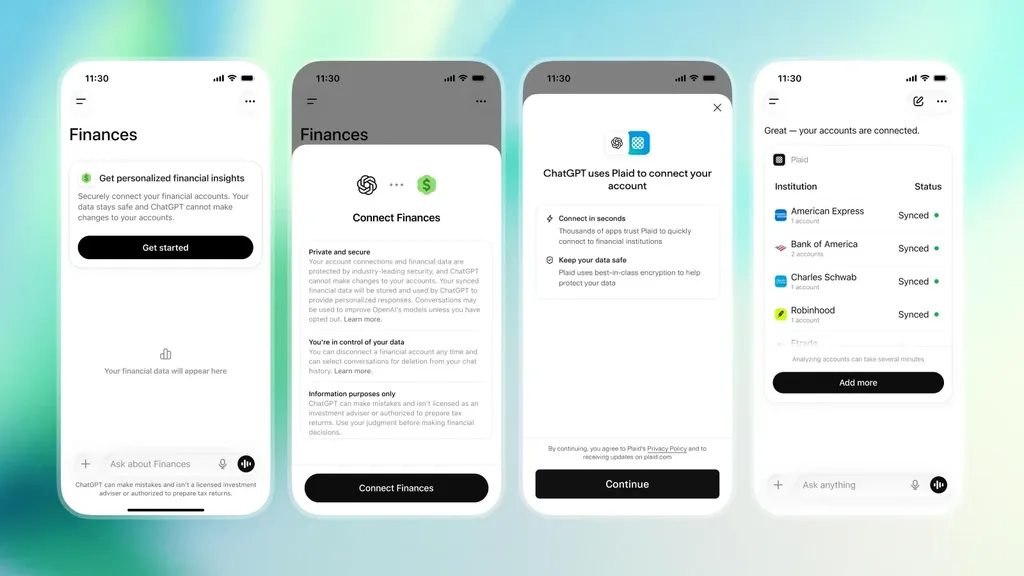
In May 2026, OpenAI did something the fintech world had both awaited and feared: it plugged ChatGPT directly into your bank account. You can read the official announcement on OpenAI’s personal finance page. Here is how it actually works. You open a “Finances” tab inside ChatGPT, connect your accounts securely through Plaid (and optionally your credit report through Experian), and suddenly ChatGPT can see your balances, transactions, investments, subscriptions, and net worth — then answer questions grounded in your real numbers. Access is read-only. It cannot move money, pay bills, or see full account numbers. Disconnecting an account deletes the synced data.
The catch is cost and availability. ChatGPT Finances launched in preview for U.S. Pro subscribers ($200/month) on May 15, 2026, and officially expanded to Plus users ($20/month) on June 25, 2026, on web, iOS, and Android. It is not available on the Free plan, and it is U.S.-only so far, with Intuit support coming. Perplexity Finance added the same kind of Plaid bank-linking about five weeks earlier, on April 9, 2026, so the two are now direct competitors. OpenAI says more than 200 million people already ask ChatGPT financial questions every month; this launch makes those answers personal. If you already pay for ChatGPT Plus, this is the best free-with-subscription finance chatbot you can get — but remember it is not tax or investment advice, and it will still occasionally get a number wrong. (Speaking of taxes, if you want AI that actually files a return, see our guide on AI taxes.)
Bank Chatbots: Free, but Limited to Your Bank
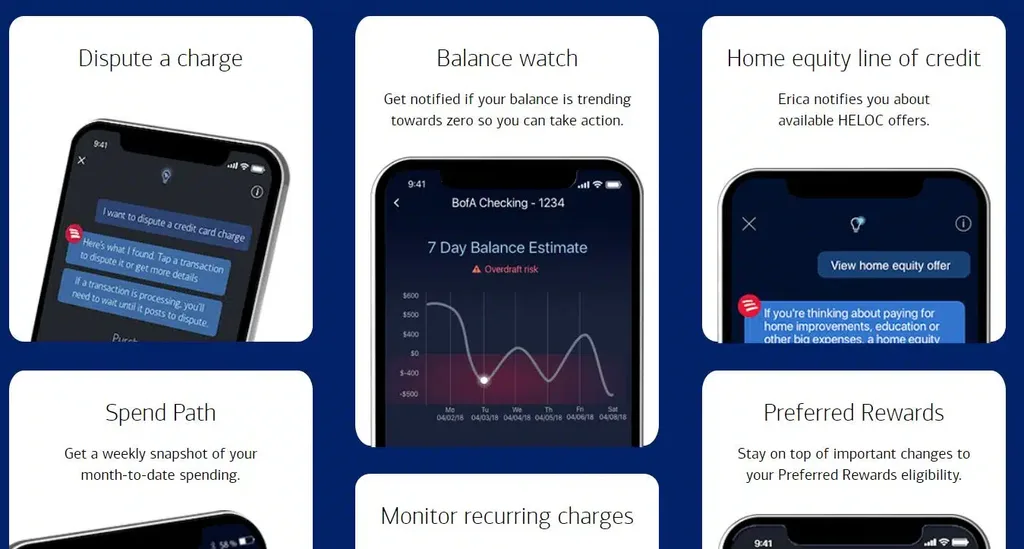
Before ChatGPT, the biggest finance chatbot in America was already inside your bank app. Bank of America’s Erica, launched in 2018, now serves 24.6 million clients and has logged 3.6 billion interactions — including 1.9 billion proactive, personalized insights — per Bank of America’s official fast facts. It handles roughly two million interactions a day, resolves about 98% of queries without a human, and can check balances, send money via Zelle, pay bills, and flag unusual spending — all inside the app you already have. Capital One’s Eno does similar work and is best known for generating virtual card numbers to protect you when shopping online. Ally Bank’s Ally Assist covers the same ground for Ally customers.
The limitation is obvious: a bank chatbot only sees accounts at that bank. Erica cannot tell you how your Fidelity portfolio is doing or that your Chase credit card just raised its APR. For a single-bank customer with simple finances, it is genuinely excellent — and free. If your money lives across multiple institutions, you want a standalone app instead.
The Best Standalone Finance AI Chatbots, Compared
| Tool | Best For | Typical Price | AI Highlight | Platforms |
|---|---|---|---|---|
| Cleo | Conversational coaching, Gen Z | Free; $5.99–14.99/mo | Sassy chat, roast mode, cash advance | iOS, Android |
| Monarch Money | All-accounts coach, couples | $14.99/mo or $99.99/yr | Chat assistant + AI insights | iOS, Android, web |
| Copilot Money | Transaction accuracy | ~$13/mo or ~$95/yr | Best-in-class AI categorization | iOS/Mac only |
| Rocket Money | Cancel subscriptions | Free; $7–14/mo | Subscription-detection AI | iOS, Android, web |
| Albert | Hybrid AI + human text | Free; Genius ~$14.99/mo | Human-reviewed answers 7 days/wk | iOS, Android |
Cleo — Best Chatbot for People Who Avoid Their Finances
Cleo is the anti-dashboard. Its entire interface is a text conversation with a personality — ask “how much did I spend on takeout?” and it answers, sometimes with a “roast mode” that calls out overspending in a way that feels like a friend teasing you, not a bank scolding you. Five million users, mostly younger, swear by it. The free tier covers basic chat and budgeting. Plus ($5.99/mo) unlocks cash advances up to $250 and credit features; Pro ($8.99/mo) adds high-yield savings at 2.75% APY, voice chat, and advanced AI coaching; Builder ($14.99/mo) adds the secured Cleo Card, credit-builder reporting, early paycheck, and advances up to $500 with direct deposit. The catch: Cleo is a cash-flow coach, not an investment or tax advisor, and its pricing has shifted repeatedly. Choose Cleo if the reason you don’t budget is that spreadsheets make you anxious.

Monarch Money — Best All-Accounts AI Assistant
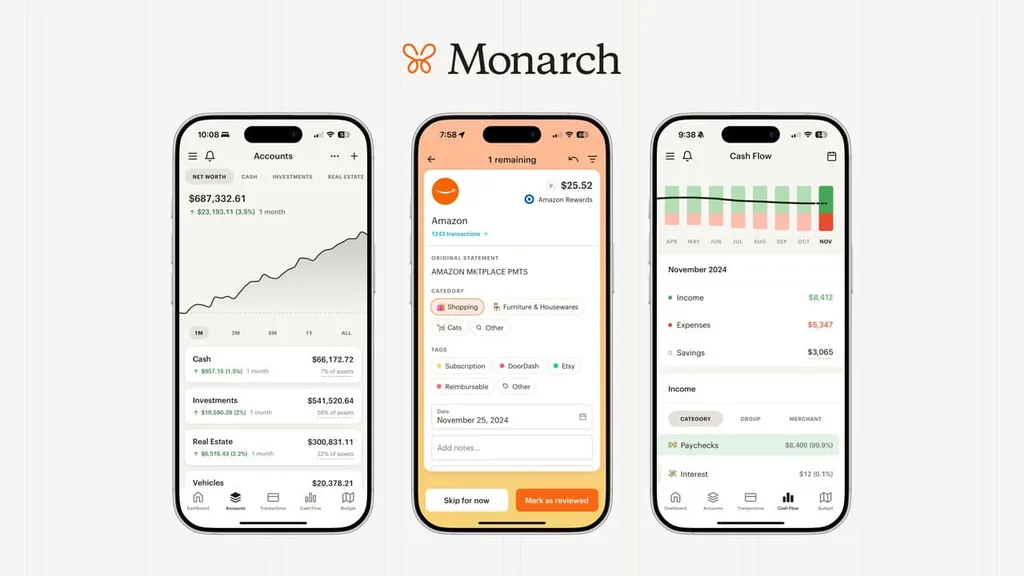
Monarch Money became the favorite of former Mint users after Intuit shut Mint down, and its AI assistant is the strongest “one coach across everything” option. For $14.99/month or $99.99/year (Core), it connects 11,000+ institutions, tracks net worth, budgets, investments, and subscriptions, and its chat assistant answers questions across all of it — “how much are we spending on subscriptions as a couple?” — with real numbers. Couples get shared household access without merging accounts. A higher Plus tier ($199/year, annual only) adds Morningstar-powered investment analysis, which is overkill for most people. There is no free tier, but a 7-day trial is standard, and annual billing saves about 45%. Choose Monarch if you want a single, clean view of your whole financial life with a chat layer on top.
Copilot Money — Best AI Categorization, iOS Only
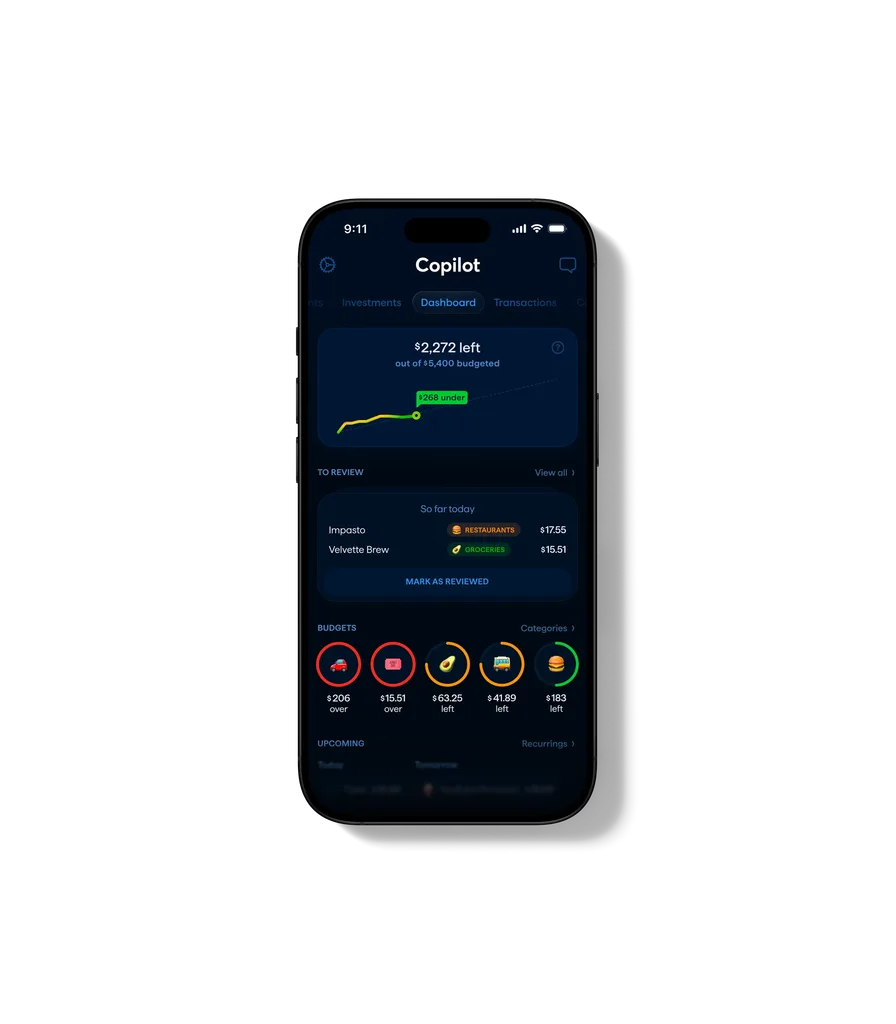
Copilot Money is the Apple Design Award winner of this category, built natively for iPhone, iPad, and Mac (with a limited web app). Its standout feature is not a chat — it is AI auto-categorization that reviewers consistently rate the most accurate in the industry, which means less time fixing mislabeled transactions. It runs about $13/month or $95/year, with a Family plan at $155/year and a one-month free trial. The tradeoff is platform exclusivity: there is no Android app, and it has no conversational chatbot. Choose Copilot if you live in the Apple ecosystem and care more about accurate transaction data than about talking to your money.
Rocket Money — Best AI for Canceling Subscriptions
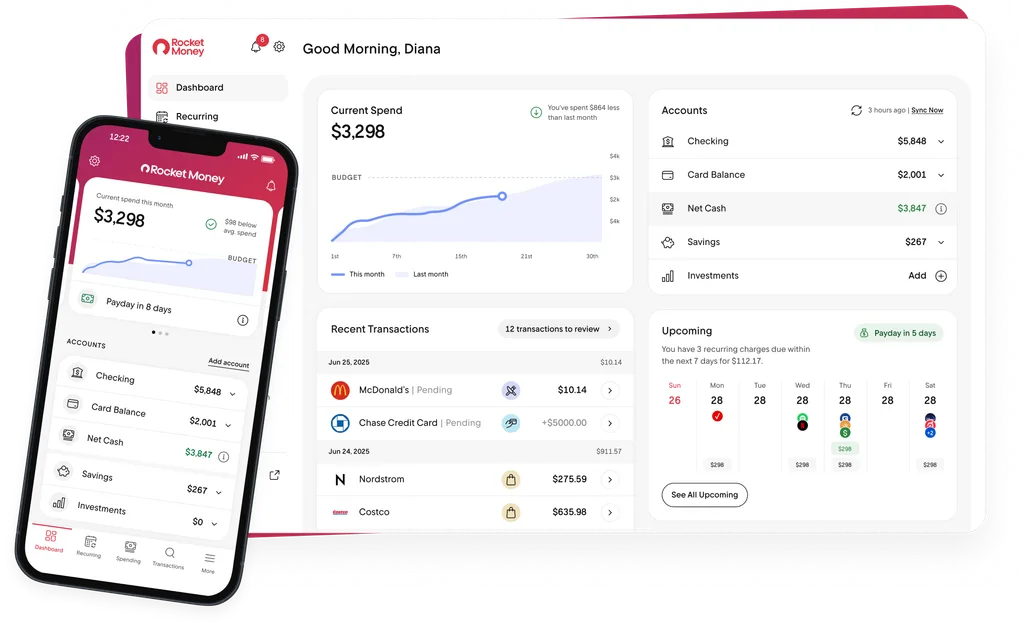
Rocket Money (formerly Truebill) has one superpower: its AI detects every recurring charge on your accounts, shows you the total, and offers to cancel the ones you don’t want — it has saved users more than $1 billion cumulatively on subscriptions and bill negotiation. The app is free and includes basic budgeting, subscription tracking, spending insights, and credit monitoring. Premium (concierge cancellation, smart savings, unlimited categories) uses a “pay what you think is fair” model, typically $7–14/month, and bill negotiation takes 35–60% of the first year’s savings — only if it succeeds. The honest caveat: Rocket Money’s cancellation team needs your login credentials for some services, and its premium pricing can feel opaque. Choose Rocket Money if your biggest money leak is forgotten subscriptions — it pays for itself in one canceled gym membership.
Albert — Best Hybrid AI + Human Chat
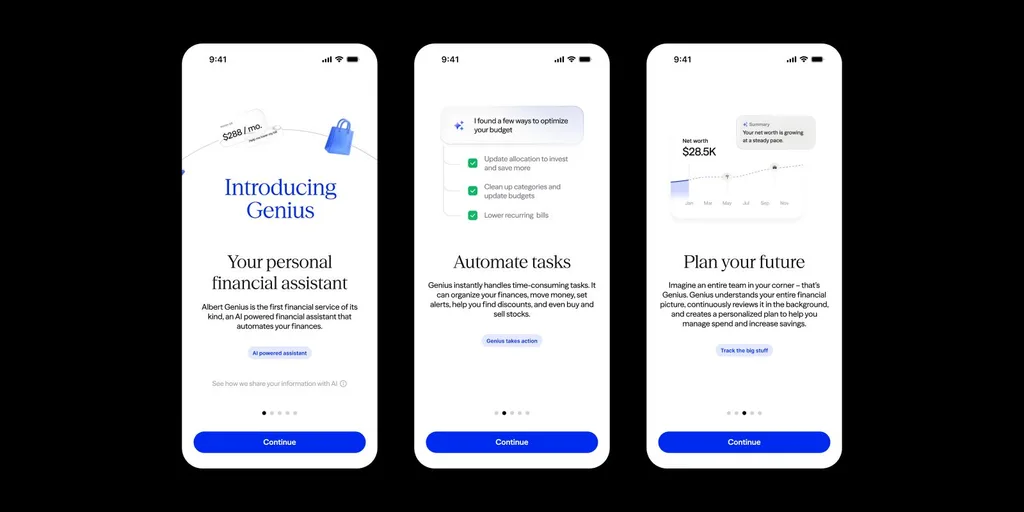
Albert’s Genius subscription lets you text any money question seven days a week; AI drafts the answer and a human “Genius” reviews it before it reaches you. Pricing shifted in 2026: many users still pay about $14.99/month with a pay-what’s-fair option as low as $6–8, while newer plan tiers list Standard at $19.99/month and Genius at $39.99, with a Family plan at $39.99 — so confirm the exact price at signup. Albert also bundles automated savings, cash advances from $25 up to $1,000 for eligible users, bill negotiation, and managed investing. Choose Albert if you want a human in the loop on everyday questions — “should I buy the car or lease?” — without paying a $250/hour advisor. The Geniuses are not all CFPs, so for complex planning you still want a professional.
How These Apps Make Money (and Why It Matters)
Their business model tells you whose interests they serve — read this before you link anything:
- Subscription-only (Monarch, Copilot, YNAB): Revenue comes from you, so their incentive is to keep you happy and subscribed. Cleanest model.
- Subscription + cash advances (Cleo, Albert): They profit when you borrow from them, which can create a subtle incentive to keep you living paycheck to paycheck.
- Subscription + bill-negotiation cut (Rocket Money): They only get paid when they save you money — aligned, but expect aggressive upsells.
- Free bank bots (Erica, Eno): Free to you, but they exist to reduce the bank’s customer-service costs and sell you more bank products.
- Included with ChatGPT Plus: Free if you already pay, but OpenAI’s long-term monetization of your financial data is still an open question.
Honorable Mentions
These are worth a look if the top seven don’t fit: Empower Personal Dashboard (free net-worth and investment tracking, formerly Personal Capital — note: the separate cash-advance app once called Empower rebranded to Tilt, so don’t confuse the two), YNAB (zero-based budgeting with AI nudges, $14.99/mo or $99/yr), Simplifi by Quicken (budgeting at about $4/month billed annually), Origin (full AI financial planning stack), Franklin AI (a newer dedicated AI financial advisor connecting 12,000+ institutions), Vera (AI money coaching), and Perplexity Finance (ChatGPT Finances’ closest competitor, also Plaid-powered). If you want your assistant to also execute trades and manage investments, our guide to AI investing apps covers that next step.
What a Finance Chatbot Can — and Can’t — Do
Set your expectations clearly. Here is what these tools genuinely deliver, and where they stop:
- What they do well: Aggregate all accounts, spot forgotten subscriptions, predict cash flow, answer “where did my money go?” instantly, nudge you to save, and estimate whether you can afford a purchase.
- What they don’t do: Move money (read-only by design), give fiduciary investment advice, guarantee returns, or replace a professional for complex situations like stock options, estate planning, or small-business taxes.
- The hallucination risk: Even ChatGPT Finances can misstate a number or misread a transaction category. Always verify anything that matters — a large transfer, a tax figure, or an investment recommendation — against the source account.
How to Choose the Right Finance Chatbot for You
Match your situation to the tool:
- You already pay for ChatGPT Plus. Start with ChatGPT Finances — it’s included and surprisingly capable.
- You avoid opening your banking app. Use Cleo. Its personality actually gets people to engage.
- Your money is spread across banks and brokerages. Use Monarch Money for one unified view.
- You’re an iPhone power user who hates miscategorized transactions. Use Copilot Money.
- Your biggest leak is forgotten subscriptions. Use Rocket Money free tier first.
- You want a human reviewing the answer. Use Albert Genius.
- You bank at one place and want free help. Use your bank’s chatbot — Erica, Eno, or Ally Assist.
Once the chatbot surfaces extra cash each month, park it in a high-yield savings account so it earns interest while you decide what to do with it.
Stay Safe: Privacy, Read-Only Access, and When to Call a Human
Every tool here connects via Plaid or a similar aggregator, and access is read-only — they cannot withdraw your money. Still, three rules keep you safe:
- Use official apps and official links. Download from the App Store or the company’s real website; never click a “finance bot” link in an unsolicited text.
- Read the privacy policy. Some apps monetize your financial data or share it with advertisers. The cleanest ones are subscription-only.
- Know when a chatbot isn’t enough. For portfolios above six figures, complex taxes, or major life decisions, work with a fiduciary financial advisor or an AI financial advisor that is regulated as one. A free chatbot is a coach, not a legal or fiduciary professional.
Frequently Asked Questions
What is the best finance AI chatbot in 2026?
If you already pay for ChatGPT Plus, ChatGPT Finances is the best value — it’s included and connects to all your accounts. For standalone apps, Cleo is the most engaging chatbot, Monarch Money is the best all-accounts assistant, and Copilot Money has the most accurate AI categorization.
Are finance chatbots safe to connect to my bank?
Yes, when they use established aggregators like Plaid. Access is read-only — they cannot move your money — and you can revoke access at any time. Stick to well-known apps with clear privacy policies and avoid unsolicited “AI money bot” links.
How much does an AI personal finance assistant cost?
Most range from free to $15/month, or $50–100/year. Bank chatbots like Erica are free with your account. ChatGPT Finances requires a ChatGPT Plus ($20/mo) or Pro ($200/mo) subscription.
Can a finance chatbot move my money or pay bills?
No. Personal finance chatbots connect in read-only mode — they can see balances and transactions but cannot withdraw funds or pay bills. Bank chatbots like Erica can initiate transfers within that bank, but only after you confirm.
Can AI chatbots give investment advice?
General chatbots cannot give fiduciary investment advice — they are not registered advisers. They can explain concepts and show you your own portfolio data. For actual advice, use a regulated robo-advisor or a human fiduciary.
Do finance chatbots sell my data?
Some do. Subscription-only models (Monarch, Copilot) are the cleanest because their revenue comes from you, not from selling data. Free apps often monetize through referrals or data sharing — read the privacy policy.
Will a finance chatbot help me save money?
Yes — most users save money by canceling forgotten subscriptions and reducing impulse spending. Rocket Money alone has saved users over $1 billion on subscriptions. But the tool only works if you actually open it and act on the nudges.
Can I use ChatGPT to manage my money now?
Yes, in the U.S. with a Plus or Pro subscription. ChatGPT Finances (launched May 15, 2026; expanded to Plus on June 25, 2026) connects to 12,000+ institutions via Plaid, shows your spending and net worth, and answers questions grounded in your real accounts. It is read-only and not financial advice.
Final Verdict
The finance chatbot category finally grew up in 2026 when ChatGPT connected to your bank, but the best tool for you still depends on how you think about money. Start with ChatGPT Finances if you already pay for Plus; add Cleo if you need a personality to keep you engaged; use Monarch or Copilot if you want the most accurate all-accounts view. None of these tools will magically fix your finances — but they will show you the truth about your money in seconds, and that is the first step. Use the chatbot for clarity, act on its nudges, and let the savings compound toward real financial independence.



Leave a Reply