
In this article
- What Is a Budget?
- How Does a Budget Work?
- Why Is Budgeting Important?
- What Are the Main Parts of a Budget?
- Budget Example for Beginners
- What Is the Difference Between a Budget and a Spending Plan?
- What Are the Most Common Types of Budgets?
- Do I Need a Budget If I Don't Have Much Money?
- What If I Make an Irregular Income?
- How to Start a Budget
- Common Budgeting Mistakes to Avoid
- Frequently Asked Questions
- Final Thoughts
If the word “budget” makes you picture complicated spreadsheets, restrictive rules, or that guilty feeling every time you order takeout — you are not alone. Somewhere along the way, budgeting got a reputation for being about restriction, punishment, and giving things up. That reputation is wrong.
Here is the truth in one sentence: A budget is simply a plan for how you will use your money. That’s it. No shame. No spreadsheets required. No promise that you must give up your morning coffee.
This guide is for beginners who want to understand what a budget actually is, how it works, and how to start one — without the judgment, jargon, or scare tactics that too many money guides rely on. By the time you finish reading, you will know exactly what a budget is, what it is not, and how to build one that fits your life instead of someone else’s rulebook.
What Is a Budget?
At its simplest, a budget is a written plan that shows how much money is coming in, where it is going, and what is left over. It answers three basic questions:
- How much money do I earn?
- How much do I spend, and on what?
- How much is left for savings, debt payoff, or other goals?
Think of it as a map for your money. It shows you the route from your paycheck to the things that matter to you — rent, groceries, an emergency fund, a vacation, retirement — so nothing gets lost along the way. The U.S. federal consumer protection resource puts it just as plainly: “A budget is a plan you write down to decide how you’ll spend your money each month” consumer.gov.
A budget is not a punishment device, a promise to become rich, or a magic spell. It is a decision-making tool. When you have a budget, you decide what your money does before the month starts, instead of wondering where it went after the month ends.
What a Budget Is NOT
Because myths about budgeting stop so many beginners from ever starting, let’s clear the air. A budget is not:
- A restriction. It is not a set of rules that forbids you from enjoying your life.
- A punishment. Missing a target one month is not a moral failure — it is data.
- A guarantee of wealth. A budget will not turn a $2,000/month income into $20,000. But it will help you make the most of what you earn.
- One-size-fits-all. The budget that works for a single graduate student will look nothing like one built for a family of four, and neither has to look like anyone else’s.
- Set in stone. Budgets change every month, and that is by design.
Once you drop those assumptions, budgeting becomes what it was always meant to be — a way to feel in control of your money instead of the other way around.
How Does a Budget Work?
A budget works by taking your incoming money and giving each dollar a purpose before it disappears. That’s it. The process behind it, once broken down, is genuinely simple:
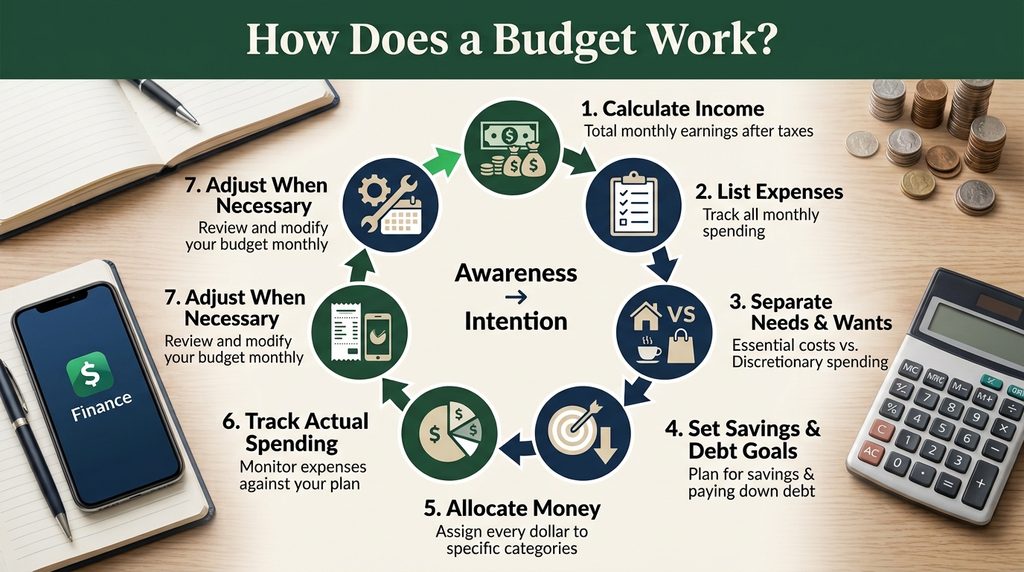
- Calculate your income. Add up the money you take home after taxes each month.
- List your expenses. Write down everything you spend money on — the rent, the streaming services, the groceries, the coffee runs.
- Separate needs from wants. Some spending is essential; some is optional. Both are allowed. You just need to know which is which.
- Set savings and debt goals. Decide how much you want to move toward an emergency fund, retirement, or paying down debt.
- Allocate your money. Assign a dollar amount to each category so that every dollar has a job.
- Track actual spending. As the month unfolds, note what you actually spend versus what you planned.
- Adjust when necessary. If your grocery estimate was off by $50, change it next month. Your budget grows and changes right along with you.
Notice what a budget is not doing here. It is not telling you what you can and cannot buy. It is showing you the consequences of choices you already make, so you can make them on purpose. That is the entire mechanism — awareness, then intention.
Why Is Budgeting Important?
Budgeting matters because money without a plan tends to disappear. Once you have a plan, several powerful things become possible:
- You know where your money goes. No more mystery about where last month’s paycheck went.
- You avoid overspending. When each category has a limit, you notice when you’re approaching it.
- You build savings on purpose. Instead of hoping money is left over, you make sure it is.
- You prepare for emergencies. The Federal Deposit Insurance Corporation recommends starting an emergency fund even with small deposits, because “starting small can lead to big savings”
- You manage debt more effectively. A budget shows exactly how much you can put toward loans or credit cards without going backwards.
- You reach financial goals faster. Whether it’s a home, a trip, or freedom from debt, a budget shortens the path.
- You reduce financial stress. Uncertainty is one of the biggest sources of money anxiety. Budgeting replaces uncertainty with clarity.
One quiet benefit budgeting provides is protection for your credit score. Budgeting itself is not reported to credit bureaus, but the behaviors that come from budgeting — paying bills on time, keeping credit card balances low, avoiding missed payments — improve your credit score over time Experian.
What budgeting will not do is instantly make you wealthy or solve every money problem in your life. That is honest, and worth saying out loud. What it will do is make sure your money is working as hard as you are.
What Are the Main Parts of a Budget?
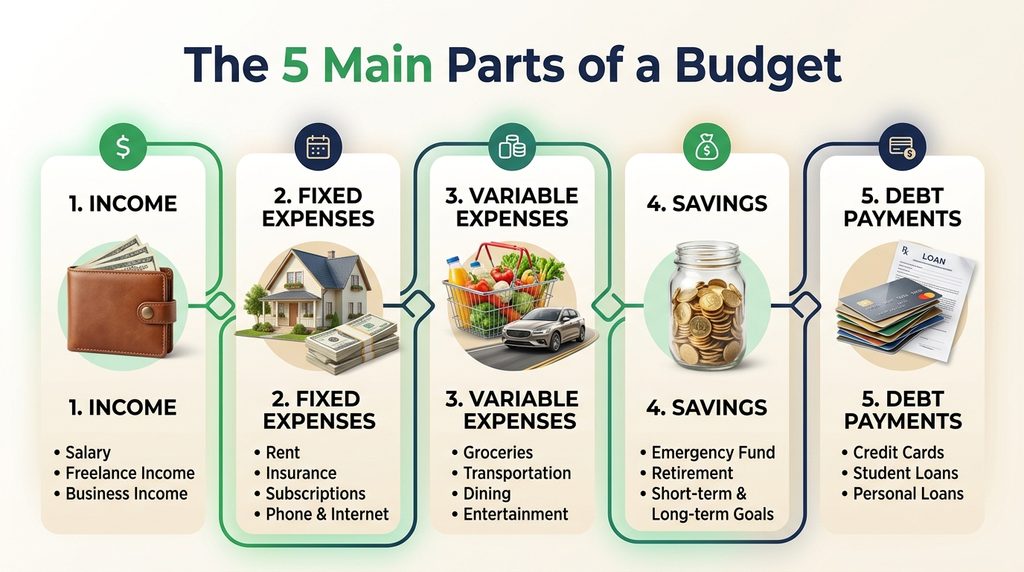
Every budget — whether it’s written on paper, built in a spreadsheet, or living inside an app — has the same core parts. Understanding them makes the whole thing far less intimidating.
1. Income
Income is any money coming in. This includes:
- Salary or wages from a job (use your take-home pay, after taxes and deductions)
- Freelance or self-employment income
- Business profit
- Side hustle earnings
- Child support or spousal support
- Government benefits, disability, or Social Security
- Investment income (dividends, interest, rental income)
Always work with net income (what actually hits your bank account), not gross income (what your job offers before tax). This one adjustment prevents most beginner budgets from failing on day one.
2. Fixed Expenses
Fixed expenses are the same amount every month. They are the obligations you can predict a mile away:
- Rent or mortgage payment
- Car loan or car insurance
- Health insurance premiums
- Subscription services (streaming, gym, cloud storage)
- Minimum loan payments (student loans, personal loans)
- Internet and phone bills
Because these numbers barely change, they are the easiest part of your budget to lock in.
3. Variable Expenses
Variable expenses change depending on the month, your choices, or the season. These include:
- Groceries
- Gas or public transportation
- Utilities that fluctuate (electricity, water)
- Dining out and takeout
- Entertainment (movies, concerts, hobbies)
- Clothing and personal care
- Household items
Variable expenses are where most budgets slip, because they feel small and forgettable. Tracking them is the single fastest way to make your budget more accurate.
4. Savings
Savings should live inside your budget as a planned expense, not “whatever is left over.” Categories can include:
- Emergency fund
- Retirement contributions
- Short-term goals (vacation, holiday, car repairs)
- Long-term goals (down payment, wedding, education)
- Sinking funds for annual bills (insurance premiums, gifts)
Treating savings as a bill you owe to your future self is one of the most effective mindset shifts in personal finance.
5. Debt Payments
If you have debt, your budget should carve out a specific amount for paying it down beyond the minimums:
- Credit card balances
- Student loans
- Personal loans
- Medical debt
- Buy Now, Pay Later obligations
Paying more than the minimum — even $25 extra — can save you hundreds or thousands in interest over the life of a debt.
Budget Example for Beginners
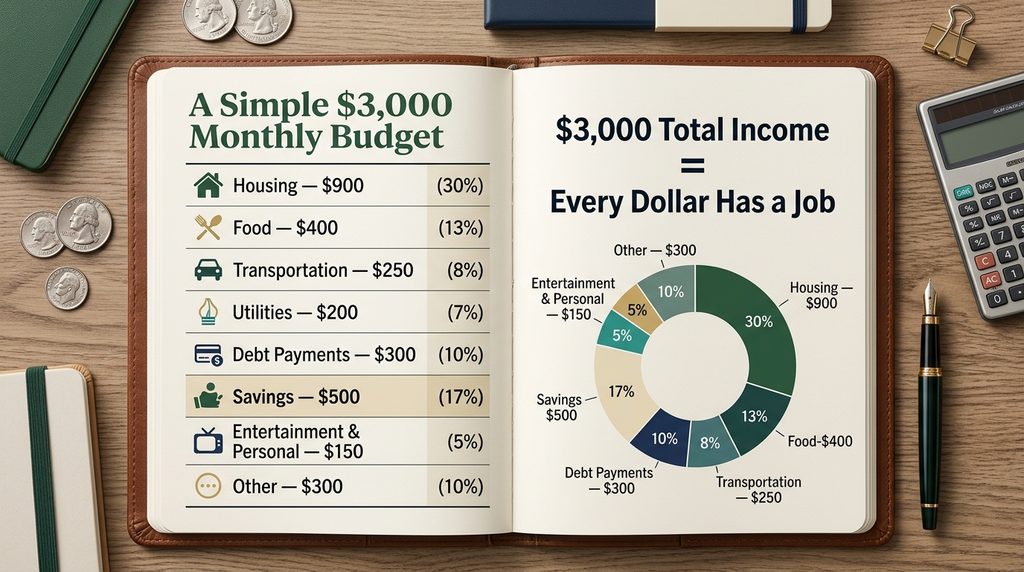
Definitions are helpful, but a real example makes budgeting click. Here is what a simple monthly budget might look like for someone bringing home $3,000 a month:
| Category | Monthly Amount | Percentage of Income |
|---|---|---|
| Take-home income | $3,000 | 100% |
| Housing (rent, insurance) | $900 | 30% |
| Food (groceries + some dining out) | $400 | 13% |
| Transportation (car, gas, insurance) | $250 | 8% |
| Utilities (electricity, internet, phone) | $200 | 7% |
| Debt payments (credit card, student loan) | $300 | 10% |
| Savings (emergency + retirement) | $500 | 17% |
| Entertainment & personal | $150 | 5% |
| Other (clothing, subscriptions, misc.) | $300 | 10% |
| Total spent + saved | $3,000 | 100% |
Notice a few things about this example. First, every dollar has a job. Second, savings appears as its own line, not an afterthought. Third, the percentages roughly track with common guidelines — housing under 30%, food around 10–15%, savings at least 10%.
This is a starting point, not a rulebook. A single person in a low-cost city might spend only 20% on housing and put more into savings. A parent of two might spend 15% on groceries. A recent graduate might dedicate 20% to debt for a couple of years. The categories stay the same. The percentages flex to fit your life.
Also notice how the budget shows a full picture before the month begins. That is what separates a budget from simple tracking. Tracking tells you what happened. A budget decides what will happen.
What Is the Difference Between a Budget and a Spending Plan?
You may have seen “spending plan” used in place of “budget” — and it’s a fair question whether there’s a real difference.
Practically, the two mean the same thing: a written plan for your money. The language, though, can matter more than it seems. “Budget” often feels like restriction to people. “Spending plan” often feels like intention. Same tool, different psychology.
If the word “budget” carries emotional baggage for you — maybe from a parent who used it as a stress word, or from years of restrictive dieting-style budgets that never stuck — calling it a spending plan can help you approach it fresh. Both names describe a document that answers the same question: how do I want to use my money this month?
Use whichever word works for you. The point isn’t the label. The point is that the money has a plan.
What Are the Most Common Types of Budgets?
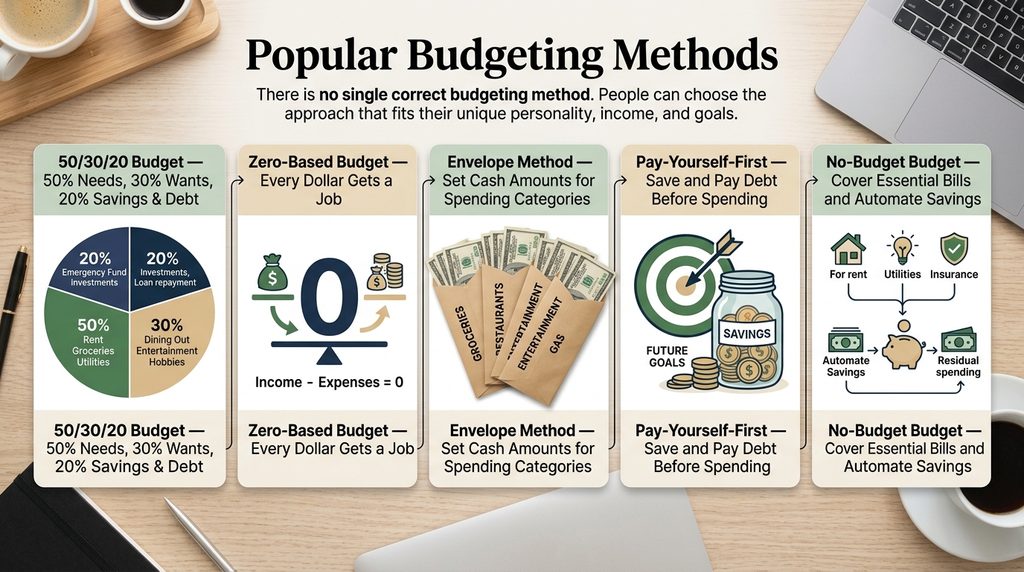
There is no single “correct” budgeting method. Different systems work for different personalities, income situations, and financial goals. Here’s a quick overview of the most popular approaches — each one is worth its own guide, and we’ll link to deeper ones as they publish.
The 50/30/20 Budget
Divide your take-home income into three buckets: 50% for needs, 30% for wants, and 20% for savings and debt payoff. Simple, flexible, and forgiving — this is the most beginner-friendly method available. It’s especially popular because you don’t have to track every dollar, just three big categories.
The Zero-Based Budget
Give every single dollar a specific job before the month begins, so that income minus expenses equals exactly zero. That “zero” doesn’t mean you have no money left — it means every dollar is assigned to a category (including savings). This method offers maximum control, but requires more effort upfront.
The Envelope Method (Cash Stuffing)
For each variable-spending category, you place a set amount of physical cash into a labeled envelope. When the envelope is empty, that category is done for the month. Trendy again thanks to TikTok “cash stuffing” videos, this old-school method works especially well for people who overspend on cards without realizing it.
The Pay-Yourself-First Method
Also called reverse budgeting. You set aside your savings and debt payments first, automatically, on payday — then you spend whatever is left however you want. This is the go-to for people who don’t want to track every category but still want to save consistently.
The “No-Budget” Budget
A minimalist system where you only track your must-pay bills (rent, utilities, minimum debt payments) and automate a small savings transfer. Everything else is unrestricted. It’s not for everyone, but it works for people whose income comfortably exceeds their fixed obligations.
For a full personality-based breakdown of these methods and which one fits you, we’ll be publishing dedicated deep dives on the 50/30/20 rule, zero-based budgeting, and cash stuffing inside this cluster.
Do I Need a Budget If I Don’t Have Much Money?
If anything, budgeting matters more when money is tight — not less. This is one of the most common myths standing between people and better finances: the idea that budgeting is only for people who already have “enough.”
When your income is limited, every dollar has to work harder. A budget shows you exactly where the pressure points are, which expenses can be trimmed, and where small changes could free up meaningful money. Without one, small overspends compound quickly and the paycheck runs out before the month does.
A realistic low-income budget usually looks different from the textbook version. It might mean:
- Housing takes 40–50% of income instead of the “recommended” 30%
- Savings starts at $20 a month, not $500
- Food and transportation categories are calculated to the dollar
- Any month with a small surplus goes straight to a mini emergency fund
None of that is failure. That is realistic budgeting. Even a $500 starter emergency fund can prevent a single flat tire from cascading into credit card debt, missed rent, and financial spiral.
The takeaway: a budget doesn’t require abundance to work. It requires honesty.
What If I Make an Irregular Income?
Freelancers, gig workers, commission-based earners, seasonal workers, and small business owners often assume budgeting doesn’t apply to them because their income isn’t predictable. It absolutely does — the approach just changes.
The core rule for irregular income: budget from your lowest expected month, not your average.
That means:
- Look back at the last 6–12 months of income
- Identify the lowest month
- Use that number as the baseline for your monthly expenses
- When higher months come, use the extra income to fill an “income smoothing” fund, an emergency fund, or savings
This approach protects you during slow seasons. When a lean month arrives, your bills are already covered because your budget was never dependent on peak months.
We’ll cover this in far greater depth in our upcoming The Freelancer’s Budget: How to Budget With Irregular Income guide.
How to Start a Budget
If you want to start a budget today, here is the simplest possible starter process. It should take under an hour the first time and about ten minutes each month after that.
Step 1: Calculate your monthly income. Add up your take-home pay from all sources. Use your lowest expected month if income varies.
Step 2: List your expenses. Grab three months of bank and credit card statements. Categorize each transaction. Don’t skip the small ones — subscriptions and coffee runs matter.
Step 3: Review your spending honestly. Where did your money actually go? Were there surprises? This step alone is often more valuable than any spreadsheet.
Step 4: Set your priorities. Decide what matters most to you this year: paying down a specific debt, building a $1,000 emergency fund, saving for a trip. Attach numbers to those priorities.
Step 5: Create your first budget. Using the categories above, assign each dollar of income a job. Include savings and debt payoff as line items, not leftovers.
Step 6: Track spending during the month. Whether you use an app, a spreadsheet, or a paper notebook — check in weekly. The check-in matters more than the tool.
Step 7: Adjust monthly. Nobody nails their first budget. Adjust categories based on reality, not judgment. Consistency, not perfection, is the goal.
If you’d like the full breakdown with tools, mistakes to avoid, and a downloadable template, read our complete guide: How to Budget Money in 2026: The Complete Beginner’s Guide (coming soon as our Budgeting cluster pillar).
You can also try the FinanceNovels Budget Calculator for free — it plans a 50/30/20 or custom monthly budget in under two minutes.
Common Budgeting Mistakes to Avoid
Even experienced budgeters trip over the same handful of mistakes. Knowing them in advance saves you weeks of frustration:
- Guessing at expenses instead of pulling real numbers. Estimate-based budgets fail. Statement-based ones survive.
- Leaving out irregular expenses. Car insurance, holiday gifts, and annual subscriptions blindside budgets that ignore them. Divide annual bills by 12 and set the money aside monthly (see sinking funds).
- Making the budget too restrictive. A budget that leaves no room for fun collapses within weeks.
- Ignoring the small stuff. Subscriptions, delivery fees, and small conveniences add up fast.
- Quitting after one bad month. A single overspend is not a failure. It is feedback.
- Not tracking actual spending. A budget you write once and never revisit is a wish list, not a plan.
Every one of these is fixable. In fact, the ability to catch and correct these mistakes is what turns a budget from a one-time exercise into a lifetime habit.
Frequently Asked Questions
What is a budget in simple terms?
A budget is a written plan that shows how much money you make and how you’ll spend it — usually over a month. It helps make sure your spending stays within your income and that your savings and debt goals actually get funded.
Why do I need a budget?
A budget gives you awareness and control over your money. Without one, you’re relying on memory and guesswork, which is why so many people wonder “where did all my money go” at the end of the month. With one, you decide in advance instead of reacting after the fact.
Is budgeting the same as saving money?
No, but they’re closely related. Budgeting is the plan; saving is one of the outcomes that plan makes possible. Think of budgeting as the strategy and saving as the result.
How much should I budget for savings?
A common starting point is 20% of your take-home income, split between an emergency fund and long-term goals like retirement. If 20% isn’t realistic yet, start with 1% or $20 a month and increase it whenever your income grows.
What is the easiest budget for beginners?
The 50/30/20 rule is the friendliest starting point — 50% needs, 30% wants, 20% savings and debt. It requires very little tracking and gives you clarity without micromanaging every purchase.
Can I create a budget with irregular income?
Yes. Use your lowest expected month as your baseline for expenses. Any income above that baseline goes to savings, debt, or an income-smoothing fund that covers you during slow months.
What happens if I go over my budget?
Nothing catastrophic. Note where the overage happened, ask why, and adjust next month’s plan. Going over budget is data, not failure — real budgets are edited, not obeyed.
How often should I update my budget?
Review it once a week during the first month, then once a month once you’re comfortable. Life changes, prices change, and goals shift — your budget should evolve with them.
Final Thoughts
A budget is not a punishment, a rigid rulebook, or a promise of overnight wealth. It is a plan — one that puts you in charge of your money instead of the other way around.
If you take one thing from this guide, take this: the best budget is the one you actually use. It doesn’t need to be elegant. It doesn’t need to match anyone else’s. It just needs to be honest about the money coming in, honest about the money going out, and intentional about what happens in between.
Start with whatever version feels doable this week — pen and paper, a spreadsheet, an app, or the FinanceNovels Budget Calculator. Track for a month. Adjust. Repeat. That’s the entire game.
When you’re ready to go deeper, work through our complete pillar guide, How to Budget Money in 2026: The Complete Beginner’s Guide, and explore the specific budgeting methods to find the one that fits your personality. From there, we’ve built out dedicated guides for couples, families, freelancers, and people paying down debt — because there is no one-size-fits-all in personal finance, and there shouldn’t be.
Budgeting isn’t about being smaller with your money. It’s about being smart with it.

Leave a Reply