
In this article
- Key Takeaways
- What Is a Bank Statement?
- How Does a Bank Statement Work?
- What Information Does a Bank Statement Include?
- What Does a Bank Statement Look Like?
- Why Is a Bank Statement Important?
- How to Read a Bank Statement
- Bank Statement vs. Bank Balance
- Bank Statement vs. Transaction History
- How Often Do You Get a Bank Statement?
- How to Get a Bank Statement Online
- How to Get a Bank Statement From a Bank Branch
- What Is a Bank Statement Used For?
- Can a Bank Statement Be Used for a Loan Application?
- Can a Bank Statement Be Used for a Rental Application?
- Can a Bank Statement Be Used as Proof of Income?
- Can a Bank Statement Be Used for Taxes?
- How Long Should You Keep Bank Statements?
- Are Electronic Bank Statements Valid?
- Are Bank Statements Safe to Share?
- How to Protect Your Bank Statements
- How Bank Statements Help With Budgeting
- How to Find Unnecessary Expenses on a Bank Statement
- How Bank Statements Can Help Identify Fraud
- What Should You Do About an Incorrect Bank Statement?
- What Is a Bank Statement Number?
- Bank Statement vs. Bank Letter
- Can You Edit a Bank Statement?
- Common Mistakes When Reading Bank Statements
- How to Organize Bank Statements
- How to Review Your Bank Statement Every Month
- Why You Should Check Your Bank Statement Regularly
- Bank Statements for Personal Financial Planning
- Bank Statements for Business Owners
- What Happens If You Lose a Bank Statement?
- Frequently Asked Questions
- Final Thoughts
Key Takeaways
- A bank statement records activity in a bank account for a specific period.
- It can show deposits, withdrawals, purchases, transfers, fees, and balances.
- Most banks provide statements through online banking, mobile apps, or mail.
- Reviewing bank statements can help you understand your spending habits.
- Bank statements may be requested for certain loans, rental applications, or financial services.
- A bank statement can support some financial records but does not replace every tax document.
- Checking your statement regularly can help you identify unfamiliar transactions and unexpected fees.
What Is a Bank Statement?
A bank statement is a document that shows the activity in your bank account during a specific period. It provides a record of money coming into and going out of your account.
Most banks provide statements on a regular schedule, often monthly. You may receive them electronically through online banking or a mobile app, while some banks still offer paper statements.
A typical bank statement can show deposits, withdrawals, debit card purchases, transfers, fees, interest, and account balances.
Understanding your bank statement can help you manage your money more effectively. It allows you to see how your account balance changed and where your money went during a particular period.
A bank statement can also serve as a useful financial record. Depending on the situation, you may need one when applying for a loan, renting a home, verifying financial information, or organizing personal records.
How Does a Bank Statement Work?
Banks record transactions whenever money enters or leaves your account. These transactions are then organized into an account statement for a specific period.
For example, suppose your bank account starts the month with $2,500. You receive a $3,000 direct deposit and spend money on rent, groceries, utilities, transportation, and other expenses.
Your bank statement records these activities and shows how they affected your account balance.
The statement period is important because it tells you exactly which dates and transactions are included. A statement covering January, for example, will normally contain activity recorded during that statement period.
Banks may use different formats, descriptions, and categories. Therefore, your statement may look different from someone else’s statement even if both accounts are at the same bank.
What Information Does a Bank Statement Include?
Bank statements usually contain several important pieces of information. The exact details depend on the financial institution and type of account.
Account Holder Information
A bank statement generally identifies the account holder. It may include your name and other basic account information.
For security reasons, banks often display only part of an account number instead of showing the complete number.
Statement Period
The statement period tells you the dates covered by the document.
For example, a statement might cover July 1 through July 31. Transactions outside that period may appear on a different statement.
Beginning Balance
The beginning balance shows the balance at the start of the statement period.
It provides a starting point for understanding how deposits, withdrawals, and other transactions changed the account during the period.
Deposits
Deposits represent money added to your account.
They can include direct deposits from an employer, cash deposits, transfers from another account, refunds, interest payments, and other incoming transactions.
Withdrawals
Withdrawals represent money taken from your account.
Examples include ATM withdrawals, checks, electronic payments, debit card purchases, and transfers to other accounts.
Transaction Descriptions
Each transaction generally includes a description that helps identify the activity.
The description may show the merchant name, payment type, transfer information, or another reference used by the bank.
Transaction descriptions do not always match the name you remember. Some businesses process payments under a different legal or payment-processing name.
Bank Fees
Your statement may also list fees charged by the bank.
Depending on your account, these may include monthly account fees, overdraft-related charges, ATM fees, or other service fees.
Reviewing these charges can help you understand the cost of maintaining and using your account.
Ending Balance
The ending balance shows the account balance at the end of the statement period.
You can compare the beginning and ending balances while reviewing the transactions in between.
What Does a Bank Statement Look Like?
A bank statement usually contains account information at the top and a list of transactions below it.
The transaction section may include dates, descriptions, deposits, withdrawals, and balances.
For example, a simplified bank statement could look like this:
| Date | Description | Amount | Balance |
|---|---|---|---|
| August 1 | Beginning Balance | — | $2,500 |
| August 3 | Direct Deposit | +$3,000 | $5,500 |
| August 5 | Rent Payment | -$1,500 | $4,000 |
| August 8 | Grocery Purchase | -$180 | $3,820 |
| August 12 | Utility Payment | -$150 | $3,670 |
| August 20 | ATM Withdrawal | -$100 | $3,570 |
Real bank statements may contain more information and use a different layout.
Some banks separate deposits and withdrawals into different columns. Others may provide additional sections for fees, interest, checks, or account notices.
Why Is a Bank Statement Important?
A bank statement gives you a detailed record of your financial activity. This can be valuable for both everyday money management and long-term recordkeeping.
One of the main benefits is spending awareness. By reviewing your transactions, you can see exactly where your money goes.
A statement can also help you compare your actual spending with your budget. If you planned to spend $500 on groceries but your statements show much higher spending, you can adjust your budget.
Bank statements can also help you notice unusual activity. An unfamiliar payment does not necessarily mean fraud, but it is worth investigating.
They may also be useful when another organization needs financial documentation. Requirements vary, so you should always check what documents are accepted.
How to Read a Bank Statement

Reading a bank statement is easier when you understand the basic sections.
First, check the account information and statement period. Make sure you are looking at the correct account and dates.
Next, check the beginning balance. This gives you the starting point for the statement period.
Then review every transaction. Look at the transaction date, description, and amount.
Separate deposits from withdrawals so you can understand how money moved through the account.
Pay attention to recurring payments. These may include rent, subscriptions, insurance payments, utility bills, and loan payments.
Finally, check the ending balance. If something does not appear correct, compare it with your own financial records.
Bank Statement vs. Bank Balance
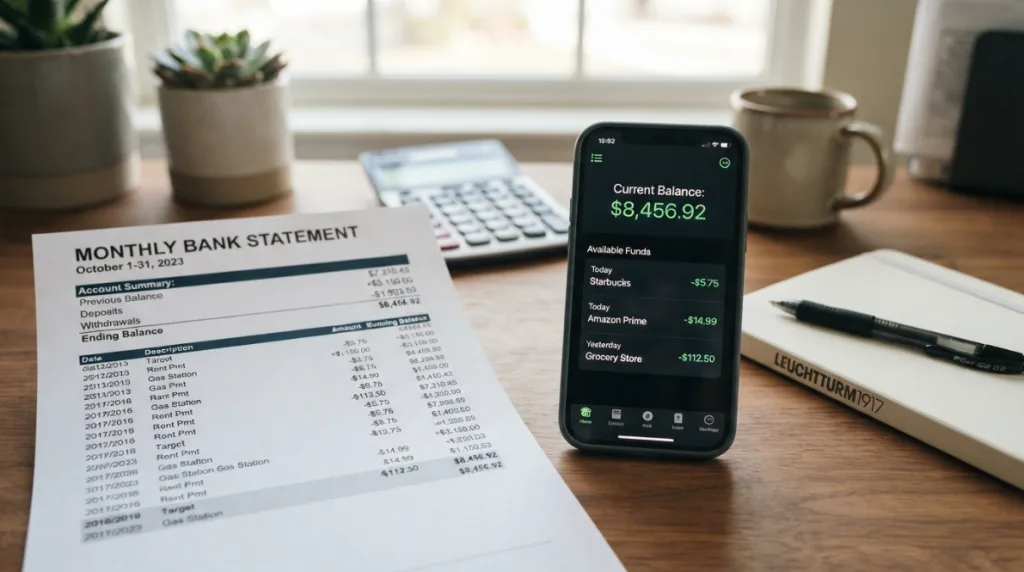
A bank statement and a bank balance are not the same thing.
A bank balance shows the amount recorded in your account at a particular time. A bank statement provides a record of account activity during a specific period.
For example, your account might currently have a $4,000 balance.
That balance does not tell you whether the money came from your paycheck, transfers, refunds, or previous savings.
The bank statement provides more context by showing the transactions that affected your account.
You should also understand that your available balance and current balance may sometimes differ because of pending transactions or other processing activity.
Bank Statement vs. Transaction History
A transaction history is a list of transactions available through your bank account.
A bank statement is generally a formal record provided by the bank for a particular statement period.
Online banking platforms may let you search your transaction history by date, amount, or transaction type.
However, an organization requesting financial documentation may specifically ask for an official bank statement.
For example, a landlord may request a bank statement instead of a screenshot of your online transaction history.
Always check the exact requirements before submitting financial documents.
How Often Do You Get a Bank Statement?
Many banks provide statements monthly, but the exact schedule can vary.
The type of account and the bank’s policies may determine how often statements are issued.
Customers who use online banking often receive electronic statements. Some banks also allow customers to choose paper statements.
If you cannot find your latest statement, check the statements or documents section of your online banking account.
You can also contact your bank if you need help accessing previous statements.
How to Get a Bank Statement Online
Getting a bank statement online is usually simple.
Start by signing in to your bank’s official website or mobile banking app.
Select the account for which you need the statement. Then look for a section called Statements, Documents, eStatements, or a similar option.
Choose the statement period you need.
Many banks allow you to open, download, save, or print the statement. PDF is a common format for electronic statements.
If you need a statement from several years ago, the document may not be available directly through online banking. In that situation, contact your bank for assistance.
How to Get a Bank Statement From a Bank Branch
You may also request a bank statement directly from your financial institution.
Depending on the bank, you may be able to visit a branch and request a printed statement.
You may need to provide identification or other information to verify that you are authorized to access the account.
Some banks may charge a fee for certain historical or printed statements.
Because policies differ, check with your bank before requesting older records.
What Is a Bank Statement Used For?
Bank statements have many practical uses.
One of the most common uses is personal budgeting. You can review your transactions to understand your monthly spending.
They can also help you verify payments. For example, if you believe you already paid a bill, your bank statement may help you confirm the transaction.
Bank statements may also be used for financial applications. Depending on the organization, you might be asked to provide statements when applying for a loan, rental property, or other financial service.
They can also be useful for recordkeeping. Keeping important financial documents organized can make it easier to find information later.
Can a Bank Statement Be Used for a Loan Application?
Some lenders may request bank statements during a loan application.
The purpose and requirements depend on the lender and type of loan.
For example, a mortgage application may require several types of financial documentation. A lender could request bank statements along with income information and other supporting documents.
Bank statements may help show account activity and available funds, but lenders can have different requirements.
You should provide only the documents requested by the lender and use a secure method to submit sensitive financial information.
Can a Bank Statement Be Used for a Rental Application?
A landlord or property manager may request a bank statement as part of a rental application.
The purpose may be to verify financial information or confirm that an applicant has sufficient funds.
However, not every landlord requires a bank statement. Some may accept pay stubs, employment verification, tax documents, or other financial records instead.
Before sending a statement, ask what information is required and whether sensitive details can be removed.
Can a Bank Statement Be Used as Proof of Income?
A bank statement can show deposits into your account, but it does not necessarily prove the source or nature of every deposit.
For example, a deposit could come from employment, a refund, a transfer, a gift, or another source.
For this reason, an organization may request additional documents to verify income.
Pay stubs, tax forms, employment records, and other documentation may be required depending on the situation.
Always follow the specific requirements of the organization requesting your financial information.
Can a Bank Statement Be Used for Taxes?
Bank statements can be useful when organizing financial records for tax purposes.
They may help you review certain deposits, payments, business expenses, or other financial activity.
However, a bank statement does not replace every tax document.
Depending on your situation, you may also need Forms W-2, Forms 1099, receipts, invoices, payment records, brokerage documents, and other supporting documents.
The IRS expects taxpayers to maintain records that support information reported on their tax returns.
Therefore, if you are using a bank statement to support a tax-related item, keep other relevant documentation when appropriate.
How Long Should You Keep Bank Statements?
There is no universal rule that says every person must keep every bank statement for exactly the same number of years.
The appropriate retention period depends on why you need the statement and what information it supports.
Tax-related records can have specific recordkeeping considerations. The appropriate period may depend on the type of transaction and your tax circumstances.
For personal financial management, you may choose to keep important electronic statements for longer periods.
Keeping digital copies can make it easier to find older records when necessary.
Are Electronic Bank Statements Valid?
Electronic bank statements are widely used by banks and customers.
They can provide the same basic account and transaction information found in paper statements, depending on the bank.
Electronic statements are convenient because they can be accessed online and stored digitally.
However, if an organization specifically requests a certified statement, original document, or another specific format, follow its requirements.
Do not assume that every organization accepts screenshots or downloaded transaction histories.
Are Bank Statements Safe to Share?
Bank statements contain sensitive financial information.
Depending on the document, a statement may include your name, account details, transaction information, address, and other personal data.
You should only share a bank statement when there is a legitimate reason to do so.
Before sending it, verify who is requesting the document. Be especially careful when receiving requests through unexpected emails, messages, or unfamiliar websites.
Use a secure method when possible.
If the recipient only needs specific information, ask whether unnecessary details can be hidden or removed.
How to Protect Your Bank Statements
Protecting your bank statements is an important part of financial security.
If you store electronic statements, keep them on a secure device or protected storage system.
Use strong passwords for your banking accounts and enable multi-factor authentication when available.
If you keep paper statements, store them in a secure place where unauthorized people cannot access them.
When disposing of old statements, use a secure method that prevents other people from easily reading the information.
You should also avoid uploading bank statements to public websites or sharing them through unsecured channels.
How Bank Statements Help With Budgeting

Bank statements can make budgeting more practical because they show your actual spending.
Instead of estimating how much you spend each month, you can review real transactions.
Start by grouping your expenses into categories such as housing, groceries, transportation, utilities, entertainment, subscriptions, and debt payments.
Then compare your spending with your monthly income and financial goals.
After reviewing several months, you may notice patterns that are difficult to see from a single month.
For example, you may discover that several small subscriptions are taking a larger portion of your budget than expected.
How to Find Unnecessary Expenses on a Bank Statement
Reviewing a bank statement can help you identify expenses that may no longer be necessary.
Start by looking for recurring payments.
Subscriptions and memberships are especially important because they can continue automatically even when you no longer use the service.
Next, look for frequent small purchases. Individual transactions may appear insignificant, but repeated purchases can become a large monthly expense.
You can also compare your current spending with previous months.
If a particular category has increased significantly, investigate the reason and decide whether you need to adjust your spending.
How Bank Statements Can Help Identify Fraud

Regularly reviewing your bank statement can help you notice suspicious activity.
For example, you may find an unfamiliar debit card purchase, ATM withdrawal, electronic payment, or transfer.
An unfamiliar transaction does not automatically mean fraud. The merchant may use a different name, or you may have forgotten about the purchase.
However, you should investigate transactions that you cannot explain.
If you believe a transaction is unauthorized, contact your bank through an official phone number, website, or branch.
Avoid using contact information provided in a suspicious message or email.
What Should You Do About an Incorrect Bank Statement?
If you notice an error on your statement, review the transaction carefully.
Check whether the amount, date, and description match your records.
Sometimes a transaction may appear under a merchant or processing name that you do not recognize immediately.
If the transaction still appears incorrect, contact your bank and explain the issue.
Keep any supporting information that may help, such as receipts, payment confirmations, or transaction records.
The bank can explain its process for investigating disputed or incorrect transactions.
What Is a Bank Statement Number?
The phrase “bank statement number” can mean different things depending on the context.
A bank document may contain an account number, statement date, statement period, or another reference number.
Your account number identifies the bank account, while the statement period identifies the dates covered by the statement.
If an organization asks you for a “statement number,” do not automatically provide your full account number.
Ask the organization exactly what information it needs.
This can help prevent unnecessary sharing of sensitive financial information.
Bank Statement vs. Bank Letter
A bank statement is a record of transactions and account activity for a specific period.
A bank letter is a separate document issued by a bank to confirm certain account or customer information.
For example, an organization may request a bank letter when it needs confirmation of account ownership or another specific detail.
A statement may be more appropriate when the organization needs to review transaction activity.
The correct document depends on the requirements of the person or organization requesting it.
Can You Edit a Bank Statement?
You should never alter a bank statement to change or misrepresent financial information.
Changing transaction amounts, dates, balances, or other financial details can create serious problems.
If you need to protect sensitive information, ask whether you can redact details that are not required.
For example, an organization may only need to see certain account information or transactions.
Always keep the original document unchanged and provide accurate information when a legitimate organization requests financial records.
Common Mistakes When Reading Bank Statements
One common mistake is looking only at the ending balance.
Although the ending balance is important, it does not explain how you spent or received your money.
Another mistake is ignoring small recurring charges.
Subscriptions, memberships, and automatic payments can continue for months without receiving much attention.
Some people also ignore bank fees because each fee may seem small.
Over time, these charges can become meaningful expenses.
Another common mistake is failing to investigate unfamiliar transactions.
You should review your statements regularly instead of waiting until there is a serious problem.
How to Organize Bank Statements
Organizing your statements can make financial recordkeeping easier.
If you use electronic statements, create secure folders based on the year and financial institution.
For example, you could create folders for 2026 Bank Statements, 2027 Bank Statements, and future years.
You can also use consistent file names that include the bank, account type, and statement month.
Avoid storing sensitive documents in public or unsecured locations.
If you use cloud storage, choose a reputable service and protect your account with strong security settings.
How to Review Your Bank Statement Every Month
A monthly statement review can take only a few minutes.
Start by checking the beginning balance and ending balance.
Then review deposits and withdrawals.
Look for unfamiliar transactions, unexpected fees, duplicate charges, and recurring payments.
Compare the information with your budget or personal financial records.
If something does not look right, investigate it promptly.
A consistent monthly review can help you maintain better control over your finances.
Why You Should Check Your Bank Statement Regularly
Regular reviews can help you understand your financial habits.
You may notice that certain expenses are increasing or that recurring payments are no longer necessary.
Checking your statements can also help you identify mistakes or suspicious activity earlier.
It can be especially useful if you have multiple accounts or several automatic payments.
A few minutes of review each month can give you a clearer picture of your financial situation.
Bank Statements for Personal Financial Planning
Bank statements can support long-term financial planning.
By reviewing several months of account activity, you can estimate your typical income and expenses.
This information can help you set realistic savings goals.
For example, if you notice that you consistently spend more than expected on dining or entertainment, you can create a specific spending limit.
You can also identify money that could potentially be redirected toward savings, debt repayment, or other financial goals.
Bank Statements for Business Owners
Business owners may also use bank statements to review business transactions.
A business bank statement can show customer payments, operating expenses, transfers, fees, and other account activity.
Reviewing these statements can help business owners monitor cash flow and identify unusual transactions.
However, a bank statement should not necessarily be the only financial record a business maintains.
Businesses may also need invoices, receipts, payroll records, accounting reports, and other documentation.
What Happens If You Lose a Bank Statement?
Losing a paper statement does not necessarily mean the record is gone.
Many banks allow customers to access previous electronic statements through online banking.
If the statement is not available online, contact your bank and ask about obtaining a copy.
The bank may have records available for previous periods, although access and fees can vary.
For important documents, consider saving secure electronic copies so you can access them when needed.
Frequently Asked Questions
What is a bank statement?
A bank statement is a record of activity in a bank account during a specific period. It can include deposits, withdrawals, purchases, transfers, fees, and balances.
What does a bank statement show?
A bank statement can show account information, transaction dates, deposits, withdrawals, fees, transfers, and beginning and ending balances.
Is a bank statement the same as a bank balance?
No. A bank balance shows the amount recorded in your account at a particular time. A bank statement provides a record of activity during a specific period.
How often do banks provide statements?
Many banks provide statements monthly, but the exact schedule depends on the financial institution and account type.
Can I get a bank statement online?
Yes. Many banks allow customers to view and download electronic statements through online banking or mobile applications.
Can I get an old bank statement?
Often, yes. Your bank may provide access to previous statements online. For older records, you may need to contact the bank directly.
Can I use a bank statement as proof of income?
A bank statement can show deposits, but it may not establish the source of every deposit. An organization may request additional income documentation.
Can a bank statement be used for taxes?
A bank statement can support certain financial records, but it does not replace all tax documents. You may need additional forms, receipts, invoices, or other documentation.
Can a landlord ask for a bank statement?
A landlord or property manager may request financial documents, including bank statements, depending on their application requirements.
Are electronic bank statements valid?
Electronic statements are commonly provided by banks. However, you should check the requirements of any organization requesting a statement.
What should I do if I see an unfamiliar transaction?
Review the transaction details first. If you still cannot identify it, contact your bank through an official channel and ask about the transaction.
How long should I keep bank statements?
The appropriate period depends on the purpose of the records. Tax-related records may have specific retention considerations, while personal recordkeeping needs can vary.
Are bank statements private?
Bank statements contain sensitive financial information and should be treated as private documents. Share them only with legitimate recipients when necessary.
Final Thoughts
So, what is a bank statement? It is a record of activity in a bank account during a specific period.
It can show deposits, withdrawals, purchases, transfers, fees, and account balances.
Bank statements are useful for more than simply checking how much money you have. They can help you understand your spending, create a realistic budget, identify unfamiliar transactions, and maintain organized financial records.
You may also need a bank statement when applying for certain loans, rental properties, or financial services.
However, a bank statement should not automatically be treated as a replacement for other financial documents. Depending on the situation, you may need additional records such as pay stubs, tax forms, receipts, invoices, or other documentation.
The best approach is to review your statements regularly and keep important records secure.
When you understand how to read a bank statement, you have a clearer picture of your financial activity and can make more informed decisions about your money.


Leave a Reply