
In this article
- Key Takeaways (TL;DR)
- Standard Deduction vs Itemized Deduction: The Quick Answer
- What Is the Standard Deduction?
- The Extra Standard Deduction: Age 65+ or Blind
- The New $6,000 OBBBA Senior Bonus (2025–2028)
- What Are Itemized Deductions?
- Standard vs Itemized Deduction: Side-by-Side Comparison
- How to Decide: The Math That Actually Matters
- When Itemizing Almost Always Wins
- When the Standard Deduction Almost Always Wins
- The OBBBA Changes That Rewire the 2025–2026 Decision
- The “Bunching” Strategy: A Smart Play for Fence-Sitters
- Real-Life Scenarios: Which Route Wins?
- The 2/37 Haircut, Explained Like a Human
- Common Traps That Cost People Real Money
- State Tax Wrinkles You Shouldn’t Ignore
- Tax Deductions vs Tax Credits: A Quick Sanity Check
- Documentation Checklist for Itemizers
- Your 4-Step Action Plan for 2025 and 2026
- Standard Deduction vs Itemized Deduction: Frequently Asked Questions
- The Bottom Line
You’ve been staring at your tax return for twenty minutes. Two little boxes are asking whether you want the standard deduction or want to itemize. Neither one has a “recommended for you” sticker. And the wrong click can hand the IRS an extra $500, $2,000, sometimes far more — money that could have stayed in your emergency fund, your Roth, or your kid’s college savings.
Here’s the good news: this decision isn’t complicated once you understand the moving parts. The bad news? The One Big Beautiful Bill Act (OBBBA), signed in July 2025, quietly rewired almost every rule you may have memorized. Standard deduction amounts jumped. The SALT cap quadrupled. Seniors picked up a fresh $6,000 bonus. Charitable giving got a new floor. And a sneaky “2/37 haircut” now nibbles at high earners.
This guide breaks all of it down in plain English — with real numbers, real examples, and a step-by-step way to pick the option that keeps the most money in your pocket for the 2025 and 2026 tax years.
Key Takeaways (TL;DR)
- You pick one — not both. Take whichever deduction is larger.
- 2025 standard deduction: $15,750 (single), $23,625 (head of household), $31,500 (married filing jointly).
- 2026 standard deduction: $16,100 (single), $24,150 (head of household), $32,200 (married filing jointly).
- About 9 in 10 filers take the standard deduction. It’s usually bigger and it needs zero paperwork.
- Itemizing tends to win if you’re a homeowner in a high-tax state, gave a lot to charity, or had a huge medical year.
- SALT cap is $40,000 for 2025 (up from $10,000), then $40,400 for 2026 — a game-changer for high-tax-state homeowners.
- Seniors 65+ get a brand-new $6,000 bonus deduction on top of either choice, for tax years 2025 through 2028.
Standard Deduction vs Itemized Deduction: The Quick Answer
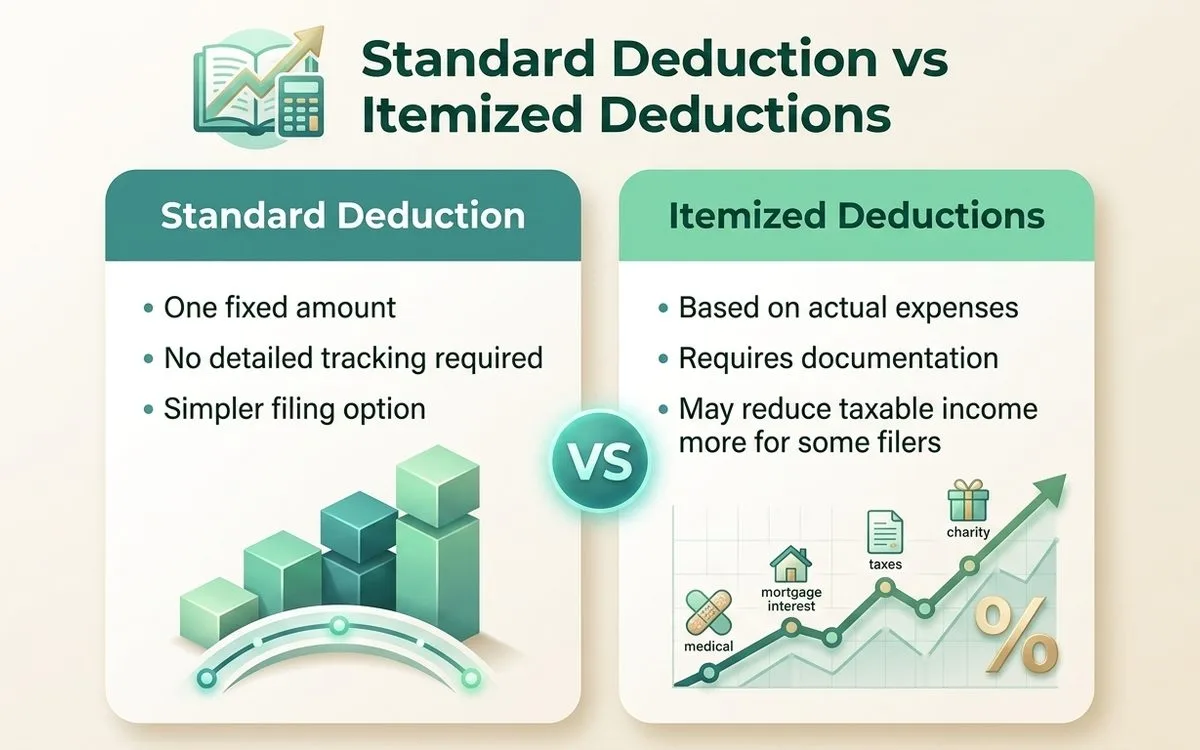
The standard deduction is a flat, no-questions-asked amount the IRS lets you subtract from your income. Itemized deductions, meanwhile, are a hand-picked list of specific expenses — mortgage interest, state and local taxes, charitable gifts, big medical bills — that you total up on Schedule A. Take whichever number is larger. You can’t take both in the same tax year.
For roughly 9 out of 10 filers, the standard deduction wins the math. The share of taxpayers itemizing fell from about 31% before 2018 to just under 10% today, according to research published by the Tax Policy Center. OBBBA’s higher standard deduction should keep that percentage low, but the enlarged SALT cap will pull some middle- and upper-middle-class homeowners back onto Schedule A.
What Is the Standard Deduction?
The standard deduction is a fixed dollar amount that lowers your taxable income without a shred of documentation. No receipts. No spreadsheets. No hunting for that Goodwill slip from March. You just claim it and move on.
2025 Standard Deduction Amounts
| Filing Status | 2025 Standard Deduction |
|---|---|
| Single or Married Filing Separately | $15,750 |
| Head of Household | $23,625 |
| Married Filing Jointly or Qualifying Surviving Spouse | $31,500 |
These figures reflect the OBBBA-boosted amounts — $750 more for singles and $1,500 more for joint filers than pre-OBBBA law would have allowed.
2026 Standard Deduction Amounts
| Filing Status | 2026 Standard Deduction |
|---|---|
| Single or Married Filing Separately | $16,100 |
| Head of Household | $24,150 |
| Married Filing Jointly or Qualifying Surviving Spouse | $32,200 |
Why the Standard Deduction Is So Popular
- Zero paperwork. No receipts to keep, no forms to attach.
- It’s usually bigger. After the 2017 tax law and OBBBA, most households can’t itemize past it.
- Very low audit risk. There’s nothing for the IRS to challenge.
- It rises each year. Annual inflation adjustments protect you from bracket creep.
- It stacks with the new $6,000 senior bonus if you’re 65 or older.
If you’re a renter, a young professional, or a homeowner in a low-tax state, chances are the standard deduction is your best friend. A quick check of your basic finances — say, whether you’re maxing out a workplace 401(k) or parking cash in a real yield account — matters far more to your bottom line than agonizing over itemizing.

The Extra Standard Deduction: Age 65+ or Blind
The IRS quietly hands out extra standard deductions to older filers and to anyone legally blind. For tax year 2025, the additional amounts are:
- $2,000 if you’re single or head of household and either age 65+ or blind
- $1,600 per qualifying condition per spouse for married filers (jointly, separately, or a qualifying surviving spouse)
- Double the amount if you’re both 65+ and blind
Real example. A married couple in 2025 where both spouses are 66 and one is legally blind would claim $31,500 (base) + $1,600 (spouse A age) + $1,600 (spouse B age) + $1,600 (spouse B blindness) = $36,300 — before ever touching the new senior bonus.
The New $6,000 OBBBA Senior Bonus (2025–2028)
Here’s the change most people are missing. Starting with tax year 2025 through 2028, the OBBBA lets every filer age 65 or older claim an additional $6,000 deduction — on top of the standard or itemized deduction. Married couples where both spouses qualify can claim $12,000 combined.
Income Phase-Out Rules for the Senior Bonus
The bonus phases out for higher earners at a 6% rate on Modified Adjusted Gross Income (MAGI) above these thresholds:
| Filing Status | Full Deduction Below | Fully Phased Out At |
|---|---|---|
| Single / Head of Household | $75,000 MAGI | $175,000 MAGI |
| Married Filing Jointly | $150,000 MAGI | $250,000 MAGI |
So a single 68-year-old with MAGI of $100,000 loses $1,500 of the bonus (6% of $25,000) and can still claim $4,500. Above $175,000 MAGI, the $6,000 vanishes entirely. The IRS newsroom announcement on OBBBA senior benefits explains the mechanics in official language.
Bottom line for retirees: a single 68-year-old in 2025 with modest income can potentially deduct $15,750 + $2,000 + $6,000 = $23,750 before considering a single itemized expense. That’s why so many seniors will stay firmly on the standard-deduction side.

What Are Itemized Deductions?
Itemizing means listing individual qualified expenses on Schedule A (Form 1040) and adding them up. You only itemize when the total beats the standard deduction — otherwise, why give yourself the extra work?
Here are the deduction buckets that live on Schedule A in 2025:
1. State and Local Taxes (SALT)
You can deduct state and local income tax (or general sales tax if you live in a state without an income tax) plus property taxes — but only up to the SALT cap. Under OBBBA, the cap jumped from $10,000 to $40,000 for tax year 2025 and rises 1% per year through 2029. The Charles Schwab primer on the new SALT rules walks through the math for high earners.
High-income phase-out: the $40,000 cap gets reduced by 30% of your MAGI over $500,000 ($250,000 for married filing separately) — but never below $10,000. Both the cap and the phase-out threshold rise 1% each year through 2029.
2. Home Mortgage Interest
You can deduct interest on up to $750,000 of qualified acquisition debt for loans taken out after December 15, 2017 ($1 million for older loans). OBBBA made the $750,000 cap permanent, so it no longer sunsets. Starting in 2026, mortgage insurance premiums — PMI, VA funding fees, FHA MIP — count as deductible mortgage interest again.
3. Charitable Contributions
Cash gifts to qualified 501©(3) public charities are deductible up to 60% of AGI, with non-cash gifts capped at 50%, 30%, or 20% depending on the asset type. Starting in 2026, a new 0.5% of AGI floor applies — you can only deduct the portion of gifts above 0.5% of your AGI. If you earn $200,000, the first $1,000 of giving no longer counts.
4. Medical and Dental Expenses
You can deduct unreimbursed qualified medical costs only to the extent they exceed 7.5% of your AGI. Big-ticket items — surgery, cancer treatment, long-term care, home modifications for medical reasons, and even mileage to appointments — can push you past that floor in a rough year.
5. Casualty and Theft Losses
Deductible only if they stem from a federally declared disaster area. Everyday losses — a stolen laptop, a small kitchen fire, water damage from a burst pipe — don’t qualify anymore.
6. Gambling Losses
Deductible only up to the amount of gambling winnings reported. You can’t create a net loss.
7. Investment Interest Expense
Interest paid to borrow money for taxable investments, subject to specific ceilings tied to your net investment income.
What You Can’t Itemize Anymore
- Miscellaneous 2% deductions (unreimbursed employee expenses, tax-prep fees, safe-deposit boxes). TCJA suspended these; OBBBA permanently repealed them.
- Personal casualty and theft losses outside federally declared disasters.
- Moving expenses for anyone who isn’t active-duty military.
Standard vs Itemized Deduction: Side-by-Side Comparison
| Feature | Standard Deduction | Itemized Deductions |
|---|---|---|
| Where it lives | Line 12, Form 1040 | Schedule A (Form 1040) |
| Effort required | Almost none | High — records, math, extra forms |
| 2025 amount (single) | $15,750 flat | Depends on your actual expenses |
| Inflation adjusted? | Yes, annually | No overall cap on the total |
| Best for | Renters, low-tax states, small mortgages | Homeowners in high-tax states, big charitable donors, large medical years |
| Documentation | None needed | Receipts, 1098s, bank records, appraisals |
| Audit risk | Very low | Higher, especially for unusual items |
| Key OBBBA changes | Higher amounts + $6,000 senior bonus | $40K SALT cap, 0.5% charitable floor (2026), 2/37 haircut for top earners (2026) |
How to Decide: The Math That Actually Matters
The rule is refreshingly simple. Add up your itemized deductions. Compare that total to your standard deduction. Take the bigger number.
Step-by-Step Decision Framework
- Estimate your SALT — combined state/local income (or sales) tax and property tax, capped at $40,000 in 2025.
- Add your mortgage interest from Form 1098 (up to the $750K/$1M loan cap).
- Add qualifying charitable gifts you can document.
- Add medical expenses above 7.5% of AGI — only the excess counts.
- Add any casualty losses from federally declared disasters.
- Compare the total to your standard deduction from the tables above.
- Take whichever number is bigger.
A Worked Example You Can Actually Use
Meet Sarah — single, 42, lives in New Jersey, and owns a home:
- State income tax: $9,000
- Property tax: $12,000
- Mortgage interest: $14,500
- Charitable gifts: $2,500
- Medical expenses above 7.5% of AGI: $0
Sarah’s itemized total: $9,000 + $12,000 (SALT combined = $21,000, well under the $40,000 cap) + $14,500 + $2,500 = $38,000.
Sarah’s standard deduction (single 2025): $15,750.
Winner: Itemize — she comes out $22,250 ahead. At a 22% marginal rate, that’s roughly $4,900 in real tax savings she would have handed over by clicking the wrong box. Under the old $10,000 SALT cap, her itemized total would have been about $27,000 — still a win, but $11,000 smaller.
Now consider Jamal — single, 29, renting in Austin, Texas:
- SALT: about $1,500 (state sales tax, no state income tax)
- Charity: $600
- No mortgage, no big medical bills
Jamal’s itemized total: $2,100. His standard deduction: $15,750. He takes the standard, no debate. His energy is far better spent building an emergency fund and locking in a solid term life insurance policy while he’s young and healthy.

When Itemizing Almost Always Wins
Certain situations tilt the scales heavily toward Schedule A:
- You own a home in a state with high income and property taxes (CA, NY, NJ, CT, IL, MA, OR, MN, MD).
- You paid a lot of mortgage interest, usually on a newer, larger loan.
- You had a huge medical year — surgery, cancer treatment, complicated birth, long-term care.
- You made large charitable gifts, especially appreciated stock or a “bunching” year.
- You had a federally declared disaster loss in your ZIP code.
- You paid state income tax on a big bonus, RSU vest, or business sale.
Nearly half of taxpayers earning over $500,000 itemized in 2018, while just 8% of filers between $50,000 and $75,000 did the same, according to research from the Tax Foundation. The higher your income, the more likely itemizing pays off — and OBBBA’s SALT expansion pushed the tipping point noticeably lower for middle-class homeowners.
When the Standard Deduction Almost Always Wins
Go standard if any of these fit you:
- You rent or your mortgage is small or paid off.
- You live in a no- or low-income-tax state (TX, FL, TN, WA, NV, WY, SD, AK, NH).
- Your charitable giving is modest.
- Your medical bills didn’t cross 7.5% of AGI.
- You value a simple return more than squeezing every last dollar.
- You’re a senior with modest income — the $6,000 bonus makes the standard side almost unbeatable.
The OBBBA Changes That Rewire the 2025–2026 Decision
The One Big Beautiful Bill Act didn’t just tweak numbers — it reshaped strategy. Here’s what you need to know before you file.
1. Standard Deduction Got a Permanent Boost
The TCJA-era higher standard deduction is now permanent, plus a small extra bump for 2025. Annual inflation adjustments will keep the number climbing.
2. SALT Cap: $10,000 → $40,000 (Then Escalates 1% a Year)
The SALT cap quadrupled starting in 2025. Here’s the full escalator schedule:
| Tax Year | SALT Cap (Most Filers) | Phase-Out Starts At MAGI |
|---|---|---|
| 2025 | $40,000 | $500,000 |
| 2026 | $40,400 | $505,000 |
| 2027 | $40,804 | $510,050 |
| 2028 | $41,212 | $515,151 |
| 2029 | $41,624 | $520,302 |
| 2030+ | $10,000 (reverts) | N/A |
That’s a temporary but massive window for homeowners in high-tax states to itemize. Whether you’re refinancing your primary residence or shopping around for lower car insurance to free up cash for higher property taxes, planning around the new SALT rules is worth an hour of your time.
3. Mortgage Interest Cap Permanent at $750,000
The $750,000 acquisition-debt limit no longer sunsets. Homeowners with pre-December 15, 2017 loans keep the higher $1 million cap.
4. Mortgage Insurance Premiums Deductible Again (2026)
Starting in tax year 2026, PMI, VA funding fees, and FHA mortgage insurance premiums count as qualified mortgage interest — a helpful nudge for buyers with less than 20% down.
5. Charitable Deduction 0.5% AGI Floor (2026)
Itemizers must first exceed 0.5% of AGI in charitable gifts before any deduction kicks in. A donor with $150,000 AGI loses the first $750 of giving to the floor.
6. The New 2/37 “Haircut” for Top-Bracket Itemizers (2026)
If your taxable income lands in the 37% bracket, your itemized deductions get reduced by 2/37 of the lesser of (a) your total itemized deductions or (b) the taxable income sitting in the 37% bracket. The mechanics in the Congressional Research Service brief work out to a hard 35-cent-per-dollar cap on the tax value of most itemized deductions for top earners.
7. New Above-the-Line Charitable Deduction (2026)
Even if you take the standard deduction, you can deduct up to $1,000 (single) or $2,000 (joint) in cash charitable gifts to qualifying public charities starting in tax year 2026. Donor-advised funds and private foundations don’t qualify for this piece.
8. The $6,000 Senior Bonus (2025–2028)
Already covered above — but it’s the OBBBA change most retirees will feel directly.
9. QBI Deduction Made Permanent
The 20% qualified business income (QBI) deduction is now permanent under OBBBA. It sits above the itemize-vs-standard line, meaning small-business owners and freelancers get it regardless of which deduction they take.
The “Bunching” Strategy: A Smart Play for Fence-Sitters
If your itemized deductions land close to your standard deduction each year, “bunching” can tip the scales in your favor.
Here’s how it works:
- In year one, front-load two or three years of charitable gifts, itemize, and blow past the standard deduction.
- In years two and three, take the standard deduction and skip donating (or give from a donor-advised fund seeded in year one).
- Repeat.
Bunching becomes even more valuable with the 2026 0.5% AGI charitable floor. Loading gifts into one year clears the floor once, instead of losing 0.5% of AGI every single year. A conversation with a CPA or a good financial advisor can tell you whether it’s worth setting up a donor-advised fund at Fidelity Charitable, Schwab Charitable, or Vanguard Charitable.
Real-Life Scenarios: Which Route Wins?
Scenario 1 — The Retired Widow in Florida
Barbara is 72, single, and lives in a paid-off condo in Sarasota. Her only deductible items are $6,000 in property tax and $3,000 in charitable gifts. AGI: $55,000.
- Itemized total: $9,000
- Standard deduction: $15,750 + $2,000 (age 65) + $6,000 (senior bonus) = $23,750
- Winner: Standard, by a mile.
Scenario 2 — The California Tech Couple
Priya and Miguel earn a combined $340,000 in Palo Alto. They pay $28,000 in California state income tax, $14,000 in property tax, $22,000 in mortgage interest, and $8,000 in charitable gifts.
- SALT (capped at $40,000): $40,000
- Mortgage interest: $22,000
- Charity: $8,000
- Itemized total: $70,000
- Standard deduction (MFJ): $31,500
- Winner: Itemize — by $38,500.
Scenario 3 — The Single Renter in Austin
Jamal earns $85,000, rents, gives $600 a year to a local food bank, and has no medical or SALT expenses worth deducting.
- Itemized total: ~$2,100
- Standard deduction: $15,750
- Winner: Standard.
Scenario 4 — The Young Family with a Big Medical Year
Ava and Chris, MFJ, AGI $130,000. They had $22,000 in unreimbursed medical bills after a complicated birth. SALT $9,500, mortgage interest $11,000, charity $2,000.
- Medical over 7.5% of AGI ($9,750 threshold): $12,250 deductible
- SALT: $9,500
- Mortgage interest: $11,000
- Charity: $2,000
- Itemized total: $34,750
- Standard deduction (MFJ): $31,500
- Winner: Itemize — a modest but real $3,250 edge.
The 2/37 Haircut, Explained Like a Human
The 2/37 rule sounds intimidating. It isn’t — unless you’re a top-bracket earner.
Here’s the plain version. Starting in tax year 2026, if any of your taxable income lands in the 37% bracket, your itemized deductions get trimmed by 2/37 (about 5.4%). The effective result: each dollar of itemized deduction only shaves 35 cents off your federal tax bill, instead of the full 37 cents a top-bracket dollar would normally save.
What this means practically:
- If your taxable income is below the 37% bracket threshold, the 2/37 rule does not touch you.
- If you’re in the 37% bracket, you’ll want to time major itemized items (large charitable gifts especially) into years when you’re not in the 37% bracket if possible.
- The Qualified Business Income (QBI) deduction is exempt from this haircut.
For the vast majority of Americans, this is a non-event. For high earners with volatile income, it’s a strong nudge to shift big deductions into lower-bracket years.
Common Traps That Cost People Real Money
- Forgetting SALT is combined. The $40,000 cap covers state/local income tax plus property tax. Many filers count only one.
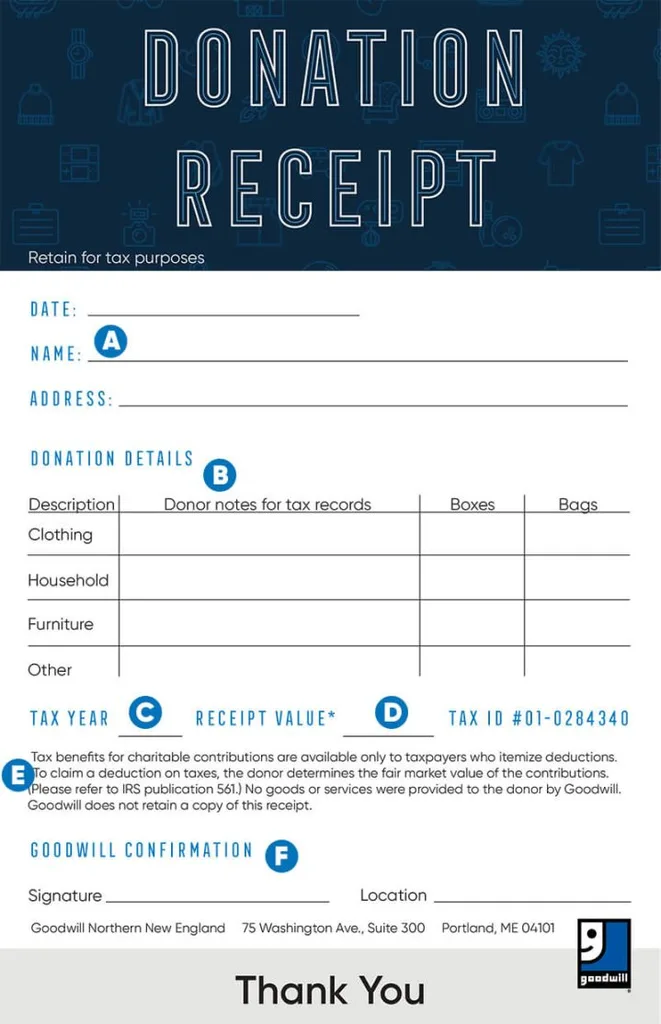
- No written acknowledgment for gifts of $250 or more. The IRS will disallow it on audit if you don’t have a written receipt from the charity.
- Confusing pre-tax and post-tax health premiums. Premiums paid pre-tax through your paycheck are already deducted — you can’t deduct them again.
- Skipping the age 65+ or blindness box. Tax software catches it, but only if you check it.
- Assuming state rules mirror federal. Many states (NY, CA, OR, MA) let you itemize on the state return even if you took the federal standard, or force alignment either way. Check yours.
- Ignoring the QBI deduction. The 20% QBI deduction is now permanent and available whether you itemize or not — freelancers and small-business owners leave real money on the table by forgetting it.
If a chunk of your take-home is going to credit-card minimums, no deduction will save you enough to fix that. Get a strategy in place first — our guide on debt consolidation walks through when it makes sense and when it doesn’t.
State Tax Wrinkles You Shouldn’t Ignore
Your federal choice isn’t always your state choice. States handle this in wildly different ways:
- Some states force alignment — itemize federally, itemize on the state return (or vice versa).
- Others let you split — take the federal standard while itemizing on the state return (California, New York, Oregon, Wisconsin, and several others).
- Some allow state-level SALT workarounds through pass-through entity (PTE) taxes, especially for business owners.
Before finalizing your federal choice, run the state math too. What saves you $1,000 federally might cost you $600 at the state level — or the reverse.
Tax Deductions vs Tax Credits: A Quick Sanity Check
New filers mix these up all the time:
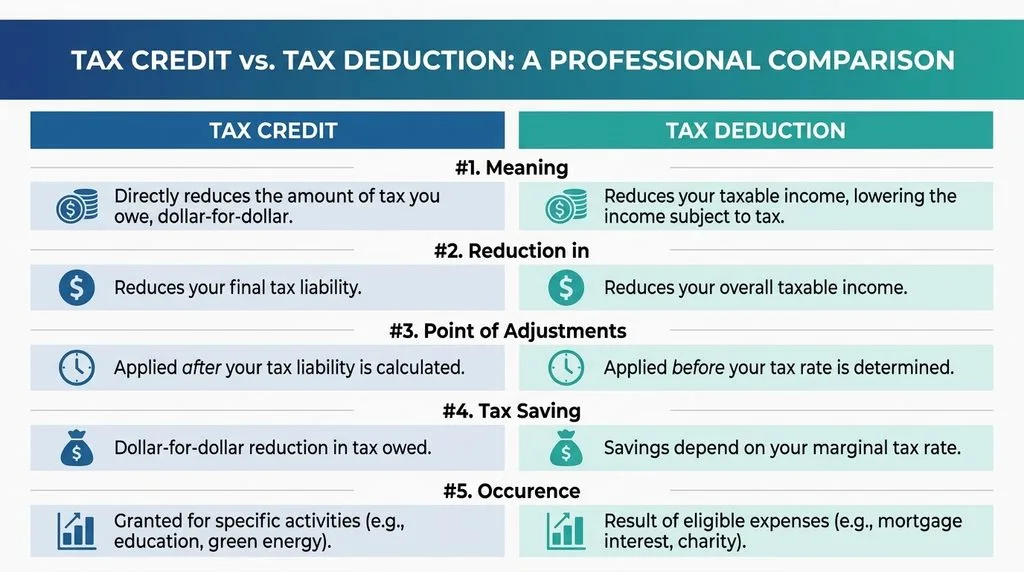
- A deduction reduces your taxable income. In the 22% bracket, a $1,000 deduction saves you about $220.
- A credit reduces your tax bill dollar for dollar. A $1,000 credit saves you the full $1,000 — over four times more powerful.
Standard and itemized deductions are, well, deductions. Popular credits — Child Tax Credit, American Opportunity Credit, Saver’s Credit, Earned Income Credit — apply on top of whichever deduction you chose. Contributions to traditional retirement accounts and HSAs are “above-the-line” — they reduce AGI before the itemize-vs-standard step. That’s why maxing them out is often a better lever than fussing over Schedule A.
Documentation Checklist for Itemizers
If you plan to itemize, gather these before you file:
- Form 1098 — mortgage interest paid
- Property tax bills or escrow statements
- State income tax records — W-2 withholding, estimated payments, prior-year state refund
- Vehicle registration receipts — the value-based portion is deductible in some states
- Charity acknowledgment letters for donations of $250 or more
- Bank statements or canceled checks for smaller cash gifts
- Medical bills, receipts, and mileage logs
- Casualty loss documentation — FEMA declaration number, appraisals, insurance settlement letters
- Investment interest expense statements from your brokerage
Keep everything for at least three years — the standard IRS audit window. Hold six years if you underreported income by more than 25%.
Your 4-Step Action Plan for 2025 and 2026
- Run a rough itemized tally by October. Don’t wait until April to see if you’re near the break-even point.
- Consider bunching charitable gifts into 2025 to dodge the 2026 0.5% AGI floor.
- If your SALT is close to $40,000, prepay 2026 property taxes in December 2025 to squeeze more out of this year’s higher cap window.
- Use tax software or a CPA to run both scenarios. Modern software does this automatically — the trick is entering every itemized expense so the comparison is real. If you’re building a bigger financial picture, park an emergency fund in a solid high-yield savings account while you plan.
Standard Deduction vs Itemized Deduction: Frequently Asked Questions
What is the standard deduction for 2025?
For tax year 2025 (returns filed in early 2026), the standard deduction is $15,750 for single filers and married individuals filing separately, $23,625 for heads of household, and $31,500 for married couples filing jointly. Anyone age 65+ or blind gets an additional $1,600–$2,000, and everyone 65+ can also claim the new $6,000 OBBBA senior bonus (subject to phase-out).
Can I take both the standard deduction and itemize?
No. The IRS makes you pick one or the other for the same tax year. Some deductions — traditional IRA contributions, student loan interest (up to $2,500), HSA contributions, and QBI — are “above-the-line” and available regardless of which choice you make.
Is it better to itemize or take the standard deduction?
It’s better to take whichever produces the larger deduction. For roughly 90% of taxpayers, the standard deduction wins. Itemizing tends to win for homeowners in high-tax states, filers with significant charitable giving, or those with major medical expenses in a given year.
Did OBBBA change the SALT cap?
Yes. The State and Local Tax deduction cap jumped from $10,000 to $40,000 starting in 2025 (or $20,000 if married filing separately) and climbs 1% per year through 2029. It reverts to $10,000 in 2030 unless Congress extends it. A phase-out begins at $500,000 MAGI in 2025 and rises 1% annually alongside the cap.
Do I lose the standard deduction if I have a mortgage?
No. Having a mortgage doesn’t force you to itemize — it just gives you a big deductible expense that might make itemizing worthwhile. If your mortgage interest plus SALT and other items still add up to less than the standard deduction, take the standard deduction.
Are charitable donations deductible if I take the standard deduction?
For tax year 2025, no — charitable gifts are only deductible if you itemize. Starting in tax year 2026, however, non-itemizers can deduct up to $1,000 (single) or $2,000 (joint) in cash gifts to qualifying public charities as an above-the-line deduction.
What’s the $6,000 senior deduction and who qualifies?
The OBBBA created a temporary bonus deduction for taxpayers age 65 or older, worth up to $6,000 per qualifying individual ($12,000 for a couple where both spouses are 65+). It applies for tax years 2025 through 2028, phases out between $75,000 and $175,000 MAGI (single) or $150,000 and $250,000 (MFJ), and stacks on top of the standard or itemized deduction.
Do I need receipts for the standard deduction?
No. That’s the whole appeal — the standard deduction is a flat amount that requires zero documentation. Itemized deductions, in contrast, require receipts, statements, and Form 1098s that you should keep for at least three years after filing.
The Bottom Line
The standard deduction vs itemized deduction decision isn’t philosophical — it’s arithmetic. Add up your itemizable expenses, compare to your standard deduction, and take the bigger number. Everything else is just details.
For 2025 and 2026, OBBBA reshuffled the deck. The higher SALT cap makes itemizing more attractive for many homeowners in high-tax states. The higher standard deduction and new $6,000 senior bonus keep most other filers firmly on the standard side. And the coming 0.5% AGI charitable floor in 2026 makes 2025 a smart year to front-load donations.
Run the numbers early. Keep your records tight. Don’t leave money on the table because the paperwork feels intimidating — an hour with your receipts, or a good CPA, can be one of the highest-return uses of your time all year.

Leave a Reply