
In this article
- What Is a Second Mortgage? (The Short Answer)
- How Does a Second Mortgage Work?
- The Two Main Types of Second Mortgages
- Current Second Mortgage Rates in 2026
- Second Mortgage Requirements: Do You Actually Qualify?
- Pros and Cons of a Second Mortgage
- How to Take Out a Second Mortgage: The 7-Step Process
- Second Mortgage vs Cash-Out Refinance: Which Wins in 2026?
- Smart (and Not-So-Smart) Ways to Use a Second Mortgage
- Tax Rules for Second Mortgages in 2026
- Red Flags: How to Spot a Predatory Second Mortgage Lender
- Zombie Second Mortgages: The Risk Nobody Talks About
- Who Should NOT Get a Second Mortgage?
- Alternatives to a Second Mortgage
- 10 Questions to Ask a Second Mortgage Lender
- How Much Can You Actually Borrow? A Quick Reference
- Second Mortgage vs Second-Home Mortgage: Don’t Mix These Up
- Common Second Mortgage Mistakes to Avoid
- Frequently Asked Questions
- Final Thoughts: Is a Second Mortgage Right for You?
Picture this. You’ve been paying your mortgage for eight years. Your kitchen still looks like it did in 2005. Your credit card balance won’t shrink no matter how much you throw at it. And Zillow just told you your home is worth $180,000 more than what you paid.
That gap between what your home is worth and what you owe? That’s home equity — and it’s quietly become the biggest source of low-cost cash most Americans have ever owned.
American homeowners are currently sitting on a staggering $34.5 trillion in home equity as of Q1 2025, with the typical mortgage-holding homeowner holding around $302,000 in equity — a jump of nearly $102,000 in tappable equity per borrower since 2018, according to Bankrate’s homeowner equity data. Yet ICE Mortgage Monitor reports that borrowers only tapped 0.41% of available tappable equity in Q1 2025 — well below long-term averages.
Translation? Most people are sitting on financial firepower they’ve never even considered using.
A second mortgage is one of the main tools that unlocks it. This guide walks through exactly what it is, how it works, current 2026 rates, real qualification requirements, and the step-by-step process to take one out — without the fluff and without pretending the risks aren’t real.
What Is a Second Mortgage? (The Short Answer)
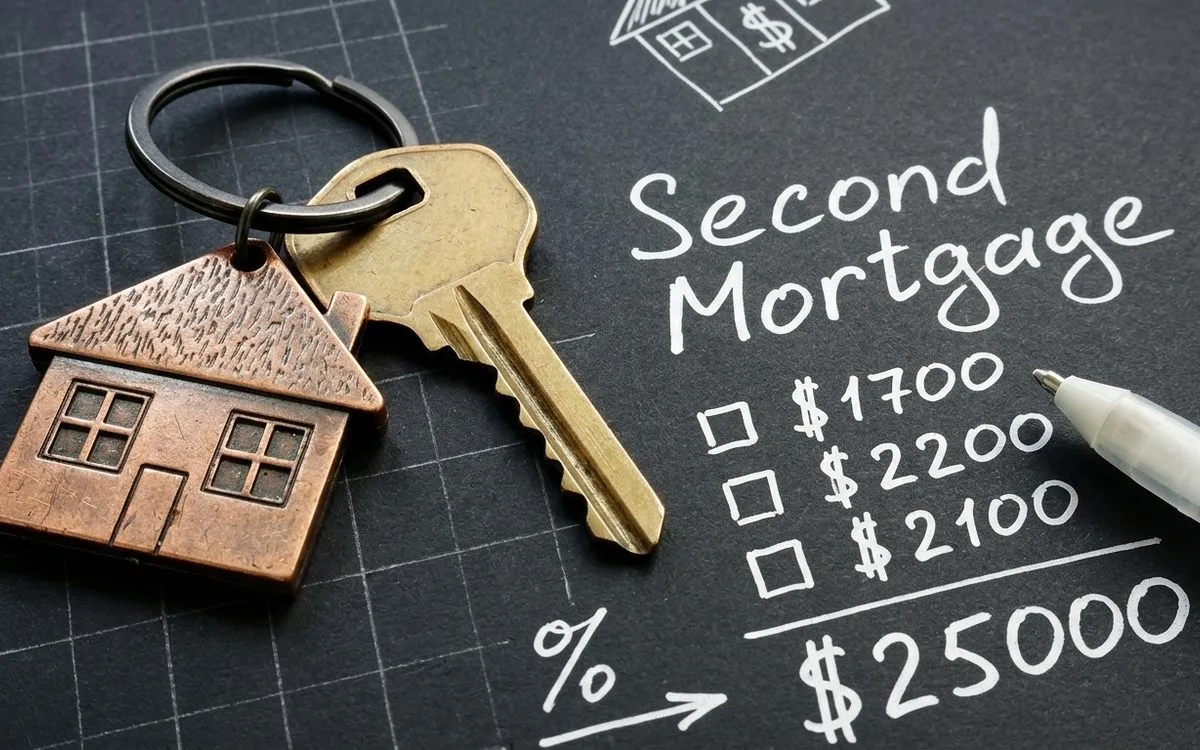
A second mortgage is a loan secured by your home while your original mortgage is still active. The lender places a “junior lien” on your property, meaning your first mortgage lender gets paid first if the home is ever sold or foreclosed on. Because that lender in second position takes on more risk, second mortgages usually carry higher interest rates than first mortgages — but still well below credit cards and personal loans.
Here’s the plain-English breakdown:
- Your first mortgage = the loan you used to buy the home.
- Your second mortgage = an additional loan borrowed against the equity you’ve built.
- Both loans use your home as collateral.
- Both loans have separate monthly payments.
- Miss either payment long enough, and you risk foreclosure.
The Consumer Financial Protection Bureau puts it simply: a second mortgage is “a loan you take out using your house as collateral while you still have another loan secured by your house.”
How Does a Second Mortgage Work?
A second mortgage works by turning a portion of your home equity into borrowed cash. Lenders review how much of the home you actually own outright, then let you borrow against that portion — while your first mortgage keeps chugging along untouched.
The mechanics play out in five steps:
- You build equity every time you make a mortgage payment or your home appreciates.
- The lender orders an appraisal to confirm current market value.
- You borrow a portion of that equity — usually up to 85% of your home’s value minus what you still owe on the first mortgage. This total ratio is called the Combined Loan-to-Value (CLTV).
- You get funds as either a lump sum or a revolving credit line.
- You repay the second mortgage with its own rate, term, and monthly payment.
A Real-Life Example
Let’s put actual numbers on it. Meet the Hendersons. They bought their home in 2018 for $310,000, and it’s now worth $465,000. They’ve paid the first mortgage down to $215,000. Here’s how their borrowing math works:
- Home value: $465,000
- 85% CLTV cap: $395,250
- Existing first mortgage: $215,000
- Maximum second mortgage available: $180,250
That’s a lot of borrowing power. But — and this is the part most articles skip — just because you can borrow $180,000 doesn’t mean you should. Cash flow, income stability, and the purpose of the loan matter far more than the ceiling.
The Two Main Types of Second Mortgages
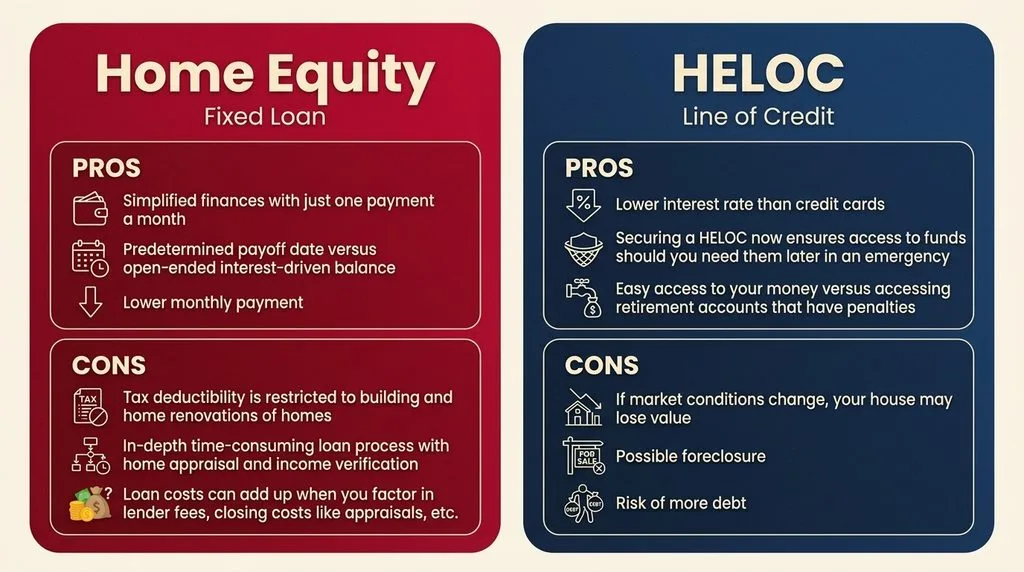
Two flavors dominate the market: a home equity loan (lump sum) and a home equity line of credit or HELOC (revolving credit). Picking the right one matters more than borrowers usually realize.
1. Home Equity Loan (The Lump Sum)
A home equity loan lands the full amount in your bank account in one shot. You then repay it in fixed monthly installments over 5 to 30 years at a fixed interest rate. Simple, predictable, boring — in the best possible way.
Choose it when:
- You know exactly how much you need
- You want stable, predictable payments
- You’re funding a one-time expense (renovation, consolidation, medical bill)
- You’d sleep better knowing your rate can’t jump
2. HELOC (The Revolving Credit Line)
A HELOC works more like a credit card backed by your house. You get approved for a maximum limit and draw funds as needed. You only pay interest on what you actually borrow.
HELOCs run in two phases:
- Draw period: Usually 3 to 10 years. You can borrow, repay, and re-borrow. Payments often stay interest-only.
- Repayment period: Usually 10 to 20 years. The credit line closes. Now you pay principal plus interest — and the payment can jump significantly.
Most HELOCs come with variable interest rates tied to the prime rate, so payments can climb (or fall) as market conditions shift.
Home Equity Loan vs HELOC: Side-by-Side
| Feature | Home Equity Loan | HELOC |
|---|---|---|
| How you get funds | One lump sum | Draw as needed |
| Interest rate | Fixed | Usually variable |
| Monthly payment | Fixed and predictable | Varies with balance and rate |
| Best for | One-time expenses | Ongoing or unpredictable needs |
| Repayment term | 5–30 years | Draw + repayment period |
| Rate risk | Low | Higher (rate can climb) |
| Interest paid on | Full loan amount | Only the amount you draw |
| Payment shock risk | None | Yes — when repayment period starts |
3. Bonus: The Piggyback Loan (80/10/10)
There’s a third, lesser-known type of second mortgage — the piggyback loan, also called an 80/10/10. Homebuyers use this at the moment of purchase to avoid private mortgage insurance or dodge jumbo loan territory.
Here’s how it breaks down:
- 80% first mortgage
- 10% second mortgage (the piggyback)
- 10% down payment from you
The piggyback often takes the form of a HELOC or a fixed home equity loan structured to close simultaneously with the primary mortgage. According to Bankrate’s piggyback loan guide, the strategy shines when you don’t have 20% down but still want to skip PMI, or when you’re buying above conforming loan limits.
Current Second Mortgage Rates in 2026
Second mortgage rates track broader interest movements but sit above first-mortgage rates because lenders take on more risk in the second-lien position. Here’s where the market stands as of August 2026:
- Home equity loan average: 8.10%, with a typical range between 5.90% and 10.75%
- HELOC national average: 7.31% (variable)
- First mortgage rates for comparison: Low-to-mid 6% range for primary residences
- LendingTree home equity loan average: 6.62% (competitive lenders can go lower for well-qualified borrowers)
What Affects Your Personal Rate
Advertised rates rarely match what you’re actually offered. Your specific rate depends on:
- Credit score — Higher scores unlock the lowest rates (700+ is the sweet spot)
- Combined loan-to-value ratio — Lower CLTV usually means better pricing
- Debt-to-income ratio — Below 43% is standard; below 36% is ideal
- Loan term — Shorter terms often carry lower rates
- Fixed vs variable — Variable rates start lower but carry rate-hike risk
- Property type — Primary residences get the best rates
- Lender type — Credit unions and community banks often beat national lenders
Some banks push aggressive intro rates. Bank of America was recently advertising a 5.740% intro variable APR on HELOCs, resetting to 8.275% after six months. Read the disclosures — teaser rates can quietly become expensive.
The Broader Rate Trend
Rates spiked hard in 2022–2023, then flatlined through 2024–2025 as the Fed held ground. Through mid-2026, HELOC and home equity loan rates have drifted lower alongside cooling inflation, but they remain roughly 1.5%–2% above first-mortgage rates. Borrowers who locked sub-4% first mortgages during 2020–2021 now have a strong reason to keep those loans in place — which is exactly why second mortgages are having a moment.
Second Mortgage Requirements: Do You Actually Qualify?
Lenders want proof you can handle a second monthly payment without breaking a sweat. Since the housing meltdown of 2008, requirements have tightened significantly. Here’s what almost every lender looks at.
1. Home Equity of at Least 15%–20%
Most lenders require you to retain 15% to 20% equity in your home after the second mortgage closes. That means your combined LTV must stay at or below 80%–85%. A small number of aggressive lenders (like AmeriSave) go up to 90% CLTV for borrowers with credit scores of 760+.
2. Credit Score Minimums
- Absolute floor: 620
- Most lenders prefer: 640–660
- Best rates unlock at: 700+
- Highest LTV tier: 760+
3. Debt-to-Income Ratio (DTI)
Your total monthly debt payments — including both mortgages — should stay below 43% of your gross monthly income. Some lenders will stretch this to 45% for strong applicants with cash reserves.
4. Verifiable Stable Income
Expect to hand over the standard package: W-2s, recent pay stubs, tax returns, bank statements. Self-employed borrowers usually need two years of tax returns plus a profit-and-loss statement.
5. A Fresh Home Appraisal
Lenders order an appraisal (or use an automated valuation model for smaller loans) to confirm current market value. You typically pay for it as part of closing costs — usually $300–$600.
6. Cash Reserves
Many lenders want to see enough savings to cover several months of combined mortgage payments. Building that cushion is easier when your emergency fund earns a competitive return — check our roundup of high yield savings accounts to make that money work harder.
Pros and Cons of a Second Mortgage
Second mortgages can be a smart, low-cost source of capital — or a fast path to losing your home. Both sides deserve equal weight.
✅ Pros
- Lower interest rates than unsecured debt. Second mortgages routinely price at 6%–10%, versus 20%+ on credit cards.
- Access to large sums of cash. Six-figure loans are common when equity supports it.
- Long repayment timelines. Terms of 10 to 30 years keep monthly payments manageable.
- Potential tax deduction. Interest may be deductible if you use the funds to substantially improve the home securing the loan (more on this below).
- Your first mortgage stays untouched. Locked in a sub-4% rate in 2020? A second mortgage lets you keep it.
- Flexible use of funds. Renovations, debt consolidation, tuition, medical bills, business capital.
- No new appraisal or income verification for HELOC draws. Once approved, you can pull funds fast.
❌ Cons
- Your home is on the line. Miss enough payments and you can lose your house. Period.
- Closing costs stack up. Expect 1%–6% of the loan amount in fees, though many lenders waive them for smaller loans.
- Extra monthly payment. Another obligation on your budget for years or decades.
- Variable-rate risk on HELOCs. Rising rates during the draw period can shock your finances.
- Payment shock when HELOC draw ends. When the interest-only phase closes, monthly payments can jump 200%–300%.
- Longer debt cycles. Rolling a five-year car loan into a 30-year second mortgage means paying interest for decades.
- Reduced equity cushion. Less equity means less flexibility if home values drop or you need to sell quickly.
How to Take Out a Second Mortgage: The 7-Step Process
Getting a second mortgage feels similar to your original loan, but faster and lighter on paperwork. Here’s the exact roadmap most borrowers follow.
Step 1 — Calculate Your Available Equity
Start with a recent home value estimate (Zillow, Redfin, Realtor.com, or a professional appraisal). Subtract your remaining first-mortgage balance to get gross equity. Multiply your home’s value by 0.85, then subtract your first mortgage — that’s roughly your borrowing ceiling.
Step 2 — Check Your Credit and DTI
Pull your free credit reports at AnnualCreditReport.com, the only federally authorized source. Aim for a score of at least 680 before applying. Also calculate your DTI: divide total monthly debt by gross monthly income.
Step 3 — Gather Documentation
Have these ready before applying:
- Two years of W-2s or full tax returns
- 30 days of recent pay stubs
- Two months of bank statements
- Current mortgage statement
- Homeowners insurance declarations page
- Property tax statement
- Government-issued ID
Step 4 — Compare Lenders
Shop at least three lenders. Include a mix — a national bank, a credit union, and an online lender. Credit unions frequently beat everyone on rate, while fintech lenders win on speed. If you don’t feel confident evaluating loan terms, a fee-only planner is worth the money — here’s a guide on finding a good financial advisor who can walk through the numbers with you.
Step 5 — Submit Your Application
Most lenders let you apply online in 15–30 minutes. Expect a hard credit inquiry and a document request within 24–48 hours. Applying with multiple lenders within a 14-day window counts as a single credit pull for scoring purposes.
Step 6 — Complete Underwriting and Appraisal
The lender orders an appraisal, verifies your income, reviews your title report, and confirms your first mortgage is current. This stage usually takes 2 to 6 weeks. Streamlined online lenders can close in as little as 10 days. Respond to document requests quickly to keep things moving.
Step 7 — Close the Loan
You’ll sign a stack of disclosures, pay any closing costs, and receive your funds. Under federal law, second mortgages on your primary residence come with a three-day right of rescission — you can cancel with no penalty within 72 hours of signing. Use it if anything feels off.

Second Mortgage vs Cash-Out Refinance: Which Wins in 2026?
Both tap home equity. They work very differently. If you locked in a low first-mortgage rate during 2020–2021, this decision is a no-brainer for most borrowers.
| Factor | Second Mortgage | Cash-Out Refinance |
|---|---|---|
| Effect on first loan | Untouched | Replaced entirely |
| Best when your first rate is… | Low (preserves it) | Higher than current market |
| Closing costs | Lower (1%–6%) | Higher (2%–6% of full new loan) |
| Interest rate | Higher than first mortgage | Typically lower than a second mortgage |
| Loan count | Two separate loans | One consolidated loan |
| Best for | Preserving a cheap first mortgage | Simplifying to one payment |
Bottom line: Homeowners who refinanced below 3.50% in 2020–2021 almost always come out ahead with a second mortgage rather than surrendering that historic rate. Cash-out refinancing typically only makes sense if current rates are equal to or lower than your existing rate.
Smart (and Not-So-Smart) Ways to Use a Second Mortgage
The best uses share one thing in common: they grow net worth, wipe out toxic debt, or handle genuine emergencies. The worst uses fund things you can’t hold onto.
Smart Uses
- Home improvements that add value. Kitchen remodels, bathroom updates, energy-efficient upgrades, additions, and ADUs. Interest is often tax-deductible when funds go into the home itself.
- High-interest debt consolidation. Rolling 22%+ credit card debt into an 8% second mortgage can save thousands — but only if you don’t run the cards back up. Read is debt consolidation a good idea before you pull the trigger.
- Funding a home addition. If you’re weighing this against a full new build, review construction loan requirements first.
- Medical emergencies when savings and insurance have been exhausted.
- College tuition (with caution). Second mortgage rates often beat private student loans, especially for parents.
- Business capital for established businesses with predictable cash flow.
Not-So-Smart Uses
- Vacations, weddings, luxury purchases. You’re putting your home at risk for something that depreciates or disappears.
- Speculative investing. Crypto, meme stocks, or day trading with home equity is a fast path to disaster.
- Debt you’ll immediately rebuild. Consolidating credit cards while keeping the same spending habits doubles your problem.
- Untested business ventures. Unsecured business loans exist for a reason.
- Everyday living expenses. If your income can’t cover routine bills, adding debt makes things worse.
Tax Rules for Second Mortgages in 2026
The Tax Cuts and Jobs Act (TCJA) reshaped mortgage interest deductibility, and the One Big Beautiful Bill Act (OBBBA), signed July 4, 2025, made the current limits permanent starting in tax year 2026. Here’s what applies now.
The Core Rules
- Interest is deductible on up to $750,000 in combined mortgage debt ($375,000 if married filing separately) for loans taken out after December 15, 2017.
- The debt must be secured by your primary or secondary home.
- Funds must be used to buy, build, or substantially improve the home securing the loan for the interest to qualify.
- Cash-out portions used for non-home purposes (like credit card payoff, tuition, or investing) are not tax deductible.
- Older loans taken before December 15, 2017 keep the original $1 million cap.
What’s New Under the OBBBA in 2026
- The $750,000 cap is now permanent (it was scheduled to sunset at the end of 2025).
- Private Mortgage Insurance (PMI) is treated as deductible mortgage interest for acquisition debt starting tax year 2026.
- SALT deduction cap raised to $40,000 (from $10,000) for households earning under $500,000, running 2025–2029.
- The threshold and cap increase by 1% annually through 2029.
Always confirm your specific situation with a CPA before claiming — tax rules interact with each other, and one wrong deduction can trigger an audit.
Red Flags: How to Spot a Predatory Second Mortgage Lender
Not every lender is playing fair. The second-mortgage space has attracted its share of aggressive operators, especially in the sub-prime tier. Watch for these warning signs.
- Pressure to sign fast. Any lender that rushes you before you understand the terms is a red flag.
- Rates significantly above the national average without a clear credit-based reason.
- Excessive points or “junk fees.” Look for anything above 5% total closing costs — ask what each line item does.
- Prepayment penalties. Legit second mortgages usually don’t have them; if yours does, know exactly when and how much.
- “Bad credit doesn’t matter” pitches. It always matters. Lenders that ignore credit charge for the risk in other ways.
- Unsolicited offers from lenders you never contacted.
- Loan flipping. Repeatedly refinancing you into new second mortgages that generate fees.
- Steering. Pushing you toward a higher-rate product when you qualify for cheaper options.
- Balloon payments hidden in the fine print.
- Verbal promises that don’t match the written documents.
According to the Center for Responsible Lending’s predatory lending guide, big fees, prepayment penalties, and inflated broker rates are the three most common traps.
Zombie Second Mortgages: The Risk Nobody Talks About
Here’s one that most homeowners have never heard of — and it’s costing families their homes. A “zombie” second mortgage is a loan a homeowner thought was written off or forgiven, only to have it resurface years later when a debt buyer purchases it for pennies on the dollar and starts foreclosure proceedings.
Many of these loans were second mortgages issued between 2004 and 2008. When home values crashed, lenders stopped sending statements. Homeowners assumed the loans were dead. Then, quietly, debt collectors bought them cheap and are now trying to foreclose.
- A 2024 NPR investigation found at least 500 Maryland homeowners facing foreclosure from apparently dormant second mortgages.
- The CFPB has issued guidance stating it is illegal to sue or threaten suit on time-barred zombie mortgages.
- California passed a law in 2024 restricting these foreclosures — though lenders are suing to block it.
How to protect yourself:
- If you took out a second mortgage between 2004 and 2010, request a full loan history from the current servicer.
- Pull your credit report annually to check for accounts you don’t recognize.
- Keep records of any bankruptcy discharge, short sale, or loan settlement forever.
- If you receive a foreclosure notice for an “old” second mortgage, don’t ignore it — contact a housing counselor at HUD.gov immediately.
Who Should NOT Get a Second Mortgage?
This is the section most articles skip because it’s uncomfortable. But it might save you your home.
A second mortgage is probably a bad idea if:
- Your income is unstable or you rely heavily on commissions/bonuses
- You have less than 3 months of expenses in emergency savings
- Your primary purpose is funding a lifestyle upgrade
- You’re near retirement and don’t want to carry debt into it
- Your first mortgage is already stretching your budget
- Your credit score is below 640 (rates will be brutal)
- You’ve filed bankruptcy in the last 3 years
- You expect to move within the next 2–3 years
- The purpose of the loan doesn’t generate financial return or eliminate higher-cost debt
If several of these apply, take a hard look at the alternatives below before applying.
Alternatives to a Second Mortgage
A second mortgage isn’t the only way to tap equity or fund a big expense. Compare these first:
- Cash-out refinance. Best if today’s rates are lower than your first mortgage rate.
- Personal loan. No home collateral, faster closing, but higher rates (10%–36%).
- 0% intro APR credit card. Solid for smaller expenses you can pay off in 12–18 months.
- Reverse mortgage. For homeowners 62+ who want to convert equity into income without monthly payments.
- Home equity investment (HEI). Companies like Point or Hometap advance cash in exchange for a share of future home appreciation — no monthly payments, but you give up upside.
- 401(k) loan. In specific cases, a 401(k) loan may make sense, though it carries its own trade-offs if you leave your job.
- Sale-leaseback. Sell your home to an investor and lease it back — extreme but occasionally used by retirees.
10 Questions to Ask a Second Mortgage Lender
Print this list before your first lender conversation. If they hedge on any answer, keep shopping.
- What is the annual percentage rate (APR), and is it fixed or variable?
- What are the total closing costs, itemized?
- Are there any prepayment penalties or early payoff fees?
- What is the maximum CLTV you’ll allow at my credit score?
- What is the loan term, and can I choose different term options?
- Do you require an appraisal, and who pays for it?
- How long does your typical closing timeline run?
- Does the loan have a balloon payment or rate reset?
- Who services the loan after closing — you or a third party?
- Can I lock the rate, and how long is the lock good for?
How Much Can You Actually Borrow? A Quick Reference
Here’s a quick reference showing maximum borrowing based on different home values and first-mortgage balances at an 85% CLTV cap:
| Home Value | First Mortgage Balance | Max CLTV (85%) | Max Second Mortgage |
|---|---|---|---|
| $300,000 | $150,000 | $255,000 | $105,000 |
| $400,000 | $250,000 | $340,000 | $90,000 |
| $500,000 | $250,000 | $425,000 | $175,000 |
| $600,000 | $350,000 | $510,000 | $160,000 |
| $750,000 | $400,000 | $637,500 | $237,500 |
| $1,000,000 | $500,000 | $850,000 | $350,000 |
A few lenders push CLTV up to 90% for elite credit borrowers, though rates run higher at that tier.
Second Mortgage vs Second-Home Mortgage: Don’t Mix These Up
These terms sound identical but mean completely different things:
- Second mortgage: A subordinate loan on the home you already own.
- Second-home mortgage: A brand-new first mortgage on a vacation home or additional property.
Second-home mortgages usually require 10%–20% down, a credit score of 660+, and a DTI below 45%. They also come with slightly higher rates than primary-residence mortgages because lenders view them as higher risk. Second mortgages require no down payment — you’re borrowing against equity you already own.
Common Second Mortgage Mistakes to Avoid
Even smart borrowers stumble here. Here are the biggest mistakes to sidestep.
- Not shopping around. Rates and closing costs vary by 1–2 percentage points between lenders. That’s tens of thousands over a 30-year term.
- Focusing only on monthly payment. A lower payment often means a longer term and more total interest.
- Ignoring the fine print on HELOCs. Variable rates, draw period rules, and repayment triggers all matter.
- Borrowing the max. Just because you qualify for $200,000 doesn’t mean you should take $200,000.
- Using the funds for something that depreciates. Cars, boats, and vacations shouldn’t be financed against your home.
- Forgetting closing costs and fees when calculating whether the loan makes sense.
- Not planning for the HELOC repayment shock. When the draw period ends, monthly payments can jump 200%+.
- Skipping the three-day rescission window. Read every document during those 72 hours.
Frequently Asked Questions
Is a second mortgage a good idea in 2026?
A second mortgage can be a smart move if you have a low first-mortgage rate, stable income, and a clear plan for the funds — especially home improvements or high-interest debt payoff. It becomes risky when used for depreciating purchases, speculative investments, or when income is unpredictable. With 2026 rates averaging 7.3%–8.1%, second mortgages still price well below credit cards and personal loans.
How long does it take to get a second mortgage?
Most second mortgages close within 2 to 6 weeks from application. Streamlined online lenders using automated appraisals can close in as little as 10 days. Traditional bank processing with full appraisals typically takes 30–45 days. Have your documents ready to move faster.
Can I get a second mortgage with bad credit?
Some lenders approve second mortgages with credit scores as low as 580–620, but expect significantly higher rates, lower borrowing limits, and stricter equity requirements (often 25%+ equity retained). Bumping your score up by 40 points before applying can save thousands over the life of the loan.
What happens if I can’t pay my second mortgage?
The second-lien lender can foreclose on your home if you miss enough payments, though your first mortgage gets paid first from any sale proceeds. Because the second lender risks losing money in that scenario, they often work with borrowers on modifications, forbearance, or repayment plans before pulling the trigger. Contact them immediately if you’re falling behind.
Can I use a second mortgage for anything I want?
Yes — funds can be used for nearly any legal purpose, including debt consolidation, tuition, medical bills, business capital, or home improvements. However, only interest on funds used to buy, build, or substantially improve the home securing the loan qualifies for the mortgage interest tax deduction.
Does a second mortgage hurt my credit score?
Your score usually dips 5–15 points from the initial hard inquiry and new account. Once you start making on-time payments, your score typically recovers within a few months and can climb higher than before as your payment history strengthens. Missed payments will drop your score significantly — expect a 60–100 point drop on the first late payment.
Are HELOC rates fixed or variable?
Most HELOCs carry variable interest rates tied to the prime rate. Some lenders offer fixed-rate conversion options that let you lock in the rate on a specific draw for a set period. Home equity loans, by contrast, almost always have fixed rates for the entire term.
Should I get a second mortgage or a personal loan?
Choose a second mortgage for larger amounts ($25,000+), longer repayment horizons, and lower interest rates. Choose a personal loan for smaller amounts, faster funding (often 24–72 hours), and when you don’t want to risk your home. Personal loans won’t cost you your house if you default.
Can I have more than one second mortgage on my home?
Technically yes, but it’s rare and hard to qualify for. Some homeowners have both a home equity loan and a HELOC. The lender in third position charges even higher rates because they’re behind two other liens. Most homeowners stick to one second mortgage.
Final Thoughts: Is a Second Mortgage Right for You?
A second mortgage sits somewhere between a powerful wealth-building tool and a serious financial risk — and where it lands depends entirely on how you use it.
Borrowers who use it strategically — for renovations that add real value, for consolidation of genuinely toxic debt, or for capital that generates returns — often come out ahead. Those who treat home equity like a checking account tend to regret it within a few years.
Before applying, run the math three ways:
- What’s the total interest cost over the life of the loan (not just the monthly payment)?
- Could you comfortably afford both mortgage payments if your income dropped 20%?
- Does the underlying reason for borrowing justify putting your home on the line?
Shop at least three lenders. Ask about closing costs and prepayment penalties upfront. Never sign paperwork you don’t understand. That three-day right of rescission exists for a reason — use it if anything feels off.
Your home is more than an ATM. But handled with care, its equity can be one of the most powerful sources of low-cost capital you’ll ever access.


Leave a Reply