
In this article
- Key Takeaways
- Stocks Turn Lower as Rate Concerns Return
- Why Warsh's Rate Message Matters
- Inflation Remains at the Center of the Debate
- Treasury Yields Put Pressure on Stocks
- Why Growth Stocks Can Feel More Pressure
- The Nasdaq Could Remain Sensitive to Rate Expectations
- Strong Jobs Data Adds to the Uncertainty
- Why Strong Economic News Can Sometimes Hurt Stocks
- Rate Expectations Matter More Than One-Day Market Moves
- What Higher Rates Mean for Companies
- The Role of Corporate Earnings
- What Investors Should Watch Next
- What This Means for Long-Term Investors
- Could Stocks Recover?
- The Bigger Picture
- Final Thoughts
Key Takeaways
- U.S. stocks came under pressure as investors reacted to stronger signals that interest rates could remain higher for longer.
- Federal Reserve Chair Kevin Warsh emphasized the importance of bringing underlying inflation back toward the Fed’s 2% target.
- Higher interest-rate expectations pushed Treasury yields higher and made investors more cautious about stocks.
- Technology and other growth-oriented companies can face greater valuation pressure when bond yields rise.
- Strong employment and persistent inflation could make the Federal Reserve more cautious about lowering interest rates.
- Investors are likely to focus closely on inflation data, jobs reports, Treasury yields and upcoming Fed decisions.
Stocks Turn Lower as Rate Concerns Return
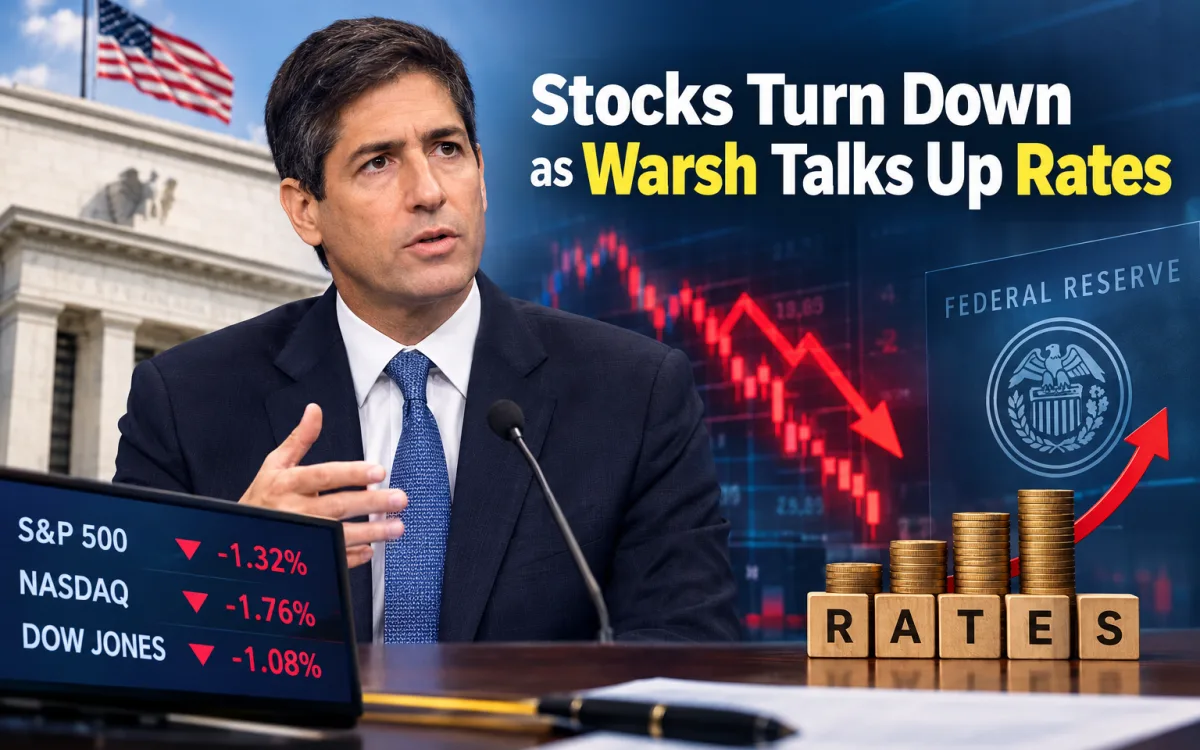
The U.S. stock market turned lower as investors reassessed the outlook for interest rates. The change in sentiment came as Federal Reserve Chair Kevin Warsh delivered a message that kept the possibility of tighter monetary policy firmly in focus.
Investors had been hoping that interest rates could move lower as inflation cooled. Warsh’s comments created a different possibility: rates may need to stay elevated, or potentially move higher, if inflation does not continue moving toward the Federal Reserve’s target.
That shift in expectations was enough to create pressure across parts of the stock market. When investors expect borrowing costs to remain high, they often become more selective about the prices they are willing to pay for stocks.
The reaction also shows how closely financial markets are watching the Federal Reserve. Even without an immediate policy change, comments from senior Fed officials can influence expectations for future interest rates.
Why Warsh’s Rate Message Matters
Interest rates play a major role in the valuation of financial assets. When rates are low, investors may be willing to pay higher prices for companies with strong expected growth because the cost of waiting for future profits is relatively low.
Higher rates change that calculation.
If borrowing costs rise, companies may have to spend more on interest payments. Consumers can also face higher costs on mortgages, credit cards, auto loans and other forms of borrowing.
At the same time, higher Treasury yields can provide investors with more attractive alternatives to stocks. This can make the equity market more sensitive to changes in monetary-policy expectations.
Warsh’s emphasis on inflation therefore matters beyond the Federal Reserve itself. His comments can influence bond yields, stock valuations and expectations for economic growth.

Inflation Remains at the Center of the Debate
The Federal Reserve’s inflation target remains one of the most important factors behind monetary policy.
If inflation moves steadily toward the 2% target, policymakers may eventually have more flexibility to reduce rates. But if price pressures remain persistent, the central bank may need to maintain a restrictive policy for longer.
This creates a difficult balance.
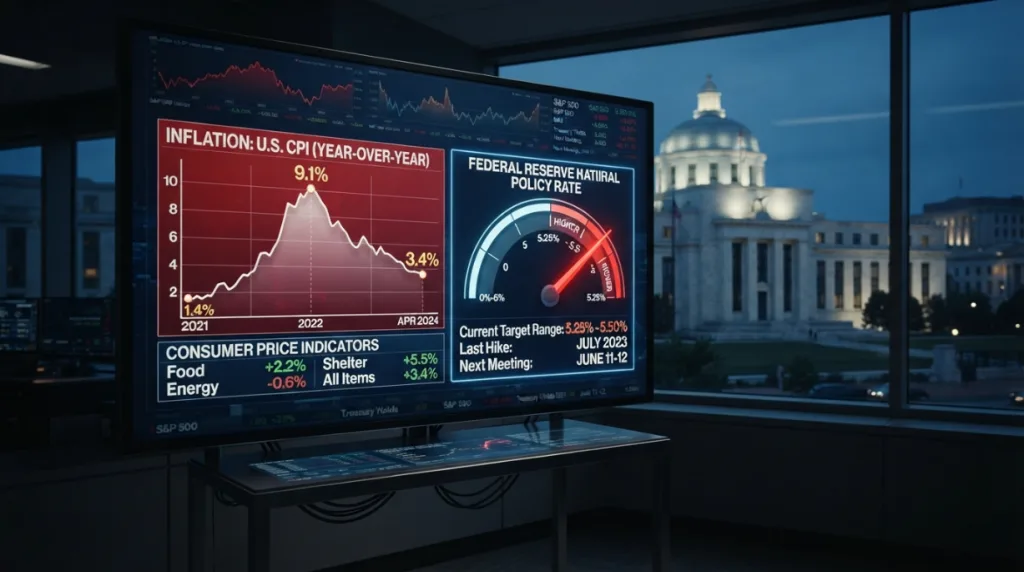
The Fed wants to control inflation without unnecessarily damaging economic growth or employment. If policymakers tighten too aggressively, economic activity could slow more than necessary. If they ease policy too quickly, inflation could remain above target for longer.
For investors, this balance creates uncertainty.
The market is therefore paying close attention to every major inflation report and to comments from Fed officials. A surprisingly strong inflation reading could increase expectations for higher rates, while softer inflation could reduce those concerns.
Treasury Yields Put Pressure on Stocks
Treasury yields are closely connected to the stock market because they influence borrowing costs and investment returns.
When Treasury yields rise, investors may demand higher potential returns from stocks to justify taking on additional risk. That can put pressure on equity valuations, particularly when stocks are already trading at elevated levels.

Short-term Treasury yields can be particularly sensitive to expectations about Federal Reserve policy.
If investors begin expecting additional rate increases, two-year Treasury yields can react quickly because they are closely linked to expectations for short-term interest rates.
Longer-term yields matter as well. They influence mortgage rates, corporate borrowing costs and the broader financial conditions faced by households and businesses.
This means that stock investors should not look only at the S&P 500 or Nasdaq. The Treasury market can provide important clues about how investors view the future path of monetary policy.
Why Growth Stocks Can Feel More Pressure
Growth stocks are often more sensitive to changes in interest rates because a significant portion of their valuations can depend on earnings expected several years into the future.
When interest rates rise, those future earnings are discounted at a higher rate.
That can reduce the present value investors assign to the company.
Technology companies are a major example. Many technology businesses have strong long-term growth prospects, but investors often value them based on expectations of substantial future earnings.
When bond yields move higher, the valuation of those future profits can become less attractive.
This does not mean every technology stock will decline when rates rise. Companies with strong balance sheets, growing revenues and healthy cash flow may remain attractive.
The important issue is whether the company’s expected growth is strong enough to justify its valuation in a higher-rate environment.

The Nasdaq Could Remain Sensitive to Rate Expectations
The Nasdaq has a large concentration of technology and growth-oriented businesses. As a result, changes in interest-rate expectations can have an especially noticeable effect on the index.
When yields rise rapidly, investors may reduce the valuation multiples assigned to companies with long-term growth expectations.
However, the Nasdaq is not driven by interest rates alone.
Corporate earnings, artificial intelligence investment, consumer demand, productivity and business spending can all influence technology stocks.
That means investors should consider both the macroeconomic environment and individual company fundamentals.
A company with strong earnings growth may continue performing well even when interest rates are elevated. A company with weak earnings and a high valuation may face much greater pressure.
Strong Jobs Data Adds to the Uncertainty
The labor market is another important part of the interest-rate outlook.
A strong employment market can support consumer spending and corporate revenue. However, continued labor-market strength can also make policymakers more cautious if it contributes to wage pressure or keeps demand strong.
Recent employment data added to expectations that the Federal Reserve could keep policy tighter than previously anticipated.
That has made upcoming economic reports particularly important for investors.
If future data continues to show strong employment and persistent inflation, expectations for higher rates could remain elevated.
If the economy begins to slow meaningfully and inflation continues to moderate, investors could become more optimistic about eventual rate reductions.
Why Strong Economic News Can Sometimes Hurt Stocks
One of the confusing aspects of the current market is that positive economic data can sometimes produce a negative reaction from investors.
Normally, strong employment and economic growth would be considered good news for stocks.
But the relationship changes when investors are worried about inflation.
Strong economic activity can keep demand high. If demand remains strong while supply is constrained, price pressures can persist.
The Federal Reserve may then have less reason to lower interest rates.
As a result, a strong jobs report can sometimes cause Treasury yields to rise and stocks to decline.
This does not mean strong economic growth is bad. Instead, it shows that markets are constantly weighing economic growth against monetary-policy expectations.
Rate Expectations Matter More Than One-Day Market Moves
Investors should also remember that stock prices often respond to expectations rather than current interest rates alone.
Suppose investors expect the Federal Reserve to lower rates several times. If new information suddenly suggests that fewer cuts are likely, stocks may fall even if the actual policy rate has not changed.
That is because financial markets attempt to price future conditions in advance.
The same principle works in the opposite direction.
If inflation falls faster than expected and investors become confident that the Fed can ease policy, Treasury yields may decline and stock valuations can receive support.
Therefore, one market decline does not necessarily establish a long-term trend.
Investors need to watch how expectations develop over several weeks and months.
What Higher Rates Mean for Companies
Higher interest rates can affect companies in several ways.
Businesses that carry large amounts of debt may face higher financing expenses when loans mature or need to be refinanced.
Companies with strong cash positions and limited debt may have more flexibility.
Higher rates can also affect expansion plans. A company may delay a new factory, acquisition or major investment if financing becomes too expensive.
Consumer companies can face another challenge.
If households pay more for mortgages, credit cards and other loans, they may have less money available for discretionary purchases.
That can affect companies that depend heavily on consumer spending.
For this reason, investors should consider a company’s debt level, cash flow and pricing power when evaluating stocks in a higher-rate environment.
The Role of Corporate Earnings
Interest rates are important, but they are only one part of the stock-market equation.
Corporate earnings ultimately play a major role in determining whether stocks can remain strong.
If companies continue increasing revenue and profits, investors may tolerate higher interest rates.
If earnings expectations begin falling at the same time that Treasury yields rise, stocks could face a much more difficult environment.
This is why investors should look beyond daily index movements.
A strong company with manageable debt and consistent cash flow may be able to handle higher rates better than a highly leveraged company with uncertain earnings.
The market can therefore become more selective when monetary policy becomes less supportive.
What Investors Should Watch Next
Several indicators will be particularly important as investors evaluate the next phase of the market.
Inflation Reports
Inflation data will remain one of the biggest market-moving factors.
A hotter-than-expected reading could strengthen expectations for higher rates. A softer reading could increase hopes that monetary policy can eventually become less restrictive.
Employment Data
Jobs reports provide clues about the strength of the economy and the potential for wage and demand pressures.
A very strong labor market could keep the Fed cautious, while signs of meaningful weakness could change expectations.
Treasury Yields
Investors should watch both short-term and long-term Treasury yields.
A sharp increase in yields can create pressure for stocks because it raises the return available from government bonds and increases financing costs across the economy.
Federal Reserve Communication
Speeches, policy statements and economic projections can change market expectations quickly.
Investors will continue looking for clues about whether policymakers believe additional tightening is necessary or whether they are becoming more comfortable with current policy.
Corporate Earnings
Earnings will remain crucial.
Strong earnings growth can help companies offset some of the pressure created by higher discount rates.
Weakening earnings expectations could make rising yields more damaging for stocks.
What This Means for Long-Term Investors
A period of rate uncertainty does not automatically mean investors should abandon stocks.
Long-term investors typically benefit from focusing on diversification, time horizon and company quality rather than trying to predict every short-term market move.
Companies with strong balance sheets, sustainable competitive advantages and consistent cash generation may be better positioned to operate through different interest-rate environments.
Investors should also consider whether their portfolios are overly concentrated in one sector.
A diversified portfolio can reduce the impact of a sharp decline in a particular part of the market.
The right approach depends on each investor’s financial goals, risk tolerance and investment horizon.

Could Stocks Recover?
A short-term decline caused by higher rate expectations does not necessarily mean the beginning of a prolonged bear market.
Stocks could recover if inflation data improves, Treasury yields stabilize and corporate earnings remain strong.
Markets could also respond positively if investors become more confident that the Federal Reserve is approaching the end of its tightening cycle.
On the other hand, continued inflation pressure combined with rising yields and weaker earnings could create a more challenging environment.
The direction of the market will therefore depend on several factors working together.
Investors should avoid assuming that one Fed speech or one trading session will determine the entire market outlook.
The Bigger Picture
The latest weakness in stocks highlights an important feature of today’s market: monetary policy remains a major driver of investor sentiment.
When Federal Reserve officials signal that inflation remains a concern, investors immediately reassess the potential path of interest rates.
That reassessment can move Treasury yields and stock valuations at the same time.
Technology and other growth stocks may experience greater sensitivity because their valuations often depend heavily on future earnings.
However, strong corporate fundamentals can still provide support.
The most important question is not simply whether rates are high or low. Investors need to consider why rates are changing and what those changes mean for inflation, economic growth and company profits.
Final Thoughts
The latest market pullback shows how quickly interest-rate expectations can influence stocks.
Kevin Warsh’s emphasis on inflation has encouraged investors to reconsider the possibility that monetary policy could remain restrictive for longer. Higher Treasury yields have added another layer of pressure to equity valuations.
Still, the outlook is not predetermined.
If inflation continues to moderate and corporate earnings remain healthy, stocks could regain momentum. If inflation stays persistent and interest-rate expectations continue moving higher, volatility could remain elevated.
For investors, the most useful approach is to watch the larger picture rather than react to every daily market move. Inflation, employment, Treasury yields, Federal Reserve communication and corporate earnings will remain the key factors shaping the stock-market outlook.
Disclaimer: This article is for educational purposes only and should not be considered personalized investment advice. Investors should conduct their own research and consider their financial circumstances before making investment decisions.



Leave a Reply