
In this article
- Key Takeaways
- What Is Token Unlock?
- Why Do Crypto Projects Lock Tokens?
- How Does a Token Unlock Work?
- What Is a Token Vesting Schedule?
- Who Receives Unlocked Tokens?
- Can a Token Unlock Affect the Price?
- Does a Token Unlock Increase Circulating Supply?
- Token Unlock vs. Token Release
- Token Unlock vs. Token Burn
- How to Track Upcoming Token Unlocks
- What Should You Check Before a Token Unlock?
- Is a Token Unlock Bad for Investors?
- Simple Example of a Token Unlock
- Frequently Asked Questions
- Final Thoughts
Key Takeaways
- A token unlock makes previously restricted tokens available according to a set schedule.
- Crypto projects often use vesting schedules to distribute tokens over time.
- Founders, employees, investors, advisors, and communities may receive locked tokens.
- A large unlock can create selling pressure if recipients sell their tokens.
- An unlock does not automatically mean the token price will fall.
- The size, timing, recipients, and purpose of an unlock all matter.
- Investors should check official tokenomics before making decisions.
If you are new to cryptocurrency, you may have seen the term token unlock on crypto news sites or market calendars. But what does it actually mean?
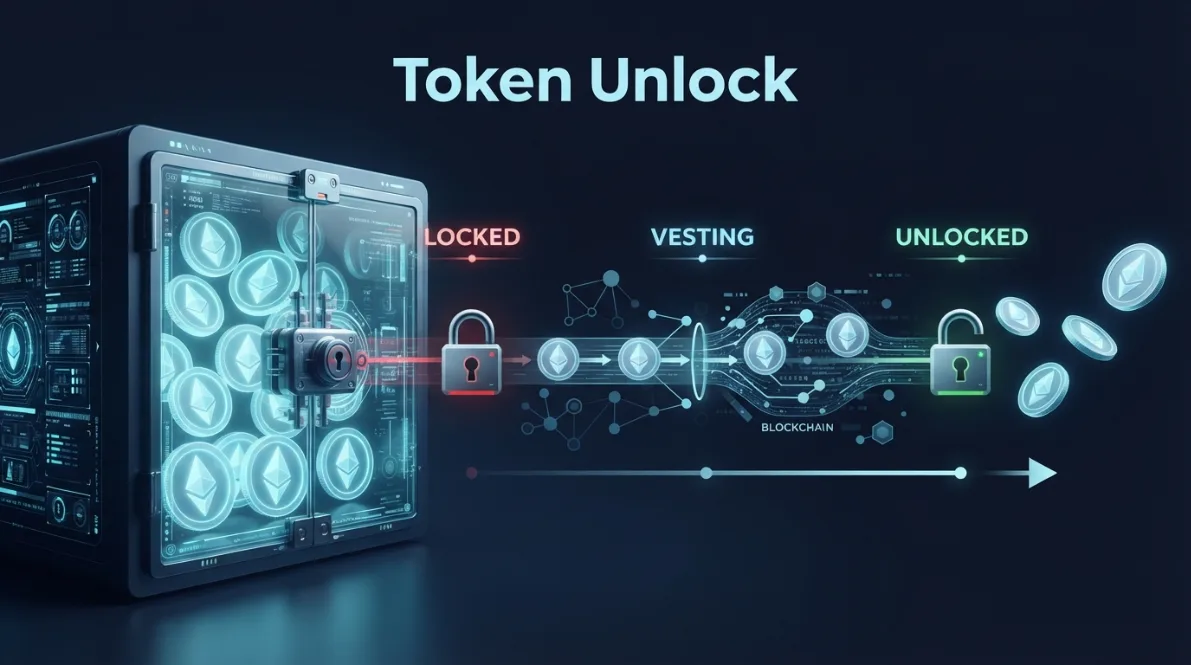
A token unlock happens when a crypto project makes previously locked tokens available to their intended holders.
Projects often lock tokens for founders, employees, investors, advisors, or community programs. They then release those tokens over time based on a predetermined schedule.
Understanding token unlocks can help you evaluate a project’s tokenomics and potential supply changes.
What Is Token Unlock?
Token unlock is the process of making previously locked cryptocurrency tokens available to their assigned holders.
A project may create a large total supply but keep part of it locked. This prevents certain holders from accessing their entire allocation immediately.
For example, imagine a project creates 1 billion tokens. It may initially circulate only 400 million tokens. The remaining tokens could stay locked under different vesting agreements.
As scheduled dates arrive, some of those locked tokens become available.
This event is known as a token unlock.
The exact rules depend on the project’s tokenomics and vesting plan.
Why Do Crypto Projects Lock Tokens?
Crypto projects often lock tokens to manage how their supply enters the market.
Without a lockup period, founders and early investors could potentially receive their full allocations at launch. If many holders sold at the same time, the token could face heavy selling pressure.
A vesting schedule spreads token distribution over a longer period.
Projects may also use lockups to encourage long-term participation. Team members and early investors may have to wait before accessing some or all of their allocations.
However, a token lock does not guarantee that a project will succeed. You should still research the project’s technology, adoption, team, tokenomics, and risks.
How Does a Token Unlock Work?
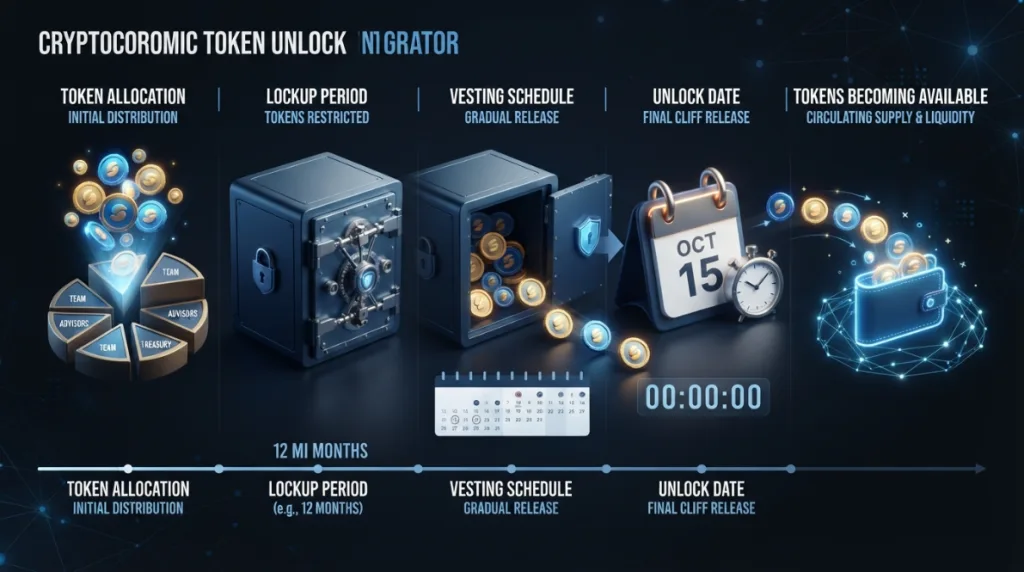
A token unlock usually follows a predefined schedule.
The basic process looks like this:
Token allocation → Lockup period → Vesting schedule → Unlock date → Tokens become available
The schedule can differ from one project to another.
Some projects release tokens every month. Others may use quarterly or yearly unlocks.
For example, a project could give its team 100 million tokens with a four-year vesting schedule.
The team may not receive the entire allocation immediately. Instead, the project could make a portion available over time.
This approach gives the project more control over token distribution.
What Is a Token Vesting Schedule?
A token vesting schedule determines when locked tokens become available.
Projects commonly use several vesting methods.
Linear Vesting
With linear vesting, tokens become available gradually over a specific period.
For example, a project may release the same portion of an allocation every month for two years.
This creates a predictable distribution schedule.
Cliff Vesting
A cliff keeps tokens locked until a specific date.
For example, an investor may have a 12-month cliff. During that period, the investor cannot access the locked allocation under the vesting agreement.
After the cliff ends, the project may begin releasing the tokens.
Cliff and Linear Vesting
Some projects combine both methods.
A project might keep tokens locked for six months and then release them gradually during the following 18 months.
The actual terms depend on the project’s tokenomics.
Who Receives Unlocked Tokens?
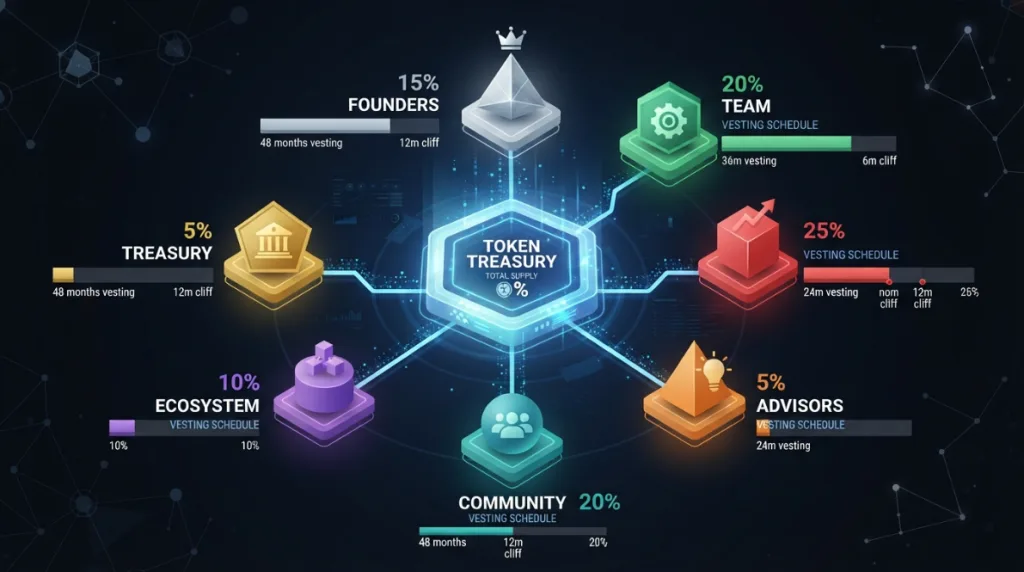
Different groups can receive tokens through an unlock schedule.
Common recipients include:
- Founders
- Team members
- Early investors
- Venture capital investors
- Advisors
- Community members
- Ecosystem participants
- Treasury or development funds
The recipient matters because each group may use the tokens differently.
For example, an ecosystem allocation could support community programs or development. An investor allocation could create selling pressure if the recipients decide to sell.
That is why you should look beyond the unlock date.
Always check who receives the tokens and why they are being unlocked.
Can a Token Unlock Affect the Price?
Yes, a token unlock can affect price, but it does not guarantee a price drop.
When a large allocation becomes available, recipients have more flexibility to use or sell those tokens.
If many recipients sell while demand remains weak, the extra selling pressure could push the price lower.
But the opposite can also happen.
Strong demand may absorb the additional supply. Some recipients may also choose to keep their tokens rather than sell them.
Several factors can influence the market reaction:
- Size of the unlock
- Current circulating supply
- Market demand
- Trading liquidity
- Token utility
- Recipient behavior
- Investor sentiment
- Overall crypto market conditions
So you should not automatically treat an upcoming unlock as a bearish signal.
Does a Token Unlock Increase Circulating Supply?
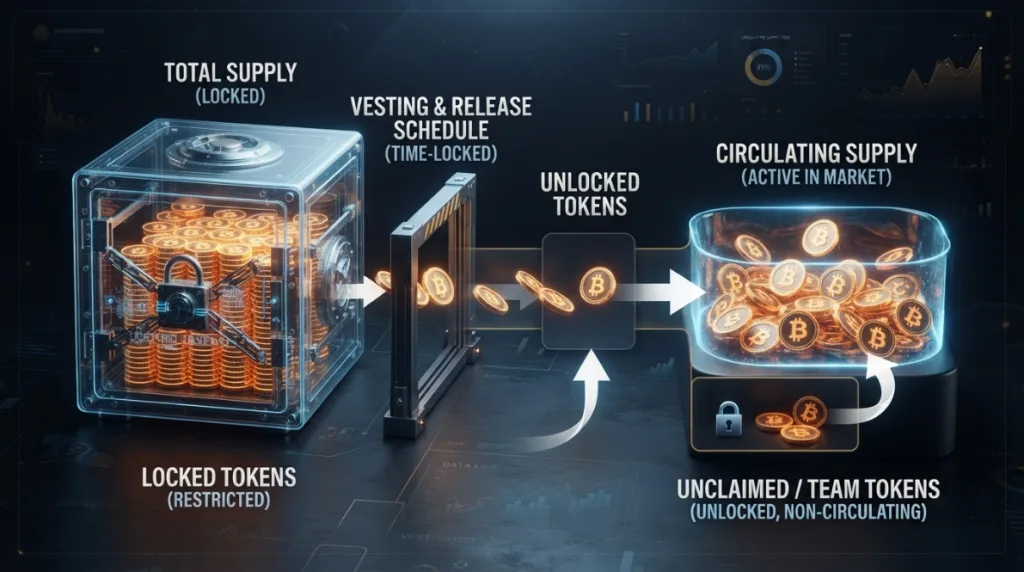
An unlock makes previously restricted tokens available under the relevant lockup or vesting agreement.
However, unlocked tokens do not always mean the same thing as circulating supply.
The definition of circulating supply can vary between projects and market-data providers.
Some unlocked tokens may still have restrictions or may not immediately qualify as freely circulating supply.
For accurate information, check the project’s official tokenomics documentation and the methodology used by the data provider.
This distinction is important when calculating the potential impact of an upcoming unlock.
Token Unlock vs. Token Release
The terms token unlock and token release often appear together, but they can describe different events.
A token unlock usually refers to previously restricted tokens becoming available under a vesting or lockup schedule.
Token release is a broader term. It can describe tokens being distributed or entering the market for different reasons.
Crypto projects do not always use these terms consistently.
Therefore, check the project’s official documentation to understand what a specific event actually means.
Token Unlock vs. Token Burn
A token unlock and a token burn have very different purposes.
A token unlock makes previously restricted tokens available.
A token burn permanently removes tokens from the usable supply.
You can think of them this way:
Token unlock: Restricted tokens become available.
Token burn: Tokens are permanently removed.
Neither event guarantees a particular price movement.
Market demand, investor sentiment, token utility, and other factors still matter.
How to Track Upcoming Token Unlocks
You can track upcoming token unlocks through several sources.
Start with the project’s official website and tokenomics documents.
Look for:
- Token distribution information
- Vesting schedules
- Unlock dates
- Allocation details
- Official announcements
You can also use established crypto market-data platforms that track token unlock events.
However, do not rely on one third-party source alone.
Unlock dates and schedules can change. If different sources show conflicting information, check the project’s official documentation.
What Should You Check Before a Token Unlock?
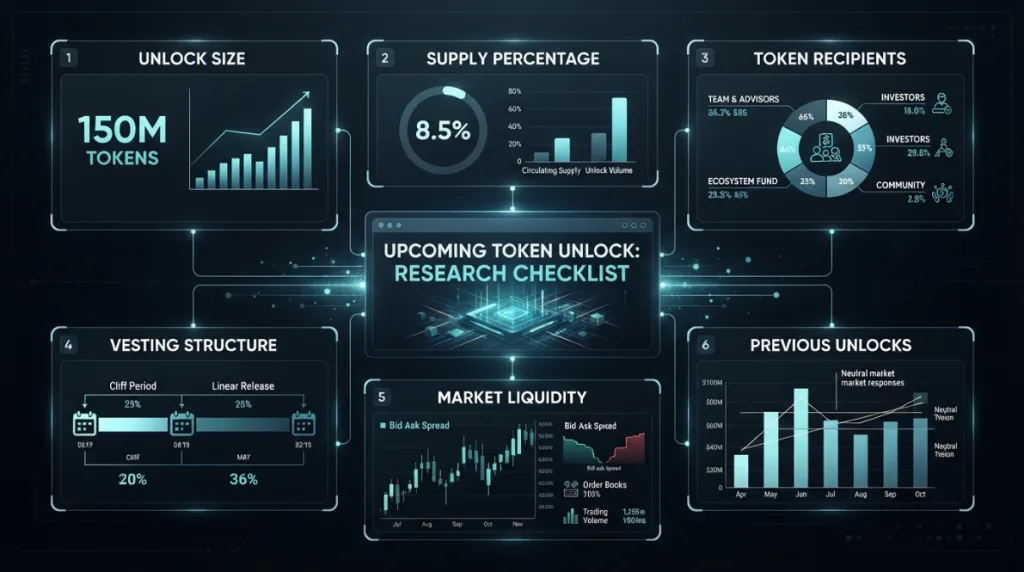
An upcoming unlock deserves more than a quick look at the date.
Consider these factors before drawing conclusions.
1. Unlock Size
Find out how many tokens will become available.
A small unlock may have little market impact, while a very large allocation could attract more attention.
2. Percentage of Supply
Compare the unlock with the current circulating supply.
An unlock equal to a large percentage of the existing supply may deserve closer attention.
3. Token Recipients
Find out who will receive the tokens.
Team members, investors, community programs, and ecosystem funds may have different uses for their allocations.
4. Vesting Schedule
Check whether the project uses linear vesting, cliff vesting, or another structure.
A single large unlock may have a different effect from many smaller releases.
5. Market Liquidity
Liquidity can influence how easily the market absorbs additional selling.
Lower liquidity may make a large transaction more noticeable.
6. Previous Unlocks
Look at earlier unlocks to understand how the market reacted.
Past performance does not predict future results, but historical data can provide useful context.
Is a Token Unlock Bad for Investors?
No. A token unlock is not automatically good or bad.
It is simply part of how a project manages its token supply and distribution.
The potential impact depends on what happens after the tokens become available.
Some holders may sell. Others may continue holding their tokens.
Some allocations may also go toward ecosystem growth, development, incentives, or community programs.
Instead of asking whether an unlock is automatically negative, ask:
How large is the unlock, who receives the tokens, and what are they likely to do with them?
That gives you a more useful way to evaluate the event.
Simple Example of a Token Unlock
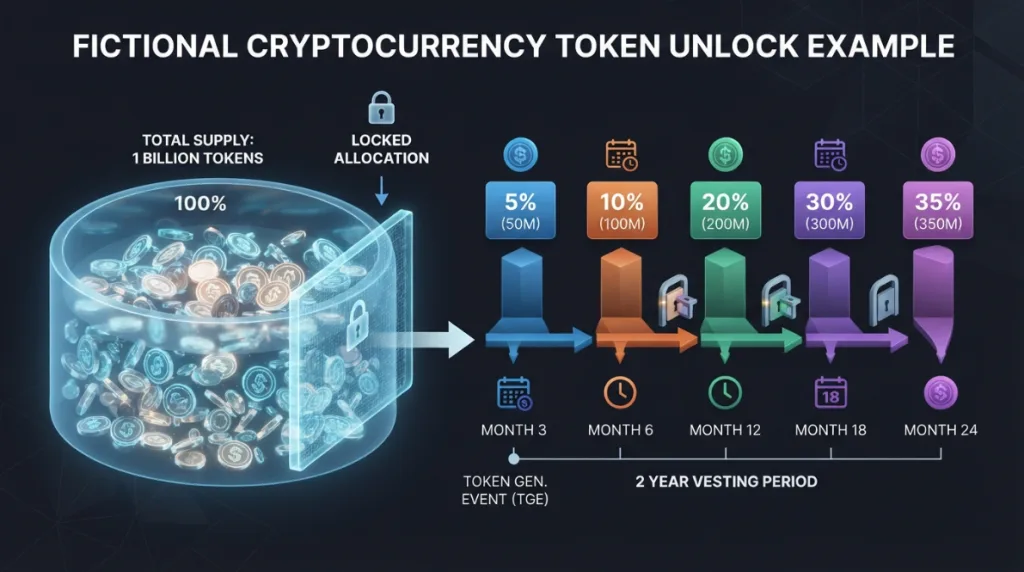
Let’s use a simple example.
Suppose Crypto Project A has a total supply of 1 billion tokens.
The project gives 100 million tokens to early investors. However, those tokens have a two-year vesting schedule.
The investors cannot access the full allocation immediately.
Instead, the project releases portions of those tokens according to the schedule.
When another portion becomes available, that event is a token unlock.
If investors hold the newly available tokens, the market impact may be limited.
If many investors sell at the same time, selling pressure could increase.
This example shows why the unlock date alone does not tell the whole story.
Frequently Asked Questions
What does token unlock mean?
Token unlock means previously restricted cryptocurrency tokens become available to their assigned holders under a specific schedule or vesting arrangement.
Does token unlock mean the price will go down?
No. A large unlock can create potential selling pressure, but price movement also depends on demand, liquidity, market sentiment, and holder behavior.
What is token vesting?
Token vesting is a schedule that determines when a person’s or organization’s allocated tokens become available.
Who receives unlocked tokens?
Founders, employees, investors, advisors, community participants, and ecosystem programs can receive tokens through different unlock schedules.
How can I find upcoming token unlocks?
Check the project’s official tokenomics and vesting documents. You can also compare the information with reputable crypto market-data platforms.
Are unlocked tokens automatically part of circulating supply?
Not necessarily. The definition of circulating supply varies, so check the project’s documentation and the methodology used by the relevant data provider.
Final Thoughts
Understanding what is token unlock can help you better evaluate crypto projects and their tokenomics.
A token unlock makes previously restricted tokens available according to a predetermined schedule. Projects often use these schedules to distribute tokens gradually among teams, investors, communities, and other participants.
A large unlock can create potential selling pressure, but it does not guarantee a price decline.
Before making an investment decision, look at the unlock size, recipients, vesting schedule, circulating supply, liquidity, and market demand.
Most importantly, verify the information through the project’s official documentation instead of relying only on a third-party unlock calendar.

Leave a Reply