

In this article
- TL;DR — The Key Takeaways
- Guarantor Insurance Definition: The Simple, Human Version
- Who Is the Guarantor for Insurance in Everyday Life?
- Guarantor vs Policyholder vs Insured vs Subscriber
- Guarantor in Medical Billing: How the Role Actually Works
- What Is a Guarantor Number on a Medical Bill?
- Types of Guarantors You’ll Actually Encounter
- The Second Meaning: State Insurance Guaranty Associations
- Guarantor vs Cosigner: Are They the Same Thing?
- When Do You Need a Guarantor for Insurance?
- HIPAA, Privacy, and the Guarantor: What Providers Can Share
- The No Surprises Act: What It Means for Guarantors
- Guarantor Responsibilities: What You’re Signing Up For
- Medical Debt on Your Credit Report — The 2026 Reality
- Real-Life Examples of Guarantor Insurance in Action
- Common Mistakes When Naming (or Being) a Guarantor
- How to Dispute a Wrong Guarantor Listing (Step-by-Step)
- How to Choose (or Be) the Right Guarantor
- Guarantor Insurance Costs: Budgeting the Worst Case
- Data Snapshot: Guarantors and Medical Debt in the U.S.
- Special Situations Where Guarantor Rules Get Complicated
- Pros and Cons of Being a Guarantor
- Mini Glossary of Guarantor-Related Terms
- Frequently Asked Questions (FAQ)
- Bottom Line
- Compact To-Do Checklist
Quick answer: A guarantor for insurance is the person or entity who’s legally on the hook for a bill or contract when the primary responsible party can’t — or won’t — pay. In medical billing, that’s usually the adult patient, a parent, or someone with power of attorney. In broader insurance law, it can also mean a state guaranty association that steps in if your insurance company goes bust. Either way, one idea sits at the center of the word: somebody promised to pay, and here’s their name.
If you’ve ever checked into a hospital, signed for a teenager’s fender-bender coverage, or bought a life insurance policy, you’ve brushed up against this role — probably without noticing. This guide breaks down the full guarantor insurance definition, how it plays out in real life, and what your rights, risks, and responsibilities actually look like in 2026.
TL;DR — The Key Takeaways
- A guarantor promises to pay a debt if the primary party doesn’t.
- In medical billing, the guarantor is usually the adult patient — or a parent, guardian, spouse, or agent under power of attorney.
- The guarantor is not the same as the policyholder, subscriber, insured, or beneficiary.
- State guaranty associations (coordinated by NOLHGA) act as guarantors when a licensed insurer becomes insolvent, up to statutory limits — typically $300,000 for life insurance death benefits and $250,000 for annuities in most states.
- A guarantor is legally different from a cosigner: guarantors pay only after a default; cosigners share responsibility from day one.
- In 2026, medical debt can still appear on U.S. credit reports after a federal ban was vacated by a Texas court — with limits.
Guarantor Insurance Definition: The Simple, Human Version
Strip away the paperwork, and a guarantor is just this: the person who says “if something goes wrong with the money, I’ll handle it.”
In insurance and healthcare, that promise takes two very different shapes.
The first — and by far the most common — is the medical billing guarantor. This is the person the hospital lists as financially responsible for a patient’s balance after insurance has done its part. According to PCH Health, the guarantor is “the person who is legally and financially responsible for paying a patient’s medical bills, whether or not they are the one receiving care.”
The second is the industry-level guarantor — usually a state guaranty association that guarantees policyholder claims if an insurance carrier fails. Clearsurance describes them as organizations “that provide a guarantee of payment or other contractual fulfillment.”
Both meanings share the same DNA: a safety net that keeps insurance from being a broken promise.
Who Is the Guarantor for Insurance in Everyday Life?
The answer changes depending on who’s sick, who signed, and who owns the plan. Here’s how the role usually plays out.
- You’re an adult with your own health plan. You’re your own guarantor. Your name is on the bill and the ID card.
- Your child needs a doctor. A parent or legal guardian signs, because minors can’t legally enter binding contracts.
- A spouse handles the family’s bills. The signer on the intake form becomes the household guarantor.
- An aging parent has dementia. The adult child holding a power of attorney (POA) becomes the guarantor.
- A patient lives in a state facility. The correctional or state agency may function as an institutional guarantor.
- A hospital treats an uninsured patient. That patient becomes a “self-pay guarantor” and personally owes the entire bill.
Most of us cycle through several of these roles across a lifetime — first as a child on our parents’ policy, later as our own guarantor, and eventually as the guarantor for kids, spouses, or aging parents.

Guarantor vs Policyholder vs Insured vs Subscriber
These four words appear on almost every insurance card and hospital intake form, and they don’t mean the same thing. Mixing them up can send bills to the wrong address, delay claims, and even trigger collections.
In one sentence: the policyholder owns the plan, the subscriber is the enrolled worker or purchaser, the insured is anyone covered by the policy, and the guarantor is the one who pays whatever the plan doesn’t.
| Role | Who They Are | What They Do | Where Their Name Appears |
|---|---|---|---|
| Policyholder / Subscriber | The person who buys and owns the insurance policy | Pays the premium and controls the plan | Insurance ID card, policy documents |
| Insured / Covered Member | Anyone eligible for benefits under the policy | Uses medical services | Benefits records, insurer’s system |
| Guarantor | The person legally responsible for the patient’s balance | Pays deductibles, copays, coinsurance, and non-covered charges | Patient statement, hospital billing account |
| Beneficiary | The person who receives a policy payout (usually life insurance) | Collects money after a covered event | Policy beneficiary designation |
| Cosigner | A person who shares direct debt responsibility from day one | Pays alongside the primary borrower | Loan or lease agreements |
According to MetLife’s policyholder explainer, “insured” refers to anyone covered by the policy, while the policyholder owns it. The guarantor sits outside both roles — closer to the money than to the medicine.
Payer software routes claims to the subscriber’s plan but sends bills to the guarantor. When the two are the same person, nobody notices. When they differ — divorce, blended family, teen dependent — sloppy data creates chaos.
Guarantor in Medical Billing: How the Role Actually Works
Medical billing is where “guarantor” earns its keep. Every U.S. hospital or clinic creates a guarantor account the first time you register. As Epic Systems, the country’s largest EHR vendor, puts it in its own technical documentation: “The guarantor is the entity ultimately responsible for payment of a balance. One guarantor can be used for many hospital accounts.”
That account controls three decisions that quietly shape your financial life:
- Statements. The mailing address attached to the guarantor determines who receives the bill.
- Collections. If a balance goes unpaid, the collections team contacts the guarantor, not necessarily the patient.
- Legal responsibility. The guarantor’s signature is the legal foundation for any lawsuit or lien.
What a Guarantor Actually Pays
The guarantor pays every dollar your plan doesn’t. That usually means:
- Deductibles owed before insurance activates
- Copays collected at the point of service
- Coinsurance — your percentage share after the deductible clears
- Non-covered services the plan explicitly excludes
- Balances after denial or appeal the insurer refuses to reconsider
If you’re evaluating coverage that could shrink this exposure — for yourself or a spouse — our roundup of term life options is a good jumping-off point for understanding how premiums, deductibles, and out-of-pocket maximums interact.
A Guarantor’s Everyday Duties
- Provide accurate insurance details at each visit
- Update coverage promptly when a plan changes
- Answer billing questions and resolve disputes
- Request a payment plan if you can’t pay a lump sum
- Keep contact information current so statements don’t age into collections
What Is a Guarantor Number on a Medical Bill?
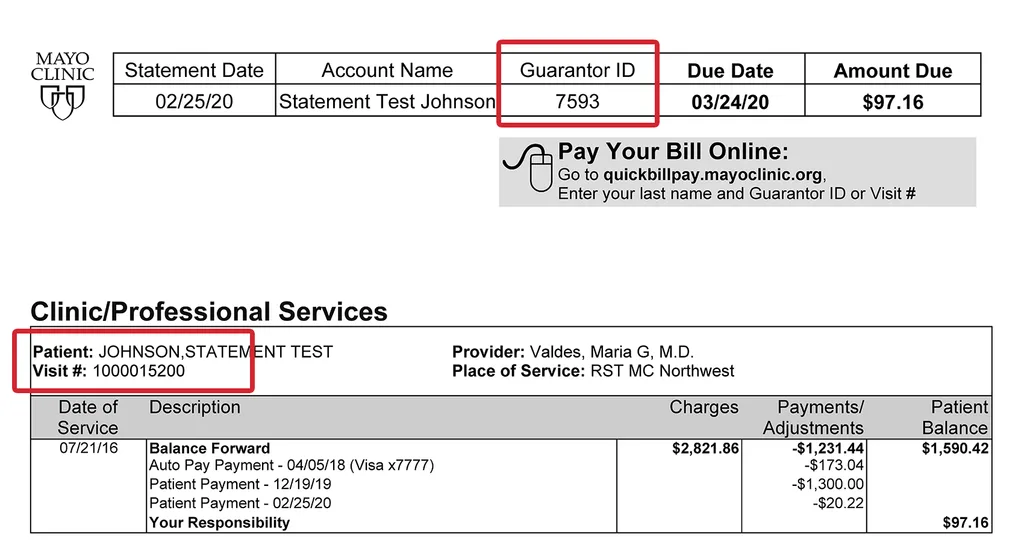
A guarantor number is the unique ID your provider assigns to the person financially responsible for one or more patient accounts. It links every visit, procedure, and outstanding balance to a single legal payer.
You’ll usually see it printed at the top of your statement, right beside the patient number. If a hospital sends you two bills — one for you and one for your child — the patient numbers differ, but the guarantor number is often the same, because you’re the payer for both.
Two things to know:
- You can have one guarantor number that covers multiple family members. That’s normal for households.
- A wrong guarantor number causes chaos. Bills may go to a stranger, an ex-spouse, or a deceased family member. Fixing it early is the difference between a five-minute phone call and a collections nightmare.
Types of Guarantors You’ll Actually Encounter
Not every guarantor looks like the classic “adult signs paperwork” version. Billing systems recognize several categories, each with slightly different rules.
- Self-guarantor — an adult patient signing for themselves. This covers most outpatient visits.
- Parent or legal guardian — the default for minors under 18.
- Spouse or domestic partner — often listed on family plans.
- Power of attorney (POA) — an adult child, sibling, or trustee legally authorized to act.
- Institutional guarantor — a nursing home, state agency, or correctional facility.
- Employer or workers’ compensation carrier — pays for job-related injuries.
- State guaranty association — the guarantor of last resort when an insurer goes under.
Same idea, different signatures: someone reliable stands behind the payment.
The Second Meaning: State Insurance Guaranty Associations
Now let’s zoom out to the other kind of guarantor — the one baked into state law. Every U.S. state operates a life and health insurance guaranty association and a property and casualty guaranty fund. These entities act as the guarantor for policyholders when a licensed insurance company becomes insolvent.
They aren’t private companies. They’re statutory bodies created by legislatures and funded by assessments on member insurers. Their national coordinating body, NOLHGA, manages multi-state failures and applies each state’s coverage limits.
What Guaranty Associations Cover (2026 Standard Limits)
According to NOLHGA’s own product-coverage guidance, most states apply these caps:
| Product Type | Typical Coverage Cap (Most States) |
|---|---|
| Life insurance death benefit | $300,000 |
| Life insurance cash surrender value | $100,000 |
| Fixed, indexed, structured settlement, or variable annuities | $250,000 in present value |
| Long-term care insurance (treated as health insurance) | Up to $300,000 |
| Unallocated annuity contracts (employer plans) | $5 million per plan sponsor |
The associations don’t sell insurance, don’t advertise, and don’t cover unlimited amounts. If you’re building a serious insurance portfolio, checking both an insurer’s AM Best rating and the applicable guaranty limit is homework worth doing. A fiduciary financial advisor can help you match policy size to the safety net that would actually apply to you.

Guarantor vs Cosigner: Are They the Same Thing?
Short answer: no. And confusing the two can cost you money.
- A cosigner signs the loan or lease on day one. They’re equally responsible for every payment from the very first bill, as Experian’s guarantor vs cosigner guide makes clear.
- A guarantor signs a separate promise to pay only if the primary party defaults. They’re a secondary line of responsibility.
In healthcare and insurance, guarantors are far more common than cosigners because the underlying relationship is about clinical care rather than shared debt. In housing, the same distinction shows up between renters, roommates, and family members — our detailed guide to lease guarantors walks through where those lines are drawn.
The practical difference: a cosigner’s credit is affected by every missed payment. A guarantor’s credit is usually affected only after the primary account defaults.
When Do You Need a Guarantor for Insurance?
You’ll be asked to name a guarantor in more situations than most people expect. The most common triggers include:
- Hospital or clinic registration. Every U.S. provider requires a guarantor before billing.
- Emergency room visits for a minor. The accompanying adult signs as guarantor.
- Uninsured or self-pay care. The patient becomes the sole guarantor.
- Dental, cosmetic, or specialty procedures. Practices often collect a payment guarantor at booking.
- A teen driver joins your policy. A parent’s policy essentially guarantees the teen’s coverage — compare options in our review of the best car insurance companies before adding a young driver.
- A carrier becomes insolvent. The state guaranty association becomes your guarantor by law.
For most adults filling out their own paperwork, you’re your own guarantor. It gets complicated only when you sign for someone else — a child, a parent, a spouse, or a patient you legally represent.
HIPAA, Privacy, and the Guarantor: What Providers Can Share
If you’re a guarantor for someone else’s care — say, a spouse or aging parent — you might wonder what the hospital can legally tell you.
Under the HIPAA Privacy Rule at 45 CFR 164.510(b), providers may share protected health information (PHI) “directly relevant to the involvement of a spouse, family member, friend, or other person” in the patient’s care or payment, according to the U.S. Department of Health & Human Services. In plain English:
- Providers can discuss billing amounts and payment options with the guarantor.
- Providers can send statements to the guarantor’s address for payment purposes.
- Providers cannot freely share clinical details unless the patient consents or is unable to object.
If your adult spouse hasn’t signed a HIPAA release, expect the office to talk to you about dollars owed, not about diagnoses. That distinction protects the patient — and it’s why hospitals ask so many permission questions at check-in.
The No Surprises Act: What It Means for Guarantors
Since 2022, the federal No Surprises Act (NSA) has quietly reshaped what a guarantor can legally be billed for. The Centers for Medicare & Medicaid Services (CMS) explains that the law protects insured patients from most out-of-network “surprise” balance bills for:
- Emergency care at any facility
- Non-emergency care at in-network facilities where an out-of-network provider participated (anesthesiology, radiology, pathology, and similar)
- Air ambulance services
For guarantors, the practical takeaway is huge. If insurance is in place, you should generally be billed only your in-network cost-sharing amount for the covered scenarios above — even if the anesthesiologist or ER physician was technically out of network. If a bill looks larger than that, dispute it before you pay.
The NSA doesn’t apply to self-pay patients in the same way, but it does require a written Good Faith Estimate before non-emergency care. As a guarantor, you have the right to request one — and to dispute the final bill if it exceeds the estimate by more than $400.
Guarantor Responsibilities: What You’re Signing Up For
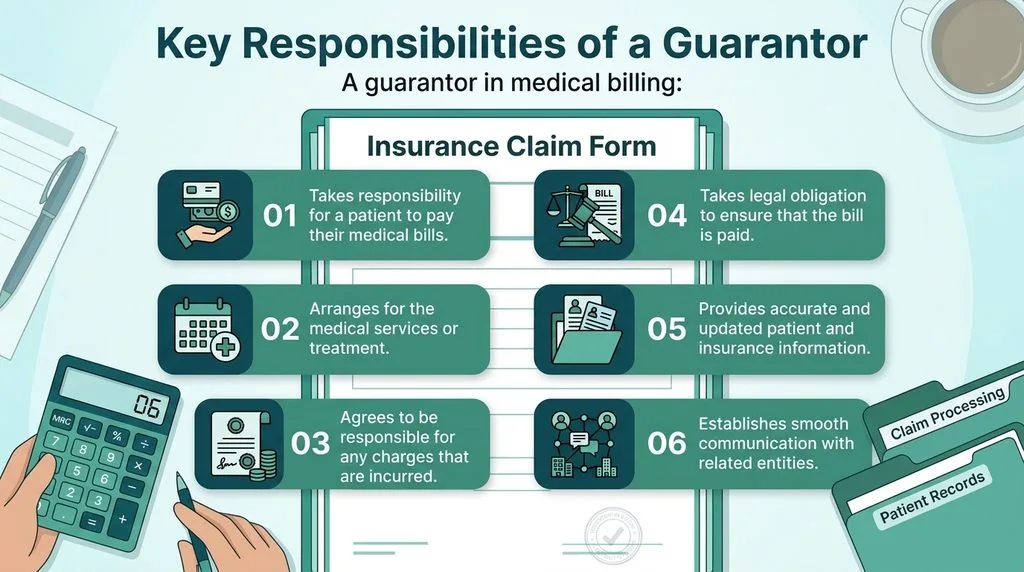
Signing a guarantor form is a legally binding financial commitment — not a formality. Before you sign, know what the responsibilities include:
- Full payment of any balance insurance doesn’t cover
- Timely response to statements, denials, and appeals
- Accurate information at registration and each visit
- Payment plan setup or negotiation with the provider if needed
- Current contact details so bills don’t drift into collections
- Cooperation with the insurance company to resolve disputes
Falling behind on a guarantor balance carries real consequences — collections calls, credit damage, and in some states, legal action or even wage garnishment. If medical debt is piling up alongside other obligations, our overview of debt consolidation strategies is worth reading before things escalate.
Medical Debt on Your Credit Report — The 2026 Reality
Here’s something that changed suddenly in mid-2025 and still confuses people: medical debt can still land on your credit report in 2026.
In January 2025, the Consumer Financial Protection Bureau (CFPB) finalized a rule that would have removed medical debt from most consumer credit reports. But on July 11, 2025, the U.S. District Court for the Eastern District of Texas vacated that rule in Cornerstone Credit Union League v. CFPB. As a result, in 2026:
- Medical debt remains reportable on U.S. consumer credit reports at the federal level.
- The three major bureaus (Equifax, Experian, TransUnion) have voluntary limits: they generally exclude medical collections under $500, less than a year past due, or already paid.
- Some states have passed their own laws banning or restricting medical debt reporting.
- Balances above $500 that stay unpaid for more than 365 days can appear on your report.
For a guarantor, that means an ignored $600 hospital bill can absolutely dent your credit score. The safest move is to open every statement, dispute mistakes early, and set up a payment plan before the account ages past a year.
Real-Life Examples of Guarantor Insurance in Action
Example 1 — Family doctor visit. Maria, 34, brings her nine-year-old to a pediatrician and signs as guarantor at check-in. Her insurance covers most of the visit, and a $47 copay lands on her statement two weeks later.
Example 2 — Elderly parent’s surgery. David holds durable POA for his father, who’s recovering from a stroke. When surgery arrives, David signs as guarantor, receives every statement, and manages Medicare appeals when part of a claim is denied.
Example 3 — Insurer insolvency. When a mid-sized life insurance carrier collapsed, NOLHGA coordinated a multi-state guaranty association response that protected annuity holders up to each state’s statutory limit — typically $250,000 in present value.
Example 4 — Uninsured adult. Jenna, 28, sprains her ankle without insurance. At urgent care she signs as her own guarantor and negotiates a 12-month interest-free payment plan.
Each story lands on the same principle: the guarantor is the person accountable for the money, whether the provider is a doctor, a hospital, or a fund.
Common Mistakes When Naming (or Being) a Guarantor
Small paperwork errors cause outsized headaches later. Watch for these traps.
- Naming the wrong household member. If both spouses have separate coverage, the guarantor should match the plan being billed.
- Skipping the update after a divorce. Old accounts still route bills to the ex-spouse — sometimes for years.
- Forgetting to attach a POA. Without the document on file, adult children can’t legally act as guarantor for parents.
- Assuming the policyholder is automatically the guarantor. They usually are, but never automatically.
- Providing outdated addresses. Bills sent to old addresses age unnoticed and land in collections.
- Signing for another adult without legal authority. This can void the guarantor agreement and complicate collections.
If you spot an incorrect guarantor on a hospital account, call patient accounts immediately. Corrections are much easier before the account ages past 90 days.
How to Dispute a Wrong Guarantor Listing (Step-by-Step)
Wrong guarantor information happens more often than hospitals admit. Here’s the cleanest way to fix it:
- Call patient accounts at the hospital or clinic listed on the statement.
- Request a written change form — most systems require documentation before updating the guarantor.
- Provide proof of the correct arrangement: divorce decree, POA, guardianship order, or updated insurance card.
- Get a confirmation number and a written statement showing the guarantor change.
- Ask for a corrected billing statement dated after the change.
- Follow up in 15 days to make sure the update actually posted to your account.
- If a bill has already gone to collections, contact the collection agency in writing to notify them of the dispute.
Keep a folder — physical or digital — with every guarantor form, insurance card, and correspondence. In a dispute, documentation is what wins.
How to Choose (or Be) the Right Guarantor
Whether you’re picking one or agreeing to be one, apply the same checklist:
- Financial stability. Can this person realistically pay if insurance falls short?
- Legal authority. For minors and incapacitated adults, do they have guardianship or POA paperwork?
- Communication access. Will they receive and actually read every statement?
- Willingness. Being a guarantor is a serious commitment, not a favor.
- Understanding of the coverage. Do they know the deductible, out-of-pocket max, and exclusions?
A simple habit worth adopting: keep a copy of every guarantor form you sign, along with the applicable insurance card and coverage summary, in one household finance file. That single folder saves hours of stress when a dispute pops up.
Guarantor Insurance Costs: Budgeting the Worst Case
You don’t pay a separate premium to be a guarantor. The role is embedded in the underlying policy or bill. But every guarantor should budget for the following out-of-pocket ranges (typical 2026 figures for U.S. commercial health plans):
| Cost Type | Typical Range (2026) | Who Pays |
|---|---|---|
| Copay per office visit | $10 – $75 | Guarantor |
| Individual health-plan deductible | $1,600 – $3,500 | Guarantor |
| Coinsurance percentage | 10% – 40% of allowed amount | Guarantor |
| Out-of-pocket maximum (individual) | $6,000 – $9,450 | Guarantor cap |
| State guaranty association life benefit cap | ~$300,000 death benefit | Association |
| State guaranty association annuity cap | ~$250,000 present value | Association |
These numbers vary by plan, state, and year. Always confirm the exact amounts on your Summary of Benefits and Coverage before signing anything.
Data Snapshot: Guarantors and Medical Debt in the U.S.
- Roughly 41% of U.S. adults carry some form of medical or dental debt, according to the KFF Health Care Debt Survey.
- About 24% have bills that are past due or unpayable; 21% are paying off bills directly to a provider.
- Most collections activity for medical debt targets the guarantor listed at registration.
- Every state runs a guaranty association, coordinated through NOLHGA.
- Life-benefit caps typically stop at $300,000; annuity caps at $250,000 present value.
- Medical debt still appears on U.S. credit reports in 2026 (subject to a $500 / 365-day / unpaid federal threshold and voluntary bureau limits).
These figures highlight why the guarantor role is more than a form field. It’s the pivot point where healthcare, insurance, and personal finance meet — and where a small paperwork mistake can quietly bloom into thousands of dollars of avoidable debt.

Special Situations Where Guarantor Rules Get Complicated
Divorce and Blended Families
Court orders often specify which parent is legally responsible for a child’s medical bills — usually apportioned by income share. But whoever signs at the hospital typically becomes the initial guarantor. Update the account after divorce and share the court order with the provider to keep responsibility clear.
Emancipated Minors
Some states allow minors to consent to certain medical services (mental health, reproductive care) without a parent. In those cases, the minor may become their own guarantor for that limited scope of care.
Foreign Nationals and Students
International students often need a U.S.-based guarantor for both housing and healthcare because their home-country credit histories don’t transfer to American systems.
High-Net-Worth Households
Wealthy families sometimes set up trusts or family LLCs as institutional guarantors to simplify billing across multiple dependents and generations.
Reverse Mortgages and Retirees
Retirees drawing on home equity should double-check that guarantor information across their insurance and healthcare accounts still matches their current living situation. Our review of reverse mortgages covers the wider financial-planning implications for older homeowners.
Pros and Cons of Being a Guarantor
Being someone’s guarantor helps them access care, credit, or coverage they might not otherwise qualify for. It also puts your own finances on the line. Here’s a balanced view.
Pros
- Enables a loved one to receive urgent medical care
- Speeds up hospital registration and reduces billing friction
- Creates a clear payment path, preventing disputes later
- Helps younger family members build responsible financial history
Cons
- Creates direct legal liability for someone else’s bills
- Can damage your credit if balances go unpaid
- May reduce your borrowing capacity for future loans
- Difficult to remove yourself once you’ve signed
The right approach isn’t to avoid the role — it’s to sign only after reading the form, confirming the coverage details, and calculating a realistic worst-case scenario.
Mini Glossary of Guarantor-Related Terms
- Guarantor account — the billing account that groups patient balances under a single financially responsible person.
- Guarantor number — the unique ID linking multiple bills to one payer.
- Subscriber — the person who buys/holds the insurance plan.
- Insured — anyone covered under the plan.
- Explanation of Benefits (EOB) — the document showing what the insurer paid and what’s left for the guarantor.
- Out-of-pocket maximum — the yearly cap on what a guarantor pays before insurance covers 100%.
- NOLHGA — the national organization coordinating state life and health insurance guaranty associations.
- NAIC — the National Association of Insurance Commissioners, which drafts model insurance laws.
Frequently Asked Questions (FAQ)
Is the guarantor the same as the policyholder?
No. The policyholder owns the insurance plan and pays the premium. The guarantor is the person legally responsible for any balance left after the insurance pays. Often the same person plays both roles, but not always — especially in families or with dependents.
Can I refuse to be a guarantor for a family member?
Yes. Being a guarantor is voluntary and requires your signature. No hospital can force you to become one for an adult relative unless you’ve signed the paperwork or hold legal authority such as a power of attorney or guardianship.
Does being a guarantor affect my credit score?
It can. If the guarantor account goes to collections, unpaid balances above $500 that are more than 365 days past due can show up on your credit report in 2026. Bureau-level voluntary limits and state laws sometimes offer extra protection, but the federal ban was vacated in July 2025.
What happens if the insurance company goes bankrupt?
Your state’s guaranty association steps in as guarantor of last resort. Most states cap life-insurance death benefits at $300,000 and annuity present value at $250,000. Check the exact caps at NOLHGA’s state directory.
Can two people share the guarantor role?
Usually not. Most billing systems require one guarantor per account for clean collections and legal responsibility. A few providers allow a secondary responsible party, but the primary guarantor stays legally liable.
How do I remove myself as guarantor from an old account?
Contact the provider’s patient accounts department in writing. You may need to prove another responsible party has taken over — a spouse post-divorce, an adult child assuming guardianship, or a POA transferring authority.
Is a guarantor the same as a beneficiary?
No, completely opposite. A beneficiary receives money from an insurance policy (usually life insurance). A guarantor pays money when someone else can’t. One collects; the other covers.
Do I need a guarantor if I have great insurance?
Even with strong coverage, providers still require a guarantor at registration. No plan covers 100% of every service without deductibles or copays, and someone has to be legally responsible for whatever remains.
Bottom Line
A guarantor for insurance is the financial anchor of the entire system — the person or entity who guarantees a bill gets paid when insurance falls short. In medical billing, that’s usually you, a spouse, or a parent. In broader insurance terms, it’s a state guaranty association standing behind your policy. Either way, the guarantor turns “who owes this?” from an open question into a clear answer.
Before you sign for someone else, read the form and understand the exposure. Before you name a family member, confirm their willingness and financial stability. And whenever your family, address, or coverage changes, update your guarantor information — because a good guarantor setup is quietly worth more than any single insurance policy.
Compact To-Do Checklist
| ✅ Task | Why It Matters |
|---|---|
| Verify who’s listed as guarantor on every medical account | Prevents misrouted bills and surprise collections |
| Update guarantor contact info after any move or life change | Avoids missed statements aging into collections |
| Refresh guarantor details after divorce, marriage, or custody changes | Ensures the right person is legally responsible |
| Keep a POA on file for elderly parents you help financially | Establishes clear legal authority to act as guarantor |
| Read the full financial responsibility form before signing | Reveals hidden fees, deposits, and exclusions |
| Check your insurer’s state guaranty association coverage limits | Protects your policy if the carrier fails |
| Save copies of every guarantor form and insurance card | Speeds up dispute resolution and appeals |
| Track deductibles and out-of-pocket max each year | Prevents overpaying beyond your true liability |
| Set up autopay or payment plans for known balances | Reduces credit risk from missed statements |
| Review your insurer’s AM Best or S&P financial-strength rating annually | Confirms the guaranty association would only be needed in rare failure cases |
| Request a Good Faith Estimate before non-emergency care | Uses your No Surprises Act rights to prevent surprise balances |



Leave a Reply