
In this article
- 🔑 Key Takeaways (30-Second Summary)
- Who This Guide Is For
- What Is a High-Yield Savings Account, Really?
- The 2026 Interest Rate Landscape (And Why Timing Matters)
- Best High-Yield Savings Accounts of August 2026 (Fully Audited)
- HYSA Rate History: How We Got Here
- How High-Yield Savings Accounts Actually Work
- APY vs. APR: The Difference That Costs Savers Money
- HYSA vs. Traditional Savings vs. Money Market vs. CD
- How to Choose the Best High-Yield Savings Account for You
- 🚩 Red Flags & Marketing Tricks to Watch For
- Pros and Cons of a High-Yield Savings Account
- Is Your Money Actually Safe? FDIC and NCUA Explained
- Are HYSA Earnings Taxed? (Yes — Here’s the Simple Version)
- How Much Should You Actually Keep in a HYSA?
- The 5-Minute HYSA Action Plan
- HYSA Strategies for Different Life Stages
- Common Mistakes That Cost HYSA Savers Money
- Rate Forecast: Where HYSA APYs Are Headed
- Frequently Asked Questions
- Final Thoughts: The Boring Move That Actually Pays
Here’s the uncomfortable truth: if your money is sitting in a “regular” savings account at a big-brand bank, you are almost certainly earning less than half a penny for every dollar — while inflation quietly clips 3.4% off your purchasing power each year. Meanwhile, the best high-yield savings accounts in August 2026 pay up to 4.25% APY, keep your cash federally insured, and let you move money whenever you want.
That gap isn’t a rounding error. On a $20,000 emergency fund, it’s the difference between roughly $76 a year and $850 a year — for money that just sits there. This guide walks you through the real leaders in the HYSA market right now, how to spot marketing tricks, how the tax hit works, and exactly how to open one before you close this tab.
🔑 Key Takeaways (30-Second Summary)
- Top APY today: ~4.25% APY at Abound Credit Union; 4.21% at Axos ONE Savings (on first $249,999.99).
- National average savings rate: 0.38% APY per the FDIC — HYSAs pay roughly 11× more.
- FDIC/NCUA insurance: Deposits protected up to $250,000 per depositor, per bank, per ownership category.
- Fed funds rate (Aug 2026): Held at 3.50%–3.75%; economists project ~0.75% in cumulative cuts through 2026.
- Best HYSA use case: Emergency fund and short-term goals (0–3 years) — not long-term wealth building.
- Interest is taxable: You’ll receive Form 1099-INT if you earn $10+ in interest during the year.
Who This Guide Is For
You’ll get the most out of this article if you fit any of these profiles:
- You are starting an emergency fund and don’t want it eaten by inflation.
- You keep more than $2,000 in checking that “just kind of sits there.”
- You have short-term goals — wedding, home down payment, sabbatical, car — arriving within 3 years.
- You’re retired or semi-retired and want a safer place for cash you may need on short notice.
- You just heard about HYSAs and want a plain-English breakdown from someone who isn’t trying to sell you their bank.
What Is a High-Yield Savings Account, Really?
A high-yield savings account (HYSA) is a federally insured deposit account that pays significantly more interest than a standard savings account — usually 10 to 25 times more. The reason isn’t magic. Online banks, credit unions, and the digital arms of traditional banks operate with lower overhead than branch-heavy institutions, and they hand a chunk of those savings back to you as higher APY.
What defines a true HYSA in 2026:
- APY well above the national average. Anything below ~3% barely qualifies right now.
- FDIC or NCUA insurance up to $250,000 per depositor, per bank, per ownership category.
- Same-week liquidity via ACH, unlike CDs that lock you in.
- Variable rate. APY rises and falls with the Federal Reserve’s decisions.
- Low or zero fees. No monthly maintenance charges from the top players.
Current benchmarks are published monthly by the FDIC’s National Rates and Rate Caps report, which is the closest thing to an unbiased scoreboard for U.S. deposit accounts.
The 2026 Interest Rate Landscape (And Why Timing Matters)
At its July 29, 2026 meeting, the Federal Reserve held the target federal funds rate steady at 3.50%–3.75%. J.P. Morgan economists expect that range to hold for the rest of 2026, and Bankrate’s annual outlook projects roughly 0.75% in cumulative rate cuts across the year.
That “higher-for-longer” backdrop is the entire reason top HYSAs still pay above 4%. Here’s the snapshot:
| Deposit Type | Typical APY (Aug 2026) |
|---|---|
| FDIC national average savings account | 0.38% |
| Big-brand brick-and-mortar savings | 0.01% – 0.45% |
| Average credit union savings | ~1.34% |
| Top online HYSA | 3.75% – 4.25% |
| Highest promotional HYSA | Up to 4.50% (on capped balances) |
| FDIC national rate cap (savings) | 4.38% |
Real-money translation. A $25,000 emergency fund parked at 0.38% earns about $95 per year. That same $25,000 in a 4.25% HYSA earns about $1,062 — roughly what many families spend on a full month of groceries.
Best High-Yield Savings Accounts of August 2026 (Fully Audited)
I verified every rate below against each bank’s own current-rates page or a recent listing on Bankrate, NerdWallet, Investopedia, or CNBC Select. Rates change weekly, sometimes daily — always confirm on the bank’s official site before you open.
| # | Bank / Credit Union | Headline APY | Minimum to Open | Real-World Notes |
|---|---|---|---|---|
| 1 | Abound Credit Union — High-Yield Savings | 4.25% APY | $5 share + $10 one-time membership fee | Requires an active account with direct deposit; NCUA insured |
| 2 | Axos Bank — ONE Savings | 4.21% APY on first $249,999.99 (then 3.50%) | $0 | Requires bundled Axos ONE checking; extended FDIC coverage up to $2.5M |
| 3 | Forbright Bank — Growth Savings | 4.15% APY | $0 | Straight rate, no tiers or hoops |
| 4 | CIT Bank — Platinum Savings | Up to 4.10% APY (with current APY boost; base 3.75% on $5,000+) | $100 | Rate boost is promotional; 0.25% APY under $5,000 |
| 5 | Bask Bank — Interest Savings | Up to 4.10% APY (base 3.75%; 0.25% boost + limited-time 0.10% offer for qualifying deposits) | $0 | Owned by Texas Capital Bank |
| 6 | Happen Bank — LevelUp Savings | 4.00% APY | $0 | Boosted rate requires $250+ monthly deposit |
| 7 | Accordia Bank — Regular Savings | 4.00% APY | $0 | Fully online, no monthly fees |
| 8 | Vio Bank — Cornerstone Money Market | 3.99% APY | $100 | Tiered — full rate on all balances above $100 |
| 9 | Bread Savings — High-Yield Savings | 3.95% APY | $100 | Owned by Bread Financial |
| 10 | Marcus by Goldman Sachs — Online Savings | 3.40% APY (up to 4.40% with referral bonus) | $0 | Highly rated app; simple, no gotchas |
| 11 | American Express — Personal Savings | 3.00% APY | $0 | Trusted brand, no fees, easy transfers |
| 12 | Ally Bank — Online Savings | 3.00% APY | $0 | Excellent tools like Savings Buckets and Surprise Savings |
You can also cross-verify these against Bankrate’s daily-updated HYSA leaderboard, which is one of the most transparent trackers in the industry.
A Closer Look at the Top Four
Abound Credit Union — 4.25% APY. The current APY leader. Anyone in the U.S. can join by opening a $5 share account plus a one-time $10 membership fee, but the 4.25% rate is tied to maintaining an active Abound account with direct deposit. If direct deposit isn’t a fit for your setup, look at the next few options instead of forcing it.
Axos ONE Savings — 4.21% APY. Axos bundles savings and checking into a single “ONE” package. The 4.21% APY applies to the first ~$250,000, dropping to 3.50% above that. As a bonus, ONE customers get access to expanded FDIC coverage up to $2.5M through Axos’s sweep network — genuinely useful for higher balances.
Forbright Bank — 4.15% APY. Forbright is my favorite “boring, does what it says” pick on this list. There’s no tiered rate, no boost you have to earn, and no promotional cliff to plan around. If you value predictability, Forbright is hard to beat.
CIT Bank Platinum Savings — Up to 4.10% APY. CIT posts a headline 4.10% APY, but the fine print is important: that number includes a promotional “APY boost” on the base 3.75% rate, and the higher tier only applies to balances of $5,000 or more. Below $5,000, you’ll earn just 0.25% — which is worse than many free checking accounts. Fine for savers with an established emergency fund; not ideal for someone just starting.
HYSA Rate History: How We Got Here
Understanding the trajectory helps you time your moves.
- 2019 (pre-COVID): Top HYSAs paid ~2.00% APY.
- 2020–2021 (near-zero era): Top rates collapsed to 0.40%–0.60% APY.
- 2022 (Fed hiking cycle begins): Rates rebounded to 3.00%+.
- 2023–2024 (peak): Top HYSAs briefly cracked 5.00% APY.
- 2025 (early Fed cuts): Rates drifted down to the mid-4s.
- August 2026 (today): Top rates 4.10%–4.25%, with likely modest cuts ahead.
The takeaway: rates move in cycles, and today’s 4.25% may look nostalgic by 2027. Locking in a CD for a portion of your cash — while keeping your emergency fund in a HYSA — is a defensible middle path if you want some rate certainty.
How High-Yield Savings Accounts Actually Work
APY is one number, but two mechanics drive it: the underlying interest rate and the compounding frequency. Almost every HYSA compounds interest daily and pays it out monthly. That means yesterday’s interest earns interest today — a small effect on Day 1, a powerful engine over years.
Example: $10,000 at 4.25% APY, no additional deposits, daily compounding.
| Year | Balance |
|---|---|
| 1 | $10,434 |
| 3 | $11,364 |
| 5 | $12,375 |
| 10 | $15,314 |
Example: $10,000 + $200/month at 4.25% APY.
- After 5 years: ≈ $25,795
- After 10 years: ≈ $45,167
For a hands-on projection with your own numbers, the SEC’s official compound interest calculator on Investor.gov takes about 30 seconds and doesn’t try to sell you anything.
APY vs. APR: The Difference That Costs Savers Money
Banks quote APY (Annual Percentage Yield) on savings and APR (Annual Percentage Rate) on loans. The key distinction:
- APR does not include the effect of compounding.
- APY does.
That’s why a 4.10% APY is slightly more generous than a 4.10% APR on the same nominal rate. Always compare APY to APY across savings accounts — never APR to APY. It’s a small trick, but it matters when banks in a marketing arms race hope you won’t notice.
HYSA vs. Traditional Savings vs. Money Market vs. CD
Each account solves a different problem. Here’s the honest comparison.
| Feature | High-Yield Savings | Traditional Savings | Money Market Account | Certificate of Deposit |
|---|---|---|---|---|
| Typical APY (Aug 2026) | 3.75% – 4.25% | 0.01% – 0.45% | 3.50% – 4.00% | 4.00% – 5.65% (varies by term) |
| Access to funds | Anytime | Anytime | Anytime (limited checks) | Locked for term; early withdrawal penalty |
| Check-writing / debit card | Usually not | Rarely | Often | Never |
| Typical minimum balance | Low or none | Low | Often higher | Varies widely |
| Federal insurance | FDIC / NCUA | FDIC / NCUA | FDIC / NCUA | FDIC / NCUA |
| Best use case | Emergency fund; 0–3-year goals | Everyday buffer at your main bank | Higher-balance liquid savings | Money you truly won’t need for a fixed term |
Quick decision rule:
- Need money soon or as a safety net → HYSA.
- Want to lock in today’s rate for 12+ months → CD.
- Keep a large cash reserve and occasionally write checks → Money market account.
- Want a spending buffer at your existing branch bank → Traditional savings (but expect crumbs).
Once your emergency fund is fully built, additional dollars are usually better directed toward long-term goals — a topic that pairs naturally with understanding retirement savings, which behaves differently across a 20- to 40-year horizon.
How to Choose the Best High-Yield Savings Account for You
The APY is the headline, but seven other factors decide whether the account is actually a good fit.
- Rate stability. Is the APY the standard rate or a promotional teaser? Ask what happens after 6 months.
- Fees. The best HYSAs charge zero monthly maintenance fees. Watch for outgoing wire fees, paper statement fees, and excess-withdrawal fees.
- Minimum-balance rules. Some accounts require a minimum to open, or a minimum to earn the top APY.
- Transfer speed. External ACH transfers typically take 1–3 business days. If liquidity really matters, prefer banks that offer same-day internal transfers.
- App and automation. Goal-based savings buckets, round-ups, and auto-transfers turn saving into a background habit.
- Customer support. 24/7 phone or chat is a small feature until you need it at 11 p.m. on a Sunday.
- Insurance coverage. If you’ll hold more than $250,000, plan across banks or ownership categories to stay fully insured.
Pro tip from the trenches: Open your HYSA at a different bank than your checking account. The 1–3 day ACH delay is not a bug — it’s a built-in circuit breaker between “I want it” and “I clicked buy.”

🚩 Red Flags & Marketing Tricks to Watch For
Banks compete hard for deposits, which means the fine print sometimes carries more weight than the bold-font APY. These are the traps to spot before you sign anything.
- Tiered APY that only applies to specific balance bands. A “4.50%” rate that stops at $5,000 pays less on a $30,000 balance than a flat 4.10%.
- “Bonus” rates that vanish after 3–6 months. Ask specifically about the rate schedule beyond the intro period.
- Qualifying-activity requirements. Some rates only apply if you make a monthly minimum deposit, keep direct deposit active, or bundle checking.
- “Up to” language. If the headline uses “up to,” assume the real rate you’ll earn is lower.
- Excessive-withdrawal fees. The federal 6-per-month rule (Regulation D) was suspended in April 2020, but many banks kept the policy anyway and still charge fees for going over.
- Signup bonuses with hidden funding minimums. A “$300 bonus” that requires a $25,000 deposit for 90 days isn’t as generous as it looks — do the effective-APY math.
Pros and Cons of a High-Yield Savings Account
Every product has trade-offs. Here’s the balanced scorecard.
Pros:
- APY often exceeds current inflation (3.4% CPI in July 2026), preserving purchasing power.
- Deposits are federally insured up to $250,000 per depositor, per bank, per ownership category.
- No early-withdrawal penalties, unlike CDs.
- Fully online setup usually takes 5–10 minutes.
- Daily compounding grows balances passively.
- Most top accounts charge zero monthly fees and have no minimum balance.
Cons:
- Rates are variable — they fall when the Fed cuts.
- Some banks still enforce their own withdrawal limits.
- Online-only banks lack in-person branch access.
- Not designed for daily debit-card spending.
- Even at 4%+, long-term stock market returns typically win over 10+ years.
If you’re weighing HYSA savings against tackling higher-interest balances, our guide on consolidating debt can help you sequence the decision. As a rule of thumb, if your credit card APR sits above 20%, paying that debt down almost always beats earning 4% on cash.
Is Your Money Actually Safe? FDIC and NCUA Explained
Yes — provided you stay within the coverage limits. The Federal Deposit Insurance Corporation (FDIC) insures deposits at member banks. The National Credit Union Administration (NCUA) does the same for federally insured credit unions. Both are backed by the full faith and credit of the U.S. government.
The coverage rules you need to know:
- $250,000 per depositor, per insured institution, per ownership category.
- Ownership categories include: single accounts, joint accounts, revocable trust accounts, and IRAs, among others.
- A married couple with a joint HYSA can be covered up to $500,000 at a single bank ($250,000 per depositor).
- Deposits held at different FDIC-insured banks are each separately insured, so splitting cash across two banks doubles your coverage.
- Since the FDIC’s creation in 1933, no depositor has lost a single penny of federally insured funds.
For the full breakdown of trust accounts, business coverage, and IRAs, the FDIC’s own Understanding Deposit Insurance guide is the definitive source.
Are HYSA Earnings Taxed? (Yes — Here’s the Simple Version)
Interest earned in any HYSA is treated as ordinary income, taxed at your marginal federal rate plus any state income tax.
What to expect at tax time:
- If you earn $10 or more in interest during the year, your bank sends you Form 1099-INT by January 31.
- You report the interest on Schedule B / Form 1040, whether or not you receive a 1099.
- Interest is taxed the year it’s credited — not the year you withdraw it.
Quick example. If you’re in the 24% federal bracket and earn $1,062 in HYSA interest, you’ll owe about $255 in federal tax, leaving roughly $807 net. Even after taxes, that’s more than 8× what a traditional 0.38% account would produce pre-tax. For a plain-English walkthrough of the actual form, TurboTax’s official 1099-INT tax guide explains every box in about 5 minutes.
If HYSA interest is one piece of a broader picture — say, self-employment income, brokerage accounts, or rental property — sitting down with a fiduciary financial advisor once a year is often money well spent.
How Much Should You Actually Keep in a HYSA?
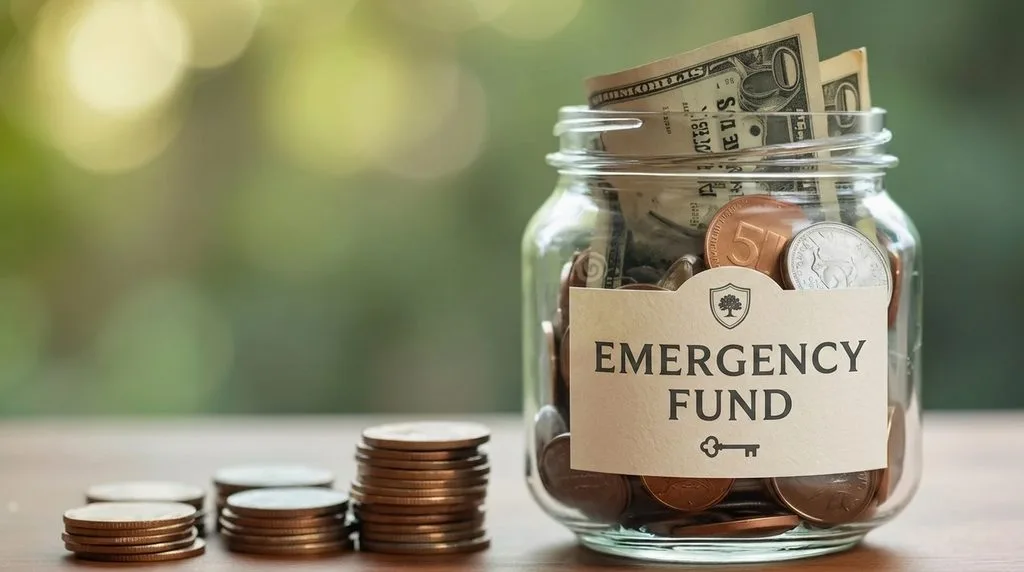
Financial planners at the CFPB, Fidelity, and Vanguard converge on the same range: 3 to 6 months of essential expenses for a fully funded emergency fund. Nine months is smarter if your income is variable or you’re the sole earner in your household.
Practical formula:
Essential monthly expenses × 3–6 = HYSA target
Example: $4,200 monthly essentials × 3 to 6 months = $12,600 to $25,200 emergency fund.
Reality-check data from Bankrate’s 2026 Emergency Savings Report:
- Only 46% of Americans have enough saved to cover three months of expenses.
- The median unexpected emergency expense is around $3,750.
- Only 41% of adults could cover a $1,000 emergency from savings alone.
That’s why building this cushion — even $500 at a time — is one of the highest-leverage financial moves you can make. The Consumer Financial Protection Bureau’s essential guide to building an emergency fund walks through the process step by step, with worksheets.
Once your emergency fund is set, protecting the household’s income becomes the next priority — often the moment savers start comparing options like term life insurance and shopping smarter car insurance to protect the savings they’ve built.
The 5-Minute HYSA Action Plan
Opening a HYSA is one of the simplest financial upgrades you’ll ever make. Here’s the exact sequence.
- Pick your account. Choose one of the top 4 rates from the table above based on your situation (balance size, willingness to bundle checking, etc.).
- Gather your details. Social Security number, driver’s license or ID, current address, employer info, and a linked funding account.
- Complete the online application. Typically 5–7 minutes end-to-end.
- Fund the account. Use ACH from your existing checking; wire and mailed check are usually options too.
- Set up a recurring transfer. Even $50 per paycheck creates momentum you’ll never regret.
- Turn on alerts and two-factor authentication. Non-negotiable in 2026.
- Test with a small round-trip. Move $20 in and $20 out to make sure transfers behave normally. Then leave your existing savings alone until the new account is fully working.
HYSA Strategies for Different Life Stages
Your ideal HYSA setup shifts with your goals. Here’s how savvy savers use them at different points.
Early career (20s–30s):
Focus on building a $1,000 starter emergency fund, then scale to 3 months of expenses. A no-minimum, no-fee HYSA (Ally, American Express, or Marcus) removes friction while you’re getting the habit going.
Mid-career (40s–50s):
You likely need a larger emergency reserve (6 months) plus a short-term “opportunity fund” for major purchases. This is where higher-APY accounts like Axos ONE or Forbright pay off, and where CDs start earning a slice of your cash.
Pre-retirement and retirees (60s+):
Cash reserves usually rise to 12–24 months of expenses to weather market downturns without selling investments at the wrong time. This is often the point where FDIC insurance limits become an active planning issue — expect to split cash across multiple institutions or ownership categories.
Self-employed / variable income:
Aim for 9–12 months of expenses. Consider a two-account setup: one HYSA for your emergency fund, a second for quarterly tax reserves that you never touch until the IRS asks for them.
Common Mistakes That Cost HYSA Savers Money
Even a great account can quietly underperform if you use it wrong. These are the traps I see most often.
- Chasing rates every 30 days. Moving money each time a competitor raises APY by 0.10% costs you time and cognitive load — the improvement often lands in the low single digits per year on typical balances.
- Ignoring the fine print. A “4.50%” rate that only applies to the first $5,000 will pay less on a $30,000 balance than a flat 4.10%.
- Skipping automation. Manual transfers get skipped. Automatic transfers get done.
- Overfunding beyond emergency needs. Once you have 3–6 months of expenses saved, additional dollars usually earn more in a diversified brokerage account over any horizon longer than 3 years.
- Forgetting FDIC limits. If your balance climbs past $250,000 at one bank, split across institutions or ownership categories to stay fully insured.
- Confusing APY with APR. APR doesn’t include compounding; APY does. Always compare APY to APY.
- Forgetting the tax hit. Set aside 20%–30% of your interest earnings so April doesn’t ambush you.
Rate Forecast: Where HYSA APYs Are Headed
Here’s what the data says now, and where informed guesses take over.
- The Fed’s stance. The FOMC held rates steady in July 2026 and signaled a data-dependent approach through year-end.
- Market pricing. Futures markets currently see roughly a 60–70% chance of at least one 0.25% cut before December 2026.
- Bankrate’s annual outlook. Bankrate economists project a total of about 0.75% in cumulative rate cuts across 2026.
- How that translates to savers. Every 0.25% Fed cut typically pulls top HYSA APYs down by about the same amount within 30–60 days.
Bottom line: If today’s 4.25% APY looks good to you, it probably won’t stick around forever. Consider laddering a portion of longer-term cash into CDs while keeping your emergency fund in a HYSA. By mid-2027, top HYSA rates may drift into the high 3s.
Frequently Asked Questions
What is the highest-paying high-yield savings account right now?
As of August 25, 2026, Abound Credit Union leads with a 4.25% APY on its High-Yield Savings Account (requires an active account with direct deposit). Axos ONE Savings follows at 4.21% APY on the first ~$250,000, and Forbright Bank offers a flat 4.15% APY. Rates change weekly.
Are high-yield savings accounts safe?
Yes. HYSAs at FDIC-insured banks or NCUA-insured credit unions are backed by the U.S. government up to $250,000 per depositor, per institution, per ownership category. Since 1933, no depositor has lost a single penny of federally insured funds.
Can I lose money in a high-yield savings account?
You cannot lose principal in an insured HYSA up to the coverage limit. However, if your APY sits below inflation, your purchasing power slowly erodes. Today’s top HYSA rates (~4.25%) currently outpace the U.S. CPI (~3.4%), so real returns remain positive.
How often do HYSA rates change?
Rates can move anytime. Banks generally adjust within 1–8 weeks of a Federal Reserve policy change, but they can raise or lower APYs independently based on their own deposit needs.
Do I need a lot of money to open a HYSA?
No. Many top-tier HYSAs — including Axos, Forbright, Marcus, Ally, and American Express — require zero minimum deposit. Others ask for $100. Very few require thousands.
Can I have more than one high-yield savings account?
Yes, and many savers do. Multiple HYSAs let you separate goals (emergency fund, down payment, taxes, vacation) and also allow you to exceed the $250,000 FDIC limit by using multiple institutions.
Does opening a HYSA hurt my credit score?
Almost never. Most banks perform a soft pull through ChexSystems rather than a hard credit inquiry to verify identity. Always confirm on the application page if you’re rate-shopping loans in parallel.
Is a HYSA better than investing in the stock market?
For short-term goals (0–3 years) and emergency savings, yes. For long-term goals (5+ years), historical stock returns have significantly outpaced any savings rate. Use each tool for its intended job.
Is HYSA interest taxed differently from regular income?
No. Interest is taxed as ordinary income at your marginal federal rate, plus any applicable state income tax. You’ll receive Form 1099-INT if you earn $10 or more in interest during the year.
Final Thoughts: The Boring Move That Actually Pays
A high-yield savings account is not the thing that makes anyone rich. What it will do — quietly, reliably, month after month — is stop your emergency fund from bleeding value, add a few hundred to a few thousand dollars to your bottom line every year, and take about 10 minutes to set up. Very few financial moves offer that kind of return on effort.
Pick one of the top accounts on this list. Open it this week. Automate the transfer. Then let compounding do the boring, patient work while you get on with your life. Rates may drift lower over the next 12–18 months, but the habit of paying yourself first — into an account that actually pays you back — is what compounds the most of all.



Leave a Reply