
In this article
- What Is a Monthly Budget Planner?
- Why Is a Monthly Budget Important?
- How to Create a Monthly Budget Planner
- Step 2: List Your Recurring Expenses
- Step 3: Estimate Your Variable Expenses
- Step 4: Set Your Savings Goals
- Step 5: Set Spending Limits
- Step 6: Track Your Actual Spending
- Step 7: Review Your Budget at Month-End
- Monthly Budget Planner Example
- What Is the 50/30/20 Budget Rule?
- How to Budget With Irregular Income
- How to Reduce Monthly Expenses
- Monthly Budget Planner for Beginners
- Common Monthly Budgeting Mistakes
- Monthly Budget Planner vs. Expense Tracker
- How to Make Your Budget Easier to Maintain
- How Much Should You Save Each Month?
- What Should You Do With Extra Money?
- Frequently Asked Questions
- Final Thoughts
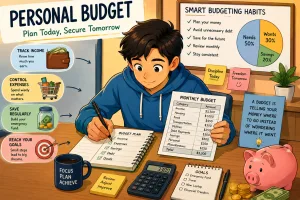
A monthly budget planner helps you organize your income, plan expenses, control unnecessary spending, and work toward your financial goals. Instead of wondering where your money went, you can decide where you want it to go before the month begins.
You do not need complicated software to create a useful budget. A notebook, spreadsheet, or simple budgeting app can work well. The important part is to record realistic numbers and review your progress regularly.
This guide explains how to create a monthly budget, track your spending, plan savings, handle irregular income, and improve your financial habits.
What Is a Monthly Budget Planner?
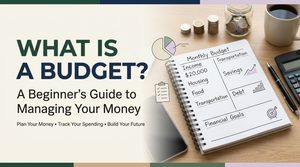
A monthly budget planner is a system for organizing your expected income and planned spending for a specific month.
A basic budget usually includes:
- Monthly take-home income
- Housing costs
- Groceries and food
- Utilities
- Transportation
- Insurance
- Debt payments
- Personal expenses
- Entertainment
- Savings
- Other financial goals
The planner helps you compare your available income with your expected expenses. You can then adjust your spending before you run out of money.
Why Is a Monthly Budget Important?
A monthly budget gives you a clearer picture of your finances. It can also help you make better spending decisions.
1. You Can See Where Your Money Goes
Tracking your expenses helps you identify your biggest spending categories. You can then decide which expenses deserve more attention.
2. You Can Reduce Unnecessary Spending
A budget gives you a spending limit for different categories. This limit can make you think twice before making non-essential purchases.
3. You Can Plan for Savings
You can include savings as a specific part of your monthly plan. This approach can make regular saving easier to maintain.
4. You Can Prepare for Unexpected Expenses
An emergency fund can help you handle unexpected costs without immediately depending on credit cards or other borrowing options.
5. You Can Work Toward Financial Goals
A budget can help you allocate money toward goals such as building an emergency fund, paying down debt, investing, education, or a major purchase.
How to Create a Monthly Budget Planner

You can build a practical budget in a few simple steps.
Step 1: Calculate Your Monthly Take-Home Income
Start with the money you actually expect to receive during the month.
You might receive income from:
- Employment
- Freelancing
- Business activities
- Side work
- Regular investment income
- Other reliable sources
If you receive a regular salary, use your take-home pay after normal payroll deductions when you plan your spending.
If your income changes from month to month, use a conservative estimate based on your recent income rather than relying on your highest-earning month.
Step 2: List Your Recurring Expenses
Write down expenses that occur regularly.
Examples include:
- Rent or mortgage payments
- Loan payments
- Insurance premiums
- Internet bills
- Phone bills
- Subscription services
- Tuition or education payments
Check your previous bills or bank records when possible. Actual records can help you avoid unrealistic estimates.
Step 3: Estimate Your Variable Expenses
Variable expenses can change from one month to another.
Common examples include:
- Groceries
- Electricity
- Transportation
- Dining out
- Clothing
- Entertainment
- Personal care
Look at your previous spending history and create realistic estimates. If you do not have past records, start tracking your expenses for the current month and use that information to improve next month’s budget.
Step 4: Set Your Savings Goals
Decide how much you want to save and what you want the money to accomplish.
You might save for:
- An emergency fund
- A short-term purchase
- Education
- A home
- Retirement
- Another long-term financial goal
Choose an amount that fits your current income and expenses. A realistic target that you can maintain consistently often works better than an aggressive target that you cannot sustain.
Step 5: Set Spending Limits
Create a reasonable limit for categories such as groceries, transportation, entertainment, and personal spending.
For example, if you normally spend $300 on groceries, setting a $50 limit may not create a realistic plan. Review your actual spending and reduce costs gradually when possible.
Step 6: Track Your Actual Spending
A budget only works well when you compare your plan with your real spending.
Record your purchases throughout the month. You can use a spreadsheet, notebook, or budgeting app.
At the end of each week, compare your actual spending with your planned amounts. If one category starts exceeding its limit, adjust your remaining spending instead of ignoring the difference.
Step 7: Review Your Budget at Month-End
Review your budget when the month ends.
Ask yourself:
- Did I stay within my planned spending?
- Which category cost more than expected?
- Which category cost less?
- Did I reach my savings target?
- Did any unexpected expense affect my plan?
- What should I change next month?
Use these answers to create a more realistic budget for the following month.
Monthly Budget Planner Example
The following fictional example uses U.S. dollars. You can replace the amounts with your own currency and actual expenses.
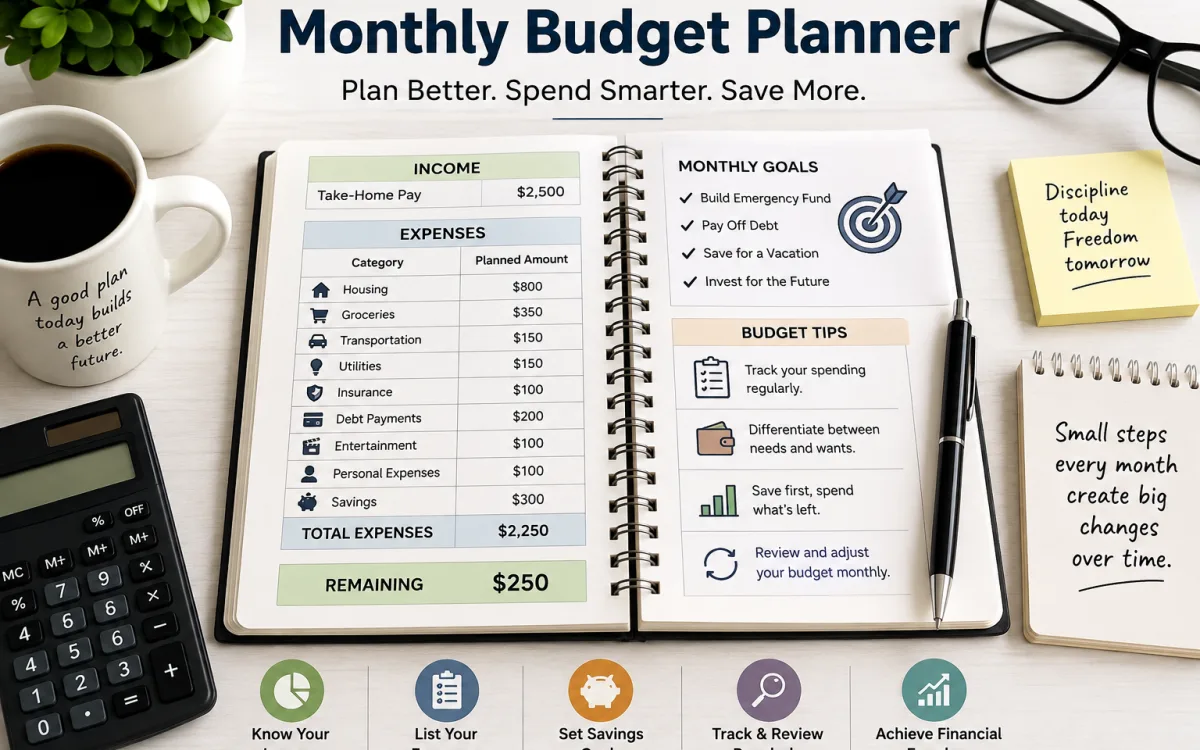
| Budget Category | Planned Amount |
|---|---|
| Housing | $800 |
| Groceries | $350 |
| Transportation | $150 |
| Utilities | $150 |
| Insurance | $100 |
| Debt Payments | $200 |
| Entertainment | $100 |
| Personal Expenses | $100 |
| Savings | $300 |
| Total Planned Amount | $2,250 |
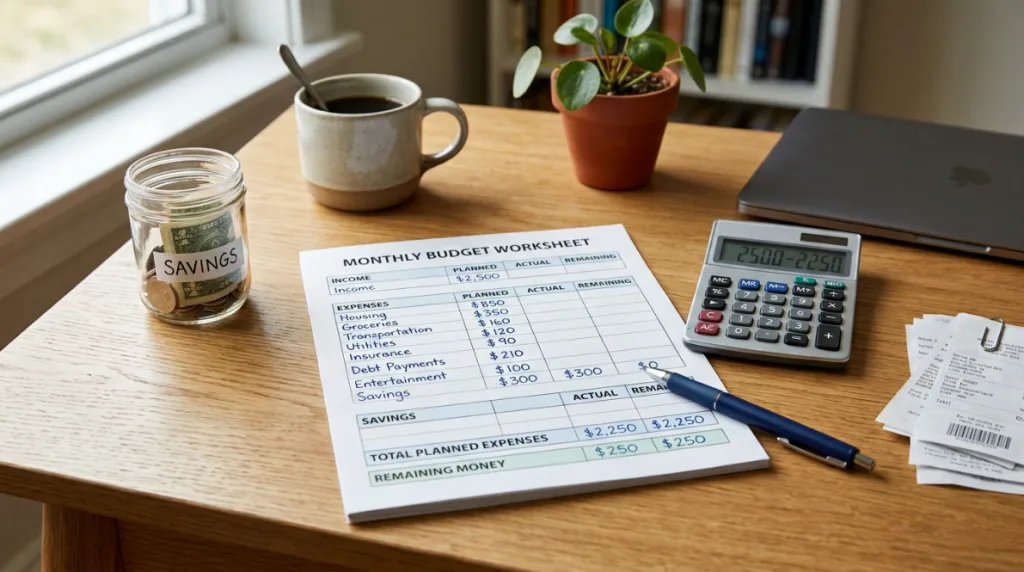
If your monthly take-home income is $2,500, the example leaves $250 unallocated.
You could assign that $250 to an additional savings goal, debt repayment, investing, or another financial priority. The right choice depends on your personal financial situation.
What Is the 50/30/20 Budget Rule?
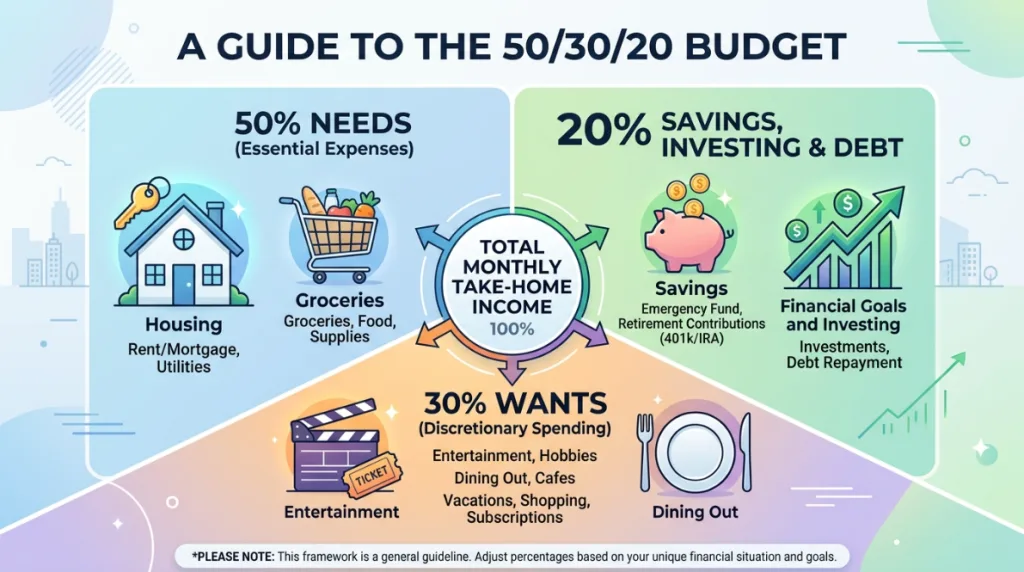
The 50/30/20 rule is a popular budgeting guideline that divides after-tax income into three broad categories:
- 50% for needs
- 30% for wants
- 20% for savings, investing, and debt repayment
This framework can make budgeting easier for beginners, but you do not need to follow it exactly.
Your housing costs, income, family responsibilities, debt, location, and financial goals can change the appropriate percentages. Treat the 50/30/20 rule as a starting framework rather than a universal requirement.
For example, someone with high debt may choose to spend less on wants and direct more money toward debt repayment. Another person may need to allocate more than 50% to essential expenses because of their current living costs.
How to Budget With Irregular Income
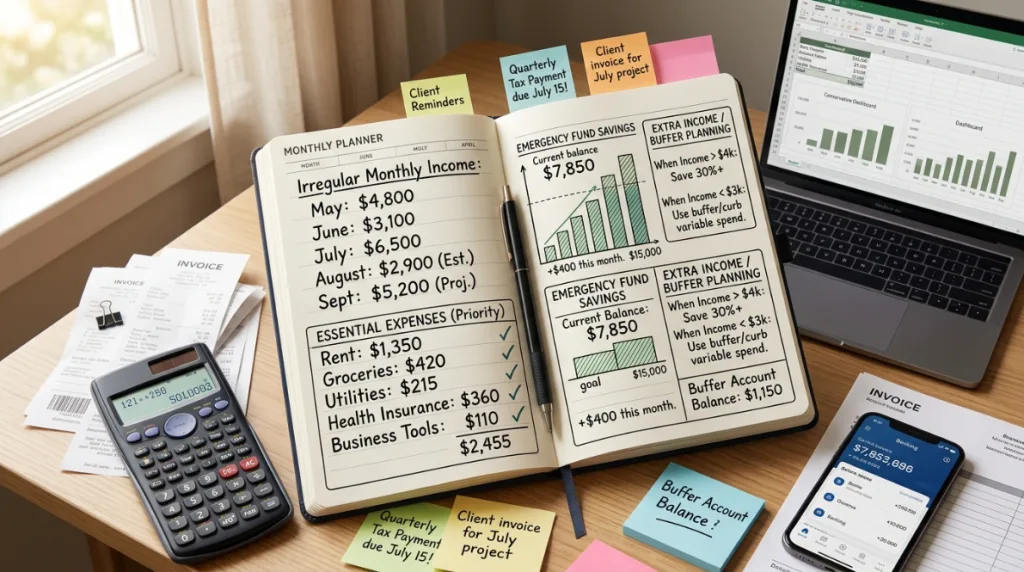
People who freelance, run businesses, work on commissions, or receive seasonal income may not earn the same amount every month.
You can still create a monthly budget by following a few practical steps.
Use a Conservative Income Estimate
Look at your recent income and choose a realistic lower-end estimate for your basic budget.
Prioritize Essential Expenses
Cover necessary expenses such as housing, food, utilities, transportation, insurance, and required debt payments before planning discretionary spending.
Keep Extra Income for Future Needs
When you earn more than expected, consider directing part of the extra money toward savings, upcoming expenses, debt repayment, or other financial goals.
Build a Larger Cash Reserve
A stronger emergency fund can provide additional flexibility when your income changes significantly from month to month.
How to Reduce Monthly Expenses

A budget can help you find opportunities to reduce unnecessary costs.
Review Your Subscriptions
Check your recurring subscriptions and cancel services you no longer use.
Plan Your Grocery Shopping
Create a shopping list before you buy groceries. Planning can help you avoid unnecessary purchases and reduce food waste.
Review Recurring Bills
Compare your regular phone, internet, insurance, and other recurring costs when suitable alternatives exist.
Limit Impulse Purchases
Before buying something you do not need, give yourself time to decide whether the purchase fits your budget and financial goals.
Set Weekly Spending Targets
A monthly limit can feel too broad. Breaking discretionary spending into weekly targets can make it easier to monitor your progress.
Monthly Budget Planner for Beginners
If you have never created a budget before, start with five basic sections:
- Income
- Essential expenses
- Debt payments
- Savings
- Discretionary spending
Track your actual expenses for one month. Then use those numbers to create a more realistic plan for the next month.
Do not expect your first budget to work perfectly. Your spending habits and financial priorities can change, so your budget should change with them.
Common Monthly Budgeting Mistakes
Ignoring Irregular Expenses
Some expenses occur only a few times each year. Examples include annual subscriptions, gifts, vehicle maintenance, school costs, or certain fees.
Estimate these expenses and set aside money for them when possible.
Creating Unrealistic Spending Limits
A budget should challenge you without ignoring reality. Extremely low spending limits can make your plan difficult to maintain.
Use your actual spending history to set reasonable targets.
Forgetting Small Purchases
Small purchases can add up over time. Track snacks, coffee, delivery charges, entertainment, and other minor expenses just as you track larger purchases.
Saving Only What Remains
If you wait until the end of the month to save whatever money remains, you may save less than you intended.
Instead, include a specific savings amount in your monthly plan.
Failing to Review the Budget
Your budget should not remain unchanged forever. Review it regularly and update it when your income, expenses, or financial goals change.
Monthly Budget Planner vs. Expense Tracker
A monthly budget planner and an expense tracker have different purposes.
A budget planner shows how you intend to use your money.
An expense tracker records how you actually use your money.
Using both tools together can give you a clearer picture of your financial habits. You can compare planned spending with actual spending and use the results to improve your next budget.
How to Make Your Budget Easier to Maintain
A complicated system can make budgeting feel like a chore. Keep your process simple.
Choose one method that you can use consistently:
- Spreadsheet
- Notebook
- Printable worksheet
- Budgeting app
- Digital document
Set aside a few minutes each week to review your spending. Then perform a more detailed review at the end of each month.
You can also automate certain financial tasks when your bank or financial service supports them. For example, you may be able to schedule recurring transfers to a savings account.
How Much Should You Save Each Month?
There is no single savings amount that works for everyone.
Your ideal monthly savings amount depends on factors such as:
- Income
- Essential expenses
- Debt
- Emergency savings
- Financial goals
- Household responsibilities
Start with an amount you can realistically maintain. As your income increases or expenses decrease, you can consider increasing your savings contribution.
What Should You Do With Extra Money?
Sometimes your budget leaves money after you cover planned expenses.
You could use extra money to:
- Build your emergency fund
- Pay down high-interest debt
- Save for a short-term goal
- Invest for a long-term goal
- Cover an upcoming large expense
Your priorities should determine where the extra money goes. If you have expensive debt, reducing that debt may deserve priority. If you already have sufficient emergency savings and manageable debt, you may consider other long-term goals.
Frequently Asked Questions
What should a monthly budget include?
A monthly budget should normally include income, essential expenses, variable expenses, debt payments, savings, and discretionary spending. You can add categories that match your personal financial situation.
How do I create a monthly budget planner?
Start by calculating your take-home income. Then list recurring and variable expenses, set savings goals, create spending limits, track actual spending, and review the results at the end of the month.
Is the 50/30/20 rule good for beginners?
It can provide a useful starting framework, but it does not suit every financial situation. Adjust the percentages based on your income, expenses, debt, and goals.
How do I budget with irregular income?
Use a conservative income estimate, prioritize essential expenses, track your actual income, and use stronger months to prepare for future expenses and lower-income periods.
Can I create a monthly budget without an app?
Yes. You can create an effective budget with a notebook, spreadsheet, or printable worksheet. The method matters less than using it consistently.
How often should I review my budget?
Check your spending at least once a week and perform a more complete review at the end of each month. You should also update your budget whenever your financial circumstances change.
Final Thoughts
A monthly budget planner can give you a simple way to organize your money and make intentional spending decisions.
Start with your take-home income, list your essential and variable expenses, set realistic savings goals, and track your actual spending. If your income changes, adjust your plan instead of abandoning it.
You do not need a perfect budget. You need a realistic system that you can follow consistently.
Review your results every month, learn from your spending patterns, and make practical adjustments. Over time, these small habits can help you manage your money more confidently and work toward your financial goals.

Leave a Reply