
In this article
- 1. Set Clear Study Goals
- 2. Create a Realistic Study Schedule
- 3. Use Active Recall
- 4. Practice Spaced Repetition
- 5. Break Large Topics Into Smaller Tasks
- 6. Study in Focused Sessions
- 7. Remove Distractions
- 8. Take Effective Notes
- 9. Explain Difficult Concepts in Your Own Words
- 10. Practice With Questions
- 11. Give More Time to Difficult Subjects
- 12. Protect Your Sleep and Rest
- 13. Use Technology as a Study Tool
- 14. Take Practice Tests
- 15. Review and Improve Your Study Method
- Common Study Mistakes to Avoid
- How to Build a Better Study Routine
- Final Thoughts
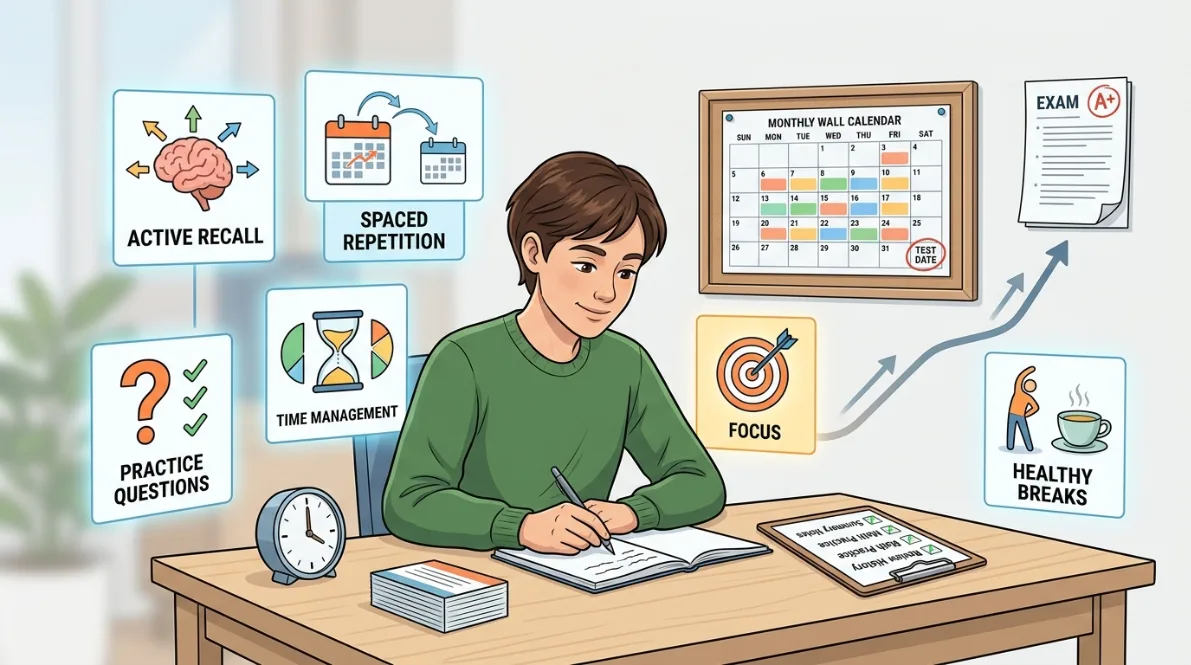
Studying for long hours does not always produce better results. The way you study matters just as much as the time you spend with your books. A well-planned study routine can help you understand difficult topics, remember information longer, and feel more confident before exams.
Whether you are in school, college, or university, effective study tips for students can make learning easier and more manageable. You do not need to study all day. Instead, focus on proven learning techniques, regular practice, and a comfortable study environment.
Here are 15 practical ways to study smarter and build better learning habits.
1. Set Clear Study Goals
Start every study session with a specific goal.
Instead of saying, “I will study mathematics,” set a clear target such as, “I will complete 20 algebra problems and review my mistakes.”
Clear goals give your study session direction and make your progress easier to measure.
You can set:
- Daily goals for individual study sessions
- Weekly goals for larger topics
- Long-term goals for exams or assignments
Keep your goals realistic. Completing a small target consistently is often more effective than creating an unrealistic schedule.
2. Create a Realistic Study Schedule
A simple study schedule can help you stay organized and avoid last-minute stress.
Choose specific times for studying and try to maintain a consistent routine. You can use a notebook, calendar, or digital planner to organize your subjects.
For example:
- Monday: Mathematics and English
- Tuesday: Science and History
- Wednesday: Mathematics and Computer Studies
- Thursday: English and Science
- Friday: Weekly revision
- Weekend: Practice tests and unfinished work
Do not fill every hour of your day with study sessions. Leave some flexible time for assignments, family activities, rest, and unexpected tasks.
3. Use Active Recall

Simply reading the same chapter several times can make you feel familiar with the material without truly understanding it.
Active recall takes a different approach. After studying a topic, close your book and try to remember the main ideas without looking at your notes.
You can practice active recall by:
- Answering questions from memory
- Explaining a concept aloud
- Writing down key points without checking your notes
- Creating your own quiz
- Using flashcards
This technique encourages your brain to retrieve information instead of simply recognizing it on a page.
4. Practice Spaced Repetition
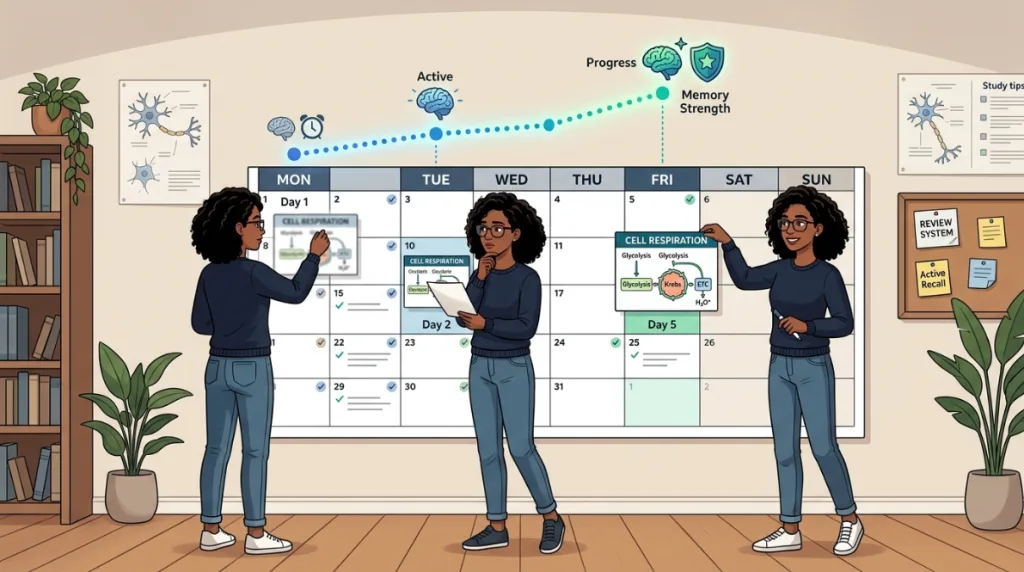
Do not leave all your revision until the night before an exam.
Spaced repetition involves reviewing information at gradually increasing intervals. For example, you might review a new topic today, revisit it after a few days, and then review it again the following week.
A simple review pattern could look like:
Day 1 → Day 3 → Day 7 → Day 14 → Day 30
You can adjust these intervals based on how well you remember the material.
Regular review helps you identify weak areas before they become a problem.
5. Break Large Topics Into Smaller Tasks
A long textbook chapter can feel overwhelming when you treat it as one large assignment.
Break the topic into smaller sections instead.
For example, a biology chapter might include:
- Cell structure
- Cell functions
- Cell division
- Genetics
- Practice questions
Focus on one section at a time. Smaller tasks can make it easier to start, maintain concentration, and track your progress.
6. Study in Focused Sessions
You do not always need to sit at your desk for several hours without stopping.
Try dividing your study time into focused sessions with short breaks. One popular approach is to study for 25 minutes and then take a 5-minute break. You can also try longer sessions, such as 40–50 minutes, if they suit your concentration style.
The ideal study period varies from person to person.
The important thing is to protect your focused time and take regular breaks before your concentration drops significantly.
7. Remove Distractions

Distractions can quickly reduce the quality of a study session.
Your phone, social media, games, messages, and unnecessary notifications can interrupt your concentration.
Before studying, try to:
- Put your phone away or enable Do Not Disturb
- Turn off unnecessary notifications
- Close unrelated browser tabs
- Keep your study area organized
- Use website blockers when necessary
- Tell others when you need quiet time
A distraction-free environment allows you to spend more of your available time actually learning.
8. Take Effective Notes
Good notes do not need to contain every sentence from your teacher or textbook.
Focus on important concepts, definitions, formulas, examples, and questions.
You can organize information with:
- Short bullet points
- Clear headings
- Diagrams
- Tables
- Mind maps
- Question-and-answer notes
After class, review your notes while the material is still fresh. Add missing details and mark anything you need to understand better.
9. Explain Difficult Concepts in Your Own Words
One of the simplest ways to check your understanding is to explain a topic without copying the textbook.
Imagine that you are teaching the concept to another student. Explain it using simple language and practical examples.
For example, after learning about photosynthesis, ask yourself:
- What is photosynthesis?
- How does it work?
- Why do plants need it?
- What role does sunlight play?
If you cannot explain the concept clearly, identify the confusing part and study it again.
This approach can reveal gaps in your understanding that passive reading may not show.
10. Practice With Questions
Practice questions help you determine whether you can actually apply what you have learned.
Do not immediately look at the solution. Attempt each question yourself first.
When you make a mistake, find the reason behind it.
Ask yourself:
- Did I misunderstand the concept?
- Did I forget a formula?
- Did I misread the question?
- Did I make a calculation error?
- Did I run out of time?
Keep track of recurring mistakes. Reviewing them can help you avoid making the same errors again.
11. Give More Time to Difficult Subjects
Students often spend more time on subjects they already enjoy because those subjects feel easier.
Instead, give additional attention to topics that challenge you.
You do not need to spend your entire day on difficult subjects. Consider studying challenging material when your concentration is strongest, then move to easier tasks.
This approach helps you use your mental energy more strategically.
12. Protect Your Sleep and Rest
Staying awake all night may seem like a way to gain extra study time, but lack of sleep can make it harder to concentrate and learn effectively.
Create a consistent sleep routine whenever possible. Give yourself enough time to rest before important exams.
You should also include short breaks during longer study sessions.
A balanced routine can help you maintain concentration without exhausting yourself.
13. Use Technology as a Study Tool
Technology can make studying easier when you use it with a clear purpose.
Students can use digital flashcards, educational videos, online practice exercises, note-taking applications, and digital calendars to support their learning.
However, technology can also become a distraction.
Before opening an app or website, ask yourself:
Will this help me understand, practice, or organize my work?
If it does, use it. If it only helps you avoid difficult work, remove the distraction and return to your study task.
14. Take Practice Tests

Do not wait until the actual exam to discover which topics you do not understand.
Use practice tests, textbook questions, class exercises, or previous exam materials when they are available.
Try completing a practice test without checking your notes. Set a reasonable time limit if the real exam has one.
Afterward, review your answers and identify your weak areas.
Then use your next study session to focus on those topics.
Practice tests can also help you become more comfortable with answering questions under time pressure.
15. Review and Improve Your Study Method
No single study method works perfectly for every student.
At the end of each week, spend a few minutes reviewing your routine.
Ask yourself:
- Which subjects improved this week?
- Which topics still confuse me?
- Which study technique helped the most?
- Where did I waste time?
- What should I change next week?
Use your answers to improve your routine gradually.
You do not need to completely change your study habits every week. Make small adjustments and keep the techniques that produce useful results.
Common Study Mistakes to Avoid
Even a good study schedule can become ineffective when you rely on poor habits.
Try to avoid:
- Studying everything at the last minute
- Reading without testing yourself
- Highlighting almost every sentence
- Checking your phone repeatedly
- Skipping breaks
- Ignoring difficult topics
- Memorizing information without understanding it
- Studying without clear goals
- Copying notes without processing the information
- Sacrificing sleep unnecessarily
You do not need a perfect study routine. You need a practical routine that you can follow consistently.
How to Build a Better Study Routine
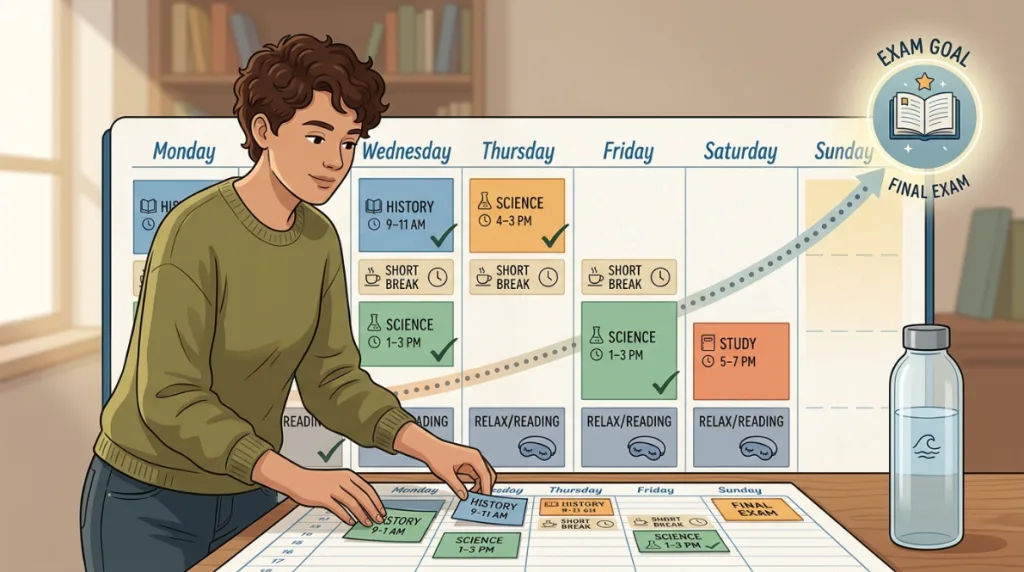
You do not need to change everything at once. Start with a simple system and improve it over time.
Step 1: Choose your priority subjects.
Identify the subjects or topics that need the most attention.
Step 2: Set weekly goals.
Decide what you want to complete by the end of the week.
Step 3: Schedule focused study sessions.
Choose realistic study periods that fit your daily routine.
Step 4: Use active learning techniques.
Practice active recall, spaced repetition, explanations, and questions.
Step 5: Review your mistakes.
Use mistakes as a guide for deciding what to study next.
Step 6: Reduce distractions.
Create a study environment that makes concentration easier.
Step 7: Review your progress.
At the end of each week, identify what worked and what needs improvement.
This approach can help you develop a study system that matches your needs instead of copying someone else’s routine.
Final Thoughts
The best study tips for students are not about studying for the longest possible time. They are about using your time effectively.
Set clear goals, create a realistic schedule, use active recall, review information regularly, practice with questions, reduce distractions, and give your brain enough time to rest.
Most importantly, stay consistent. You do not need to master every study technique at once. Start with one or two methods, see how they affect your learning, and gradually build a routine that works for you.
Smart studying is not about doing more work. It is about making the work you do more effective.



Leave a Reply