

In this article
- TL;DR: Our Quick Picks
- What Is an AI Financial Advisor Startup?
- AI Advisor vs. Robo-Advisor vs. Human Advisor: What's the Difference?
- Before You Hire an AI Advisor: 3 Moves First
- How We Ranked These Startups
- The Best AI Financial Advisor Startups at a Glance
- Detailed Reviews of the Best AI Financial Advisor Startups
- How These Startups Make Money (So You Know the Incentives)
- What the AI Can — and Can't — Do
- How to Choose the Right Startup for You
- Stay Safe: Fiduciaries, Red Flags, and When to Call a Human
- Frequently Asked Questions
- Final Verdict: Which AI Financial Advisor Startup Should You Pick?
TL;DR: Our Quick Picks
- Best overall: Origin — one subscription for budgeting, investing, tax, and estate planning, with SEC-regulated AI reasoning.
- Best for portfolio audits: PortfolioPilot — free tier analyzes any existing brokerage and flags risk, fees, and tax inefficiency.
- Best hybrid AI + human: Albert — text a money question seven days a week; AI drafts, a human reviews.
- Best for cash-flow coaching: Cleo — a chat-based AI coach with personality that actually gets people to save.
- Best AI research assistant: Magnifi — ask plain-English investing questions, get sourced answers.
- Best household dashboard: Monarch Money — cleanest all-accounts view for couples, with an AI assistant.
- Best for algorithmic strategies: Composer — turn plain English into backtested, auto-executed portfolios (more intermediate).
An AI financial advisor startup is a young, venture-backed company that uses machine learning and large language models to deliver personalized financial guidance — budgeting, investing, tax planning, and goal tracking — for a fraction of a human advisor’s cost. After testing the field in 2026, we named Origin the best overall AI advisor for most households, PortfolioPilot the best for auditing an existing investment portfolio, Albert the best hybrid of AI and human text advice, and Cleo the most engaging AI coach for day-to-day cash flow. If you want pure AI investment research, Magnifi is the closest thing to ChatGPT for your portfolio.
Money is pouring into this space. KPMG’s Pulse of Fintech reports that AI-related fintech deal value hit $21.4 billion in just the first half of 2026 — nearly matching the full-year total for 2025 — which means these startups are improving fast, but it also means you need to separate substance from marketing. This guide covers the seven strongest consumer-facing startups, what their AI actually does, how they are regulated, and how to pick one without getting scammed. If you want a platform that also executes trades for you, start with our companion piece on AI investing apps before reading on.
What Is an AI Financial Advisor Startup?
A true AI financial advisor does more than categorize your transactions. It connects to your bank and brokerage accounts, reasons over your full financial picture, and answers questions like “can I afford to quit my job in two years?” or “should I pay off my student loan or invest the bonus?” The best ones are registered investment advisers (RIAs) — or partner with one — which legally binds them to a fiduciary standard: they must put your interests first.
We excluded incumbents like Fidelity, Schwab, and Vanguard (they are not startups) and pure budgeting apps that only categorize spending. We also excluded tools built exclusively for professional advisors. Every company below sells directly to consumers and uses AI as its core differentiator. Many overlap with AI budgeting tools, but the ones here go further into investing, tax, and planning.
AI Advisor vs. Robo-Advisor vs. Human Advisor: What’s the Difference?
These three terms get mixed up. Here is the honest distinction, because it changes what you should pay.
| AI Financial Advisor Startup | Traditional Robo-Advisor | Human Financial Advisor | |
|---|---|---|---|
| Core interface | Chat + AI reasoning over all your accounts | Questionnaire → fixed ETF portfolio | Meetings, email, phone |
| Scope | Budgeting, investing, tax, goals, estate | Investing + rebalancing only | Full financial plan |
| Typical cost | $5–$15/mo or $50–$150/yr | 0.25% AUM (~$250/yr on $100k) | 1% AUM (~$1,000/yr on $100k) or $200–$400/hr |
| Human access | Sometimes (add-on or hybrid) | Rarely (extra cost) | Yes, built in |
| Best for | Routine questions, households under $500k | Hands-off investing | Complex situations, $1M+ |
Independent analysis finds AI matches human advisors for most households under $500,000, while hybrid human-AI advice wins above $1 million. So for most people reading this, an AI startup is genuinely enough — as long as it is regulated.
Before You Hire an AI Advisor: 3 Moves First
An AI advisor works best on a stable foundation. Do these three things first, in order:
- Pay off debt above ~8% interest. Credit cards at 20%+ APR beat any realistic investment return, so clear them first.
- Build a starter emergency fund. Keep $500–$1,000 in a liquid high-yield savings account so you never sell investments at a loss when life happens.
- Claim your full employer 401(k) match. That match is an instant, guaranteed return. Skip it and you leave free money on the table.
Once those are handled, even $50–$100 a month guided by one of these startups will compound into something meaningful over a decade.
How We Ranked These Startups
We did not trust any app’s “AI-powered” label. We scored every startup against five concrete criteria:
- Genuine AI depth. Does the AI reason over connected accounts and goals, or does it just categorize transactions? We favored tools that answer real planning questions.
- Regulation and fiduciary duty. Is the company, or a partner, a registered investment adviser? You can verify any firm on the SEC’s Investor.gov before you link accounts.
- Pricing transparency. We penalized opaque “contact us” pricing and teaser rates that jump after a promo.
- Funding and traction. A startup with real venture backing and tens of thousands of users is less likely to disappear overnight.
- Independent validation. We cross-checked app-store ratings, Trustpilot, and independent review sites.
The Best AI Financial Advisor Startups at a Glance
Use this table to narrow your shortlist, then read the full review of your top two or three.
| Startup | Best For | Starting Price | Model | AI Highlight |
|---|---|---|---|---|
| Origin | Whole-household financial plan | $99/yr ($1 first-yr promo) | SEC-regulated AI + human CFPs | AI Advisor reasons over all accounts |
| PortfolioPilot | Portfolio analysis & self-directed investors | Free; Gold from $20/mo | RIA (Global Predictions) | Portfolio score, tax & risk recommendations |
| Albert | Hybrid AI + human text advice | $14.99/mo (pay-what’s-fair from $6) | AI + human Geniuses | Text a money question 7 days a week |
| Cleo | Conversational cash-flow coaching | Free; paid from $5.99/mo | Chatbot AI | Personality-driven coaching, roast mode |
| Magnifi | AI investing research assistant | Free; $14/mo premium | AI + broker-dealer (TIFIN) | Natural-language portfolio research |
| Monarch Money | Household financial dashboard | $99.99/yr (Plus $199/yr) | Aggregation + AI assistant | Weekly AI recap, couples planning |
| Composer | AI strategy building & automation | Free + $19–24/mo | Brokerage (SEC/FINRA/SIPC) | No-code AI strategies, backtesting |
Detailed Reviews of the Best AI Financial Advisor Startups
1. Origin — Best Overall AI Financial Advisor
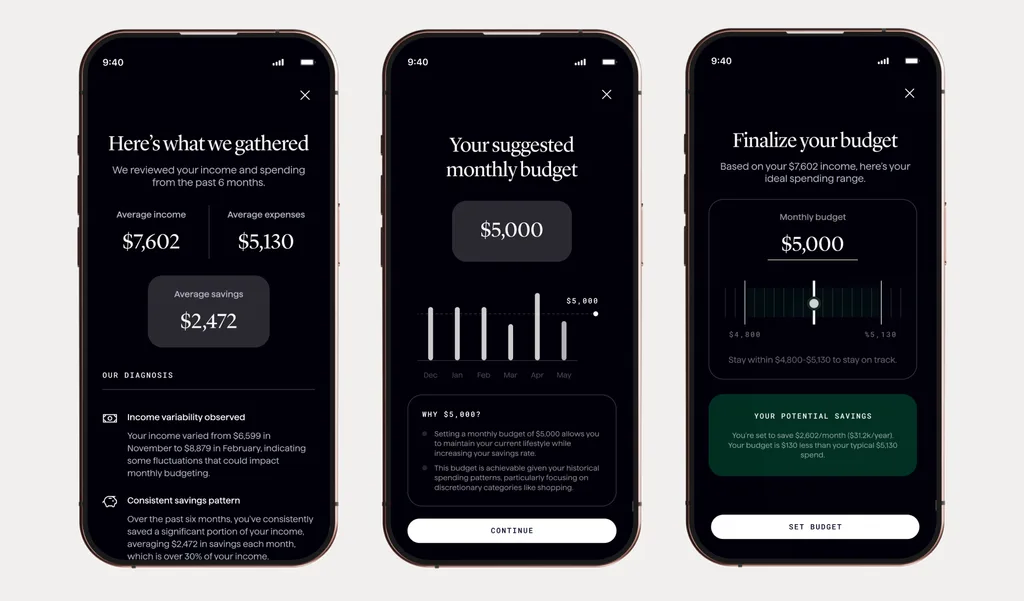
Origin wins the top spot because it covers the most of your financial life in one subscription. Its AI Advisor connects your bank, credit card, and investment accounts and answers real planning questions conversationally — “am I saving enough for a house in three years?” or “what happens if I take a lower-paying job?” Origin built its system with full-context reasoning and regulates it under the SEC; its AI is read-only by design, meaning it can analyze and advise but cannot move your money on its own. The company is SOC 2 certified and GDPR/CCPA compliant.
Pricing runs $99 per year standard (or $12.99 monthly), with a heavily promoted $1 first-year offer and a 7-day free trial. Budget for the $99 renewal. The subscription bundles budgeting, automated investing, tax filing, and a basic will at no extra cost; full wills run $119 and trusts $359, with member discounts. A high-yield cash account pays around 4.37% APY. Add-on sessions with a human certified financial planner cost $119 each. Partner access for couples is included. The tradeoff: there is no permanent free tier, and it can feel like overkill if you only want a budget app.
Key details:
- Price: $99/yr standard (often $1 first year); $12.99/mo monthly; CFP sessions $119.
- AI: Full-context AI Advisor over connected accounts; what-if scenario modeling; read-only by design.
- Pros: SEC-regulated, couples included, bundles investing + tax + estate, human CFP upgrade.
- Cons: No free tier, promo pricing can mislead, newer company.
2. PortfolioPilot — Best for Portfolio Analysis and Self-Directed Investors
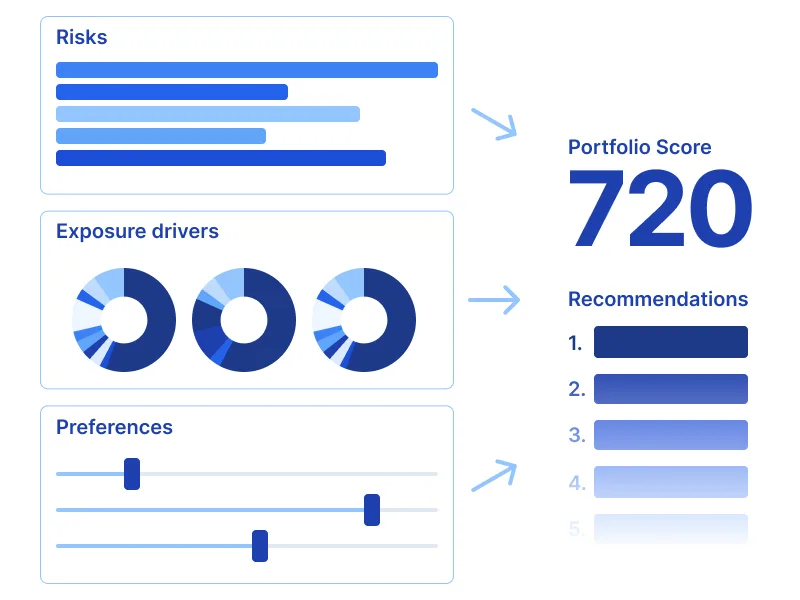
PortfolioPilot, built by registered investment adviser Global Predictions, is the sharpest tool for someone who already invests and wants AI to audit the portfolio. It connects your brokerage in read-only mode, assigns a portfolio score, and flags concentration risk, hidden fees, tax inefficiency, and exposure to inflation or recession. It currently analyzes portfolios worth more than $30 billion for over 40,000 users. Its official pricing starts with a genuinely useful free tier; Gold ($20/month billed annually, or $29 monthly) adds personalized recommendations and tax optimization, with Platinum ($49/mo) and Pro ($99/mo) tiers above that.
The honest limitation: PortfolioPilot does not custody your money or execute trades. It tells you what to fix, and you place the trades yourself. That makes it perfect for self-directed investors who want a second opinion, but not for someone who wants hands-off management.
Key details:
- Price: Free; Gold from $20/mo (annual); Platinum $49/mo; Pro $99/mo.
- AI: Portfolio score, risk analysis, tax-loss harvesting suggestions, scenario planning.
- Pros: Strong free tier, RIA-backed, analyzes $30B+ in portfolios, works with any broker.
- Cons: No trade execution, recommendations still require your judgment, paid tiers get expensive.
3. Albert — Best Hybrid of AI and Human Text Advice
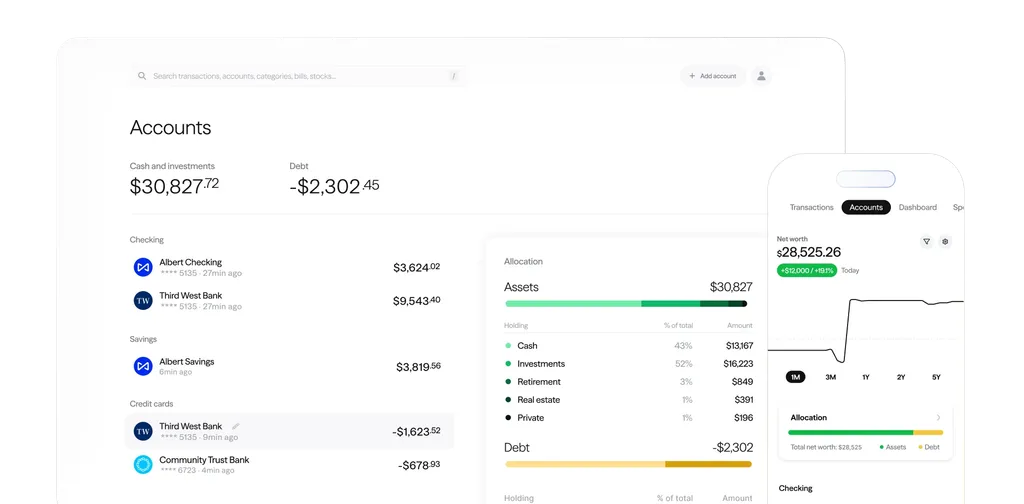
Albert’s smartest move is pairing AI with real humans. Its Genius subscription ($14.99/month, with a pay-what’s-fair option starting at $6) lets you text a money question seven days a week; AI drafts the answer and a human “Genius” reviews it. A Family plan runs up to $39.99/month. Beyond advice, Albert automates savings, negotiates bills, and runs managed investment portfolios. Its cash-advance feature (Albert Instant) offers $25 to $1,000 — though most new users start at $25–$50 and few qualify for the top limit. Standard delivery is free; instant transfers to an external bank cost $5.99–$14.99.
The model works because most people have simple, one-off questions — “should I buy the car or lease?” — that a text can answer in minutes, not a $250 hourly advisor meeting. The catch: the human Geniuses are not all CFPs, and advice quality varies. Albert is best for everyday decisions, not complex estate or tax planning.
Key details:
- Price: Genius $14.99/mo (pay-what’s-fair from $6); Family up to $39.99/mo.
- AI: Continuous monitoring, auto-savings, plus human-reviewed text answers.
- Pros: Human-reviewed advice, 7-day texting, cash advance up to $1,000, bill negotiation, investing.
- Cons: Monthly fee adds up, Geniuses not all CFPs, weaker on complex planning.
4. Cleo — Best Conversational AI Coach for Cash Flow
Cleo is the anti-dashboard. Its entire interface is a chat with a personality — ask “how much did I spend on takeout this month?” and it answers in plain English, sometimes with a “roast mode” that calls out overspending. It is wildly popular with younger users who find spreadsheets terrifying. Its official pricing starts free; Plus is $5.99/month, Pro $8.99/month (adds high-yield savings at 2.75% APY and advanced AI coaching), and Builder $14.99/month adds a secured credit-builder card and early paycheck access. Paid tiers unlock a no-interest cash advance up to $250, subject to eligibility.
The honest caveat: Cleo is a cash-flow coach, not an investment advisor. It will not build you a retirement portfolio or optimize your taxes. Pair it with a low-cost investing app if you want both.
Key details:
- Price: Free; Plus $5.99/mo, Pro $8.99/mo, Builder $14.99/mo.
- AI: Conversational chat, roast mode, automated savings, spending insights.
- Pros: Most engaging interface, genuinely fun, low entry cost, credit-builder card.
- Cons: Not a fiduciary investment advisor, cash advances have eligibility rules, pricing shifts often.

5. Magnifi — Best Pure AI Investing Research Assistant
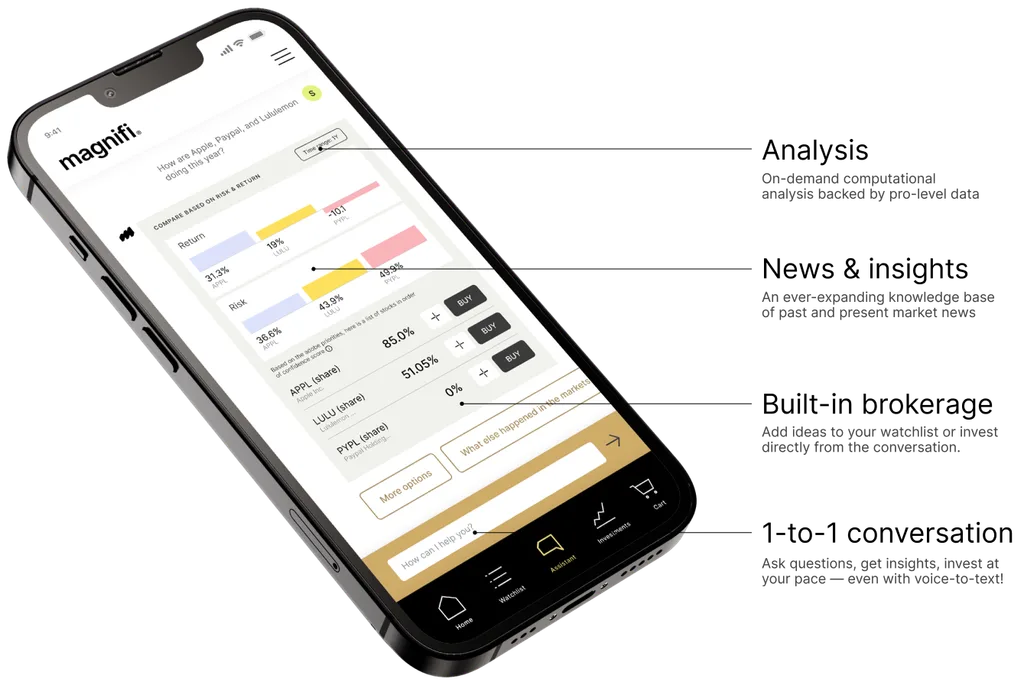
Magnifi, built by fintech company TIFIN (a registered broker-dealer), is the closest thing to “ChatGPT for stocks” run by a licensed platform. Its free tier lets you type plain-English questions — “compare VTI and VOO” or “build a beginner portfolio for a 30-year-old” — and the AI pulls real, sourced data and explains the reasoning. Premium costs $14/month, or $8.25/month billed annually ($99/year), with a 7-day trial. It connects 200+ brokerages, including Robinhood, E*TRADE, Schwab, and Vanguard. If you want Magnifi to manage a portfolio for you, those managed portfolios add roughly a 0.23% annual fee on assets.
Magnifi is research-first. It is ideal for someone who wants to learn by asking questions before committing money. Use its free tier to learn, then execute through a low-cost custodian or through Magnifi’s own commission-free trading if you want everything in one app.
Key details:
- Price: Free basic; Premium $14/mo ($8.25/mo annual); managed portfolios ~0.23% AUM.
- AI: Natural-language semantic search, portfolio health score, links 200+ brokerages.
- Pros: Best conversational AI for investing, connects major brokerages, paper-trading simulations.
- Cons: Managed money adds an AUM fee, younger company, less brand recognition than Fidelity.
6. Monarch Money — Best AI Household Financial Dashboard
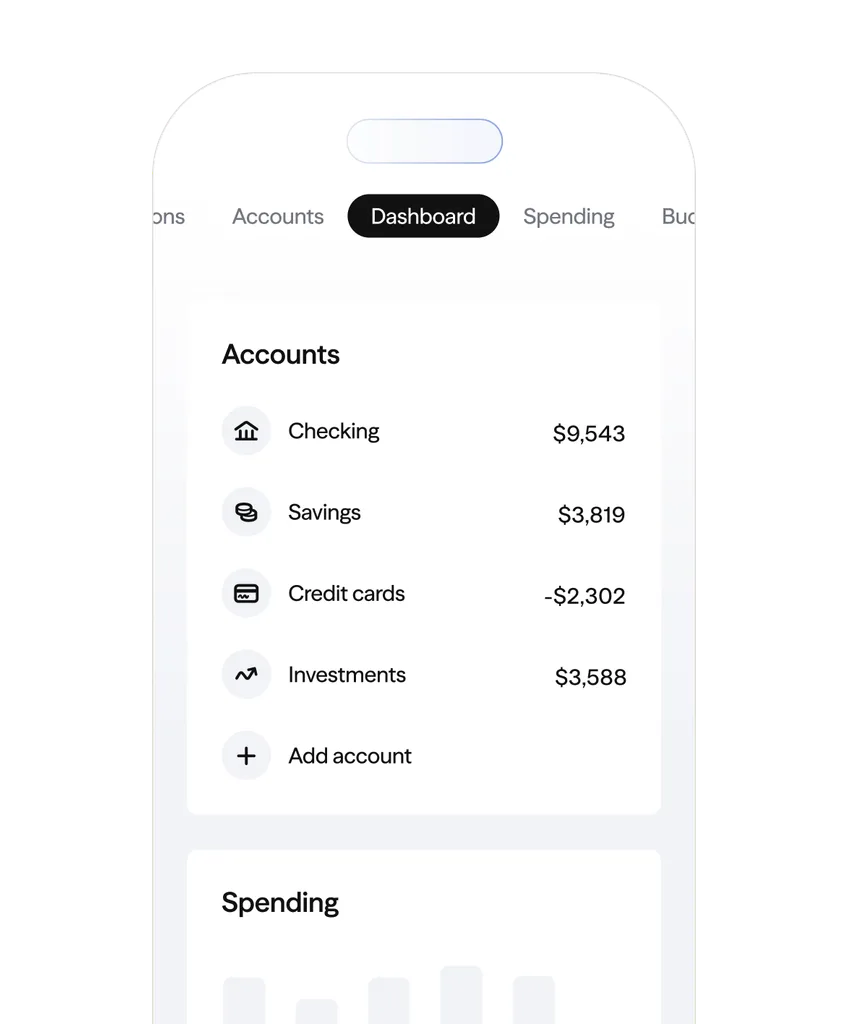
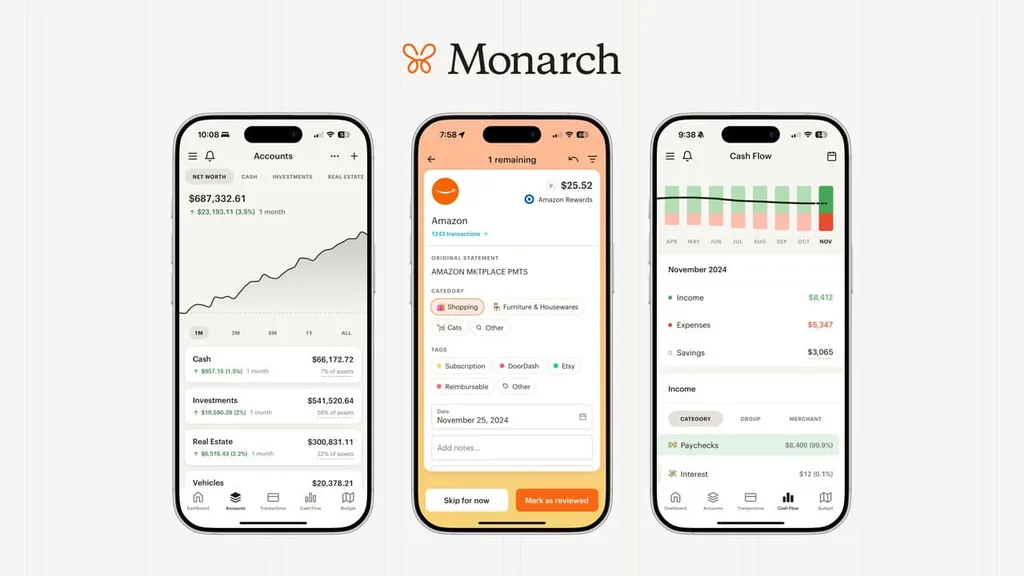
Monarch Money is the premium dashboard for people who want every account in one place with a clean interface and an AI assistant that summarizes it all. The Core plan costs $99.99 per year (or $14.99 monthly) and includes the AI assistant, unlimited accounts, and household sharing for couples. A Plus plan ($199/year) adds advanced forecasting and Morningstar data. It connects to 11,000+ financial institutions, tracks net worth, budgets, investments, and subscriptions, and sends a weekly AI recap of what changed and what needs attention. There is no permanent free tier, but a 7-day trial is standard.
Monarch does not custody money or give fiduciary investment advice — it is aggregation plus AI insights. It is the right pick if you already invest through a broker and want a clearer, AI-assisted view of your whole financial life. Its AI assistant is strong at answering “where did my money go?” questions across all your accounts.
Key details:
- Price: Core $99.99/yr or $14.99/mo; Plus $199/yr.
- AI: Weekly AI recap, conversational assistant across all linked accounts.
- Pros: Best-in-class interface, couples support, subscription tracking, no custody risk.
- Cons: No investing or tax execution, no free tier, subscription cost for what some apps do free.
7. Composer — Best AI Strategy Builder (More Intermediate)
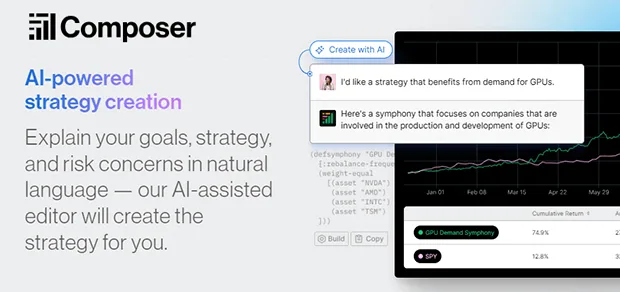
Composer, founded in Toronto in 2020 and backed by $16.7 million in venture funding, lets you describe an investing idea in plain English — “a portfolio that shifts toward bonds when volatility spikes” — and its AI converts it into a rules-based strategy you can backtest against 10+ years of history before funding. Once live, it rebalances automatically. A free tier offers pre-built strategies; the Trading Pass runs around $19–24/month billed annually (about $30 monthly), with a 14-day trial. It requires $50 to start and is regulated by SEC/FINRA with SIPC protection.
Composer is the most advanced tool on this list. It is not for a brand-new beginner — you should understand a strategy’s logic before funding it. But for someone who has outgrown basic index funds and wants algorithmic, AI-assisted investing without coding, it is the best on-ramp.
Key details:
- Price: Free tier; Trading Pass ~$19–24/mo (annual billing).
- AI: Plain-English to executable strategy, 10+ year backtesting, auto-rebalancing.
- Pros: No coding needed, real backtesting, regulated brokerage, community strategies.
- Cons: More intermediate, monthly fee, strategy risk still falls on you.
Honorable mentions: Walnut (connects to the broker you already have; $56M raised), Q.ai (AI investment kits from $100), Finelo (AI lessons and simulation), and Vera (AI money coaching). Farther is worth watching if your net worth climbs into six or seven figures — it is a hybrid human-AI wealth manager (RIA) that pairs dedicated human advisors with an AI platform, and it raised $150M at a $1B valuation in May 2026. Established names like Wealthfront and Betterment are not startups, but they remain solid hands-off options.
How These Startups Make Money (So You Know the Incentives)
Understanding the business model tells you whose interests the AI serves. There are three common models:
- Subscription (Origin, Monarch, Albert, Cleo, Magnifi premium). You pay a flat monthly or annual fee. This is the cleanest model — the company’s revenue comes from you, not from selling your data or steering you into products.
- Assets under management (Magnifi managed portfolios, many robo-advisors). The company takes a percentage of your invested balance. This aligns them with your growth, but it also gives them an incentive to keep more of your money invested with them.
- Freemium + add-ons (PortfolioPilot, Composer, Albert). Free tier hooks you; paid tiers unlock recommendations, tax tools, or human access. Watch for teaser free tiers that charge for the features you actually need.
The cleanest choice for most people is a flat subscription with no AUM fee, because it removes the incentive to push you into investments that pay the platform more.
What the AI Can — and Can’t — Do
It is important to set expectations. Here is what these startups’ AI actually delivers, and what it does not:
- What it does well: Aggregate all your accounts, spot hidden fees and subscriptions, model “what if” scenarios, rebalance portfolios, suggest tax-loss harvesting, and answer basic planning questions instantly and cheaply.
- What it does not do: Guarantee returns, predict the market, or replace a human for complex situations — estate planning, stock options, small-business taxes, divorce, or portfolios above seven figures. As noted, AI matches human advisors for most households under $500,000, but hybrid human-AI advice wins above $1 million.
The market still goes down in bad years. The AI manages the process and removes human mistakes like panic-selling; it cannot eliminate market risk.
How to Choose the Right Startup for You
Match your situation to the pick:
- You want one app for your whole financial life. Choose Origin. Its $99/yr bundles more than any competitor.
- You already invest and want a second opinion. Start with PortfolioPilot’s free tier.
- You want to text a real human your money questions. Choose Albert Genius.
- You find budgeting stressful and need a nudge. Choose Cleo — its personality actually gets people to save.
- You want to learn investing by asking questions. Start with Magnifi’s free tier.
- You want a clean dashboard for you and a partner. Choose Monarch Money.
- You’re ready for algorithmic strategies. Choose Composer, but start small.
If retirement is your main goal, open a Roth IRA at any low-cost broker and run a retirement calculator to set your monthly target before you pay for an advisor subscription.
Stay Safe: Fiduciaries, Red Flags, and When to Call a Human
Legitimate AI advisor startups are regulated. If they give investment advice, they (or a partner) must be registered with the SEC or a state securities regulator as an RIA. If they hold your money, they must be a broker-dealer with SIPC insurance. Before you link any account, check three things:
- The firm is registered. Look it up on the SEC’s Investment Adviser Public Disclosure or FINRA BrokerCheck. FINRA’s free investing basics hub explains how brokerage and advisory accounts work.
- Returns are never guaranteed. Any startup or influencer promising “guaranteed 20% monthly returns” is running a scam. The market does not work that way.
- You can withdraw easily. Reputable apps let you unlink accounts and withdraw cash within days. If withdrawal is complicated, walk away.
When your portfolio grows into six figures, or your taxes get complex, consider a fiduciary financial advisor who can build a plan around your full life. The AI handles the routine; the human handles the exceptions.
Frequently Asked Questions
What is the best AI financial advisor startup in 2026?
For most households, Origin is the best overall pick because it bundles budgeting, investing, tax, and estate planning for $99/year with SEC-regulated AI. PortfolioPilot is best if you already invest and want a free AI audit. Albert is best if you want human-reviewed answers by text.
Are AI financial advisor startups safe?
Yes, when they are registered investment advisers or partner with one, and when any money they hold is at an SIPC-protected broker. Verify the firm on SEC or FINRA databases before linking accounts. Avoid any app promising guaranteed high returns.
How much does an AI financial advisor cost?
Most cost $5–$15 per month, or $50–$150 per year. That is a fraction of a human advisor, who typically charges 1% of assets annually (about $1,000 a year on a $100,000 portfolio) or $200–$400 per hour.
Can AI really replace a human financial advisor?
For routine questions and households under $500,000, AI matches human advisor performance at a tiny fraction of the cost. For complex situations — stock options, small-business taxes, estate planning, or portfolios above $1 million — a human fiduciary still wins. Many people use both.
Do these startups manage my money or just give advice?
It varies. Origin and Albert can manage investments. PortfolioPilot, Monarch, and Magnifi’s free tier are read-only advisors that recommend but don’t custody. Composer executes trades you design. Check the model before signing up.
What happens if a startup shuts down?
If the startup only gives advice (read-only), you lose the tool but keep your money at your existing broker. If it holds your money, the assets sit at an SIPC-protected custodian and are transferable. Still, prefer startups with real funding and tens of thousands of users.
Are AI financial advisors fiduciaries?
Only if they (or a partner) are registered investment advisers. Broker-dealers operate under a weaker “best interest” standard. Check the registration before you trust the advice. Origin and PortfolioPilot, for example, operate under RIA oversight; pure chatbots like Cleo’s free tier do not give fiduciary investment advice.
Should I use an AI advisor or just invest in index funds myself?
If you are disciplined enough to buy low-cost index funds monthly and never panic-sell, you may not need an AI advisor at all. Most people benefit from the automation and second opinion. Start with a free tier (PortfolioPilot or Magnifi) and upgrade only if you find real value.
Final Verdict: Which AI Financial Advisor Startup Should You Pick?
You cannot go wrong with the top three, so choose based on where you are today:
- Origin if you want one subscription to plan your whole financial life.
- PortfolioPilot if you already invest and want a free AI audit.
- Albert if you’d rather text a question than open a spreadsheet.
Start with a free or low-cost tier, link your accounts, and let the AI surface insights for a month before paying for a premium plan. The best financial technology is the kind you actually use. Keep contributing, automate the boring parts, and let compounding carry you toward real financial independence.


Leave a Reply