
In this article
- Key Takeaways
- What Is RSP?
- What Is SPY?
- RSP vs SPY: What Is the Main Difference?
- How Does RSP's Equal-Weight Strategy Work?
- How Does SPY's Market-Cap Weighting Work?
- RSP vs SPY: 20-Year Returns
- Why Can SPY Outperform RSP?
- Why Can RSP Outperform SPY?
- RSP vs SPY: Diversification
- RSP vs SPY: Mega-Cap Exposure
- RSP vs SPY: Fees and Expenses
- RSP vs SPY vs VOO vs IVV
- RSP vs SPY: Which Has Better Diversification?
- Advantages of RSP
- Disadvantages of RSP
- Advantages of SPY
- Disadvantages of SPY
- Which Is Better: RSP or SPY?
- RSP vs SPY for Long-Term Investors
- What Should Investors Compare Before Choosing?
- Frequently Asked Questions About RSP vs SPY
- Final Thoughts
When comparing S&P 500 exchange-traded funds (ETFs), RSP vs SPY is an important comparison to understand. Both ETFs give investors exposure to companies in the S&P 500, but they use different weighting methods that can lead to very different portfolio results.
SPY follows the traditional market-cap-weighted S&P 500. RSP, on the other hand, uses an equal-weight approach. In simple terms, SPY gives larger companies more influence, while RSP gives the companies much more similar weights.
That difference can affect returns, diversification, volatility, sector exposure, and how strongly mega-cap companies influence your investment. Understanding these differences is more useful than simply asking which ETF performed better in a particular year.
Key Takeaways
- RSP is the Invesco S&P 500 Equal Weight ETF.
- SPY is the SPDR S&P 500 ETF Trust.
- Both ETFs provide exposure to companies in the S&P 500, but they weight those companies differently.
- RSP uses an equal-weight methodology, so individual companies have much more similar portfolio weights.
- SPY uses market-cap weighting, so the largest companies have a much greater influence on performance.
- SPY can benefit when mega-cap companies lead the market.
- RSP can benefit when market performance becomes broader and companies outside the largest stocks perform strongly.
- Equal weighting does not automatically mean lower risk or higher returns.
- Historical performance between RSP and SPY can change depending on the market environment.
- Investors should compare fees, performance, volatility, concentration, liquidity, and investment goals before choosing between them.
What Is RSP?
RSP is the ticker symbol for the Invesco S&P 500 Equal Weight ETF. The fund provides exposure to the companies included in the S&P 500 but uses an equal-weight methodology rather than traditional market-cap weighting.
The idea behind RSP is straightforward. Instead of allowing the largest companies to dominate the portfolio, the fund gives each S&P 500 constituent a much more similar weight.
This creates a different type of S&P 500 exposure. You still own a broad group of large U.S. companies, but the largest companies do not have the same level of influence they have in a traditional S&P 500 ETF.
RSP therefore appeals to investors who want to reduce concentration in the biggest companies while maintaining exposure to the broader S&P 500 universe.
What Is SPY?
SPY is the ticker symbol for the SPDR S&P 500 ETF Trust. It is designed to track the S&P 500 Index using the traditional market-cap-weighted approach.
Market-cap weighting means that companies with larger market values receive larger weights in the index. As a result, the biggest companies can have a substantial effect on the overall performance of SPY.
For example, if several of the largest technology companies experience strong growth, their large weights can make a meaningful contribution to SPY’s overall return.
SPY has also become one of the most widely recognized and heavily traded ETFs. Its liquidity makes it popular among long-term investors as well as traders who use ETFs and options.
RSP vs SPY: What Is the Main Difference?

The biggest difference between RSP and SPY is how they weight the companies in the S&P 500.
RSP uses an equal-weight methodology. SPY follows the market-cap-weighted S&P 500.
That distinction is important because the two ETFs can hold the same companies but give those companies very different levels of influence.
| Feature | RSP | SPY |
|---|---|---|
| Full name | Invesco S&P 500 Equal Weight ETF | SPDR S&P 500 ETF Trust |
| Weighting | Equal weight | Market-cap weight |
| S&P 500 exposure | Yes | Yes |
| Mega-cap influence | Lower | Higher |
| Individual company concentration | Lower | Higher |
| Main strategy | Balanced company weighting | Traditional S&P 500 weighting |
| Trading profile | ETF investment exposure | Highly liquid ETF and trading vehicle |
The key takeaway is simple:
RSP changes the weighting, not the basic universe of companies.
How Does RSP’s Equal-Weight Strategy Work?
To understand RSP, imagine the S&P 500 as a classroom containing 500 students.
With an equal-weight strategy, each student receives roughly the same amount of influence. A very large company does not automatically receive a dramatically larger position simply because its market capitalization is greater.
RSP periodically adjusts its portfolio to maintain its equal-weight structure. This means the fund does not simply allow successful companies to become increasingly dominant.
The result is a portfolio where companies outside the largest mega-cap names have greater relative influence than they would in a market-cap-weighted S&P 500 fund.
This can be useful when market leadership broadens across many companies.
However, it can also work against RSP when the largest companies are responsible for most of the market’s gains.
How Does SPY’s Market-Cap Weighting Work?
SPY follows the traditional market-cap-weighted S&P 500 methodology.
Under this approach, a company’s weight is related to its size in the market. The larger the company becomes relative to other S&P 500 companies, the larger its influence can become within the index.
This creates an important characteristic: winners can become bigger positions automatically.
If a mega-cap company grows rapidly, its weight can increase. If it falls in value, its weight can decrease relative to other companies.
Investors who choose SPY therefore accept the natural concentration that comes with market-cap weighting.
This has been particularly important during periods when a relatively small group of large technology companies has driven a significant portion of the market’s gains.
RSP vs SPY: 20-Year Returns

Historical performance is one of the most searched topics when people compare RSP vs SPY.
The important point is that long-term returns can differ even though both ETFs are linked to the S&P 500. The reason is the difference in weighting.
When the biggest companies outperform the broader market, SPY receives more benefit from those gains because those companies have larger weights.
When performance becomes more evenly distributed across S&P 500 companies, RSP can become more competitive because companies outside the largest names have greater relative weights.
Historical comparisons therefore depend heavily on the exact start date, end date, dividend reinvestment assumptions, and whether the calculation uses price return or total return.
For that reason, investors should avoid using one historical number as proof that either RSP or SPY will always outperform.
The broader lesson is more important: weighting methodology can have a major impact on long-term investment results.
Why Can SPY Outperform RSP?
SPY can outperform RSP when the largest companies drive a large share of market returns.
Imagine that the biggest technology companies rise sharply while many other S&P 500 companies produce only modest returns. SPY will generally benefit more from that environment because the strongest mega-cap companies already have large portfolio weights.
RSP does not give those companies the same level of dominance.
This became particularly relevant during periods when investors strongly favored large technology and AI-related companies.
A market dominated by a handful of mega-cap winners can therefore create an environment that favors market-cap-weighted strategies.
That does not mean SPY is always better. It simply explains why its weighting structure can be advantageous during certain market cycles.
Why Can RSP Outperform SPY?
RSP can outperform when market gains become broader.
Suppose large technology companies stop leading the market while financial, industrial, healthcare, consumer, energy, and other S&P 500 companies begin performing strongly.
In that situation, RSP can benefit because it gives those companies a larger relative position than they would receive in a market-cap-weighted ETF.
Equal weighting can therefore work well during periods of strong market breadth.
Recent market movements have shown that leadership can change. When more stocks participate in an advance, equal-weight strategies can sometimes close the performance gap or move ahead of traditional cap-weighted indexes.
This is why investors should look at market conditions rather than assuming that one weighting method will always win.
RSP vs SPY: Diversification
RSP and SPY are both diversified compared with investing in only a few individual stocks.
However, they are diversified in different ways.
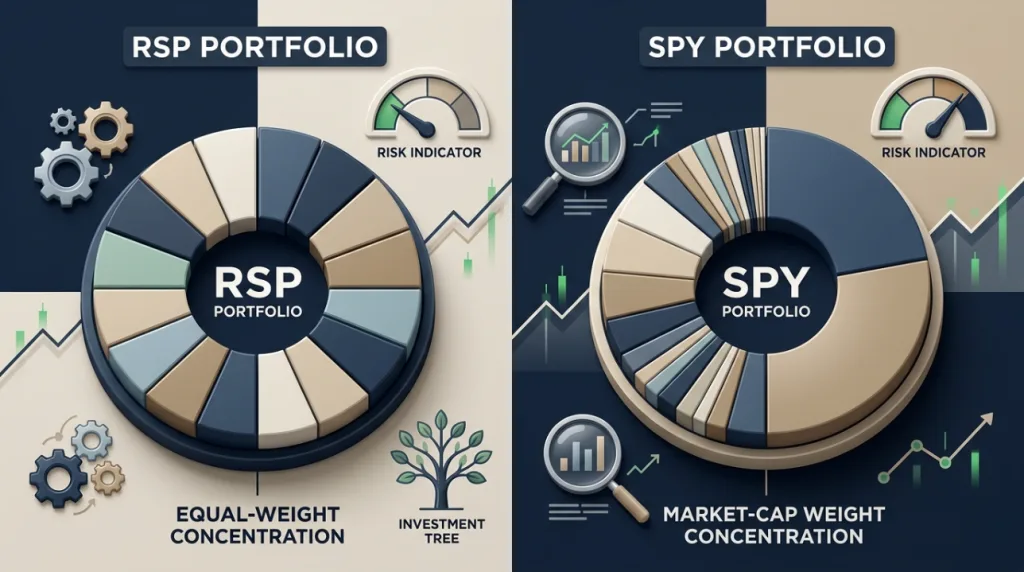
SPY spreads exposure across the S&P 500 but gives the largest companies substantially more influence. RSP spreads individual company weights more evenly.
Therefore, RSP can be described as more balanced by individual company weight.
That does not mean RSP is automatically safer.
An equal-weight fund may have higher exposure to companies that are smaller within the S&P 500, and historical volatility can vary between the two strategies.
Investors should therefore avoid confusing equal weighting with lower overall investment risk.
RSP vs SPY: Mega-Cap Exposure

Mega-cap exposure is one of the clearest differences between these ETFs.
In SPY, the largest companies can account for a significant portion of the portfolio. Their performance can therefore strongly affect the ETF.
RSP reduces this concentration because it does not allow the largest companies to dominate the portfolio to the same extent.
This can be attractive for investors who believe that the market has become too dependent on a small group of companies.
On the other hand, investors who want strong exposure to the biggest and most successful companies may prefer the traditional structure of SPY.
RSP vs SPY: Fees and Expenses
Expense ratios are another factor investors should consider.
An ETF’s expense ratio represents the annual operating expenses charged by the fund. Even a relatively small fee difference can matter over a long investment period because fees reduce the amount of money that remains invested.
However, investors should not compare RSP and SPY solely on fees.
They have different investment strategies, so the relevant question is not simply which fund costs less. Investors should ask whether the strategy justifies the cost and whether it fits their portfolio.
For traditional S&P 500 exposure, VOO and IVV are also worth comparing because they generally have lower expense ratios than SPY.
ETF.com has compared VOO, SPY, and IVV in terms of expenses, liquidity, and structure, making it a useful reference when evaluating traditional S&P 500 ETFs.
RSP vs SPY vs VOO vs IVV
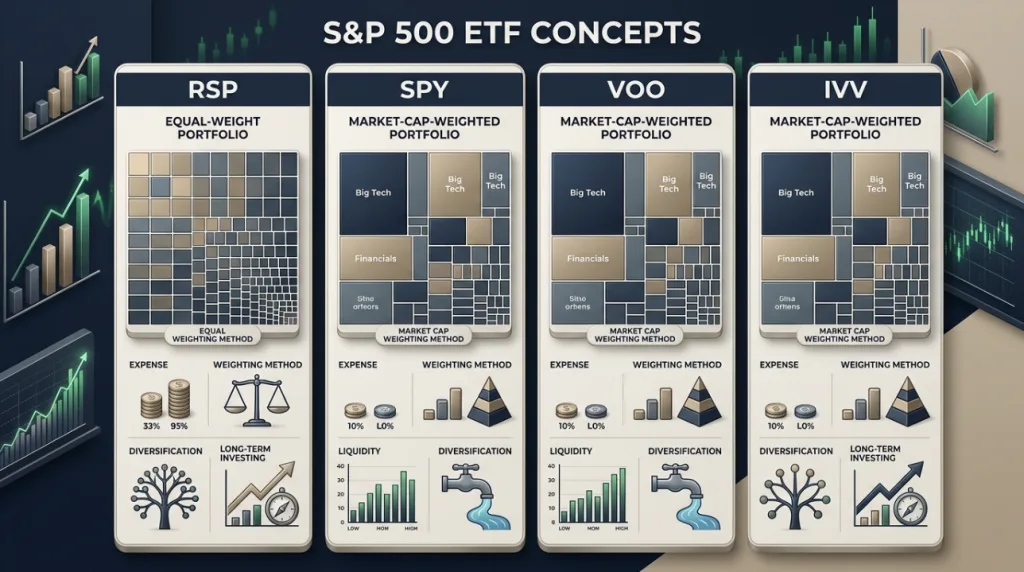
Once investors start researching RSP and SPY, they will often encounter VOO and IVV.
The main distinction is that RSP uses equal weighting, while SPY, VOO, and IVV use traditional market-cap-weighted S&P 500 exposure.
That means RSP is not simply another version of SPY with a different provider. It uses a different portfolio construction method.
SPY, VOO, and IVV are much closer substitutes because they all seek to provide traditional S&P 500 exposure.
| ETF | Weighting Method | Main Difference |
|---|---|---|
| RSP | Equal weight | More balanced individual company weights |
| SPY | Market cap | High liquidity and traditional S&P 500 exposure |
| VOO | Market cap | Low-cost traditional S&P 500 exposure |
| IVV | Market cap | Low-cost traditional S&P 500 exposure |
ETF.com and Investing.com both provide useful comparisons of SPY, VOO, and IVV for investors evaluating traditional S&P 500 ETFs.
RSP vs SPY: Which Has Better Diversification?
The answer depends on what you mean by diversification.
If you mean more balanced individual company weights, RSP has the advantage.
If you mean owning a broad collection of large U.S. companies, both ETFs provide broad S&P 500 exposure.
Neither fund provides diversification across completely different asset classes.
For example, neither RSP nor SPY is designed to provide a dedicated bond portfolio or international stock exposure.
The main difference is therefore concentration within the S&P 500 rather than the overall asset allocation of an investor’s portfolio.
Advantages of RSP
1. More Balanced Company Weights
RSP reduces the influence of the largest companies by using an equal-weight methodology.
This can make the portfolio less dependent on a handful of mega-cap stocks.
2. Broader Participation
When many S&P 500 companies perform well, RSP can benefit from its broader individual-company weighting.
This can be particularly useful when market leadership expands beyond the largest stocks.
3. Different Return Profile
RSP can behave differently from traditional market-cap-weighted S&P 500 ETFs.
That difference may be useful for investors who want an alternative approach to large-cap U.S. equities.
Disadvantages of RSP
1. Less Benefit From Mega-Cap Winners
If the biggest companies dramatically outperform the rest of the S&P 500, RSP may lag because it does not give those companies very large weights.
2. Regular Rebalancing
The equal-weight structure requires periodic rebalancing to maintain the intended weights.
3. Equal Weight Does Not Mean Low Risk
RSP should not be considered automatically safer just because its company weights are more balanced.
Market conditions can cause its volatility to differ from SPY.
Advantages of SPY
1. Traditional S&P 500 Exposure
SPY provides exposure to the traditional market-cap-weighted S&P 500.
This makes its strategy easy for investors to understand.
2. Strong Mega-Cap Exposure
When the largest companies lead the market, SPY can benefit significantly from their large index weights.
3. High Liquidity
SPY is one of the most established and actively traded ETFs.
Its liquidity can be particularly relevant for traders and investors who use options or make frequent transactions.
Disadvantages of SPY
1. Greater Mega-Cap Concentration
The largest companies can have a significant influence on SPY’s performance.
Investors who want more balanced individual company exposure may prefer an equal-weight strategy.
2. Higher Cost Than Some Alternatives
SPY’s expense ratio is higher than some competing traditional S&P 500 ETFs.
VOO and IVV are commonly considered by investors looking for lower-cost traditional S&P 500 exposure.
3. Less Equal Exposure
SPY does not give each S&P 500 company a similar portfolio weight.
Instead, the largest companies receive the greatest influence.
Which Is Better: RSP or SPY?
There is no universal winner in the RSP vs SPY comparison.
The better option depends on what you want from your investment.
RSP may be more appealing if you want a more balanced weighting across S&P 500 companies and want to reduce dependence on mega-cap stocks.
SPY may be more appealing if you want traditional market-cap-weighted S&P 500 exposure and value its liquidity and established trading ecosystem.
Neither strategy guarantees higher returns.
Market leadership changes over time, so an ETF that performs well during one market cycle may lag during another.
RSP vs SPY for Long-Term Investors
Long-term investors should focus on the investment strategy rather than chasing the latest performance number.
If your goal is to own the S&P 500 using the traditional market-cap approach, SPY is one established option. However, VOO and IVV may also deserve consideration because they provide similar traditional S&P 500 exposure with lower expenses.
If you specifically want an equal-weight approach, RSP offers a meaningful difference rather than simply another version of the same cap-weighted strategy.
The decision should also consider your existing portfolio.
For example, an investor already heavily exposed to mega-cap technology stocks may view RSP differently from an investor whose portfolio has little exposure to those companies.
What Should Investors Compare Before Choosing?
Before selecting RSP or SPY, consider these factors:
Investment Strategy
Understand whether you prefer equal weighting or market-cap weighting.
Historical Performance
Look at multiple periods instead of focusing on a single year.
Expense Ratio
Compare annual fund expenses because costs can compound over time.
Volatility
Check how much the ETF has historically fluctuated during different market conditions.
Concentration
Determine how much influence the largest companies have on the portfolio.
Liquidity
Liquidity can matter if you trade frequently or use options.
Investment Goal
Choose the structure that fits your long-term portfolio rather than simply choosing the recent winner.
Frequently Asked Questions About RSP vs SPY
Is RSP the same as SPY?
No. Both provide exposure to S&P 500 companies, but they use different weighting methods. RSP uses equal weighting, while SPY follows the traditional market-cap-weighted S&P 500.
Is RSP more diversified than SPY?
RSP provides more balanced exposure by individual company weight. However, both funds invest in the broad S&P 500 universe, so RSP should not automatically be considered a lower-risk investment.
Why does SPY sometimes outperform RSP?
SPY can outperform when the largest S&P 500 companies generate stronger returns than the broader market because those companies have larger weights in SPY.
Why does RSP sometimes outperform SPY?
RSP can outperform when market gains become broader and companies outside the largest mega-cap stocks perform strongly.
Which ETF has more mega-cap exposure?
SPY generally has greater exposure to the largest S&P 500 companies because it uses market-cap weighting.
Is RSP safer than SPY?
Not necessarily. RSP reduces individual-company concentration, but equal weighting does not guarantee lower volatility or lower investment risk.
Should I choose RSP or SPY for long-term investing?
The answer depends on your goals. RSP may suit investors who want equal-weight exposure, while SPY may suit investors who want traditional market-cap-weighted S&P 500 exposure.
Are VOO and IVV alternatives to SPY?
Yes. VOO and IVV are both traditional market-cap-weighted S&P 500 ETFs and are often compared with SPY because they provide similar broad index exposure.
Final Thoughts
The RSP vs SPY comparison is really a comparison between two different ways of investing in the S&P 500.
RSP uses an equal-weight approach that gives companies much more similar influence. SPY uses market-cap weighting, allowing the largest companies to have a much greater effect on the portfolio.
That difference can produce meaningful performance differences over time.
SPY may benefit when mega-cap companies lead the market, while RSP may benefit when market performance becomes broader and more evenly distributed across S&P 500 companies.
For investors, the most important lesson is not that one ETF is always better. Instead, it is that the way an index weights its holdings can significantly influence returns, concentration, and portfolio behavior.
Before choosing between RSP and SPY, compare their methodology, costs, historical performance, volatility, liquidity, and how each fund fits into your overall investment strategy.



Leave a Reply