
In this article
- 📌 Key Takeaways (Read This First)
- What Is a Reverse Mortgage? (Definition + Simple Analogy)
- How Does a Reverse Mortgage Work? (Step-by-Step)
- The Three Types of Reverse Mortgages Explained
- Who Qualifies for a Reverse Mortgage in 2026?
- How Much Money Can You Actually Borrow?
- The Five Payout Options — Choose Your Cash Flow
- What Does a Reverse Mortgage Cost? The Real Numbers
- What Is a LESA (Life Expectancy Set Aside)?
- Non-Borrowing Spouse Protections: Critical Rules
- Reverse Mortgage vs. HELOC vs. Home Equity Loan
- HECM for Purchase: Using a Reverse Mortgage to Buy a Home
- The Pros and Cons — An Honest Balance Sheet
- Common Reverse Mortgage Myths — Busted
- Reverse Mortgage Scams: How to Protect Yourself
- When Does a Reverse Mortgage Become Due?
- How to Shop for a Reverse Mortgage (Smart Buyer’s Checklist)
- Real-Life Scenarios: When It Works, When It Doesn’t
- Alternatives to Consider Before Committing
- Tax, Estate, and Benefit Considerations
- 2026 Regulatory Snapshot
- Who Should — and Shouldn’t — Consider a Reverse Mortgage?
- Author’s Perspective: When It Genuinely Makes Sense
- Frequently Asked Questions
- Bottom Line
Retirement was supposed to feel like exhaling. Instead, for millions of Americans over 62, it feels like holding your breath at the bottom of the checkbook. Social Security barely keeps pace with groceries, medications creep upward every year, and yet — sitting quietly beneath the roof — there’s often a small fortune in home equity that nobody’s touching.
That’s the puzzle a reverse mortgage tries to solve.
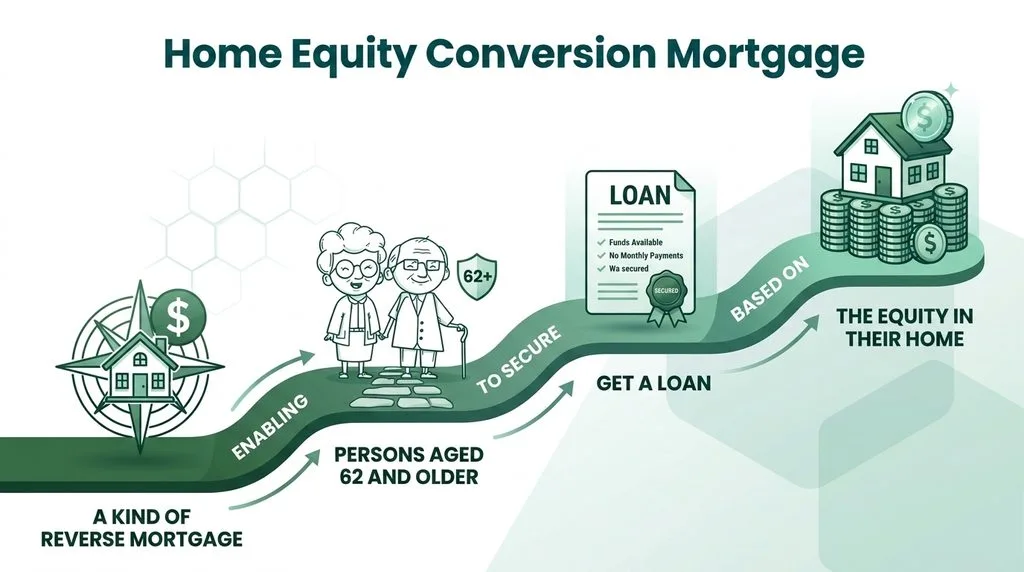
Quick answer: A reverse mortgage is a loan that lets homeowners aged 62 or older borrow against their home equity without making monthly mortgage payments. The lender pays you (as cash, monthly income, or a line of credit), interest quietly accrues on the balance, and the loan is repaid when you sell, move out for more than 12 months, or pass away. The most common version, the Home Equity Conversion Mortgage (HECM), is federally insured by the FHA.
Now here’s the part most articles gloss over — a reverse mortgage isn’t inherently good or bad. It’s a specialized retirement tool, and how well it works depends almost entirely on who uses it, when, and why. Let’s break it down properly, in plain English, using current 2026 numbers.
📌 Key Takeaways (Read This First)
- Minimum age: 62 for HECMs (some private jumbo programs allow 55+).
- 2026 HECM loan limit: $1,249,125, per the FHA announcement from HUD.
- You still own the home. The title remains in your name.
- No monthly mortgage payments are required — but taxes, insurance, and upkeep are.
- The balance grows as interest and fees accrue (opposite of a regular mortgage).
- Non-recourse protection: You or your heirs never owe more than the home’s value.
- Senior home equity hit a record $14.92 trillion in Q1 2026, per NRMLA data.
- Foreclosure risk is real — usually triggered by unpaid property taxes or insurance.
- You have 3 business days to cancel after closing, with no penalty.
What Is a Reverse Mortgage? (Definition + Simple Analogy)
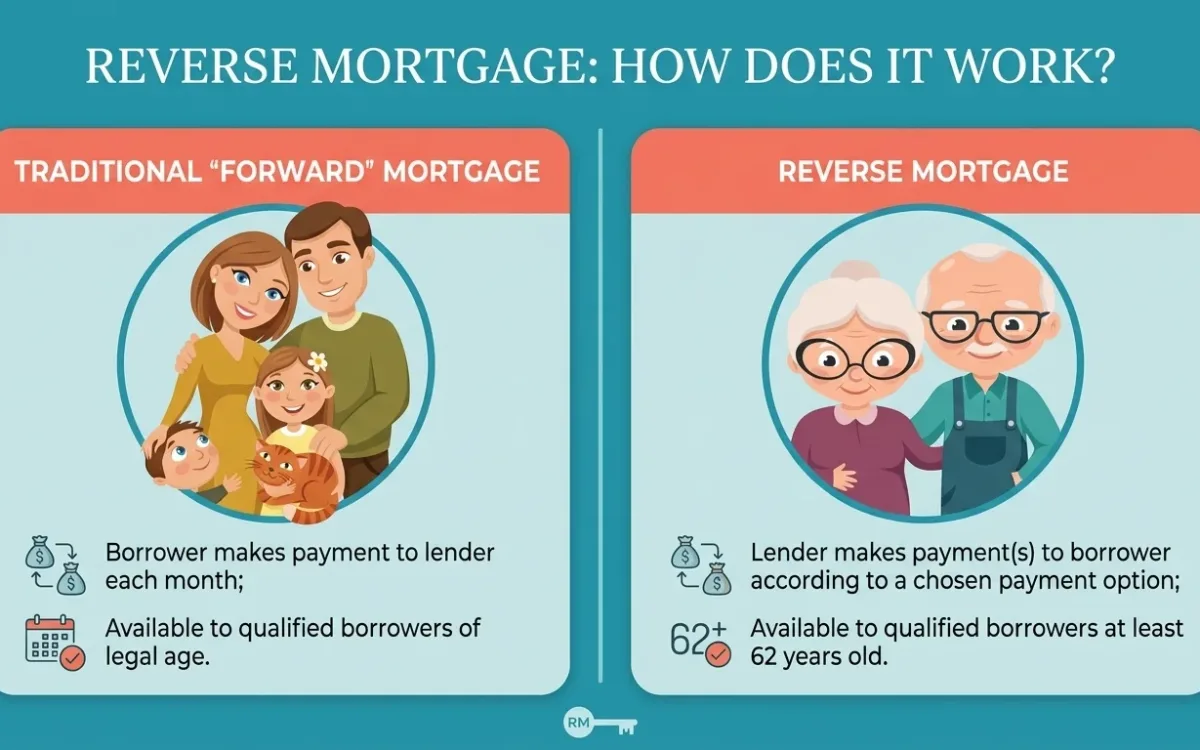
A reverse mortgage is a home equity loan for senior homeowners that flips the traditional mortgage on its head. Rather than you paying the lender, the lender pays you — as a lump sum, monthly deposits, a line of credit, or some mix of the three.
Here’s the simplest analogy: think of your home equity as a locked room full of cash you’ve been saving your whole life. A reverse mortgage hands you a key without forcing you to move out. You can walk in, take some money whenever you like, and keep living in the house. Eventually — when you leave the room for good — whatever’s left gets settled up.
The most common variety is the HECM (Home Equity Conversion Mortgage). According to the Consumer Financial Protection Bureau, HECMs are federally insured, regulated by HUD, and account for the overwhelming majority of reverse mortgages issued in the United States.
Two important truths often left unsaid:
- A reverse mortgage is not free money. It’s a loan with real interest, real fees, and a real balance that grows every month.
- You are still the homeowner. The bank does not take title; it simply places a lien, just like any other mortgage lender.
How Does a Reverse Mortgage Work? (Step-by-Step)
A reverse mortgage is a rising-balance loan. A traditional mortgage starts big and shrinks with every payment. A reverse mortgage starts small and grows because interest is added — not paid down — each month.
Here’s the full lifecycle from application to payoff:
- You attend HUD-approved counseling. Federal law requires a certified counselor to walk you through the mechanics, risks, and alternatives before any lender can take your application.
- The lender pulls credit and orders an appraisal. Your home’s market value determines the “maximum claim amount” that flows into the borrowing formula.
- The lender runs a financial assessment. Underwriting confirms you can realistically keep paying property taxes, homeowners insurance, HOA dues, and basic upkeep.
- You choose a payout structure. Options include lump sum, term payments, tenure payments (paid as long as you live in the home), a growing line of credit, or a hybrid.
- You sign and close. A 3-business-day right of rescission gives you a window to cancel with no penalty.
- The lender disburses funds. Any existing mortgage is paid off first; the remainder is yours.
- Interest and mortgage insurance accrue every month. Your loan balance rises, your remaining equity falls.
- You live in the home and meet all obligations. As long as you occupy the home as your primary residence, pay property charges, and keep it in good condition, the loan doesn’t become due.
- A “maturity event” ends the loan. Selling the home, moving out for more than 12 consecutive months, or the death of the last borrower triggers repayment.
- The loan is paid off. Usually via a home sale. Any surplus equity goes to you or your heirs; any shortfall is covered by FHA insurance thanks to the HECM’s non-recourse protection.
The Three Types of Reverse Mortgages Explained
Not every reverse mortgage is created equal. There are three distinct structures — each with different price tags, borrowing ceilings, and rulebooks.
1. HECM (Home Equity Conversion Mortgage) — The FHA Standard
The HECM is the federally insured, HUD-regulated flagship. When people talk about “the reverse mortgage,” this is almost always what they mean.
- 2026 max loan amount: $1,249,125
- Insurance: FHA-backed; heirs never owe more than the home is worth
- Payout options: Lump sum, term, tenure, line of credit, or combination
- Counseling required: Yes, with a HUD-approved counselor
- Ideal for: Most senior homeowners with primary residences valued at or below the FHA cap
2. Proprietary (Jumbo) Reverse Mortgages
These are private-lender products designed for high-value homes that exceed the HECM cap. If your home is worth $2M+, a jumbo may unlock significantly more equity.
- Loan amount: Often up to $4 million or more
- Insurance: Not FHA-insured; risk sits with the lender
- Minimum age: Sometimes as low as 55, depending on the lender
- Fees: No FHA MIP, but rates and origination fees can run higher
- Ideal for: Owners of luxury homes and younger applicants (55–61) shut out of HECMs
Notably, proprietary reverse mortgage production hit $953 million in Q1 2026, surpassing HECM volume for the first time — a signal that jumbo products are reshaping the market.
3. Single-Purpose Reverse Mortgages
Offered by some state agencies and nonprofits, these are the cheapest but most restrictive option.
- Use of funds: Limited to one specific purpose — usually property tax deferral or home repairs
- Cost: Very low fees and interest rates
- Availability: Not offered in every state
- Ideal for: Lower-income seniors with a single, defined need
Quick Comparison Table
| Feature | HECM | Proprietary (Jumbo) | Single-Purpose |
|---|---|---|---|
| Backed by | FHA/HUD | Private lender | State agency/nonprofit |
| Minimum age | 62 | Often 55–62 | Varies |
| 2026 loan ceiling | $1,249,125 | Up to ~$4M+ | Low (varies) |
| Use of proceeds | Any purpose | Any purpose | One approved use |
| MIP required | Yes | No | No |
| Non-recourse protection | Yes | Usually | Varies |
| Counseling required | Yes | Usually | Sometimes |
Who Qualifies for a Reverse Mortgage in 2026?
To qualify for a HECM in 2026, you must meet borrower, property, and financial criteria — and pass a federally required counseling session. HUD spells out the rulebook, and lenders don’t bend it.
Borrower Requirements
- Be at least 62 years old (all borrowers on title).
- Live in the home as your primary residence.
- Not be delinquent on any federal debt (taxes, student loans, etc.).
- Complete HUD-approved reverse mortgage counseling.
- Pass a financial assessment demonstrating you can afford ongoing property charges.
Property Requirements
Only certain property types qualify:
- Single-family homes (most common)
- HUD-approved condominiums
- 2-to-4-unit properties where you live in one unit
- Manufactured homes built after June 15, 1976, meeting FHA standards
- Townhouses and some planned unit developments (PUDs)
Ineligible property types typically include cooperatives, mobile homes without permanent foundations, and second homes or investment properties.
Financial Requirements
The FHA introduced financial assessment in 2015 to reduce defaults. Lenders now review:
- Credit history and payment patterns
- Current income and cash flow
- Ability to keep paying taxes, insurance, HOA dues, and maintenance
- Any existing liens or judgments against the property
If your financials are borderline, you may still qualify — but the lender will require a Life Expectancy Set Aside (LESA). More on that in a moment.

How Much Money Can You Actually Borrow?
The amount you can borrow — your principal limit — depends on four main variables:
- Age of the youngest borrower (older = more)
- Home value, capped at $1,249,125 in 2026
- Expected interest rate at closing (lower = more)
- Existing mortgage balance that must be paid off from proceeds
The FHA publishes Principal Limit Factors (PLFs) — a percentage of the home’s value that determines your borrowing base.
2026 Principal Limit Factors by Age (Approximate)
| Borrower’s age | Principal Limit Factor* | Example: $500K home |
|---|---|---|
| 62 | 35.1% | ~$175,500 |
| 65 | 37.2% | ~$186,000 |
| 70 | 40.9% | ~$204,500 |
| 75 | 43.8% | ~$219,000 |
| 80 | 48.2% | ~$241,000 |
| 85 | 54.4% | ~$272,000 |
| 90 | 61.4% | ~$307,000 |
*Assumes an expected rate of ~5.875%. Actual PLF varies with rates. Table adapted from published HUD PLF data on Reverse.mortgage.
Reality check: These figures are gross principal limits. After you subtract upfront costs (typically $10,000–$25,000), any existing mortgage payoff, and possibly a LESA, the cash actually landing in your bank account is meaningfully smaller.
Try a professional reverse mortgage calculator to see personalized numbers.
The Five Payout Options — Choose Your Cash Flow
Adjustable-rate HECMs offer serious flexibility. The fixed-rate HECM only permits a single lump-sum payout.
- Lump sum (fixed rate only): All money at closing. Simple, but interest starts on the full balance immediately.
- Term payments: Equal monthly deposits for a set number of years you choose.
- Tenure payments: Equal monthly deposits for as long as at least one borrower occupies the home.
- Line of credit: Draw funds when you need them. Unused portions actually grow each month.
- Modified term/tenure: Combines a line of credit with scheduled monthly payments.
The Line of Credit’s Hidden Superpower
The line of credit is arguably the most underappreciated feature in retirement finance. According to Longbridge Financial, the unused balance grows monthly at a rate equal to the current interest rate plus the 0.5% annual MIP.
Translation: if interest rates climb, your available credit climbs faster. Many financial planners recommend opening a HECM line of credit early in retirement — even before you need it — precisely because the unused portion compounds. Think of it as an insurance policy that pays more, the longer you leave it alone.
What Does a Reverse Mortgage Cost? The Real Numbers
A reverse mortgage is not cheap. According to the CFPB’s official cost guide, here’s what to budget.
Upfront Costs (Paid at Closing)
- Origination fee: 2% of the first $200,000 of home value + 1% of the amount above, capped at $6,000 total (minimum $2,500).
- Initial mortgage insurance premium (MIP): 2% of the lesser of your home’s appraised value or the FHA max claim amount.
- Third-party closing costs: $1,500–$4,000. Includes title insurance, appraisal, credit report, recording fees, flood certification.
- Counseling fee: $125–$200 (occasionally waived for low-income borrowers).
Ongoing Costs (Added to Loan Balance)
- Annual MIP: 0.5% of the outstanding loan balance, accruing monthly.
- Servicing fee: Up to $35/month (many lenders build it into the rate).
- Interest: Compounds monthly on the growing balance.
Sample Cost Snapshot — $500,000 Home
| Cost item | Estimated amount |
|---|---|
| Origination fee | $5,000 |
| Initial MIP (2% of appraised value) | $10,000 |
| Appraisal | $600 |
| Counseling | $150 |
| Title, recording, other | $2,500 |
| Total upfront costs (approx.) | ~$18,250 |
That’s the price tag before you receive a single dollar. Most borrowers roll these costs into the loan balance rather than paying out of pocket — which means interest starts accruing on those fees too.
Current 2026 Interest Rates
Rates change daily. As of mid-2026, HECM rates trend in these ranges:
- Fixed rate: ~7.68% (APR near 9.19%, including fees)
- Adjustable rate: ~5.50%–6.00% (with margins of 1.75%–2.50% over the 1-year CMT index)
Because interest compounds on a rising balance, even a 0.5% rate difference can mean tens of thousands over 15 years.
What Is a LESA (Life Expectancy Set Aside)?
Introduced in 2015 to protect borrowers and lenders, a LESA is a portion of your reverse mortgage proceeds carved out at closing to cover future property taxes and homeowners insurance.
Think of it as a mandatory escrow account funded by your own equity. It’s required if the lender’s financial assessment reveals you may struggle to keep paying property charges. Some borrowers voluntarily elect a LESA to guarantee peace of mind.
How it works:
- The lender calculates estimated taxes and insurance over your life expectancy, grossed up 20% for inflation.
- That amount is subtracted from your available loan proceeds.
- The lender pays taxes and insurance directly from the LESA when they come due.
- Any unused LESA at loan payoff simply reduces the final balance.
The tradeoff is straightforward: a LESA reduces your immediate cash but nearly eliminates the biggest cause of reverse mortgage foreclosure — unpaid taxes and insurance.
Non-Borrowing Spouse Protections: Critical Rules
Suppose one spouse is 65 and the other is only 58. Can they still get a HECM? Yes — with strict protections.
Under FHA rules, a spouse under 62 can be classified as an Eligible Non-Borrowing Spouse (NBS). If the borrowing spouse dies or moves out permanently, an Eligible NBS can trigger a deferral period and remain in the home without the loan becoming due — provided they:
- Were married to the borrower at the time of loan closing (or in a legally recognized committed relationship in some jurisdictions)
- Continued to occupy the home as a primary residence
- Keep paying property taxes, insurance, and maintenance
- Cure any default within 30 days of notice
Important caveats:
- The NBS does not receive any additional loan proceeds after the borrower’s death.
- If the NBS moves out or fails to comply, the loan becomes due.
- Ineligible NBS status (for example, someone who married the borrower after closing) does not qualify for deferral.
Reverse Mortgage vs. HELOC vs. Home Equity Loan
Reverse mortgages are one of several ways to tap home equity. Depending on your age, income, and time horizon, cheaper alternatives may serve you better. A second mortgage product could be preferable if you can comfortably manage monthly payments.
| Feature | Reverse Mortgage (HECM) | HELOC | Home Equity Loan |
|---|---|---|---|
| Minimum age | 62 | 18 | 18 |
| Monthly payments? | None while in home | Yes | Yes |
| Interest rate (2026 avg) | 5.5%–7.7% | ~8%–10% | ~7.5%–9% |
| Upfront costs | $10K–$25K+ | Low to $0 | Low to $0 |
| Repayment trigger | Death/move/sale | Ongoing monthly | Ongoing monthly |
| Income required? | Modest (LESA option) | Yes | Yes |
| Best for | Cash-flow-strapped retirees | Flexible short-term needs | Big one-time expenses |
If you’re 62+ with strong income and a plan to stay only a few years, a HELOC or refinance is usually cheaper. If you’re 65+ with tight monthly cash flow and plan to age in place, a HECM often wins on net cost over time.
HECM for Purchase: Using a Reverse Mortgage to Buy a Home
Yes — you can use a HECM to buy a new primary residence, not just tap equity in your current one. It’s called HECM for Purchase, and it’s especially popular with retirees who want to downsize or relocate.
Here’s how it works:
- You bring a large down payment — typically 45%–62% of the purchase price, depending on age and current rates
- The reverse mortgage funds the rest
- You never make monthly mortgage payments as long as you live in the home
- You must occupy the property within 60 days of closing
For someone selling a $700,000 home in a high-cost area and buying a $400,000 condo closer to family, HECM for Purchase can preserve retirement savings that would otherwise go to a cash purchase.
The tradeoff: all standard HECM costs, MIP, and rising interest apply. Run the numbers with a fiduciary financial advisor before committing.
The Pros and Cons — An Honest Balance Sheet
Both the FTC and AARP consistently note that reverse mortgages are neither villains nor heroes. They’re tools — powerful for the right situation, brutal for the wrong one.
✅ The Genuine Advantages
- No required monthly mortgage payments while you live in the home
- Tax-free proceeds — the IRS treats loan money as non-income
- Non-recourse protection — you and heirs never owe more than the home’s value
- Multiple payout options to match cash-flow needs
- Line-of-credit growth — unused credit compounds monthly
- You keep the title and can leave the home to heirs
- Federal insurance protects you if the lender goes bankrupt
- Flexibility to age in place with dignity and financial breathing room
❌ The Real Drawbacks
- Steep upfront costs — typically $10K–$25K
- Erodes home equity fast, especially with lump-sum draws
- Foreclosure risk if you miss property taxes, insurance, or maintenance
- Complicated for heirs — they have 6 months (extendable to 12) to settle
- Can affect Medicaid and SSI eligibility if proceeds sit as assets
- Vulnerable to scams — the industry has a well-documented history of predatory actors
- Long absence (12+ months) triggers repayment, even for medical stays
- Not portable — moving means the loan becomes due
Common Reverse Mortgage Myths — Busted
Myths about reverse mortgages die hard. Let’s stake a few of them properly.
❌ Myth 1: “The bank takes your house.”
Fact: You keep the title. The lender only holds a lien, exactly like any traditional mortgage. When the loan matures, your heirs decide how to settle it — usually by selling the home.
❌ Myth 2: “You can’t leave your home to your heirs.”
Fact: You absolutely can. Heirs inherit the home and choose whether to pay off the loan (usually by refinancing or selling). Any equity left after repayment goes to them.
❌ Myth 3: “You could end up owing more than your house is worth.”
Fact: Not with a HECM. Non-recourse protection means neither you nor your heirs are personally liable for a shortfall. FHA insurance covers the gap.
❌ Myth 4: “Reverse mortgages are only for desperate people.”
Fact: Increasingly, financial planners recommend HECMs as strategic retirement tools. Opening a line of credit early — before it’s needed — is a defensive move against sequence-of-returns risk and rising costs.
❌ Myth 5: “You have to make monthly payments.”
Fact: No monthly mortgage payments are required. You do, however, have to keep paying property taxes, insurance, HOA dues, and maintenance.
❌ Myth 6: “Reverse mortgage income is taxable.”
Fact: Reverse mortgage proceeds are loan money, not income, so the IRS doesn’t tax them. However, they can affect need-based benefit programs like Medicaid or SSI if funds accumulate as assets month-to-month.
Reverse Mortgage Scams: How to Protect Yourself
The FTC has repeatedly warned that reverse mortgage fraud disproportionately targets older Americans. Here are the traps most commonly reported.
Red flag scenarios:
- Home-repair contractors who insist you need a reverse mortgage to fund “critical” repairs
- Fake VA offers — the Department of Veterans Affairs does not issue reverse mortgages, period
- Annuity or insurance cross-sells — being pushed to invest reverse mortgage proceeds into other products
- Rushed closings with same-day paperwork and no time to consult family
- Family coercion — sadly common, where relatives pressure elderly homeowners into borrowing so they can access the cash
How to protect yourself:
- Never sign anything at a first meeting
- Use only HUD-approved lenders and counselors
- Insist on 24–48 hours to review documents
- Invite a trusted family member or attorney to every meeting
- Know your 3-business-day right of rescission — you can cancel any reverse mortgage within 3 business days of closing, in writing, with no penalty
When Does a Reverse Mortgage Become Due?
A reverse mortgage matures when any of these “maturity events” occur:
- The last borrower dies
- The home is sold or title transfers
- The borrower moves out permanently (12+ consecutive months, including assisted living)
- Failure to pay property taxes, insurance, or HOA dues
- Failure to maintain the property to FHA standards
- The home ceases to be the primary residence
When the loan matures, heirs typically have 6 months to settle, with two possible 3-month extensions (up to 12 months total). Their options:
- Sell the home and use proceeds to pay off the loan
- Refinance into a traditional mortgage if they want to keep the property
- Pay off the balance directly (with cash, another loan, or debt consolidation)
- Sign a deed-in-lieu of foreclosure and walk away
Because HECMs are non-recourse, heirs never owe more than the home’s fair market value at payoff — even if the loan balance exceeds it.

How to Shop for a Reverse Mortgage (Smart Buyer’s Checklist)
Shopping for a reverse mortgage is nothing like shopping for a standard mortgage. Because the loan compounds for decades and heirs often bear the consequences, small differences in rate and structure add up dramatically. Here’s how to do it right.
Step 1: Get counseling first, not last
Complete HUD counseling before talking to lenders. A counselor gives you the objective baseline you’ll need to spot a bad offer.
Step 2: Get quotes from at least three lenders
Compare on these variables:
- Interest rate (fixed vs. adjustable) and index
- Margin on adjustable products
- Origination fee — is it at the cap or below?
- Servicing fee structure
- Any LESA requirement based on financial assessment
- Available payout options for the product
Step 3: Ask these questions before signing
- What’s my total upfront cost, itemized?
- What’s my projected loan balance at years 5, 10, and 15?
- Am I subject to a LESA, and if so, how much?
- Are you HUD-approved? Can I verify?
- What happens to my spouse or partner if I pass first?
- What are the specific default triggers?
- Can I make voluntary payments to slow interest?
Step 4: Invite family and a fiduciary advisor
Your reverse mortgage will outlast most other financial decisions. Family and an independent advisor add checks against pressure tactics.
Step 5: Use your rescission window if you feel rushed
Even after closing, you can cancel within 3 business days without penalty. This is a federal right, not a favor.
Real-Life Scenarios: When It Works, When It Doesn’t
Two hypothetical retirees explain the story better than any spreadsheet.
Susan, 74 — the strategic user. Her $600,000 Oregon home is paid off. Social Security covers essentials but nothing else. Susan opens a HECM line of credit, draws roughly $12,000 per year for medical costs and travel, and lets the rest of the credit compound. Ten years later, she’s still in her home, still hasn’t touched most of the credit line, and hasn’t worried about a mortgage payment.
Mike, 63 — the cautionary tale. Mike takes a lump-sum HECM to fund a “guaranteed” annuity a salesperson pitched. Two years later, he wants to move closer to his grandchildren. The reverse mortgage becomes due, the annuity charges surrender fees, and Mike walks away with far less than if he’d simply sold the home in the first place.
Same product. Wildly different outcomes. The difference isn’t the loan — it’s strategy, time horizon, and discretion.
Alternatives to Consider Before Committing
A reverse mortgage isn’t the only way to fund retirement. Before signing, explore:
- Downsizing. Sell the current home, pay cash for a smaller one, pocket the rest.
- Property tax deferral programs. Many states allow qualifying seniors to defer property taxes until sale.
- Sale-leaseback. Sell to an investor, rent back at market rate.
- HELOC or home equity loan. Usually cheaper if you can afford payments.
- Cash reserves. A well-funded emergency fund in a high-yield savings account covers short-term needs without borrowing.
- Retirement account drawdowns. A structured 401(k) withdrawal plan may outperform tapping home equity in some tax scenarios.
- Family loan agreements. Formalized loans from adult children, structured with an interest rate and IRS-compliant documentation.
Tax, Estate, and Benefit Considerations
Reverse mortgages introduce quirks worth flagging:
- Proceeds are not taxable income — the IRS treats them as loan money.
- Interest is only deductible when paid, typically at loan payoff, not during the life of the loan.
- Medicaid and SSI eligibility can be affected if you retain unspent proceeds as assets.
- Property tax deductions still apply — you still pay them.
- Heirs inherit the home along with the loan. If they want to keep the property, they need to repay the reverse mortgage.
- Estate value shrinks as equity is spent.
Consult an elder-law attorney if Medicaid planning is on your radar. The interaction between reverse mortgages and benefit programs is subtle and easy to get wrong.
2026 Regulatory Snapshot
A quick roundup of what’s new and what to watch:
- HECM maximum claim amount: $1,249,125, per HUD’s official 2026 announcement — up from $1,209,750 in 2025.
- 10th consecutive year of HECM limit increases, reflecting home price appreciation.
- Senior home equity reached a record $14.92 trillion in Q1 2026, giving reverse mortgages more raw material than ever.
- Proprietary reverse mortgages outpaced HECM volume in Q1 2026 for the first time, signaling market maturation.
- Non-borrowing spouse protections remain in force, though the specifics haven’t changed materially since 2015.
- LESA rules remain in force — expect them if your financial assessment shows any weakness.
Who Should — and Shouldn’t — Consider a Reverse Mortgage?
A reverse mortgage tends to work best when several conditions line up together.
Good candidates:
- Age 65+ with significant home equity
- Plan to stay in the home for at least 5–7 years
- Have limited retirement income relative to expenses
- Want to eliminate an existing forward mortgage payment
- Comfortable keeping up with property taxes, insurance, and upkeep
- Have no strong desire to leave maximum equity to heirs
- Understand the loan and have discussed it with family and an advisor
Bad candidates:
- Likely to move within 3–5 years (fees make short holds very expensive)
- Have a much-younger non-borrowing spouse or family member who needs to remain long-term
- Have significant liquid retirement assets that could be used first
- Prioritize preserving maximum inheritance for heirs
- Cannot reliably afford ongoing property charges
- Struggle to understand the loan mechanics without pressure
Author’s Perspective: When It Genuinely Makes Sense
After weighing the numbers, the risks, and the real-world outcomes, here’s the honest bottom line — a reverse mortgage rewards patience, strategy, and clarity of purpose. It punishes impulsivity, short time horizons, and any decision made under pressure.
If you’re 65+, sitting on substantial home equity, plan to age in place, and want a way to smooth out cash flow — especially through a line of credit that compounds unused — a HECM can be a genuinely powerful retirement tool. If you’re chasing quick cash, following a sales pitch, or unsure how long you’ll stay in the home, walk away and revisit the decision after you’ve slept on it, called your family, and priced every alternative.
Your home is likely the largest asset you’ll ever own. Treat any loan against it with the seriousness — and the second opinions — it deserves.
Frequently Asked Questions
Do I still own my home with a reverse mortgage?
Yes. The title remains in your name for the life of the loan. The lender only holds a lien, exactly like a traditional mortgage. You can sell whenever you want — you’ll just need to pay off the reverse mortgage from the sale proceeds.
What happens if I have to move to a nursing home?
If you’re absent from the home for more than 12 consecutive months, the loan becomes due. However, if a co-borrower or Eligible Non-Borrowing Spouse still occupies the home as a primary residence, they can typically remain there under the deferral period.
Can my kids lose the house when I pass away?
Not automatically. Heirs inherit the home and generally have 6 months (extendable to 12) to settle the loan — usually by selling the home or refinancing. Because HECMs are non-recourse, heirs never owe more than the home’s fair market value at payoff.
Are reverse mortgage funds taxable?
No. The IRS treats reverse mortgage proceeds as loan money, not income. That said, the funds can affect eligibility for need-based programs like Medicaid or SSI if they accumulate as unspent assets month-to-month.
Can I pay off a reverse mortgage early?
Yes, at any time and in any amount, with no prepayment penalties. Many borrowers make occasional voluntary interest payments to slow the balance’s growth.
Is a reverse mortgage a good idea in 2026?
It depends. Adjustable-rate HECMs currently run around 5.5%–6%, which is competitive for retirees needing cash-flow relief. Fixed-rate products near 7.7% are more expensive. For long-term stays and strategic use — particularly a growing line of credit — 2026 can still make sense. Short-term needs are usually better served by other products.
What’s the difference between a HECM and a regular mortgage?
A traditional mortgage requires monthly payments and reduces your balance over time. A HECM requires no monthly mortgage payments and grows the balance over time as interest and fees accrue. The tradeoff is cash-flow relief now in exchange for less home equity later.
How long does it take to get a reverse mortgage?
Most HECMs close within 30–45 days from application, assuming counseling, appraisal, and title work move smoothly. Some proprietary jumbo products close faster because they avoid the FHA case-number process.
Bottom Line
A reverse mortgage is neither a miracle nor a scam. It’s a specialized retirement tool that shines for the right homeowner — one with a long time horizon, a clear purpose, and the financial discipline to keep up with property charges — and quietly wrecks the finances of the wrong one.
Before signing anything: complete HUD counseling, get quotes from at least three lenders, run the numbers against every reasonable alternative, and pull family and a fiduciary advisor into the decision. Your home has funded your life so far. Any loan against it deserves the same care you’d give any other major decision — and probably more.
Leave a Reply