
In this article
- What Does 401(k) Stand For?
- Why Is It Called a 401(k)? The Story Behind the Name
- When Did 401(k)s Start? A Short History
- Which Type of Retirement Account Does Your Employer Contribute To?
- How Does a 401(k) Actually Work?
- Traditional vs. Roth 401(k): Which Should You Pick?
- The Free Money Nobody Should Ignore: Employer Matching
- The Compounding Machine: How Small Contributions Turn Into Real Wealth
- What to Invest In Inside Your 401(k)
- How Does a 401(k) Work When You Retire?
- Common Ways Retirees Draw Down a 401(k)
- Early Withdrawals: Loans, Hardships, and the $1,000 Emergency Rule
- 401(k) vs. IRA: A Side-by-Side Comparison
- Average 401(k) Balances by Age
- Common 401(k) Mistakes That Silently Cost You Money
- Auto-Enrollment: The Quiet Revolution in American Retirement
- What’s Changing for 2026 and Beyond
- Protecting Your 401(k) From Life’s Curveballs
- Frequently Asked Questions (FAQ)
- Final Thoughts
You’ve probably stared at your first paycheck, spotted the mysterious “401(k)” line quietly nibbling at your income, and thought: what exactly is that thing? You’re not alone. Millions of Americans contribute to a 401(k) every single payday without fully understanding the plan that could easily become the biggest financial account of their lives.
This guide fixes that gap in under 30 minutes of honest reading. You’ll learn what “401(k)” actually stands for, why it carries such an odd name, when it started, how your employer fits into the picture, how the plan works while you’re still clocking in, and — most importantly — how it works when you finally retire and start pulling money out.
Quick-Answer Summary (TL;DR)
- 401(k) is named after Section 401, subsection (k) of the U.S. Internal Revenue Code.
- The provision was signed into law on November 6, 1978, took effect January 1, 1980, and produced its first working plan in 1981 thanks to benefits consultant Ted Benna.
- Employees contribute pre-tax (or Roth after-tax) dollars from every paycheck, and employers usually add a matching contribution.
- The 2026 employee contribution limit is $24,500, with catch-up options for older workers.
- At age 59½, you can withdraw penalty-free. Required Minimum Distributions begin at age 73 (or 75, depending on your birth year).
What Does 401(k) Stand For?
Short answer: The name comes directly from the U.S. tax code. “401” refers to Section 401 of the Internal Revenue Code, and “(k)” is the specific subsection that authorizes this type of employer-sponsored savings arrangement. That’s it — there’s no clever acronym or hidden meaning.
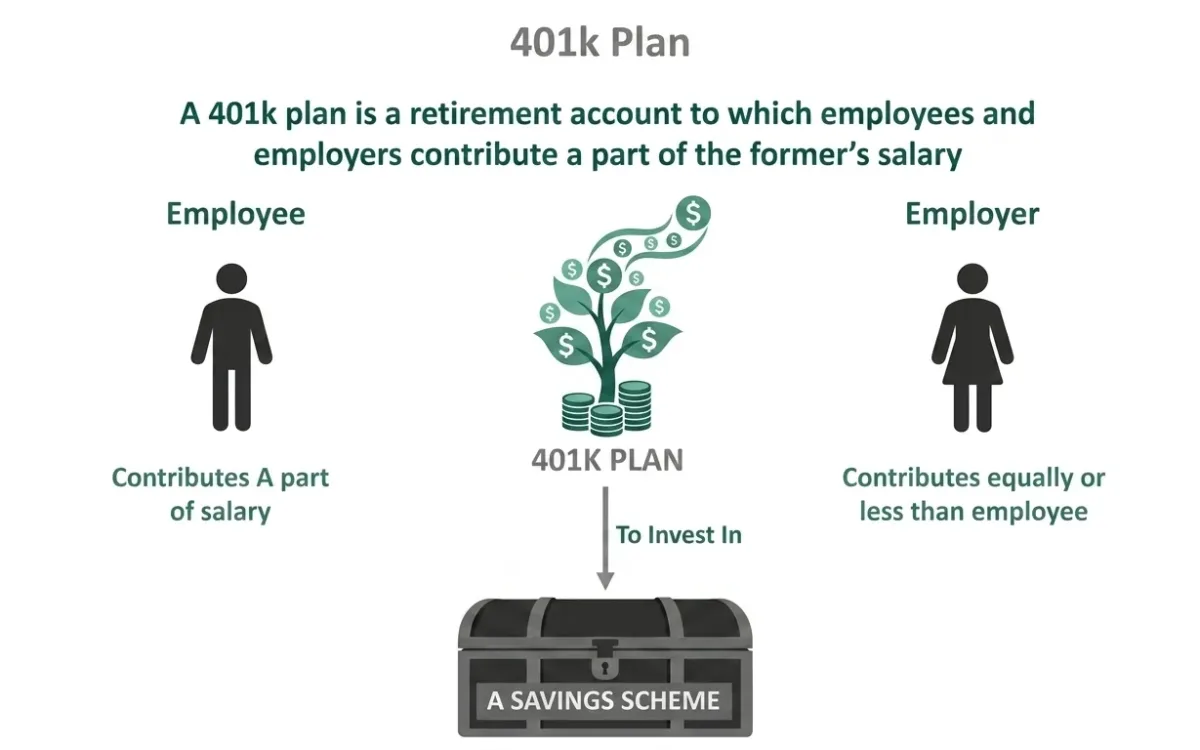
In practical terms, a 401(k) is an employer-sponsored, defined-contribution retirement plan. Your employer creates the plan, you decide how much of your paycheck to funnel into it, and the money grows inside a tax-sheltered account until retirement.
The plan is called “defined-contribution” because only your contributions are defined — not the final payout. Unlike an old-school pension that promises a fixed monthly check for life, your future 401(k) income depends entirely on:
- How much money you put in
- How much your employer chips in
- How your investments perform
- How and when you withdraw the money
That flexibility is both the plan’s greatest strength and its greatest source of anxiety. You control your retirement, but you also carry the responsibility.
Why Is It Called a 401(k)? The Story Behind the Name
Lawyers rarely give things catchy names. When Congress passed the Revenue Act of 1978, it slipped a small provision into Section 401 of the Internal Revenue Code. Subsection (k) allowed employees to defer part of their compensation into a qualified retirement account without paying immediate income tax on that money.
Congress didn’t set out to reshape retirement. The provision originally addressed a narrow tax dispute between the IRS and companies offering profit-sharing arrangements to executives. The wording was technical, and virtually no one anticipated its impact.
Then a Pennsylvania benefits consultant named Ted Benna read the fine print in 1980, spotted the opening, and realized that ordinary workers — not just corporate executives — could contribute pre-tax dollars and receive employer matches. He built the first working 401(k) plan for his own firm, the Johnson Companies, and the IRS blessed the design in 1981.
Ever since, the nickname “401(k)” has stuck to the product the same way “Section 8 housing” stuck to a subsidized rental program. Awkward legal citation? Yes. But now it’s dinner-table vocabulary.

When Did 401(k)s Start? A Short History
Short answer: Section 401(k) became law on November 6, 1978, took effect on January 1, 1980, and produced its first fully operational plan in 1981.
The full timeline plays out in four quick chapters:
- Before 1978: A handful of employers used cash-or-deferred arrangements (CODAs), but the IRS and Treasury kept challenging their tax treatment, leaving companies wary.
- November 6, 1978: President Jimmy Carter signs the Revenue Act of 1978 into law. Subsection (k) is added to Section 401 of the Internal Revenue Code.
- 1980–1981: Ted Benna interprets the new language, designs the first true 401(k) plan for the Johnson Companies, and adds a novel twist — an employer match to encourage participation. According to reporting from History.com, Benna’s innovation of pairing pre-tax salary deferrals with matching contributions was not part of the original statute.
- 1981 onward: The IRS issues clarifying regulations, and major employers race to launch their own plans.
Adoption exploded almost immediately. Traditional pensions covered roughly 30 million active workers in 1980 but shrank to 21 million by 2005. Meanwhile, 401(k) plans grew from zero participants to more than 47 million active savers in the same window. The Pension Protection Act of 2006 later supercharged growth by making auto-enrollment easier, and today Fidelity alone administers more than 26 million individual 401(k) accounts.
Interestingly, Ted Benna has publicly voiced regrets about what his invention became. He argues that fees ballooned and that plans were never designed to fully replace pensions. Yet the 401(k) has become the retirement backbone for the American middle class, and knowing how it works is now a basic adult financial skill — right alongside understanding whether debt consolidation makes sense for your situation.
Which Type of Retirement Account Does Your Employer Contribute To?
Short answer: Your employer contributes to your 401(k) — not to your IRA. Traditional and Roth IRAs are personal accounts you open yourself, and employers cannot legally deposit money into them.
Employer contributions to a 401(k) usually arrive in one of three forms:
- Matching contributions. Your company adds money based on what you contribute. A common structure is dollar-for-dollar on the first 3% of pay and 50 cents on the dollar for the next 2%.
- Non-elective (safe harbor) contributions. Your employer deposits a fixed percentage of your salary — typically 3% — regardless of whether you contribute anything.
- Profit-sharing contributions. Your company distributes part of its yearly profits into employees’ 401(k) accounts, usually at year-end.
The average employer match now sits between 4% and 6% of an employee’s salary, according to industry surveys from Fidelity and Vanguard. Some employers — especially in technology and finance — offer 10% or more, which is one of the strongest reasons to review the retirement page of every job offer carefully.
Other employer-sponsored plans that receive employer contributions include:
| Plan Type | Who Offers It | Typical Employer Contribution |
|---|---|---|
| 401(k) | Private, for-profit companies | Match or profit-sharing |
| 403(b) | Public schools, hospitals, nonprofits | Match, often smaller |
| 457(b) | State and local government | Occasional match |
| Thrift Savings Plan (TSP) | Federal employees and military | Up to 5% automatic match |
| SIMPLE IRA | Small businesses under 100 employees | 2% non-elective or 3% match |
Notice something important: none of these are IRAs. If your employer says “we contribute to your retirement,” they’re contributing to a workplace plan — a 401(k) in the vast majority of private-sector cases.
How Does a 401(k) Actually Work?
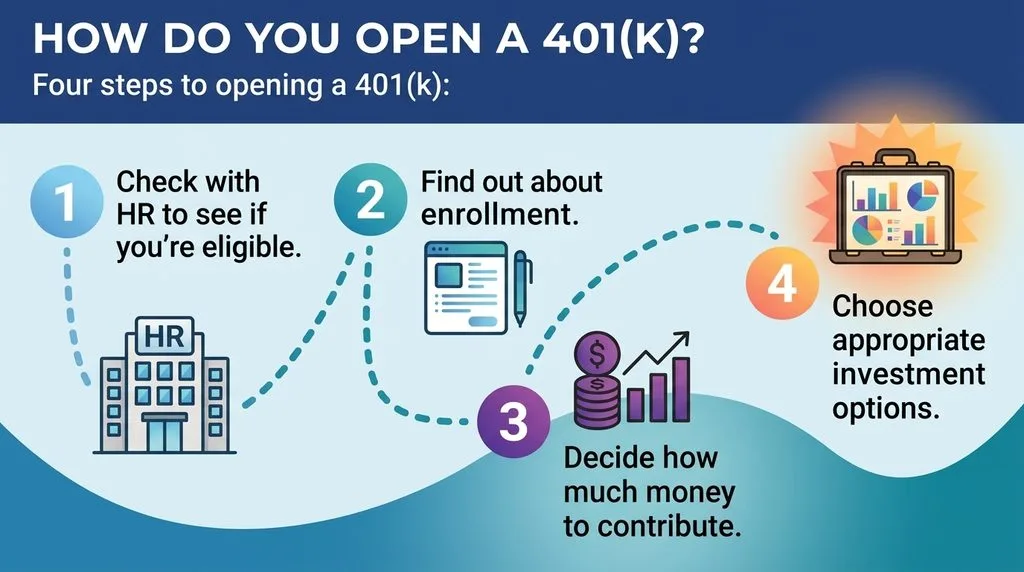
Short answer: You pick a percentage of your paycheck, your employer automatically deposits it into an investment account before taxes are calculated, your employer often adds a matching contribution, and the money grows tax-deferred until you withdraw it in retirement.
Once you enroll, the plan runs on a beautifully simple loop:
- You pick a contribution percentage — often 3% to 15% of each paycheck.
- Your payroll system diverts the money automatically. In a traditional 401(k), contributions come out before income taxes, shrinking your taxable income for that year.
- Your employer’s match hits your account — usually each pay cycle, though some employers deposit annually.
- The money gets invested according to your choices from a menu of mutual funds, index funds, and target-date funds.
- Earnings compound tax-deferred. Dividends, interest, and capital gains grow untouched by taxes year after year.
- You withdraw in retirement. Traditional 401(k) withdrawals are taxed as ordinary income; qualified Roth 401(k) withdrawals are tax-free.
A quick example makes the tax angle vivid. If you earn $80,000 and contribute $8,000 to a traditional 401(k), the IRS treats you as if you earned only $72,000 for the year. In the 22% federal bracket, that saves you roughly $1,760 in federal taxes upfront — money that keeps compounding inside the account rather than heading to Washington.
2026 Contribution Limits at a Glance
The IRS announced the 2026 limits in November 2025, and the ceilings are meaningfully higher than the previous year:
| Contribution Type | 2026 Limit |
|---|---|
| Employee elective deferral (under 50) | $24,500 |
| Standard catch-up (age 50 and older) | $8,000 |
| “Super” catch-up (ages 60–63, if plan allows) | $11,250 |
| Combined employee + employer (Section 415©) | $72,000 |
| Compensation cap counted for match | $360,000 |
| Traditional/Roth IRA contribution (under 50) | $7,500 |
| Traditional/Roth IRA catch-up (50 and older) | $8,600 |
You can pull the official numbers directly from the IRS retirement plan limits page any time you want to double-check.
Traditional vs. Roth 401(k): Which Should You Pick?
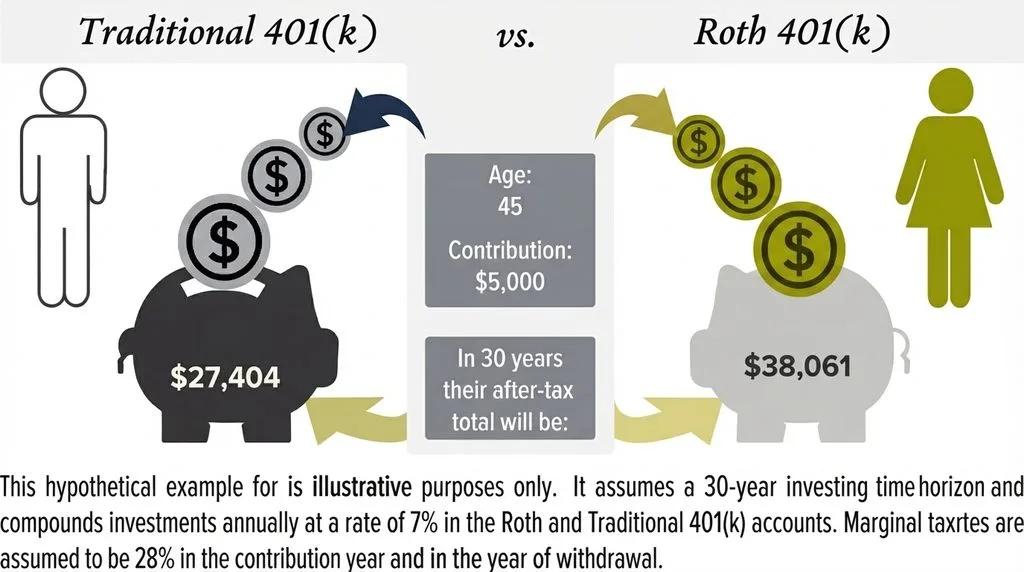
Short answer: A traditional 401(k) gives you a tax break today; a Roth 401(k) gives you tax-free withdrawals in retirement. Choose based on whether you expect a higher or lower tax bracket later.
The difference boils down to one question: when do you want to pay the taxman?
- Traditional 401(k): Contributions go in pre-tax. You skip the tax bill today, but every dollar you withdraw in retirement — contributions and growth — is taxed as ordinary income.
- Roth 401(k): Contributions go in with after-tax dollars. You get zero upfront tax break, but qualified withdrawals in retirement, including all growth, are completely tax-free.
Here’s a practical rule of thumb:
- Pick Roth if you expect to be in a higher tax bracket in retirement than you are now. This suits young workers with rising incomes, high-growth professionals, and anyone worried that future federal tax rates will climb.
- Pick Traditional if you expect a lower tax bracket in retirement, especially if you plan to relocate from a high-tax state to a low-tax one.
- Split the difference by contributing to both. Nothing in the tax code forces you to pick one team, provided your combined contributions stay under the annual limit.
Historically, employer matching dollars had to land in the pre-tax bucket. Under SECURE 2.0, employers can now offer Roth matching, though the matched amount counts as taxable income in the year it’s deposited.
The Free Money Nobody Should Ignore: Employer Matching
Capturing the full 401(k) match is arguably the highest-return move in personal finance. It’s a guaranteed 50% to 100% return on your contribution, no market performance required.
Picture a typical match: 100% on the first 3% of pay and 50% on the next 2%. If you earn $70,000 and contribute 5%, you’re putting in $3,500. Your employer adds $2,800. You’ve now saved $6,300 for retirement while spending only $3,500 out of pocket — a 480% first-year return before markets do anything.
Workers who contribute less than the match effectively accept a lower salary. Millions of Americans do exactly that every year, walking away from billions in unclaimed employer money.
Vesting: The Fine Print That Trips People Up
Not every dollar your employer deposits instantly belongs to you. Companies use vesting schedules to encourage retention. Your own contributions are always 100% yours from day one, but employer contributions may follow one of these paths:
- Immediate vesting. Employer money is yours from the moment it lands.
- Cliff vesting. You own 0% for a set period — usually up to three years — then jump to 100% ownership all at once.
- Graded vesting. Ownership increases each year, commonly 20% per year over five years.
If you quit before hitting the vesting milestones, you forfeit whatever percentage hasn’t vested. Under federal law, vesting cannot take longer than six years total for graded schedules or three years for cliff schedules. Reading the vesting schedule of a new job offer matters just as much as reading the salary line.
The Compounding Machine: How Small Contributions Turn Into Real Wealth
A 401(k) is essentially a tax-deferred compounding machine. Because earnings are not siphoned off each year to pay taxes, they keep working. Over decades, the difference is enormous.
Meet Alex and Jordan:
- Alex starts at age 25 and contributes $500 per month for 10 years, then stops entirely.
- Jordan waits until age 35 and contributes $500 per month for 30 straight years.
At a 7% annual return, Alex reaches age 65 with roughly $602,000 despite contributing only $60,000. Jordan, who contributed $180,000, ends up with about $566,000. Alex wins by starting earlier — even after contributing three times less money.
The data confirms this at scale. Fidelity’s Q1 2026 retirement analysis reported an average 401(k) balance of $131,380, with the highest-ever recorded employee savings rate of 9.6% — pushing the combined employee-plus-employer rate to 14.4%, close to Fidelity’s suggested 15% benchmark.
What to Invest In Inside Your 401(k)
Most plans offer a curated menu of 10 to 25 investment options. The typical lineup includes:
- Target-date funds that automatically shift from stocks to bonds as you approach the target retirement year (e.g., 2050, 2060).
- Index funds tracking major benchmarks such as the S&P 500 or the total U.S. stock market.
- Actively managed mutual funds across large-cap, mid-cap, small-cap, international, and bond categories.
- Stable value or money-market funds for the conservative slice of your allocation.
- Company stock, in some plans — though experts widely advise capping this at 10% of your balance to avoid concentration risk.
If you have no idea where to start, a low-cost target-date fund is a perfectly respectable default. Long-term investors who prefer more control often build a simple three-fund portfolio: total U.S. stock market, total international stock market, and a broad bond index.
Whatever you choose, watch the fees. A fund charging 1.00% per year quietly consumes a huge portion of your future balance over 40 years. The SEC’s plain-English investor guide at Investor.gov’s diversification page is a solid free primer if you want to sharpen your allocation strategy.
How Does a 401(k) Work When You Retire?

Short answer: After you leave your employer, you can leave the money in the plan, roll it over to an IRA, roll it into a new employer’s 401(k), or cash it out. Withdrawals become penalty-free at age 59½, and required minimum distributions kick in at age 73 or 75.
Once you retire — or simply leave a job — you generally have four options for the money sitting inside your 401(k):
1. Leave It in the Plan
Most plans let former employees keep their money right where it is, provided the balance sits above $7,000. The upside is administrative simplicity and continued access to the plan’s investment lineup. The downside is that you cannot add new contributions, and the investment menu often looks limited compared to what you’d get on your own.
2. Roll It Over to an IRA
A direct rollover to a Traditional IRA (or a Roth IRA if you’re converting) preserves the tax-advantaged status and unlocks thousands of new investment options — individual stocks, ETFs, mutual funds, bonds, real estate investment trusts, and more. This is the most common choice for retirees who want maximum control.
3. Roll It Into a New Employer’s 401(k)
If you’re still working and your new employer accepts rollovers, consolidating simplifies your paperwork and keeps everything in one dashboard. It also preserves your ability to borrow against the balance through a plan loan — a feature IRAs cannot offer.
4. Cash Out
You can take the money as a lump sum, but the tax hit is brutal. Full ordinary-income taxes apply, and if you’re under 59½, a 10% early-withdrawal penalty piles on top. Very few situations make cashing out the smartest move.
The Ages That Change Everything
Retirement withdrawal rules pivot on three specific ages:
- Age 55 (Rule of 55). If you separate from your employer during or after the calendar year you turn 55, you can pull money from that employer’s 401(k) penalty-free. Income tax still applies to traditional dollars. The rule does not extend to IRAs or to 401(k)s at prior employers.
- Age 59½. Withdrawals from any 401(k) become penalty-free. Traditional dollars are still taxed as ordinary income; qualified Roth 401(k) withdrawals are entirely tax-free.
- Age 73 (or 75). Required Minimum Distributions begin. Under SECURE 2.0, the RMD age is 73 if you were born between 1951 and 1959, and 75 if you were born in 1960 or later. Missing an RMD triggers a 25% excise tax, which drops to 10% if you correct the mistake quickly.
One quietly powerful change deserves attention: Roth 401(k) accounts no longer require RMDs during the account holder’s lifetime as of 2024, thanks to SECURE 2.0. That single tweak makes the Roth version a much stronger estate-planning tool.
Common Ways Retirees Draw Down a 401(k)
Retirees usually pick one of these income strategies:
- The 4% Rule. Withdraw 4% of your balance in year one, then adjust that dollar amount for inflation every year after. Research suggests a high probability of a 30-year portfolio life, though newer studies argue the number should sit closer to 3.3% in today’s low-yield environment.
- The Bucket Strategy. Split your money into short-term (1–2 years in cash), medium-term (3–7 years in bonds), and long-term (7+ years in stocks) buckets. Refill as market conditions allow.
- Systematic Withdrawal. Set a fixed monthly amount and adjust annually based on portfolio performance.
- Partial Annuitization. Convert a portion of your 401(k) into a fixed or variable annuity for guaranteed lifetime income. SECURE 2.0 encouraged plans to offer annuity options directly inside the plan menu.
- Roth Conversion Ladder. Gradually shift traditional dollars to Roth in low-income years to reduce future RMDs and tax exposure.
Picking the right combination is where a fiduciary advisor genuinely earns their fee. If you’re not sure where to look, our guide on how to find a good financial advisor breaks down what questions to ask before you sign a client agreement.
Early Withdrawals: Loans, Hardships, and the $1,000 Emergency Rule
Life sometimes forces early access to retirement money. The IRS provides three main escape hatches, each with distinct trade-offs.
401(k) Loans
- Borrow up to 50% of your vested balance or $50,000, whichever is less.
- Interest rate is typically prime + 1% to 2%. You pay yourself the interest.
- Standard repayment window is five years, and your paycheck covers the payments automatically.
- If you leave your job, the outstanding balance may become due within a short window; otherwise, it’s treated as a taxable distribution.
Hardship Withdrawals
Available for immediate and heavy financial needs, such as:
- Medical expenses over 7.5% of adjusted gross income
- Funeral costs for immediate family
- Purchase of a primary residence
- Prevention of eviction or foreclosure
- Post-secondary education expenses for you or a dependent
- Federally declared disaster relief
Hardship withdrawals are taxable, and if you’re under 59½, the 10% early-withdrawal penalty typically applies. They also cannot be repaid — the money is gone from the account permanently.
The Rule of 55
If you separate from your employer during or after the year you turn 55 (age 50 for qualified public-safety workers), you can take penalty-free distributions from the 401(k) held with that specific employer. Regular income taxes still apply to traditional contributions.
The $1,000 Emergency Withdrawal
Thanks to SECURE 2.0, since January 2024 you can withdraw up to $1,000 once per year for personal or family emergency expenses without the 10% penalty. You have three years to repay the money and restore your standing. Only one such withdrawal is allowed every three years unless you’ve paid back the previous one.
The Student Loan Match
SECURE 2.0 also allows employers to treat qualified student loan payments as if they were 401(k) contributions for matching purposes. That means workers drowning in student debt can now earn the full employer match while paying down loans instead of contributing to the 401(k) themselves — a small but genuinely transformative change for younger employees.
401(k) vs. IRA: A Side-by-Side Comparison
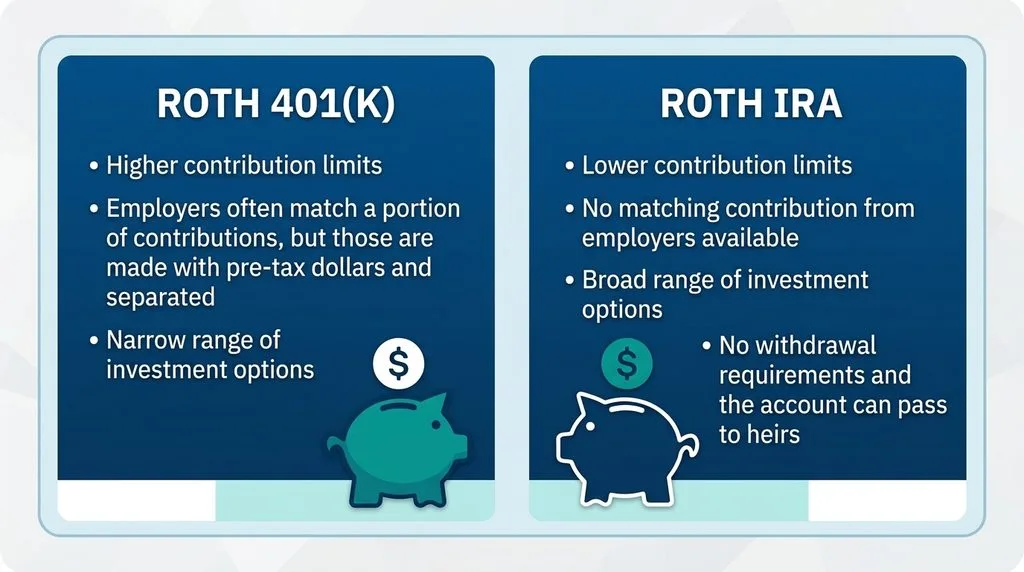
Many savers use both accounts, and the strategic case for doing so is strong. Here’s the side-by-side:
| Feature | 401(k) | IRA |
|---|---|---|
| Sponsored by | Your employer | You (self-directed) |
| 2026 contribution limit | $24,500 (+$8,000 catch-up at 50+) | $7,500 (+$1,100 catch-up at 50+) |
| Employer contributions? | Yes (match / profit-sharing) | No |
| Investment menu | Curated by plan sponsor | Almost unlimited |
| Loans available? | Yes (up to $50,000) | No |
| RMD start age | 73 (or 75 if born 1960+) | 73 (or 75 if born 1960+) |
| Roth version available? | Yes | Yes |
| Income limits for Roth contributions? | No | Yes (phase-outs apply) |
| Rule of 55 applies? | Yes | No |
A common playbook: contribute to the 401(k) up to the employer match, max out an IRA (often a Roth for tax diversification), and then return to max out the 401(k) if you still have savings capacity.
Average 401(k) Balances by Age
Fidelity’s Q1 2026 data reveals how retirement savings scale — or don’t — across generations:
| Generation | Average 401(k) Balance |
|---|---|
| Gen Z (under 28) | ~$18,000 |
| Millennials (29–44) | ~$82,600 |
| Gen X (45–60) | ~$215,600 |
| Baby Boomers (61+) | ~$260,300 |
The chasm between Gen X and Boomer balances underscores a hard truth: the years between ages 45 and 65 do most of the heavy lifting because both your account balance and your contribution capacity are usually near their peak. Yet those same years often coincide with peak family costs — college tuition, aging-parent care, and mortgage payoffs — which is why locking in disciplined contributions early carries so much weight.
Common 401(k) Mistakes That Silently Cost You Money
Even careful savers slip up. Watch out for these traps:
- Contributing less than the match. Leaving the match on the table is functionally identical to accepting a smaller salary.
- Cashing out when you change jobs. Roughly 40% of workers cash out their 401(k) when leaving an employer. That decision incinerates decades of future growth in a single afternoon.
- Ignoring fees. A 1% expense ratio may sound tiny; over 40 years, it can shrink your final balance by nearly 25%.
- Loading up on company stock. Employees at Enron, Lehman Brothers, and Silicon Valley Bank learned this the hard way. Concentration risk can vaporize a lifetime of savings.
- Skipping the Roth option. Younger workers often default to traditional pre-tax contributions when the Roth math would work dramatically better.
- Forgetting to update beneficiaries. Retirement accounts pass by beneficiary designation, not by will. An outdated form can send your money to an ex-spouse without any court intervention.
- Panic selling during bear markets. Selling during a 30% drawdown locks in the loss. Historically, staying invested has been the winning strategy every single time.
Auto-Enrollment: The Quiet Revolution in American Retirement
Since the Pension Protection Act of 2006, employers have been allowed to automatically enroll new hires in the company 401(k) at a default contribution rate (typically 3–6%), with an opt-out option available.
The SECURE 2.0 Act took this further, and starting January 1, 2025, most newly established 401(k) and 403(b) plans must automatically enroll new employees. The default contribution rate starts between 3% and 10% and automatically escalates by 1% each year until the rate reaches at least 10%.
The behavioral impact is dramatic. When employees have to opt in, participation typically hovers around 60%. When they must opt out, participation soars above 90%. Millions of Americans now save for retirement essentially by default — a policy nudge that has become one of the most consequential retirement reforms in decades.
What’s Changing for 2026 and Beyond
The 401(k) landscape is evolving rapidly. Several developments deserve attention:
- Mandatory Roth catch-up for high earners. Beginning January 1, 2026, employees who earned more than $145,000 in FICA wages during the prior year must direct their catch-up contributions to Roth accounts rather than pre-tax accounts. According to reporting from CNBC’s coverage of the 2026 catch-up rules, the change forces high earners to pay taxes upfront on their extra retirement dollars.
- Super catch-up for ages 60–63. Workers in that age band can contribute an extra $11,250 (instead of the standard $8,000) if the plan allows.
- Auto-portability. New regulations make it easier to automatically move a small 401(k) balance to a new employer’s plan when you change jobs, reducing cash-outs.
- Emergency savings sidecars. Employers can now attach a small Roth-based emergency savings account to the 401(k), capped at $2,500, allowing penalty-free withdrawals for genuine emergencies.
- Student loan matching. Employers can match student loan payments as if they were 401(k) contributions — a game-changer for younger workers.
- In-plan annuities. Expect more employers to add fixed-annuity options for retirees seeking guaranteed lifetime income.
The IRS updates limits annually. For the definitive figures each year, the IRS 2026 retirement contribution announcement is the primary reference you can trust.
Protecting Your 401(k) From Life’s Curveballs
A strong retirement plan is more than a healthy account balance. Life still throws surprises, and the wrong disruption at the wrong time can unravel decades of discipline. Consider these complementary safeguards:
- Emergency fund of 3–6 months’ expenses so you never raid the 401(k) during a rough patch.
- Adequate health insurance to prevent medical bankruptcy — still the leading cause of personal insolvency in the U.S.
- Term life insurance if anyone depends on your income.
- Long-term disability insurance — statistically more likely to trigger than life insurance during working years.
- Auto and homeowner’s coverage to protect your assets. Reviewing the best car insurance options periodically can save hundreds a year without weakening coverage.
- A properly funded estate plan with beneficiaries updated after every major life event.
None of these directly grow your 401(k). All of them prevent an outside event from consuming it.
Frequently Asked Questions (FAQ)
What’s the minimum I should contribute to my 401(k)?
Contribute at least enough to earn the full employer match. If your company matches 100% of the first 5%, contribute 5%. Anything less is refusing free money. Once you’ve captured the match, work toward the recommended combined 15% savings rate over time.
Can I have a 401(k) and a Roth IRA at the same time?
Yes, absolutely. Contributing to both diversifies your future tax exposure — you’ll retire with some money that’s already been taxed and some that hasn’t. Roth IRA contributions are subject to income phase-outs, so high earners may need to use a “backdoor Roth” strategy or stick with Roth 401(k) contributions instead.
What happens to my 401(k) if my employer goes bankrupt?
Your 401(k) assets are held in a separate trust and legally protected from your employer’s creditors under ERISA. Bankruptcy of the sponsoring company does not put your savings at risk, though administrative access may be temporarily delayed while a new plan administrator is assigned.
Can I withdraw from my 401(k) to buy a first home?
Yes, but proceed carefully. You can take a 401(k) loan for a home purchase (repayable over five years, or longer for a primary residence) or take a hardship withdrawal. Both have downsides. Loans must be repaid quickly if you leave your job. Hardship withdrawals trigger taxes and the 10% penalty if you’re under 59½. Most planners recommend leaving retirement money alone and saving separately for a down payment.
What if I forget to take my Required Minimum Distribution?
The IRS imposes a 25% excise tax on the amount you should have withdrawn. If you correct the mistake within a “correction window,” the tax drops to 10%. Many plan custodians now calculate and even auto-execute your RMD if you request it.
Does a 401(k) withdrawal affect Social Security benefits?
Withdrawing from a traditional 401(k) can increase your “provisional income,” which may cause a larger portion of your Social Security to become taxable. It does not, however, reduce the Social Security benefit itself.
Is my 401(k) protected in a lawsuit or divorce?
401(k) balances receive strong federal protection under ERISA against most creditors. In a divorce, a Qualified Domestic Relations Order (QDRO) can split the account between spouses without triggering taxes or penalties.
Should I still contribute during a recession?
Yes. Continuing to buy shares while the market is down means you’re purchasing more shares at lower prices — a strategy called dollar-cost averaging. Historically, staying invested through downturns has been the most reliable path to long-term wealth.
Final Thoughts
The 401(k) began as a footnote in a 1978 tax bill and became the retirement scaffolding for tens of millions of American households. Understanding it — the name, the mechanics, the taxes, the withdrawals — is one of the highest-leverage financial skills anyone can develop.
Small choices compound over decades: an extra 1% saved in your twenties, capturing the full match in your thirties, resisting the urge to cash out in your forties, and drawing down thoughtfully in your sixties. None of it requires genius-level math. It just requires showing up, staying invested, and letting Section 401(k) of the tax code do what it was accidentally designed to do — build wealth quietly in the background while you’re busy living your life.
Leave a Reply