
In this article
- TL;DR — The Straight Answer
- The 60-Second Self-Check: Is It a Good Idea for You?
- What Is Debt Consolidation, Really?
- The Numbers That Actually Decide This (2026 Data)
- The Two Main Ways People Consolidate Debt
- Debt Consolidation Loan vs. Balance Transfer Card: Head-to-Head
- The Real Pros of Debt Consolidation
- The Cons Nobody Puts in the Ad Copy
- How Debt Consolidation Actually Affects Your Credit Score
- When Debt Consolidation Is a Bad Idea
- Debt Consolidation vs. Debt Settlement vs. Bankruptcy
- A Simple 6-Step Framework Before You Consolidate
- What Lenders Actually Look At
- Smart Alternatives to Debt Consolidation
- The Five Most Common Consolidation Mistakes
- Is Credit Card Debt Consolidation a Good Idea Specifically?
- Home Equity, HELOCs, and Why Your House Isn’t Free Money
- How to Avoid Debt Consolidation Scams
- Real Example: The Math That Actually Convinced Sarah
- The First 90 Days After You Consolidate
- Frequently Asked Questions
- The Honest Bottom Line
TL;DR — The Straight Answer
Debt consolidation is a good idea in 2026 when three conditions hold at the same time: you qualify for a rate meaningfully lower than what you pay now, your monthly debt payments stay under about 40% of your gross income, and you have a real plan to stop adding new balances. Miss any one of those, and consolidation usually just repackages the problem in a shinier wrapper. With the New York Fed reporting $1.26 trillion in credit card balances nationwide and average card APRs hovering near 21%, the right consolidation move can save thousands—but the wrong one costs even more.
Key takeaways at a glance:
- Consolidation is one big payment replacing many small ones—ideally at a lower rate.
- The two main tools are debt consolidation loans and 0% balance transfer credit cards.
- It’s smart if you have fair-to-good credit, steady income, and a written spending plan.
- It’s risky if you keep swiping the newly emptied cards or extend the term too long.
- It restructures debt. It does not erase it.
The 60-Second Self-Check: Is It a Good Idea for You?
Before you scroll through 3,000 more words, run these five questions. If you answer “yes” to at least four, keep reading with confidence. If you answer “no” to three or more, consolidation probably isn’t your best move right now.
- Is your credit score at least 640?
- Are your total monthly debt payments under 40% of your gross income?
- Can you get a new loan or 0% card at least 3–5 points lower than your current average rate?
- Do you know why the debt piled up—and have a plan to stop repeating it?
- Can you commit to paying the new loan off in 1–7 years without missing a payment?
That’s the whole test. Everything below is the why behind each of those questions.
What Is Debt Consolidation, Really?
Debt consolidation is what happens when you take several debts—credit cards, medical bills, personal loans, maybe a store card or two—and roll them into a single new loan or credit line. From then on, you make one payment instead of five. If the new interest rate is lower than your old weighted average, more of every dollar you send actually chips away at what you owe instead of feeding the interest machine.
Here’s the part the ads don’t say out loud: consolidation doesn’t make debt smaller. It moves it. You still owe the same principal. What changes is the cost of carrying it and the shape of the payment schedule. If your blended card APR was 24% and your new loan sits at 12%, that ten-point spread is where the savings live. If the new rate is only a point or two lower, add fees to the equation and you may have paid to stand still.
And people are asking about this now for a reason. The 2024 Wells Fargo Money Study found that 44% of Americans admit to carrying more debt than they’re comfortable with, and roughly two-thirds have cut spending to cope. That discomfort is exactly what makes consolidation feel like a lifeline—and exactly why you owe yourself a cold, honest look before signing anything.
The Numbers That Actually Decide This (2026 Data)
Debt consolidation lives or dies by two rates: what you pay today, and what you can qualify for tomorrow. Here’s the current landscape.
| Debt type | Average rate (mid-2026) |
|---|---|
| Credit cards, all accounts | ~20.94% APR |
| Credit cards, accounts with interest | ~22.15% APR |
| Personal loan, excellent credit (800+) | ~15.34% APR |
| Personal loan, good credit (690–719) | ~19.39% APR |
| Personal loan, 700 FICO, 3-year avg | ~12.42% APR |
| Personal loan, subprime (below 580) | ~30.02% APR |
| 0% balance transfer card, intro period | 0% for 15–21 months |
| Home equity loan / HELOC | ~7–9% APR |
| Nonprofit debt management plan | Negotiated to ~7–10% |
The most useful number here is the spread. Cutting a 22% weighted card APR down to a 12% personal loan on a $15,000 balance saves roughly $2,700 in interest across three years—and shaves years off the payoff calendar. If your best offer is 18% and your cards average 20%, that’s a two-point win eaten by fees. Walk away.
Reality check: According to the Federal Reserve Bank of New York, roughly 6.97% of credit card balances rolled into serious delinquency in Q2 2026—the highest level in over a decade. This means the “just make the minimum payment” strategy is quietly failing more households every quarter, which is why the consolidation conversation is louder than ever.

The Two Main Ways People Consolidate Debt
Most consolidations come down to a choice between a fixed-rate installment loan and a promotional-rate credit card. They solve slightly different problems.
1. The debt consolidation loan (an unsecured personal loan)
A debt consolidation loan is a fixed-rate installment loan you use to wipe out several balances on day one. From that moment forward, you owe one lender, one payment, one predictable schedule—usually one to seven years. Rates in 2026 span from about 6% for pristine credit to nearly 36% for subprime applicants, so the person you were when you first opened those cards matters less than the person your credit report says you are today.
Best for: Mixed unsecured debts (cards plus medical bills plus a personal loan), balances above $10,000, or borrowers who want a hard payoff date on the calendar.
Watch out for: Origination fees of 1–8% (Upgrade, for example, charges 1.85–9.99%), longer terms that shrink the monthly payment while quietly raising total interest, and prepayment penalties on some older loan products.

2. The 0% balance transfer credit card
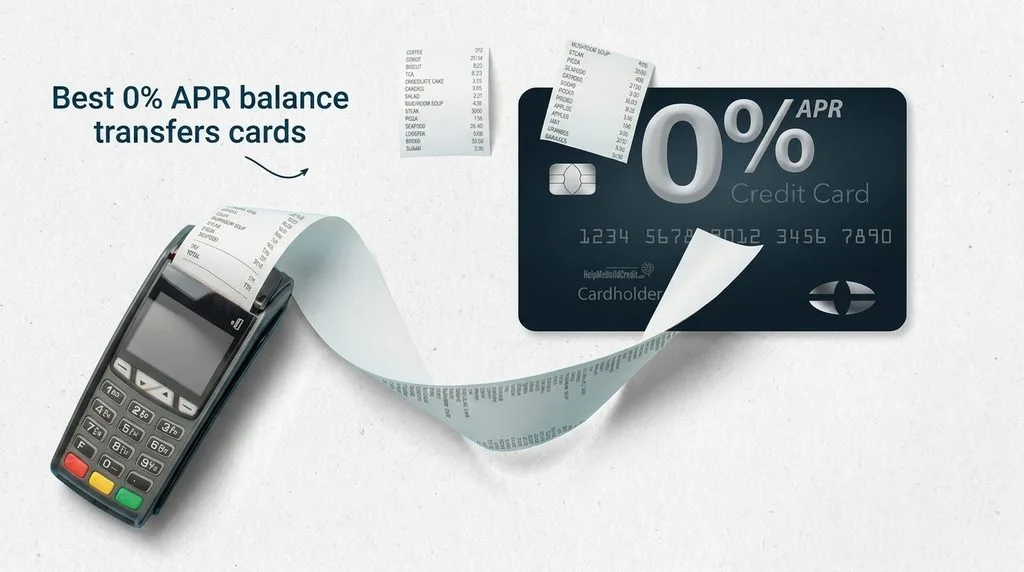
A balance transfer card lets you move existing card balances onto a brand-new card that charges no interest for a promo window—commonly 15 to 21 months. Every dollar you send during that window attacks principal directly. When the promo ends, the card’s ongoing APR kicks in (often 20% or more), so the play only works if you clear the balance before the deadline. Miss it, and the interest hangover can be brutal.
Best for: Card-only debt in the $3,000–$10,000 range, borrowers with credit scores of 690 or higher, and people who can commit to a fixed payment large enough to zero out before the promo expires.
Watch out for: A 3–5% transfer fee assessed upfront (that’s $150–$250 on a $5,000 balance), deferred-interest traps on some retail cards, and the seductive urge to keep spending on the newly opened line.
3. Other consolidation vehicles worth knowing
- Home equity loans and HELOCs — cheapest rates, but your house is now collateral.
- 401(k) loans — deceptively cheap; brutal if you leave your job.
- Debt management plans (DMPs) — nonprofit-negotiated repayment plans that can drop your card APRs to around 7–10% without opening any new credit.
When you’re weighing options this consequential, an outside voice helps. Our guide on how to find a good financial advisor walks through the exact vetting questions that also apply when you’re shopping consolidation lenders.
Debt Consolidation Loan vs. Balance Transfer Card: Head-to-Head
| Feature | Debt consolidation loan | Balance transfer card |
|---|---|---|
| Best for | Mixed unsecured debts | Credit card debt only |
| Interest structure | Fixed rate, full term | 0% intro, then ongoing APR |
| Typical term | 1–7 years | 15–21 months promo |
| Credit needed | Fair to excellent (580+) | Good to excellent (690+) |
| Upfront fee | 0–8% origination | 3–5% transfer fee |
| Monthly payment | Fixed, predictable | Flexible minimum (dangerous) |
| Risk profile | Adds one new tradeline | Frees up old cards for reuse |
Rule of thumb: If you can pay it off in under 18 months, a 0% transfer card usually wins. If you’ll need three or more years, take the fixed-rate loan and lock in your rate—so an interest-rate reset can’t surprise you halfway through.
The Real Pros of Debt Consolidation
Consolidation, done right, is one of the cleanest financial resets a middle-class borrower can pull off. These are the benefits that hold up under a fluorescent light.
- You save real money on interest. A weighted APR drop from 22% to 12% on $15,000 saves about $2,700 over three years—and gets you to the finish line sooner.
- One payment beats five. Fewer due dates means fewer chances to miss one, which protects your payment history (the biggest single factor in your credit score).
- You get a finish line. A three-year installment loan tells you exactly when you’ll be debt-free. Minimum credit card payments? Payoff calculators show it can take 11+ years just to clear a single average balance, and often 20+ years for a bigger one.
- Your credit score usually rises within a year. Paying down revolving balances lowers your credit utilization ratio, and utilization accounts for 20–30% of your FICO score, per Experian and myFICO.
- You get your bandwidth back. Financial stress is a documented driver of anxiety, insomnia, and relationship strain. Simplifying five statements into one is a real quality-of-life upgrade, not just a spreadsheet one.
The Cons Nobody Puts in the Ad Copy
Lenders love the word “consolidation” because it sounds like a solution when it’s only a tool. These are the trade-offs the brochures skip.
- You may not actually get a lower rate. If your credit slipped since you opened your first cards, the loan you qualify for could match—or exceed—what you pay now.
- Longer terms often cost more in total. Stretching $20,000 over seven years drops the monthly bill but usually adds thousands in lifetime interest.
- Freed-up cards invite fresh spending. The Consumer Financial Protection Bureau flags this as the single most common relapse trigger after consolidation.
- Fees eat your savings. Origination fees, balance-transfer fees, annual fees, and (occasionally) prepayment penalties can quietly wipe out a decent rate cut.
- Your credit dips briefly. A hard inquiry usually costs fewer than five points, and opening a new account lowers your average account age by a small amount.
- Nothing is guaranteed. Consolidation restructures debt. It does not fix the spending pattern that created it. If nothing else changes, your balances will simply climb back to where they started, only now with a new loan payment on top.
How Debt Consolidation Actually Affects Your Credit Score
Most credit-score effects from consolidation are temporary. Here’s the first-year breakdown.
| Credit factor | Immediate effect | Long-term effect |
|---|---|---|
| Hard inquiry | −3 to −5 points | Fades in 12 months, off report in 24 |
| Average account age | Slight decrease | Rebuilds as new account ages |
| Credit utilization | Big drop if cards stay open | Stays low if you don’t respend |
| Payment history | Neutral at first | Improves with on-time payments |
| Credit mix | Slight positive (adds installment loan) | Positive over time |
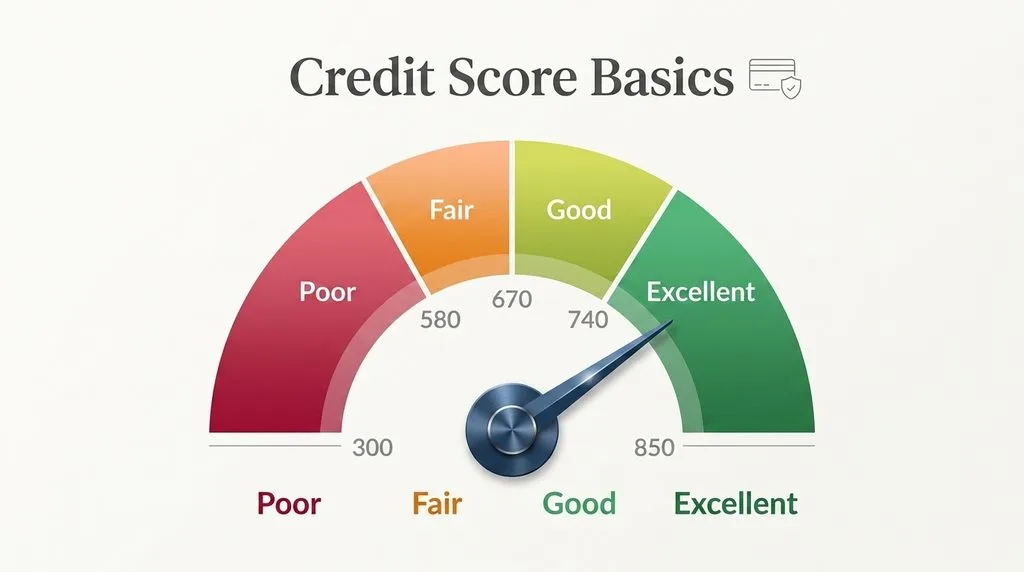
The net effect after six to twelve months of on-time payments is usually positive, because the utilization improvement outweighs the small application ding. The catch: miss one payment on the new loan and your score can drop 60 to 110 points, wiping out years of progress. Autopay is not optional here—set it up the same day the loan funds.
When Debt Consolidation Is a Bad Idea
Sometimes the honest answer is “not yet” or “not this way.” Skip consolidation—or postpone it—if any of the following describes you:
- You haven’t fixed the habits that created the debt. Consolidation without a budget is a bandage on a burst pipe.
- Your total debt is small enough to knock out in under 12 months. A focused snowball or avalanche payoff avoids origination fees entirely.
- You can’t qualify for a meaningfully lower rate. If your best offer is 22% and your cards average 20%, walk away.
- Your income is unstable or seasonal. Missing a personal loan payment is worse on your credit than missing a card payment.
- You’re already considering bankruptcy. Consolidating first can drain assets you could otherwise protect. Talk to a certified counselor at the NFCC’s agency finder before you sign anything.
Debt Consolidation vs. Debt Settlement vs. Bankruptcy
These three terms often get thrown around interchangeably. They’re wildly different. Here’s the honest comparison.
| Factor | Debt consolidation | Debt settlement | Bankruptcy (Chapter 7/13) |
|---|---|---|---|
| What it does | Combines debts into one new loan | Negotiates creditors to accept less than owed | Legally discharges qualifying debts |
| Total paid | Full principal at lower APR | 40–60% of principal (typically) | Little to none (Ch. 7) |
| Credit impact | Small dip, recovers in 12 months | Severe drop, 7-year mark | Severe, 7–10 year mark |
| Time to complete | 1–7 years | 2–4 years | 3–6 months (Ch. 7) |
| Tax consequence | None | Forgiven debt often taxed as income | None (with exceptions) |
| Best for | Manageable debt, decent credit | Unmanageable debt, willing to take credit hit | Truly insurmountable debt |
The takeaway: consolidation is the least destructive of the three—but only appropriate when your debt is still manageable. If you’re already 90 days behind on multiple accounts, the other tools may serve you better.
A Simple 6-Step Framework Before You Consolidate
Here’s the sequence that separates borrowers who benefit from consolidation from borrowers who regret it.
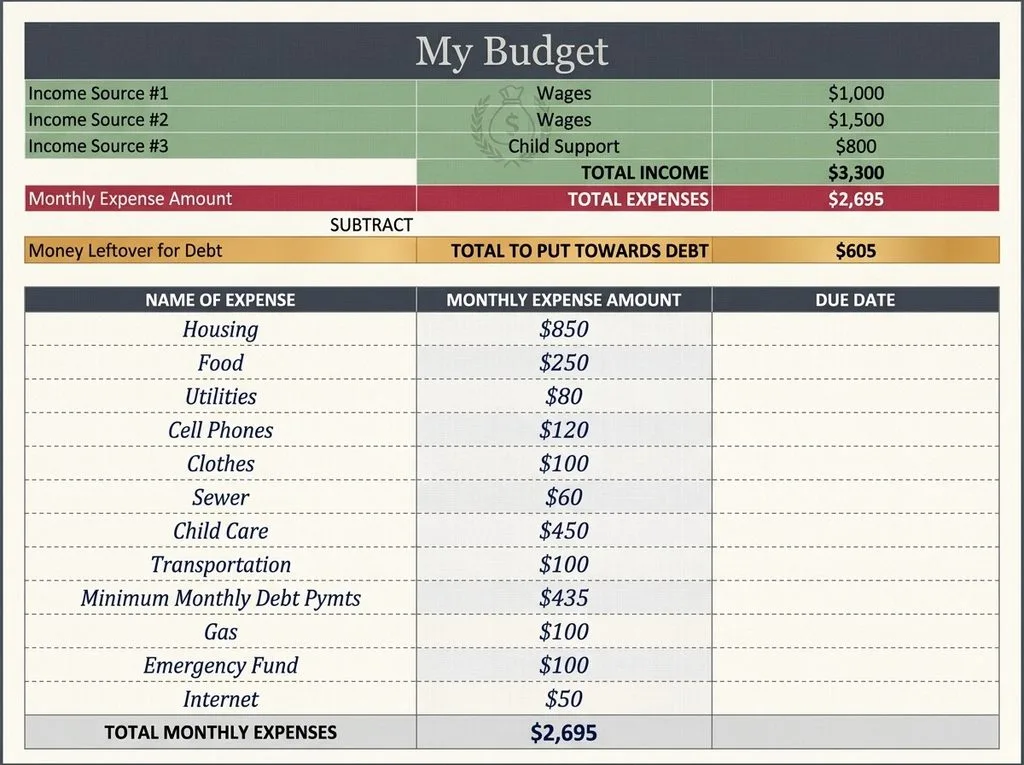
- List every debt. Balance, minimum payment, APR, and due date for each. Total the balances and calculate the weighted average APR (each debt’s rate multiplied by its share of the total).
- Pull your credit report at AnnualCreditReport.com—the only site the federal government actually authorizes for free reports. Aim for a score of 670 or higher before you apply.
- Calculate your debt-to-income ratio. Total monthly debt payments divided by gross monthly income. Under 36% is healthy. Between 36% and 43% is workable. Above 43% signals deeper problems that consolidation alone won’t solve.
- Prequalify with three to five lenders using soft-pull tools that don’t ding your score.
- Do the total-cost math. Multiply the new monthly payment by the number of months, add fees, then compare that number to what you’d pay staying on your current path. If the new total isn’t lower by at least four figures, keep shopping.
- Set up automatic payments and hide the old cards. Behavioral guardrails matter more than the interest rate you land.
What Lenders Actually Look At
Prequalification is not approval. When you formally apply, most lenders weigh five things:
- FICO score — the single biggest gatekeeper. Scores of 720+ unlock the sub-12% tier.
- Debt-to-income ratio — most personal loan lenders cap approvals near 43–50%.
- Employment history — steady income for at least 12 months is standard.
- Loan purpose — some lenders won’t allow proceeds to pay off their own products.
- Recent credit activity — three or more hard inquiries in six months is a red flag.
If any of these are shaky, work on them for 60–90 days before applying. A single point of DTI improvement can move you into a whole new pricing tier.
Smart Alternatives to Debt Consolidation
Consolidation is one tool. It isn’t the only one, and often it isn’t the best one. Consider these first if your situation is borderline.
- Debt avalanche method — pay minimums everywhere, throw every extra dollar at the highest-APR debt first. Mathematically the cheapest option.
- Debt snowball method — attack the smallest balance first for quick psychological wins. Behaviorally sticky, especially if you’ve stalled before.
- Nonprofit debt management plans — certified counselors negotiate reduced APRs (often down to around 8%) with your creditors, and you send one monthly payment they distribute. No new loan required, no credit dip.
- Direct hardship programs — many card issuers quietly offer temporary APR reductions if you call and explain. Almost nobody advertises this.
- Negotiated settlement — for seriously delinquent accounts, creditors sometimes accept 40–60 cents on the dollar. This hurts credit but avoids new debt.
- Roth IRA or brokerage withdrawal — rarely optimal, but sometimes the math beats consolidation. Talk to a fiduciary first.
While you’re paying down debt, don’t forget the other side of financial resilience. Affordable term life coverage protects your family’s floor for pennies a day, so a medical event doesn’t blow up the payoff plan you just built.
The Five Most Common Consolidation Mistakes
I’ve watched enough borrowers stumble in the same spots to name them. Avoid these and you’ve already beaten most of the field.
- Chasing a lower monthly payment instead of a lower total cost. Stretching to seven years feels good on payday. It usually costs more overall.
- Closing the old cards immediately. That instantly shrinks your available credit and spikes your utilization ratio. Keep them open but locked away.
- Ignoring the origination fee. A “7.99% APR” loan with an 8% origination fee behaves more like an 11–12% APR.
- Not automating the payment. One missed payment can undo 12 months of score gains.
- Treating the empty cards as a raise. They’re not a raise. They’re a test.
Is Credit Card Debt Consolidation a Good Idea Specifically?
Credit card debt is the single most common reason people consolidate—and often the most defensible use case. Here’s why:
- Credit card APRs (around 21% on average) sit dramatically higher than most personal loan APRs (12–15% for good credit).
- Cards are revolving, so minimum payments stretch payoff for a decade or more.
- The spread is wide enough that even after fees, consolidation typically wins.
Credit card consolidation makes the most sense when your total card balances land between $5,000 and $30,000, your credit score is 670 or higher, and you can realistically finish payoff in three to five years. Below $5,000, a focused snowball beats the fees. Above $30,000, a home equity product or a nonprofit debt management plan may serve you better than an unsecured loan.
Home Equity, HELOCs, and Why Your House Isn’t Free Money
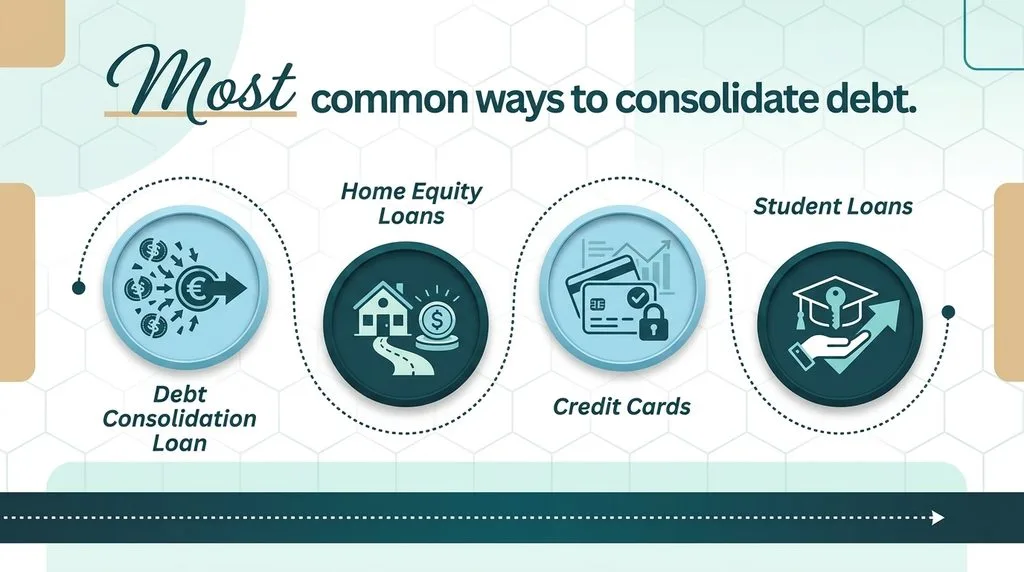
A home equity loan or HELOC can offer rates in the 7–9% range in 2026, far below most personal loans or credit cards. That looks irresistible on paper. But turning unsecured debt into secured debt means one bad quarter can put your home at risk. Most financial advisors only green-light this route when three conditions are met:
- Your income is stable and you have an emergency fund of at least three months of expenses.
- Your total housing costs stay under 28% of gross income after the new payment.
- You commit—in writing to yourself—not to run the old cards back up.
For most families, the psychological weight of collateralizing the house makes home equity consolidation a last resort rather than a first move. If freeing up cash flow is part of the puzzle, shopping car insurance alone can save the average household several hundred dollars a year—money that could go straight toward the payoff instead of new borrowing.
How to Avoid Debt Consolidation Scams
The Federal Trade Commission warns that debt-relief scams spike whenever household debt hits new highs—exactly what’s happening right now. Watch for these red flags:
- Any company asking for upfront fees before settling a single debt.
- Guarantees to “cut your debt in half” or “make debt disappear.”
- Robocalls or texts from someone claiming to represent the CFPB, FTC, or your creditor.
- Pressure to stop paying your current creditors while they “negotiate.”
- No physical address, no state licensing, and no visible team page on the website.
Legitimate options include federally credentialed nonprofit counselors, banks, credit unions, and established online lenders with clear rate disclosures. If a pitch feels like a used-car sales rush, it is one.
Real Example: The Math That Actually Convinced Sarah
Sarah, a 34-year-old marketing manager, walked into 2026 with four balances: $6,200 on a store card at 26.99%, $4,800 on a rewards card at 22.4%, $2,500 on a second rewards card at 19.9%, and $3,000 in medical debt accruing at 15%. Total: $16,500 at a weighted average of 22.4% APR. Her minimum payments added up to $497 a month, and her payoff timeline at minimums stretched past 2044.
She prequalified for a five-year personal loan at 11.9% APR with a 3% origination fee. Her new monthly payment: $367. Total interest over the life of the loan: about $5,480. Compared with riding the minimums—which was projected to cost roughly $23,000 in interest and drag on for nearly two decades—she saves close to $18,000 in interest and finishes about a decade sooner.
That’s the math that makes consolidation worth it. And it only worked because she closed two of the freed-up cards, froze the third in a jar of water in her freezer, and set the loan payment on autopay the same afternoon.
The First 90 Days After You Consolidate
The riskiest period isn’t the application. It’s the first three months after your loan funds. Here’s a simple playbook:
- Day 1: Confirm every old account shows a $0 balance. Screenshot each one.
- Day 2: Enable autopay on the new loan. Set a calendar reminder to verify the first payment posted.
- Week 1: Freeze or hide the paid-off cards. Don’t close them yet.
- Week 2: Update your budget to reflect one payment instead of five. Redirect the difference to an emergency fund.
- Month 1: Check your credit report for correct account statuses. Dispute any errors.
- Month 3: Reassess. If you’ve spent zero on the old cards and made three on-time loan payments, you’re in the top quartile of borrowers.
Frequently Asked Questions
Is debt consolidation a good idea if I have bad credit?
Usually no. LendingTree marketplace data shows borrowers with FICO scores below 580 receive average debt consolidation loan APRs near 30%—higher than most credit cards. If your credit is poor, focus on six months of on-time minimum payments to lift your score into the 640+ range, then reconsider.
Does debt consolidation hurt my credit score?
Short-term, yes—by about three to five points from the hard inquiry, plus a small dip from opening a new account. Long-term, most borrowers see their score rise within 6 to 12 months as their credit utilization drops and their payment history strengthens. The one thing that ruins this is running the old cards back up.
How long does debt consolidation take to pay off?
Debt consolidation loans typically run one to seven years, with three to five being most common. Balance transfer cards give you 15 to 21 months of 0% interest, so you need to clear the balance in that window—or the ongoing APR (often 20%+) resets the math against you.
Can I still use my credit cards after consolidating?
Yes, but you probably shouldn’t for the first year. The number-one reason consolidation fails is that borrowers treat freed-up credit lines as a raise. Keep one card open for autopay on a small recurring charge (to keep it “active”), and either freeze or close the rest until the consolidation loan is paid off.
What’s the difference between debt consolidation and debt settlement?
Debt consolidation combines what you owe into one new loan; you still repay 100% of the principal at a lower rate. Debt settlement negotiates to pay creditors a fraction—often 40 to 60 cents on the dollar—but severely damages your credit and can trigger a taxable “forgiven debt” income event with the IRS.
Is a debt consolidation loan a good idea if I own a home?
It depends on your risk tolerance. Home equity products offer the lowest rates but convert unsecured debt into secured debt. If your income is stable and your spending discipline is iron-clad, they can save thousands. If your income wobbles, one home equity mistake can end in foreclosure—so most experts recommend using unsecured personal loans first.
What credit score do I need for the best debt consolidation loan rates?
To access rates below 12%, most lenders want a FICO score of 720 or higher paired with a debt-to-income ratio under 36%. Scores in the 670–719 range still qualify for reasonable rates (roughly 14–19%), while scores below 670 usually face APRs that make consolidation less attractive than a disciplined snowball or avalanche payoff.
Can debt consolidation stop collection calls?
Yes—once your consolidation loan pays off the original accounts, those creditors mark the accounts as paid or settled and stop calling. However, if any accounts have already been sold to third-party collectors, you may need to settle those separately, because some lenders exclude collection accounts from consolidation eligibility.
Will consolidating debt affect my ability to get a mortgage later?
Short-term, yes: a new personal loan adds a monthly obligation to your DTI and creates a hard inquiry. Long-term, it usually helps, because paying down revolving debt improves your credit utilization ratio and your payment history—the two biggest FICO factors. Wait 6 to 12 months after consolidating before applying for a mortgage.
The Honest Bottom Line
Debt consolidation is a good idea when the math and the habits both point the same direction. If you qualify for a rate at least a few points below your current weighted APR, if your income can absorb one fixed payment for the next few years, and if you commit—on paper, not just in your head—to not refilling the cards you just paid off, consolidation is one of the most reliable ways to shave years off your payoff timeline and thousands off your interest bill.
If any of those conditions wobbles, the smarter move is usually a nonprofit credit counselor, a disciplined snowball or avalanche payoff, or a hardship program with your current creditor. Consolidation is a tool, not a rescue. Used right, it can be genuinely transformative. Used to postpone the harder conversation with yourself about spending, it just repackages the problem in a nicer envelope.
The best time to decide is before you apply—not after the loan funds hit your account.


Leave a Reply