
In this article
- What Does Cost Basis Mean?
- How Is the Cost Basis of an Airdrop Calculated?
- Step 1: Find Out How Many Tokens You Received
- Step 2: Determine When You Actually Had Control
- Step 3: Determine the Token's Fair Market Value
- What If the Airdropped Token Has Almost No Trading Activity?
- What Happens When You Sell the Airdropped Tokens?
- What If You Sell the Tokens for Less Than Their Original Value?
- What If You Receive the Same Token More Than Once?
- What About Airdropped Tokens That Are Locked?
- Keep a Record of Every Airdrop
- Common Mistakes to Avoid
- A Simple Airdrop Cost Basis Example
- Final Thoughts
Getting free crypto through an airdrop can feel like a nice bonus. You receive tokens in your wallet without buying them, and sometimes those tokens can become surprisingly valuable.
But there is another side to airdrops that is easy to overlook: taxes.
If you eventually sell, swap, or otherwise dispose of those tokens, you may need to know their cost basis. That can be confusing because you did not actually pay money to receive the tokens in the first place.
So, how do you calculate the cost basis for airdropped tokens?
The basic idea is to determine the fair market value of the tokens when you received control of them and keep good records of that value. The exact tax treatment can depend on your situation and the rules that apply to you.
Let’s walk through it with some simple examples.
What Does Cost Basis Mean?
Cost basis is basically the amount used to measure your gain or loss when you later dispose of an asset.
With crypto that you purchase, the starting point is usually easy to understand. If you buy $1,000 worth of Bitcoin, your starting basis is generally around $1,000, adjusted for applicable transaction costs.
Airdropped tokens are different.
You may receive 1,000 tokens without paying anything for them. That doesn’t automatically mean your future cost basis is $0.
Instead, you need to look at the circumstances surrounding the airdrop and the value of the tokens when you obtained control of them.
How Is the Cost Basis of an Airdrop Calculated?
Let’s use a simple example.
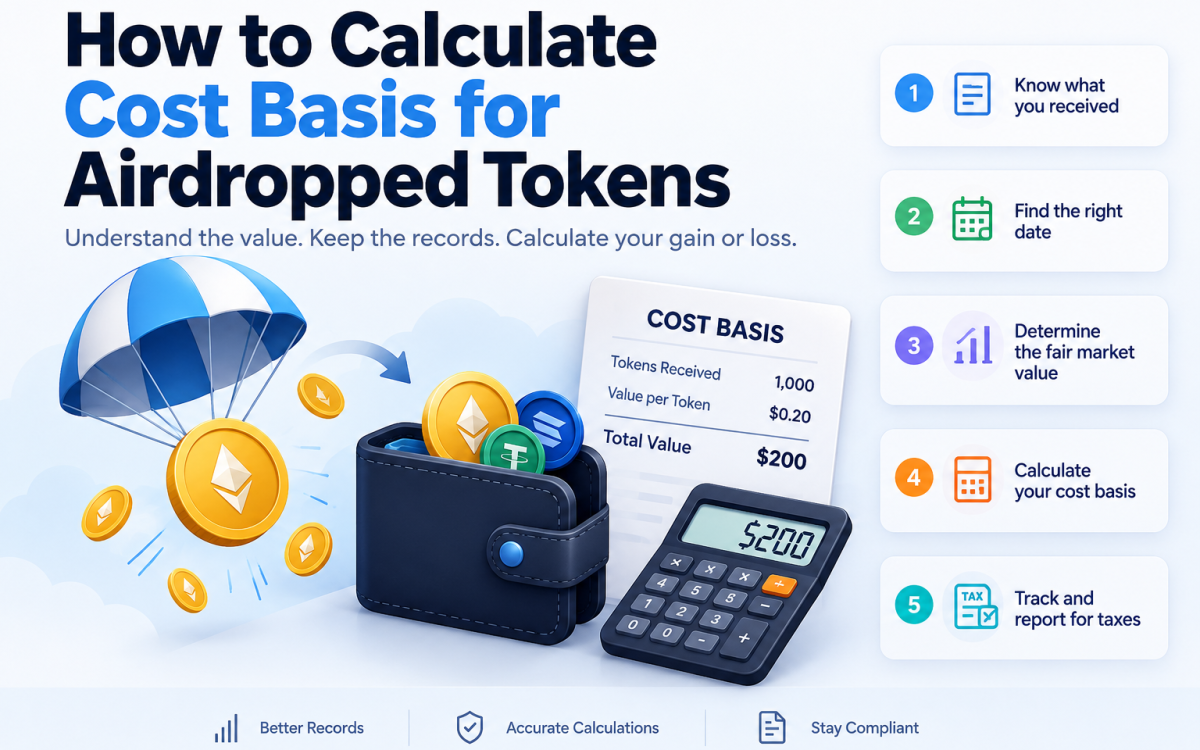
Imagine that you receive 1,000 tokens through an airdrop.
At the time you receive and can control the tokens, they are trading at about $0.20 each.
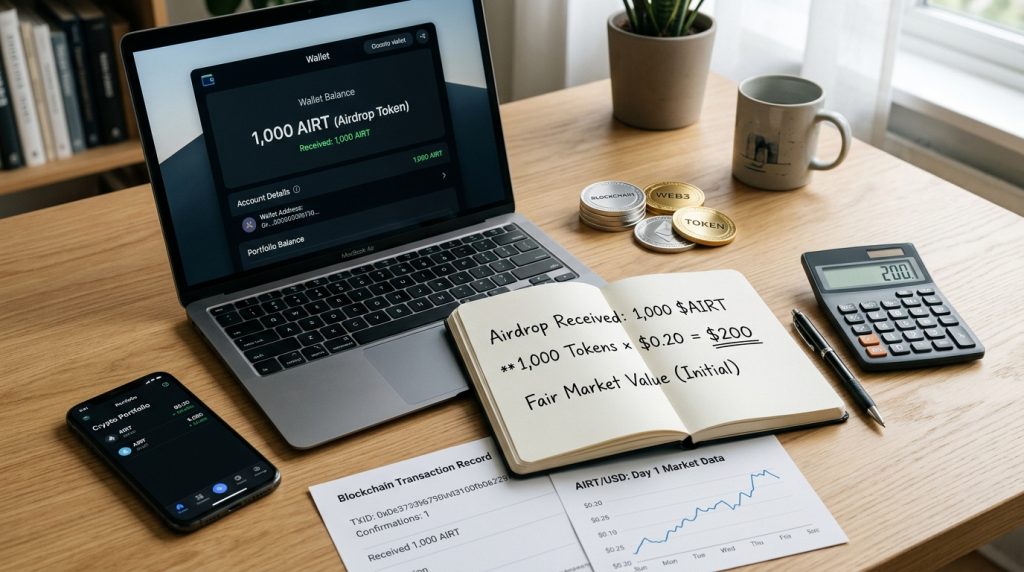
The total value is:
1,000 × $0.20 = $200
If that $200 is the amount treated as taxable income when you receive the tokens, it would generally become your starting cost basis.
So in this example:
Initial cost basis = $200
Later, when you sell the tokens, you can compare your adjusted sale proceeds with that basis to determine your gain or loss.
Step 1: Find Out How Many Tokens You Received
The first thing to record is the exact amount of crypto you received.
Don’t rely on memory, especially if you participate in several airdrops.
For example:
- Token: ExampleToken
- Amount received: 1,000
- Date received: August 17, 2026
- Wallet: Your personal wallet
- Transaction ID: Blockchain transaction hash
Your wallet history or the blockchain can usually help you verify the number of tokens involved.
Keeping this information from the beginning can save you a lot of work later.
Step 2: Determine When You Actually Had Control
The date an airdrop was announced isn’t necessarily the date that matters for your tax records.
Sometimes a project announces an airdrop weeks before the tokens can actually be claimed. In other cases, tokens may arrive in your wallet but remain locked or subject to restrictions.
That’s why you should look at when you actually obtained control of the tokens.
For example, suppose a project announces an airdrop on August 1 but you cannot claim or use the tokens until August 17.
The relevant date may be connected to when you actually gained control, rather than simply the announcement date.
The details matter, particularly when tokens are subject to vesting or other restrictions.
Step 3: Determine the Token’s Fair Market Value
Once you know the relevant date, you need to determine what the tokens were worth at that time.
Suppose you received 2,000 tokens and their market price was $0.15 each.
The calculation would be:
2,000 × $0.15 = $300
So the total fair market value would be $300.
If that amount is treated as taxable income at receipt under the applicable rules, $300 would generally be the starting point for your basis.
Try to keep evidence showing where your price came from.
For example, you might save:
- The exchange or market used for the price
- Date and time of the price
- Token price
- Trading information
- Screenshot or exported record
- Blockchain transaction details
This becomes especially useful if the token’s price changes dramatically later.
What If the Airdropped Token Has Almost No Trading Activity?
This is where things can get more complicated.
Not every airdropped token has a well-established market price. A new token might have very little trading volume, limited liquidity, or only a few markets.
In that situation, you shouldn’t simply pick a random price from a website and assume that it represents the token’s true value.
Look at the information that was actually available when you received control of the tokens.
Things worth documenting include:
- Where the token was trading
- Actual trading prices
- Trading volume
- Liquidity
- Whether you could actually sell the token
- Any restrictions on transferring the token
The more unusual the situation, the more important your records become.
What Happens When You Sell the Airdropped Tokens?

This is where your cost basis becomes really important.
Let’s say you received 1,000 tokens when their total value was $200.
That gives you a starting basis of $200, assuming that amount is the applicable basis under the tax treatment of the receipt.
Several months later, you sell those tokens for $750.
Suppose you also paid $20 in selling fees.
A simplified calculation would look like this:
Sale price: $750
Selling fees: $20
Adjusted proceeds: $730
Cost basis: $200
Your resulting gain would be:
$730 − $200 = $530
So you would have a $530 gain in this simplified example.
The actual tax calculation can depend on the type of transaction, applicable rules, and your individual circumstances.
What If You Sell the Tokens for Less Than Their Original Value?
The same basic concept works when the token price falls.
Imagine you received 1,000 tokens when they were worth $200 in total.
Your basis is $200.
Later, the entire position is worth only $80 and you sell it.
Ignoring fees for a moment:
Sale proceeds: $80
Cost basis: $200
Loss: $120
That $120 difference may be relevant when calculating your capital gain or loss, depending on the applicable tax rules.
This is one reason why you shouldn’t wait until the end of the year to figure out what your airdropped tokens were worth when you received them.
What If You Receive the Same Token More Than Once?
This happens quite often with crypto.
You might receive one airdrop in January, another distribution in March, and another one later in the year.
Don’t automatically combine everything into one record.
For example:
| Date | Tokens Received | Value Per Token | Total Value |
|---|---|---|---|
| January 10 | 500 | $0.10 | $50 |
| March 15 | 1,000 | $0.20 | $200 |
| June 20 | 750 | $0.40 | $300 |
Each transaction has its own date and valuation.
If you later sell only part of your holdings, having separate records can make it much easier to determine which tokens you’re disposing of and what basis applies.
What About Airdropped Tokens That Are Locked?
Some crypto projects don’t give users immediate access to all of their tokens.
For example, an airdrop might come with:
- A vesting schedule
- A lockup period
- Claiming requirements
- Transfer restrictions
- Smart-contract restrictions
In these situations, the tax question can become more complicated.
You shouldn’t automatically assume that the token’s value on the project announcement date is the amount you should use.
Instead, pay attention to when you actually received control of the tokens and the restrictions attached to them.
If the amounts involved are significant, getting advice from a qualified tax professional may be worthwhile.
Keep a Record of Every Airdrop
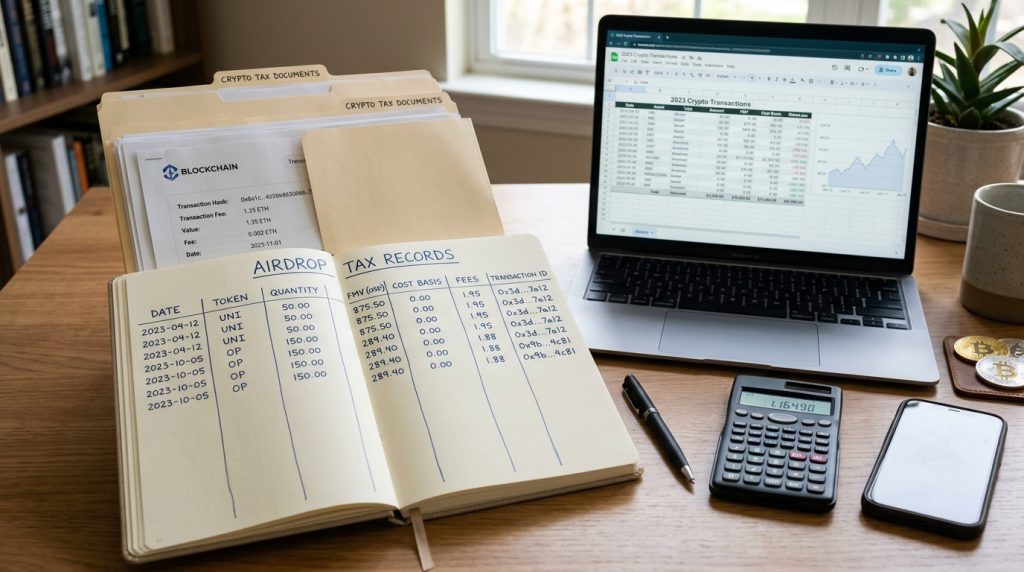
Crypto tax calculations become much easier when you keep your records from the beginning.
You don’t need an elaborate system. Even a well-organized spreadsheet can be useful.
For each airdrop, consider recording:
| Information | Example |
|---|---|
| Date | August 17, 2026 |
| Token | ExampleToken |
| Quantity | 1,000 |
| Price per token | $0.20 |
| Total value | $200 |
| Wallet | Personal wallet |
| Transaction ID | Blockchain hash |
| Price source | Market/exchange record |
| Fees | $0 |
When you eventually sell or swap the tokens, add the disposal information to the same record.
That way, you have a clear history from the moment you received the airdrop to the moment you disposed of it.
Common Mistakes to Avoid
Assuming the Cost Basis Is Always Zero
The fact that you didn’t pay cash for an airdrop doesn’t automatically mean your future basis is zero.
The tax treatment of the receipt needs to be considered first.
Using the Current Token Price
Don’t use today’s price to calculate what the token was worth when you received it.
Crypto prices can move dramatically in a short period of time.
Forgetting Transaction Fees
Fees can affect the calculation when you acquire, sell, or otherwise dispose of crypto.
Keep records of them instead of trying to reconstruct everything months later.
Losing Your Blockchain Records
Your wallet history can become difficult to organize if you have hundreds of transactions.
Save transaction IDs and other relevant information when you receive the tokens.
Mixing Different Airdrops Together
If you received tokens at different times and prices, keep those transactions separate.
This gives you a much clearer cost-basis history.
A Simple Airdrop Cost Basis Example
Here’s the whole process in one example.
You receive 1,500 tokens through an airdrop.
At the relevant time, each token is worth $0.25.
Your calculation is:
1,500 × $0.25 = $375
So, assuming the $375 is the applicable taxable amount at receipt, your starting basis would be $375.
Later, you sell the tokens for $600 and pay $15 in selling costs.
Your simplified calculation becomes:
$600 − $15 − $375 = $210 gain
This is the basic idea behind calculating the cost basis for airdropped tokens.
The difficult part isn’t usually the multiplication. It’s keeping accurate records and determining the appropriate value and timing.
Final Thoughts
Airdropped crypto may feel like free money, but keeping track of it is still important.
If you want to know how to calculate cost basis for airdropped tokens, start by recording when you gained control of the tokens, how many you received, and what they were reasonably worth at that time.
Then keep those records until you eventually sell, swap, or otherwise dispose of the tokens.
A simple formula can help:
Number of tokens × Fair market value per token = Total value
For example:
1,000 tokens × $0.20 = $200
That $200 can become the starting point for your cost-basis records when the applicable tax rules treat the airdrop as taxable income at receipt.
Crypto tax rules can be complicated, and the correct treatment can change depending on the country, type of airdrop, restrictions on the tokens, and your individual circumstances. For significant transactions, consider speaking with a qualified tax professional rather than relying on a general online calculation.


Leave a Reply