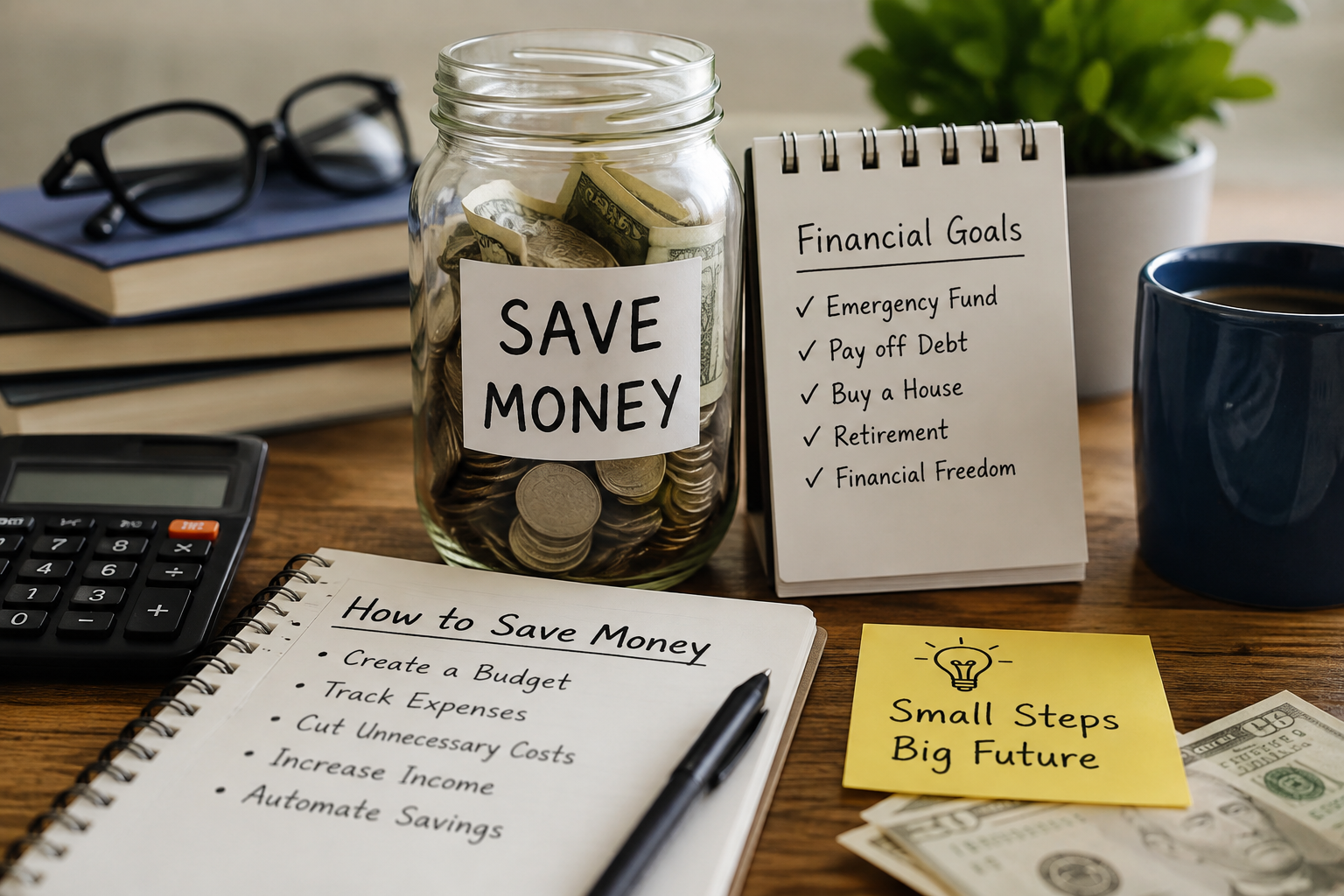

Saving money is one of the most important habits you can develop for your financial future. Yet for many people, saving is easier to talk about than to actually do. Monthly bills, groceries, transportation, debt payments, subscriptions, unexpected expenses, and everyday purchases can quickly consume an income.
The good news is that learning how to save money does not necessarily require a high income or a dramatic change in your lifestyle. A better approach is to understand where your money goes, set realistic goals, reduce unnecessary spending, and create a system that makes saving consistent.
Whether you are saving for an emergency fund, a large purchase, a future goal, or simply trying to improve your financial situation, small changes can make a meaningful difference over time.
This guide explains practical ways to save money, how to create a savings habit, how to reduce unnecessary expenses, and how to build a financial system you can maintain for the long term.
Why Is Saving Money Important?
Saving money gives you more financial flexibility.
When you have money set aside, an unexpected expense does not necessarily have to become a credit card balance or a new loan. An emergency fund can help you handle situations such as an unexpected repair, medical expense, or temporary loss of income.
Saving also helps you prepare for planned expenses. Instead of borrowing money for every major purchase, you can gradually build the amount you need in advance.
The Consumer Financial Protection Bureau explains that even relatively small amounts set aside for unexpected expenses can help people recover from financial emergencies and get back on track toward larger goals.
Saving can also reduce financial stress. When you know how much you have, where your money is going, and what you are working toward, financial decisions become easier to manage.
1. Create a Realistic Monthly Budget
The first step in learning how to save money is understanding your current financial situation.
A budget is simply a plan for your income and expenses. It helps you see how much money comes in, how much goes out, and how much may be available for savings.
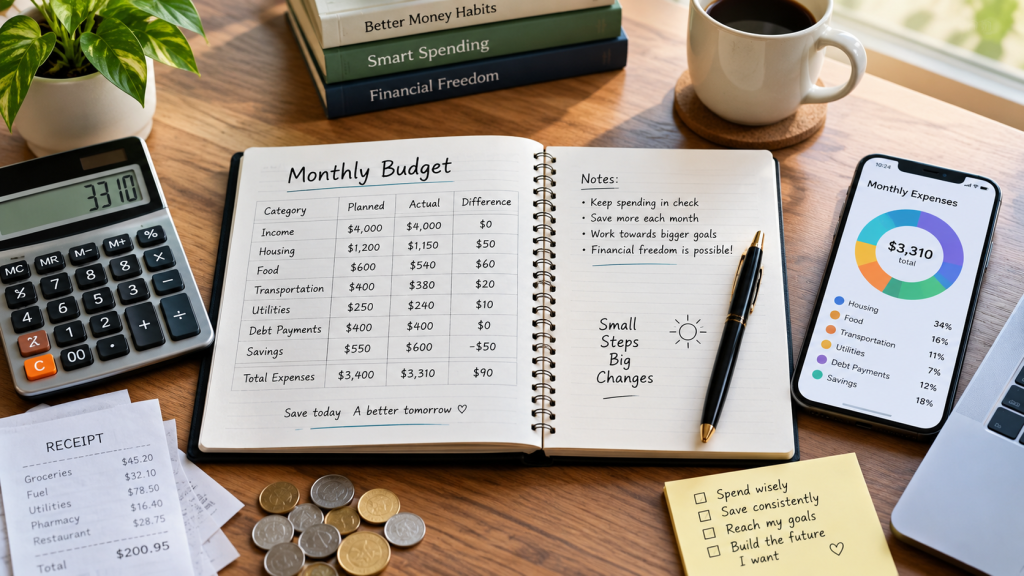
Start by writing down your monthly income. Then list your regular expenses.
- Housing
- Utilities
- Groceries
- Transportation
- Insurance
- Debt payments
- Phone and internet
- Entertainment
- Subscriptions
- Shopping
- Savings
Do not create a budget based on what you think you should be spending. Start with what you actually spend.
The CFPB recommends reviewing your spending over several months because some expenses do not occur every month. Insurance payments, medical costs, gifts, vacations, tuition, and other irregular expenses can easily be forgotten when creating a monthly budget.
Once you understand your spending, you can identify areas where adjustments may be possible.
A Simple Budget Example
Suppose your monthly take-home income is $3,000.
You might organize it like this:
- Housing: $1,000
- Food: $400
- Transportation: $300
- Utilities and phone: $250
- Debt payments: $300
- Insurance: $150
- Personal spending: $250
- Savings: $350
These numbers are only an example. Your actual budget should reflect your income, location, household situation, and financial obligations.
The important point is that savings should be included as a planned category rather than treated as whatever money happens to remain at the end of the month.
2. Track Every Expense
Creating a budget is useful, but tracking your actual spending is what makes the budget meaningful.
For one month, record every purchase you make.
That includes large expenses and small ones.
A $5 purchase may not seem important. But repeated small purchases can become a significant monthly expense.
You can track spending using:
- A spreadsheet
- A budgeting application
- Your bank statements
- A notebook
- A simple notes application
At the end of the month, group your spending into categories.
You may discover that your actual spending is different from what you expected.
For example, you might believe you spend $200 per month on restaurants, but after checking your transactions, you discover that the real number is $350.
That difference gives you useful information.
You do not necessarily have to eliminate restaurant spending completely. Instead, you could decide to reduce it from $350 to $250 and redirect the remaining $100 toward savings.
This approach is more sustainable than trying to remove every enjoyable expense.
3. Separate Needs From Wants
One of the simplest ways to save money is to distinguish between things you need and things you want.
A need is generally something required for basic living or an important financial obligation.
Examples may include:
- Housing
- Basic food
- Essential utilities
- Necessary transportation
- Required debt payments
A want is something that can improve your lifestyle but is not essential.
Examples may include:
- Premium subscriptions
- Frequent restaurant meals
- Expensive entertainment
- Unplanned shopping
- Upgrading a phone that still works
FDIC financial education materials describe budgeting as a way to distinguish between needs and wants and to make better spending decisions.
This does not mean you should never spend money on wants.
The goal is balance.
If you spend all of your income on necessities, saving may be difficult. But if too much money goes toward wants, your financial goals can also suffer.
A useful question before a non-essential purchase is:
"Does this purchase support my priorities?"
If the answer is no, consider delaying it or skipping it.
4. Set a Specific Savings Goal
A savings goal gives your money a purpose.
Instead of saying, "I want to save more," choose a specific target.
For example:
- Save $500 for unexpected expenses.
- Save $2,000 for a car.
- Save $5,000 for a home-related expense.
- Save $1,000 for a vacation.
- Save a specific amount for retirement.
A goal should ideally include both an amount and a timeframe.
For example:
Goal: Save $1,200 in 12 months.
That means you would need to save an average of $100 per month.
Breaking a large goal into smaller targets can make it feel more manageable.
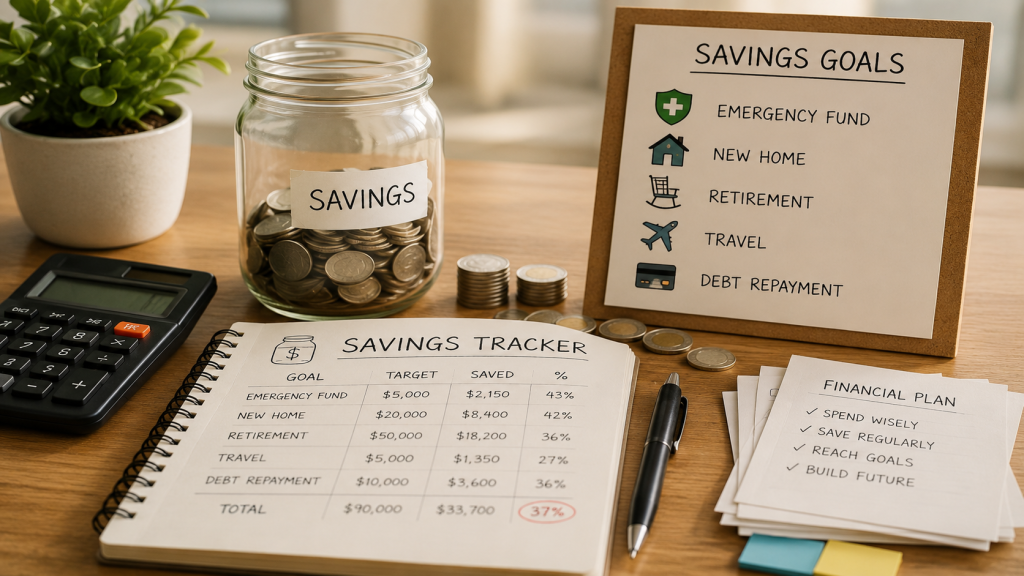
The CFPB recommends setting a specific savings goal, creating a plan, putting the plan into action, and reviewing the results so adjustments can be made when necessary.
Use Separate Savings Goals
If your bank allows multiple savings accounts or labeled savings spaces, you can separate money by purpose.
For example:
Emergency Fund
Money for unexpected expenses.
Travel Fund
Money for planned travel.
Home Fund
Money for future home-related costs.
Long-Term Savings
Money intended for longer-term financial goals.
Separating money can make it easier to understand how much you have available for each purpose.
5. Pay Yourself First
Many people make the same mistake every month:
They pay their bills, spend money, and then try to save whatever is left.
The problem is that there may be nothing left.
A different approach is to save first.
When your income arrives, transfer a predetermined amount to your savings account before discretionary spending.
For example, if you receive $2,500 and have decided that $200 is your savings contribution, you can move the $200 into savings soon after receiving your income.
This is often called "paying yourself first."
The exact amount is not the same for everyone. If $200 is unrealistic, start with an amount you can consistently afford.
Even a small amount can help you establish the habit.
FDIC guidance similarly recommends regular saving and notes that people who cannot comfortably save a fixed percentage can start with an amount they can afford and increase contributions as their circumstances improve.
6. Automate Your Savings
Automation is one of the easiest ways to make saving consistent.
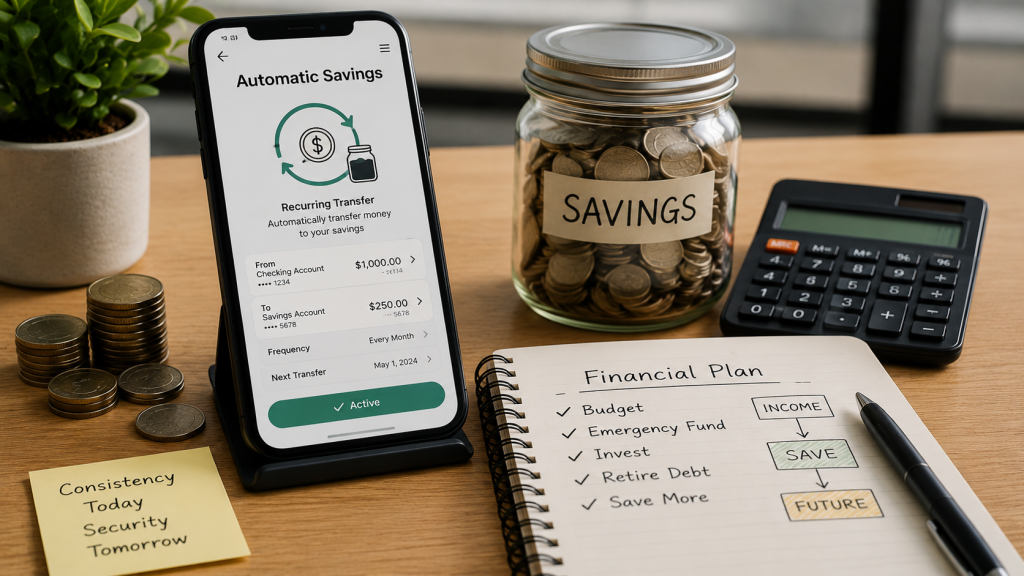
Instead of relying on motivation every month, set up an automatic transfer from your checking account to your savings account if your financial institution offers that feature.
For example:
Payday → Automatic transfer → Savings
You choose the amount and frequency, and the transfer happens automatically.
This can be particularly helpful if you tend to spend most of your available money before the next paycheck.
The CFPB identifies automatic recurring transfers as a practical way to make savings contributions consistent. It also warns that you should monitor your account balance so an automatic transfer does not create an overdraft or other fee.
You may also be able to split direct deposits between accounts if your employer offers that option.
The important thing is to choose an amount that works with your cash flow.
Automation should make saving easier, not create a new financial problem.
7. Cut Unnecessary Recurring Expenses
Recurring expenses deserve special attention because they continue month after month.
Look through your bank and credit card statements and identify subscriptions, memberships, and services you rarely use.
Examples might include:
- Streaming services
- Fitness memberships
- Software subscriptions
- Premium applications
- Delivery memberships
- Unused cloud services
- Expensive phone plans
You do not need to cancel everything.
Instead, ask whether each recurring payment provides enough value to justify its cost.
Suppose you find three subscriptions costing $15 each per month.
That is $45 every month, or $540 over a year.
If you cancel services you genuinely do not use, that money can be redirected toward savings.
The FDIC recommends reviewing recurring expenses and considering whether they can be eliminated, reduced, or replaced with a better deal.
8. Reduce Impulse Spending
Impulse purchases can make saving difficult because they happen outside your planned budget.
Common examples include:
- Buying something because it is on sale
- Ordering food because you do not want to cook
- Purchasing unnecessary gadgets
- Shopping because of social media advertisements
- Making an unplanned online purchase
A simple strategy is to introduce a waiting period.
For small purchases, wait a few hours.
For larger purchases, consider waiting 24 hours or longer.
During that time, ask yourself:
- Do I actually need this?
- Do I already own something similar?
- Is this purchase in my budget?
- Would I rather have the item or the money?
- Will I still want it next week?
This small pause can reduce unnecessary purchases without requiring you to stop spending altogether.
9. Build an Emergency Fund
An emergency fund is money set aside specifically for unexpected financial needs.
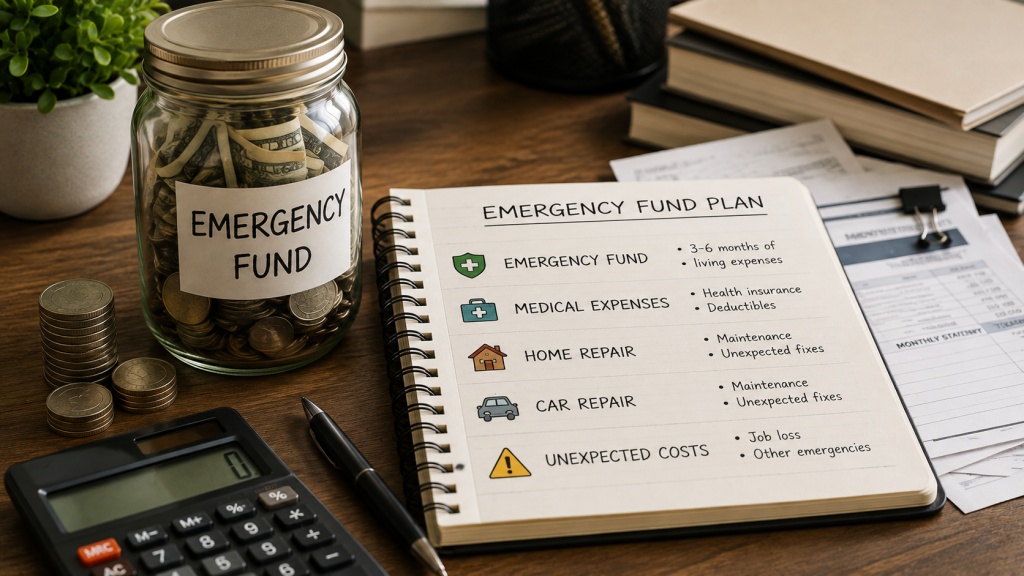
Possible emergencies include:
- A major vehicle repair
- Unexpected medical expenses
- Essential home repairs
- A sudden loss of income
- Urgent family expenses
Without emergency savings, an unexpected expense can force you to use a credit card or borrow money.
The CFPB recommends dedicated emergency savings as an important part of preparing for unexpected expenses. It also explains that the appropriate amount can vary depending on an individual's circumstances.
There is no universal emergency-fund number that applies perfectly to every person.
Someone with a stable income and low expenses may have different needs from someone with variable income and significant financial responsibilities.
A practical approach is to start with a small, achievable target and gradually build from there.
Keep Emergency Money Accessible
Emergency savings should generally be kept somewhere you can access when you genuinely need it.
The account should also be appropriate for your financial situation and should not expose you to unnecessary fees or restrictions.
The FDIC notes that emergency savings can be kept separately from everyday spending to reduce the temptation to use the money for routine purchases.
If you use emergency savings, that is not a failure.
The purpose of the fund is to help you handle an emergency.
Once the situation is resolved, make replenishing the fund a priority.
10. Be Careful With High-Interest Debt
Saving and debt repayment often need to be considered together.
High-interest debt can make it harder to build wealth because interest charges consume part of your available cash.
For example, if you carry a large credit card balance with a high interest rate, putting all of your extra money into low-yield savings while allowing expensive debt to grow may not be the most efficient strategy.
However, having no emergency savings at all can also leave you vulnerable.
A balanced approach may be to:
- Build a basic emergency cushion.
- Make all required debt payments on time.
- Focus additional money on expensive debt.
- Increase savings as the debt decreases.
Your exact approach should depend on your interest rates, income, expenses, and overall financial situation.
How to Save Money on a Low Income
Saving can be difficult when most of your income already goes toward essential expenses.
If that describes your situation, do not assume that saving is impossible.
Start small.
Even a modest recurring contribution can help you build the habit.
For example, if you can comfortably save $10 per week, that is better than setting an unrealistic target and giving up after one month.
Look for opportunities to improve your cash flow.
You might:
- Review recurring bills.
- Reduce unnecessary subscriptions.
- Compare service costs.
- Cook more meals at home.
- Reduce impulse purchases.
- Sell unused belongings.
- Look for legitimate additional income.
- Direct part of occasional extra income toward savings.
The goal is not to make your life unnecessarily restrictive.
The goal is to create a financial system that works with the money you actually have.
How to Save Money From Extra Income
Occasional extra income can provide an opportunity to accelerate your savings.
Extra money might come from:
- A bonus
- Freelance work
- A side job
- A cash gift
- Selling unused items
- A tax refund
Instead of spending all of it immediately, consider dividing it between financial priorities.
For example:
50% — Savings
30% — Debt repayment
20% — Personal spending
These percentages are only an example. You can create your own allocation.
The key idea is to avoid treating every unexpected dollar as spending money.
The CFPB specifically identifies one-time inflows, such as tax refunds, as potential opportunities to build emergency savings.
A Simple Monthly Money-Saving Plan
If you want a straightforward system, use the following process every month.
Step 1: Calculate Your Income
Determine how much money you expect to receive.
Use take-home income when creating a household spending plan.
Step 2: List Essential Expenses
Write down housing, food, utilities, transportation, insurance, debt payments, and other necessary costs.
Step 3: Review Previous Spending
Look at your bank and credit card transactions.
Identify categories where you are spending more than expected.
Step 4: Choose a Savings Target
Pick an amount that is realistic for your current situation.
Step 5: Automate the Transfer
If available, schedule the savings transfer around the time your income arrives.
Step 6: Control Discretionary Spending
Give yourself a reasonable amount for entertainment and personal purchases.
Step 7: Review the Month
At the end of the month, compare your plan with your actual spending.
Step 8: Adjust
If you saved less than expected, determine why.
If you saved more, consider whether you can maintain or slightly increase that amount.
This process turns saving into a routine rather than a one-time decision.
How Much Money Should You Save Each Month?
There is no single monthly savings amount that works for everyone.
Your ideal savings amount depends on:
- Income
- Housing costs
- Debt
- Family responsibilities
- Location
- Insurance
- Employment stability
- Financial goals
- Existing savings
A percentage-based target can be useful as a starting point, but it should not become a rule that forces you to neglect essential expenses.
If your financial situation is tight, start with a manageable amount.
If your income increases, consider increasing your savings contribution as well.
For example, if you receive a $300 monthly raise, you could decide to save part of the increase rather than immediately increasing your lifestyle spending by the entire amount.
Common Money-Saving Mistakes
Saving money becomes harder when the strategy is unrealistic.
Mistake 1: Setting an Unrealistic Goal
A very aggressive target may work for a short time but become impossible to maintain.
Choose a goal that fits your current situation.
Mistake 2: Ignoring Irregular Expenses
Annual bills, repairs, medical expenses, gifts, and holidays can disrupt your budget if you do not plan for them.
Mistake 3: Using Savings for Everyday Spending
If money for emergencies and money for entertainment are mixed together, it can become easy to spend your emergency fund.
Mistake 4: Forgetting About Fees
Account fees, overdraft fees, and other charges can reduce your available money.
Understand the fees associated with your financial accounts.
Mistake 5: Never Reviewing Your Plan
Your financial situation can change.
A budget that worked six months ago may not work today.
Review your plan regularly.
How to Make Saving Money Easier
Saving does not have to depend entirely on willpower.
You can design your financial environment to make good decisions easier.
For example:
Automate savings.
This reduces the number of decisions you need to make.
Separate savings from spending money.
A separate account can make your savings less tempting to spend.
Use specific goals.
Knowing what you are saving for can make the process more motivating.
Track progress.
Watching your savings balance grow can reinforce the habit.
Increase savings gradually.
When your income increases or an expense disappears, consider redirecting some of that money toward savings.
The CFPB recommends setting a goal, creating a consistent system, monitoring progress, and automating savings where practical.
How to Save Money Without Giving Up Everything You Enjoy
A common misconception is that saving money means eliminating all entertainment and personal spending.
That approach may not be sustainable.
Instead, create a reasonable spending category for things you enjoy.
For example, your budget might include money for:
- Restaurants
- Entertainment
- Hobbies
- Travel
- Shopping
The amount depends on your financial situation.
The purpose is to make your budget realistic enough that you can follow it for months and years.
A sustainable financial plan is generally more useful than a perfect plan that you abandon after a few weeks.
Saving Money for Short-Term and Long-Term Goals
Not every savings goal has the same timeframe.
Short-Term Goals
These might include:
- A vacation
- A new laptop
- A car repair
- A security deposit
- A holiday purchase
Medium-Term Goals
These might include:
- A vehicle
- Education
- A major home expense
- Starting a business
Long-Term Goals
These might include:
- Retirement
- Buying a home
- Long-term wealth building
- Future education costs
Understanding the timeframe can help you decide how to organize the money and what type of account or financial product may be appropriate.
For long-term investing decisions, remember that investing involves risk and is different from simply keeping emergency savings in an accessible savings account.
What Should You Do After You Start Saving?
Once you develop a consistent savings habit, do not stop reviewing your financial priorities.
You may eventually want to:
- Increase your emergency fund.
- Pay down high-interest debt.
- Save for major purchases.
- Contribute toward retirement.
- Invest for long-term goals.
- Review insurance coverage.
- Increase your income.
- Improve your financial knowledge.
The order depends on your circumstances.
Saving is not the final destination. It is one part of a broader financial plan.
Frequently Asked Questions
What is the easiest way to save money?
One of the simplest approaches is to create a realistic savings target and automate regular transfers into a savings account. Automation can make saving more consistent because you do not have to remember to make the transfer manually.
How can I save money every month?
Start by tracking your expenses, identifying unnecessary spending, setting a realistic monthly target, and moving that amount into savings consistently.
How can I save money on a low income?
Start with an amount you can realistically afford. Then look for recurring expenses that can be reduced, unnecessary fees that can be avoided, and opportunities to increase income.
Should I save money or pay off debt first?
It depends on the type and cost of your debt, your emergency savings, and your overall financial situation. High-interest debt can be expensive, but having no emergency reserve can leave you vulnerable to unexpected expenses.
How much should I keep in an emergency fund?
There is no single amount that works for everyone. Your target should reflect your essential expenses, income stability, family responsibilities, and financial risks. Some financial guidance uses several months of living expenses as a long-term emergency-fund target, but your starting goal can be smaller.
Is automatic saving a good idea?
Automatic saving can be an effective way to make contributions consistent. However, you should monitor your account balance and adjust the transfer if your income or expenses change.
How can I stop impulse spending?
Try introducing a waiting period before non-essential purchases. Tracking your spending and removing saved payment information from shopping websites may also reduce temptation.
Is saving a small amount worth it?
Yes. A small, consistent contribution can help establish the habit and gradually build a financial cushion. The important thing is to choose an amount you can maintain.
Final Thoughts
Learning how to save money is not about finding one magical trick.
It is about building a financial system that you can follow consistently.
Start by understanding your income and expenses. Create a realistic budget. Track your spending. Separate needs from wants. Set specific savings goals and pay yourself first. Where practical, automate your savings so that the process does not depend on motivation every month.
At the same time, build an emergency fund, manage expensive debt carefully, and review recurring expenses regularly.
You do not need to completely change your lifestyle overnight.
Start with one improvement.
Then another.
Over time, those small decisions can create a stronger financial foundation and give you more control over your money.
The most important step is to start saving with an amount you can realistically maintain—and then keep improving your system as your financial situation changes.