

In this article
- Key Takeaways
- What Is Net Income?
- How Does Net Income Work?
- Gross Income vs. Net Income
- What Is Net Pay?
- What Can Reduce Your Net Pay?
- Why Is Net Income Important?
- How to Calculate Net Income
- Net Income for Employees
- Net Income for Self-Employed Workers
- How Net Income Helps With Budgeting
- How Net Income Can Affect Financial Decisions
- How to Find Your Net Income
- Is Net Income the Same as Take-Home Pay?
- Frequently Asked Questions
- Final Thoughts
Key Takeaways
- Net income is the amount left after applicable taxes, deductions, and expenses are taken from gross income.
- For employees, the amount deposited into a bank account is generally called net pay or take-home pay.
- Gross income is the amount earned before deductions, while net income reflects what remains afterward.
- Taxes, insurance premiums, retirement contributions, and other deductions can reduce your take-home pay.
- Understanding net income can help you create a realistic budget and make better financial decisions.
- Your net income may change when your salary, work hours, taxes, benefits, or deductions change.
When you look at a salary or hourly wage, the number you see is not always the amount that ends up in your bank account. Taxes and other deductions can reduce your earnings before you receive your paycheck.
That is why understanding what net income is and how it works can be useful. It gives you a clearer idea of how much money remains after applicable deductions and expenses.
What Is Net Income?
Net income is the amount of money remaining after applicable deductions, taxes, and expenses have been subtracted from gross income. The exact meaning can vary depending on whether you are talking about an individual, employee, or business.
For an employee, people often use net income to describe the money available after payroll deductions. Your paycheck may show this amount as net pay or take-home pay.
For example, imagine your gross earnings are $3,000 for a pay period. If $600 is deducted for taxes, insurance, retirement contributions, and other deductions, you could receive $2,400.
In this simplified example, $3,000 is your gross income and $2,400 is your take-home amount.
How Does Net Income Work?
Net income is calculated by starting with your gross income and subtracting the taxes, deductions, and applicable expenses.
A simple way to understand the calculation is:
Net Income = Gross Income − Taxes − Other Applicable Deductions and Expenses
The actual calculation can be more complicated because not every deduction works in the same way. Your tax situation, benefits, retirement contributions, business expenses, and other factors can affect the final amount.
This is also why two people with the same gross salary may receive different amounts of money in their bank accounts.
Gross Income vs. Net Income

Your gross income and net income represent two different amounts of money.
Gross income is the total amount you earn before taxes and other deductions are taken out. Net income, on the other hand, is the amount that remains after applicable taxes, deductions, and expenses have been accounted for.
For example:
- Gross income: $4,000
- Taxes and other deductions: $900
- Net amount: $3,100
The difference matters when you are planning your everyday finances. A $4,000 gross salary does not necessarily mean you have $4,000 available to spend.
Your actual take-home amount provides a better starting point for creating a personal budget.
What Is Net Pay?
Net pay is the amount an employee receives after payroll deductions have been taken from their gross wages. It is commonly known as take-home pay.
For example, if your gross paycheck is $2,500 and $500 is withheld or deducted, your net pay would be $2,000.
Your pay stub should normally show both your gross earnings and the deductions that affect your final paycheck.
What Can Reduce Your Net Pay?
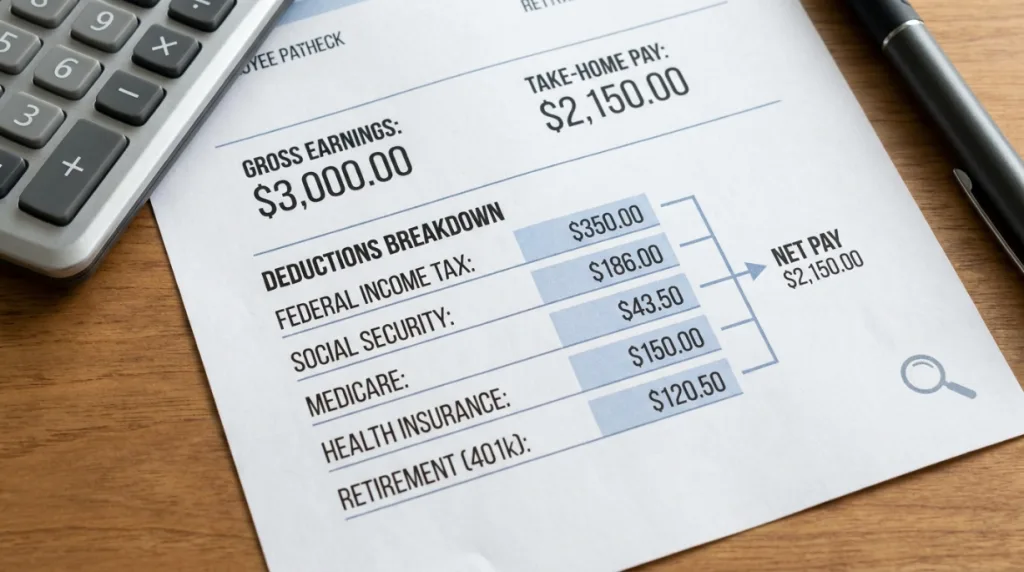
Several deductions can reduce the amount you receive from a paycheck. Some are required by law, while others depend on your employer and the benefits or financial options you choose.
Common deductions may include:
- Federal income tax
- State or local income tax
- Social Security tax
- Medicare tax
- Health insurance premiums
- Retirement plan contributions
- Flexible spending account contributions
- Other employee benefit deductions
The deductions on your paycheck depend on your individual circumstances. Reviewing your pay stub can help you understand exactly where your money is going.
Why Is Net Income Important?
Net income is important because it provides a more realistic view of the money available to you after applicable deductions and expenses.
When you create a monthly budget, using your take-home income can help you estimate how much you can put toward housing, food, transportation, debt payments, savings, and other expenses.
It can also help you avoid making financial commitments based on your gross salary when your actual monthly cash flow is lower.
How to Calculate Net Income

The basic process of calculating net income is straightforward.
First, determine your gross income for the period you are reviewing. Then subtract the applicable taxes, deductions, and expenses.
For example:
Gross income: $4,000
Taxes and other deductions: $900
Net income: $3,100
So, in this simplified example, $3,100 remains after the $900 in deductions.
Your actual calculation may be different because taxes and deductions depend on your circumstances. If you are calculating income for tax purposes, you may need to use more detailed financial information.
Net Income for Employees
For employees, net income is closely connected to the amount they take home from work.
Your gross earnings may come from a salary, hourly wages, overtime, bonuses, commissions, or other compensation. Payroll taxes and other deductions can then reduce the amount you receive.
This means a salary increase does not necessarily increase your take-home pay by the exact amount of the raise. Additional earnings may be subject to taxes and other deductions.
Checking your paycheck after a raise can help you understand the actual change in your income.
Net Income for Self-Employed Workers

Self-employed workers may calculate net income differently from employees.
Instead of receiving a traditional paycheck, a freelancer or business owner may receive payments from multiple clients or customers. They may also have business-related expenses that affect the amount remaining from their income.
For example, suppose a freelancer receives $6,000 from clients and has $1,500 in eligible business expenses.
A simplified calculation would be:
$6,000 − $1,500 = $4,500
The $4,500 represents the amount remaining after those business expenses in this simplified example. Tax obligations may still need to be considered separately.
Because self-employment taxes and deductible expenses can be more complicated, detailed calculations may require professional tax guidance.
How Net Income Helps With Budgeting

Your budget should generally be based on the money you can realistically use. For many employees, that means looking at their regular take-home pay rather than their gross salary.
Suppose your monthly take-home income is $3,100. You can use that amount as the starting point for planning your monthly expenses.
You can then divide your income among essential bills, debt payments, savings, and discretionary spending. This approach can make your budget more realistic and easier to maintain.
How Net Income Can Affect Financial Decisions
Knowing your net income can help you evaluate major financial decisions.
Before taking on a new loan, renting a home, increasing your monthly subscriptions, or making a large purchase, you can compare the expected payment with your actual cash flow.
Lenders and other financial institutions may use different measures of income when evaluating an application. Therefore, your net income is not necessarily the only number they consider.
However, knowing your take-home income can help you understand whether a new financial commitment fits comfortably within your budget.
How to Find Your Net Income
If you are an employee, your latest pay stub is usually one of the easiest places to start.
Look for terms such as net pay, net earnings, or a similar label. Your pay stub should also provide information about gross wages and individual deductions.
If your income changes regularly because of overtime, commissions, bonuses, or changing work hours, reviewing several paychecks can give you a better idea of your average take-home income.
Is Net Income the Same as Take-Home Pay?
Net income and take-home pay are related, but they are not always identical terms.
Take-home pay or net pay usually refers to the amount an employee receives after payroll deductions. Net income is a broader financial term that can refer to the amount remaining after applicable expenses, deductions, and taxes are accounted for.
In everyday personal budgeting, however, people may use these terms similarly when discussing the money they have available after deductions.
The important thing is to understand which calculation is being used in a particular financial situation.
Frequently Asked Questions
Is net income the money in my bank account?
For an employee, the amount deposited into your bank account is generally your net pay or take-home pay. It is the amount left after payroll deductions have been taken from your gross earnings.
Is net income lower than gross income?
Generally, yes. Gross income is measured before applicable deductions and expenses, while net income represents what remains after those amounts are accounted for.
Why is my take-home pay lower than my salary?
Your advertised salary is generally a gross amount. Taxes, insurance premiums, retirement contributions, and other deductions can reduce the amount you actually receive.
Can net income change from month to month?
Yes. Your net income or take-home pay can change if your work hours, salary, bonuses, tax withholding, benefits, or other deductions change.
Should I use net income when creating a budget?
For personal budgeting, your actual take-home income is usually a more practical starting point than your gross salary because it reflects the money you have available after payroll deductions.
Final Thoughts
Understanding what net income is and how it works can help you see the difference between what you earn and what you actually have available after applicable deductions and expenses.
Gross income shows your earnings before those reductions, while net income provides a clearer picture of what remains. By reviewing your pay stub and tracking your take-home income, you can create a more realistic budget and make better-informed financial decisions.



Leave a Reply