
In this article
- Key Takeaways
- What Is a Roth 401(k)?
- How Does a Roth 401(k) Work?
- Roth 401(k) Contribution Limits for 2026
- Roth 401(k) vs. Traditional 401(k)
- What Are the Benefits of a Roth 401(k)?
- What Are the Disadvantages of a Roth 401(k)?
- Are Roth 401(k) Withdrawals Tax-Free?
- Can You Have a Roth 401(k) and Traditional 401(k)?
- Does a Roth 401(k) Get an Employer Match?
- Roth 401(k) vs. Roth IRA
- Who Should Consider a Roth 401(k)?
- How Much Should You Contribute to a Roth 401(k)?
- How to Start a Roth 401(k)
- Frequently Asked Questions About Roth 401(k)s
- Final Thoughts
Key Takeaways
- A Roth 401(k) is an employer-sponsored retirement account funded with after-tax money.
- You generally pay income tax on Roth contributions before the money enters the account.
- Qualified Roth 401(k) withdrawals can generally be tax-free.
- The 2026 employee contribution limit for a 401(k) is $24,500.
- Employees age 50 and older may generally contribute an additional $8,000 in 2026.
- Employees who are 60, 61, 62 or 63 during 2026 may qualify for a higher $11,250 catch-up limit.
- You can generally split your employee contributions between a Roth 401(k) and traditional 401(k), subject to the combined limit.
- A Roth 401(k) may be especially useful if you expect to face a similar or higher tax rate in retirement.
What Is a Roth 401(k)?
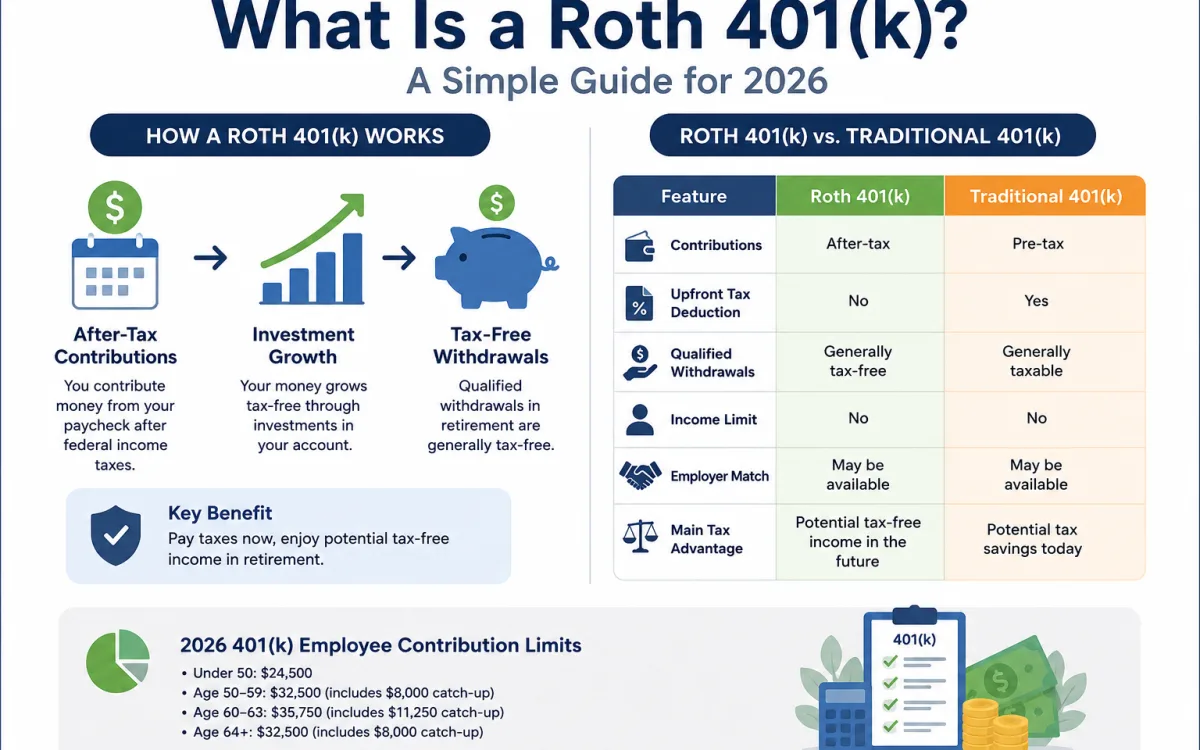
A Roth 401(k) is a workplace retirement account that allows employees to save for retirement with after-tax income. Unlike a traditional 401(k), Roth contributions generally do not provide an upfront federal income tax deduction.
Instead, the main tax benefit comes later. If you meet the requirements for a qualified distribution, you can generally withdraw your Roth 401(k) money without federal income tax on the qualified amount.
This can make a Roth 401(k) an attractive option for workers who want to pay taxes on retirement contributions today and potentially receive tax-free qualified income in the future.
How Does a Roth 401(k) Work?
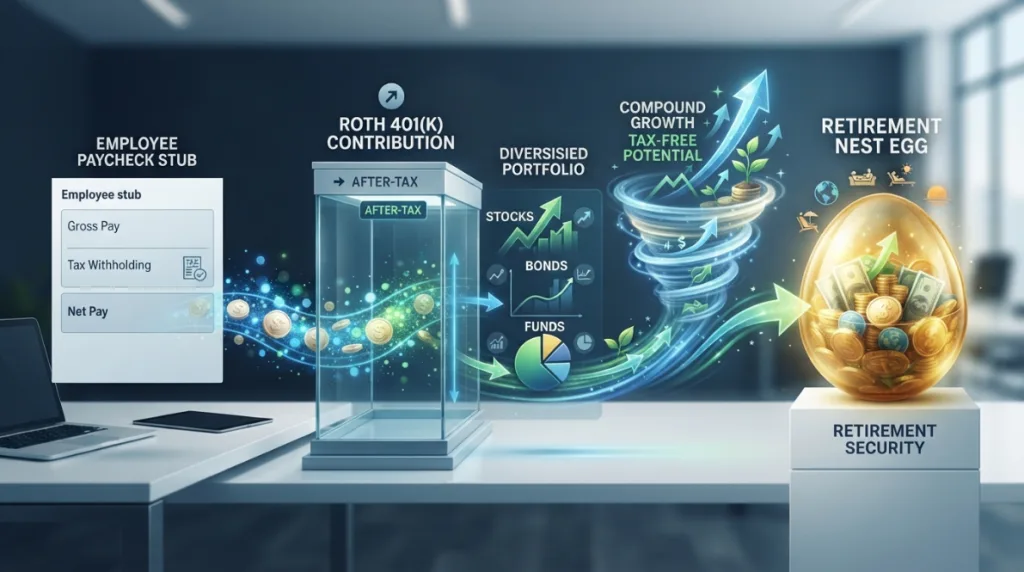
A Roth 401(k) is offered through an employer-sponsored retirement plan. If your employer provides a Roth option, you can choose how much of your paycheck to contribute.
Your contribution is taken from your pay after applicable income taxes are calculated. The money then goes into your Roth 401(k) account, where you can invest it using the choices available through your employer’s plan.
The account can grow over many years through contributions and investment returns. The longer you keep the money invested, the more time your retirement savings may have to grow.
However, a Roth 401(k) is intended for retirement. Taking money out before you meet the applicable distribution requirements can create tax or penalty consequences, particularly for taxable investment earnings.
Roth 401(k) Contribution Limits for 2026
For 2026, the basic employee contribution limit for a 401(k) is $24,500. This limit applies to your employee elective deferrals across traditional and Roth 401(k) contributions rather than giving you a separate $24,500 limit for each account.
Employees who are age 50 or older by the end of 2026 may generally make an additional $8,000 catch-up contribution, bringing the potential employee contribution total to $32,500.
A special higher catch-up limit applies to eligible employees who are age 60, 61, 62 or 63 during 2026. For these workers, the higher catch-up amount is $11,250, rather than $8,000.
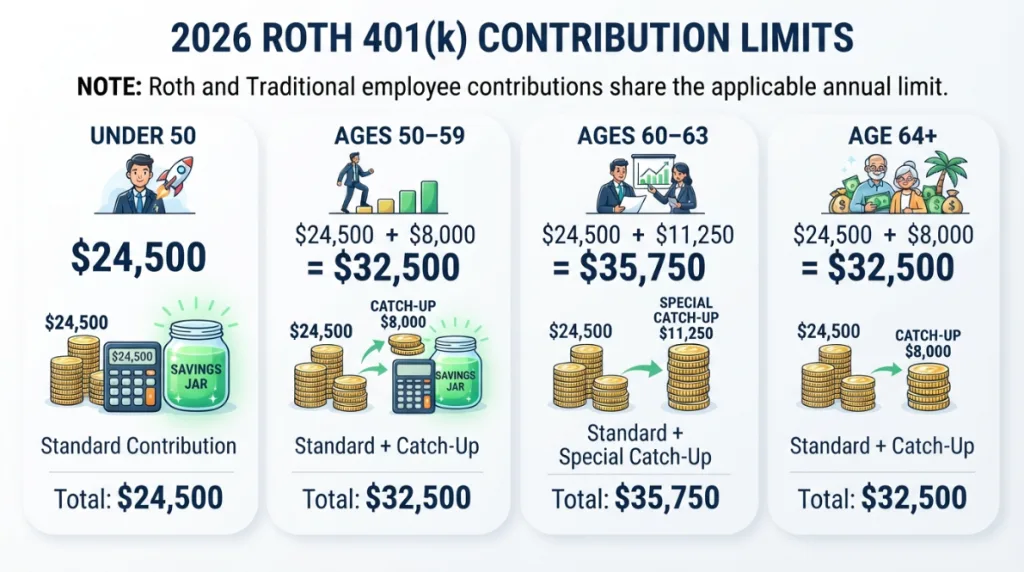
| Age in 2026 | Basic Limit | Potential Catch-Up | Potential Total |
|---|---|---|---|
| Under 50 | $24,500 | — | $24,500 |
| 50–59 | $24,500 | $8,000 | $32,500 |
| 60–63 | $24,500 | $11,250 | $35,750 |
| 64+ | $24,500 | $8,000 | $32,500 |
Your employer’s plan may impose additional restrictions, so check the specific rules of your workplace retirement plan before maximizing contributions.
Roth 401(k) vs. Traditional 401(k)
The primary difference between a Roth 401(k) and a traditional 401(k) is the timing of the tax benefit.
With a traditional 401(k), contributions are generally made before federal income taxes, which can reduce your taxable income for the year. However, withdrawals are generally taxable as ordinary income when you take the money out.
With a Roth 401(k), contributions are made after tax. You generally don’t receive an upfront income tax deduction, but qualified withdrawals can generally be tax-free.
| Feature | Roth 401(k) | Traditional 401(k) |
|---|---|---|
| Contributions | After-tax | Generally pre-tax |
| Upfront federal income tax deduction | No | Generally yes |
| Qualified withdrawals | Generally tax-free | Generally taxable |
| Income limit for contributions | Generally none | Generally none |
| Employer match | May be available | May be available |
| Main tax advantage | Potential future tax-free income | Potential tax savings today |
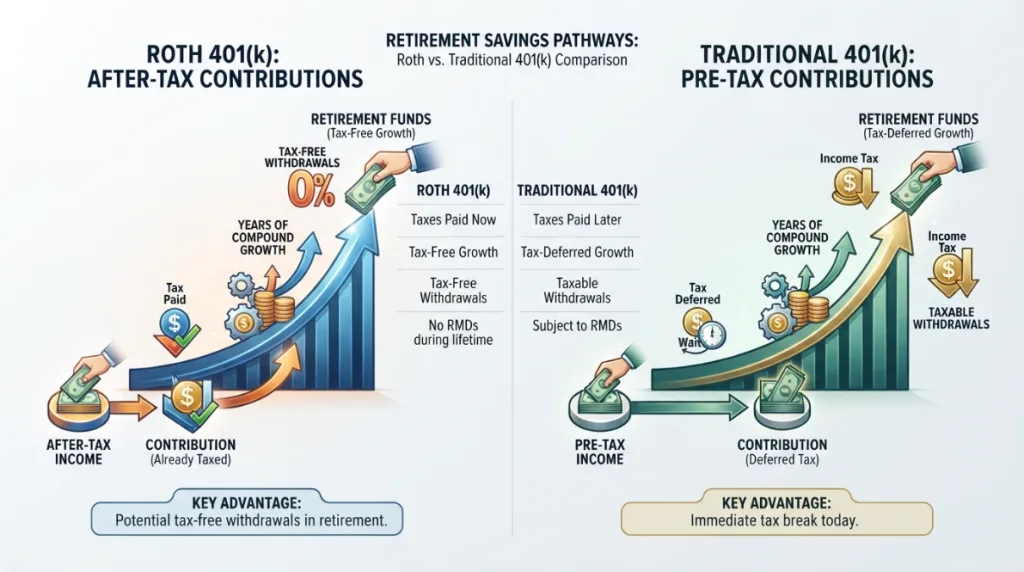
Neither account is automatically better. The right choice depends on factors such as your current tax bracket, expected retirement income, savings goals and overall financial situation.
What Are the Benefits of a Roth 401(k)?
A Roth 401(k) can offer several useful benefits for long-term retirement planning.
Potential Tax-Free Qualified Withdrawals
The biggest attraction is the possibility of tax-free qualified distributions.
If you satisfy the applicable requirements, your Roth 401(k) distributions can generally be excluded from federal taxable income. This can provide more flexibility when managing retirement income.
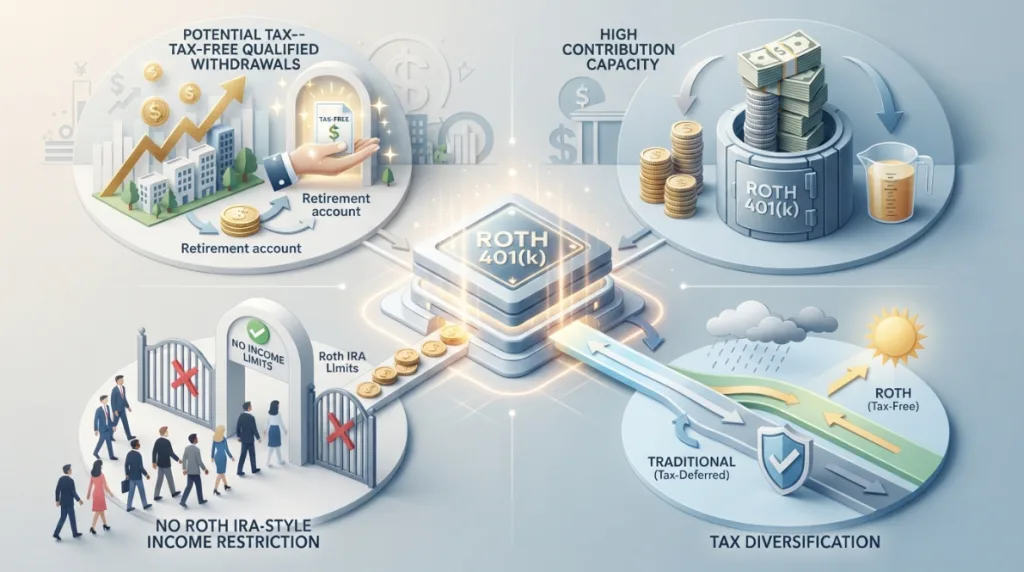
High Contribution Limits
A Roth 401(k) allows significantly more employee contributions than a Roth IRA in many cases.
For 2026, the basic 401(k) employee contribution limit is $24,500, before any applicable catch-up contribution.
This gives employees substantial room to build retirement savings in a Roth account.
No Roth IRA-Style Income Limit
Roth IRAs have income-based eligibility rules for direct contributions. A Roth 401(k) generally does not have the same income restriction.
That can make a Roth 401(k) useful for employees whose income is too high to make direct Roth IRA contributions.
Tax Diversification
A Roth 401(k) can provide a different tax treatment from traditional retirement accounts.
For example, someone with both Roth and traditional retirement savings may have access to potentially tax-free and taxable sources of retirement income. That can provide additional flexibility when planning withdrawals.
Automatic Contributions
Roth 401(k) contributions are generally deducted directly from your paycheck.
This makes retirement saving automatic and can help you maintain a consistent savings habit without manually transferring money every month.
What Are the Disadvantages of a Roth 401(k)?
A Roth 401(k) also has some potential drawbacks that you should consider before choosing it.
No Upfront Tax Deduction
Roth contributions generally don’t reduce your taxable income for the year.
If you’re currently in a high tax bracket and expect to have substantially lower taxable income in retirement, a traditional 401(k) may provide a more valuable immediate tax benefit.
Lower Take-Home Pay
Because Roth contributions are made after taxes, your take-home pay can be lower than it would be if you made the same dollar contribution to a traditional 401(k).
The difference comes from when you pay the tax rather than from the amount saved for retirement.
Early Withdrawals Can Have Consequences
A Roth 401(k) is designed for long-term retirement savings.
If you take a nonqualified distribution, the tax treatment can be more complicated. Investment earnings may be subject to income tax and an additional 10% tax in some situations.
For that reason, it’s generally better to treat your Roth 401(k) as retirement money rather than an emergency fund.
Are Roth 401(k) Withdrawals Tax-Free?
Roth 401(k) withdrawals are not automatically tax-free simply because the account is a Roth account.
A distribution generally needs to meet the requirements for a qualified distribution to receive the full tax benefit. In general, this means the account must satisfy the applicable five-year rule and the distribution must occur after a qualifying event, such as reaching age 59½, becoming disabled or dying.
If the distribution isn’t qualified, the tax treatment can differ between your contributions and investment earnings.
Because withdrawal rules can depend on your specific circumstances, review your plan documents before taking a distribution.
Can You Have a Roth 401(k) and Traditional 401(k)?
Yes. If your employer’s plan offers both options, you can generally divide your employee contributions between a Roth 401(k) and traditional 401(k).
However, the employee contribution limit applies to your combined elective deferrals. For 2026, you generally cannot contribute $24,500 to each account separately.
For example, you could contribute $14,500 to a traditional 401(k) and $10,000 to a Roth 401(k). Together, those contributions equal the $24,500 basic employee limit.
Using both account types can also create tax diversification, giving you retirement savings with different tax treatments.
Does a Roth 401(k) Get an Employer Match?
Your employer may match your 401(k) contributions if the workplace plan provides a matching benefit.
The important point is that employer contributions can have different tax treatment from your own Roth contributions. Recent retirement-plan rules also allow plans to offer Roth treatment for employer matching or nonelective contributions, but whether that option is available depends on the plan.
Therefore, don’t assume that every employer match automatically goes into the Roth portion of your account. Check your plan’s rules to understand how matching contributions are handled.
If your employer offers a match, understand the formula and contribution level required to receive the full available benefit.
Roth 401(k) vs. Roth IRA
Both accounts use after-tax contributions, but they have different rules and purposes.
A Roth 401(k) is generally offered through an employer. A Roth IRA is an individual retirement account that you open independently with a financial institution.
The contribution limits are also different. A Roth 401(k) generally allows much higher employee contributions, while Roth IRA contributions have a separate annual limit and income-based eligibility rules.
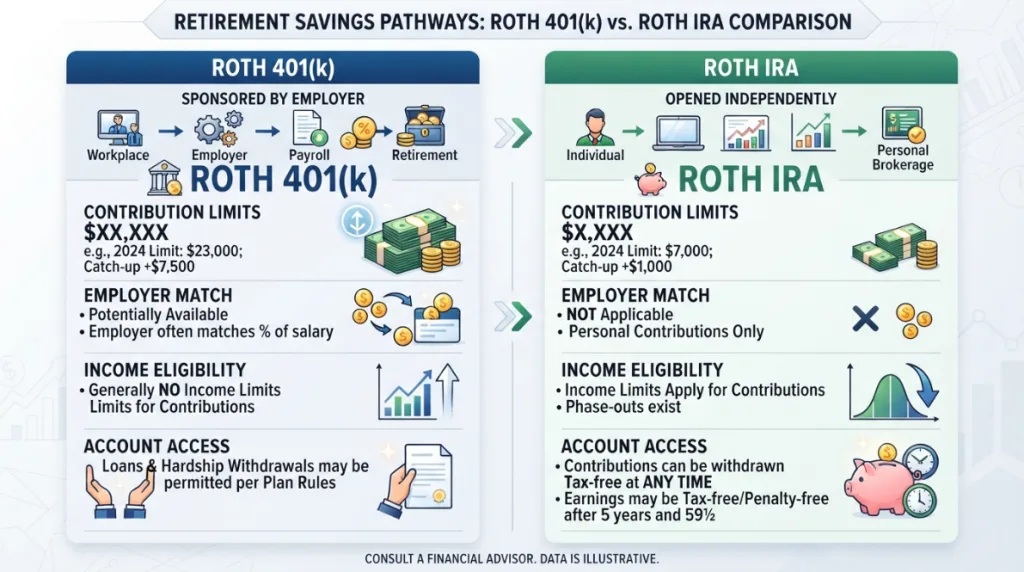
Another important difference is employer matching. A Roth IRA does not come with an employer match, while a workplace 401(k) may offer one.
For someone who has access to a Roth 401(k), comparing both account types can help determine how to divide retirement savings.
Who Should Consider a Roth 401(k)?
A Roth 401(k) may be worth considering if you expect your tax rate in retirement to be similar to or higher than your current rate.
It can also appeal to younger workers who have many years before retirement and want to build a source of potentially tax-free qualified retirement income.
Higher-income employees may also benefit from having a Roth 401(k) option because there is generally no Roth IRA-style income limit on making Roth 401(k) contributions.
On the other hand, a traditional 401(k) may be more attractive if you’re currently in a high tax bracket and expect to be in a significantly lower bracket after you retire.
How Much Should You Contribute to a Roth 401(k)?
There isn’t one contribution percentage that works for everyone.
Start by looking at your income, essential expenses, emergency savings, debt and other financial priorities. Choose a contribution amount that you can maintain consistently without putting your monthly budget under unnecessary pressure.
If your employer offers a matching contribution, check how much you need to contribute to receive the full available match. Once that goal is covered, you can consider whether increasing your retirement contributions fits your financial plan.
The important thing is to save consistently and increase your contribution when your income or financial situation allows.
How to Start a Roth 401(k)
If your employer offers a Roth 401(k), you can usually enroll through your company’s retirement benefits platform.
1. Check Your Workplace Plan
Review your benefits portal or speak with your HR department to confirm that the plan offers a Roth 401(k) option.
2. Choose Your Contribution Rate
Select the percentage or dollar amount you want to contribute from each paycheck.
3. Review the Employer Match
Find out whether your employer provides matching contributions and what you need to contribute to receive the full match.
4. Select Your Investments
Choose from the investment options available in your workplace plan. Consider factors such as your retirement timeline, diversification and risk tolerance.
5. Review Your Account Regularly
Your income, expenses and retirement goals can change over time. Review your contribution rate and investment choices periodically and adjust them when appropriate.
Frequently Asked Questions About Roth 401(k)s
Is a Roth 401(k) better than a traditional 401(k)?
Not necessarily. A Roth 401(k) may be better suited to someone who wants to pay taxes now and potentially receive tax-free qualified withdrawals later. A traditional 401(k) may be more appealing when an upfront tax deduction is more valuable.
Can I contribute to both a Roth 401(k) and traditional 401(k)?
Yes. If your employer offers both options, you can generally split your employee contributions between them. Your contributions are still subject to the applicable combined annual limit.
Does a Roth 401(k) reduce taxable income?
Generally, no. Roth 401(k) contributions are made with after-tax money, so they generally don’t provide the upfront federal income tax deduction associated with traditional 401(k) contributions.
Is there an income limit for a Roth 401(k)?
Generally, there is no income limit for making Roth 401(k) contributions. This differs from a Roth IRA, which has income-based eligibility rules.
Can I withdraw money from a Roth 401(k) before retirement?
You may be able to take money out before retirement, but the distribution may not receive the full Roth tax benefit.
If the withdrawal is not qualified, part of the distribution may be taxable, and an additional 10% tax may apply in certain circumstances.
What happens to my Roth 401(k) if I change jobs?
Your options can depend on your new employer’s plan and your circumstances. You may be able to leave the money in the old plan, roll eligible funds into another retirement account or take a distribution.
Each choice can have different tax and administrative consequences, so review the rules before moving the money.
Final Thoughts
A Roth 401(k) can be a valuable retirement savings option for people who want to pay taxes on their contributions today in exchange for the potential of tax-free qualified withdrawals later.
The account can be particularly useful when you expect your future tax rate to remain similar or increase. However, a traditional 401(k) can offer a valuable upfront tax deduction, making it a better fit in some situations.
Before choosing between the two, consider your current tax situation, expected retirement income, employer benefits and long-term savings goals. The best retirement strategy is one that fits your financial situation and that you can maintain consistently over time.



Leave a Reply